Is Mountain Dew Bad for You? Ingredients, Sugar and Caffeine
Is Mountain Dew bad for you? Mountain Dew ingredients, sugar and caffeine per can, Yellow 5, BVO, Mountain Dew mouth and Diet vs Zero Sugar.
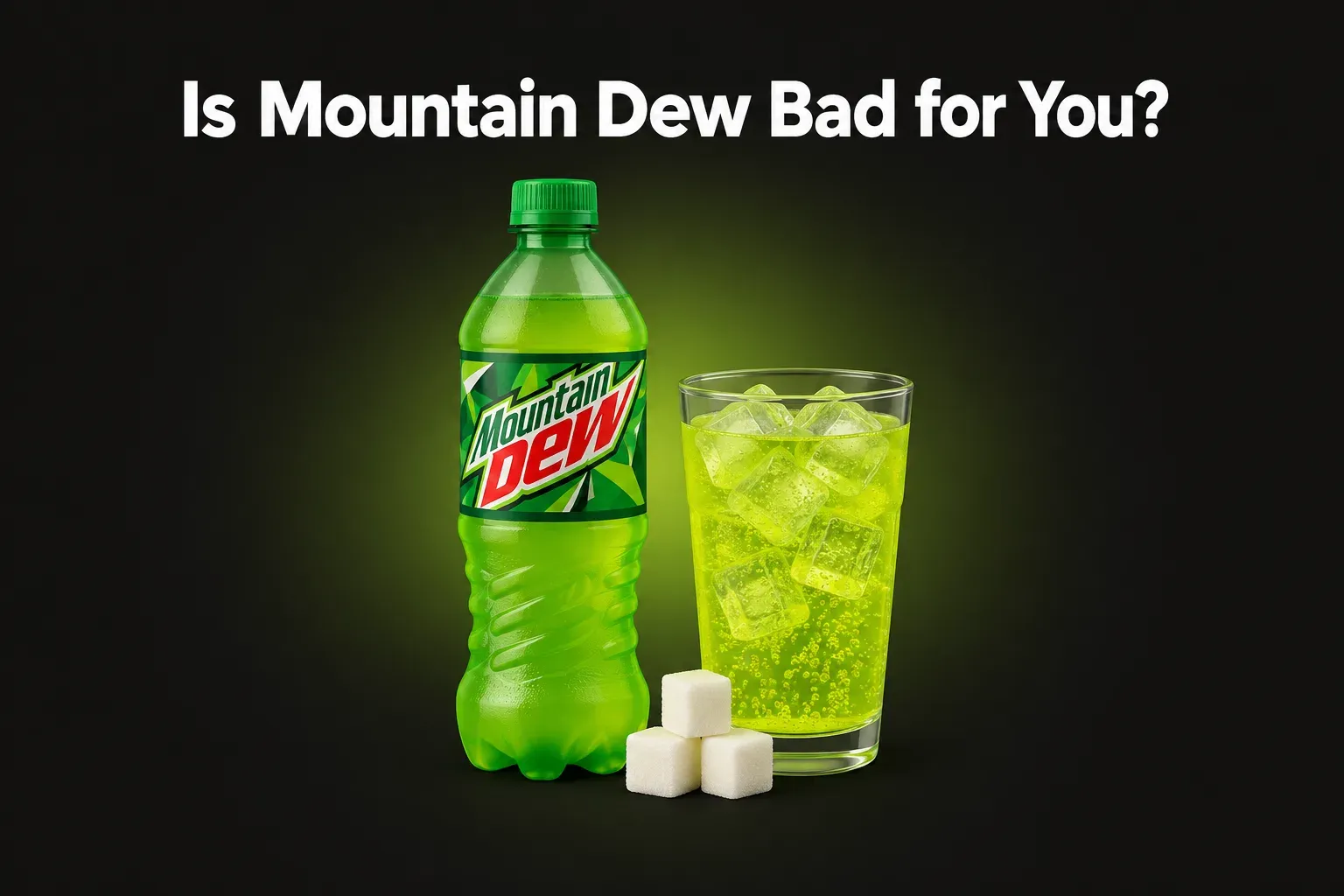
Mountain Dew is the neon yellow-green soda with a big kick. It has more sugar and more caffeine than most sodas. So is Mountain Dew bad for you?
The short answer: one can now and then is fine for most healthy adults. But a 12 oz can has 46 g of added sugar – more than the daily limit for both men and women. It also has 54 mg of caffeine, Yellow 5 dye and the preservative sodium benzoate. Drink it every day, and your teeth, weight and blood sugar pay the price. The diet versions skip the sugar but add three sweeteners with open questions.
Mountain Dew ingredients: what’s in a can
Here is the current US label for regular Mountain Dew:
| Per serving | 12 oz can (355 ml) | 20 oz bottle (591 ml) |
|---|---|---|
| Calories | 170 | 290 |
| Sugar (all added) | 46 g | 77 g |
| Caffeine | 54 mg | about 90 mg |
| Sodium | 60 mg | 105 mg |
| Fat, protein, fiber | 0 g | 0 g |
12 oz: PepsiCo product sheet (updated September 2024) and Open Food Facts. 20 oz: Costco Business Center (calories, sugar, sodium). 20 oz caffeine is worked out from the 12 oz label (4.5 mg per fl oz), as Caffeine Informer does.
The ingredients, in label order:
- Carbonated water – water made fizzy with carbon dioxide gas.
- High-fructose corn syrup – a sweet syrup made from corn that gives almost all the calories.
- Concentrated orange juice – orange juice with most of the water taken out, for a citrus taste.
- Citric acid – the sour acid found in lemons, which gives the tart bite and makes the drink acidic.
- Natural flavor – a flavor mix made from plant or animal sources. The label doesn’t say what’s in it.
- Sodium benzoate – a preservative that stops mold and yeast (“preserves freshness” on the label).
- Caffeine – a stimulant that perks you up, with 54 mg per can.
- Sodium citrate – a salt made from citric acid that keeps the sour taste in check.
- Gum arabic – a gum from acacia tree sap that helps keep the flavor oils mixed in.
- Erythorbic acid – a close cousin of vitamin C that keeps the drink fresh (“preserves freshness” on the label).
- Calcium disodium EDTA – grabs tiny bits of metal so the flavor stays the same (“to protect flavor” on the label).
- Yellow 5 – a dye made from petroleum that gives the bright color.
Diet Mountain Dew has no corn syrup. Instead, it uses aspartame, acesulfame K and sucralose. It adds potassium benzoate, a preservative like sodium benzoate. It also has citrus pectin, a fiber from fruit peel, and potassium citrate, a salt. It has no erythorbic acid.
Ingredients: US 12 oz can labels on Open Food Facts – Mountain Dew (updated November 2026) and Diet Mountain Dew (updated May 2025).
Sugar: the biggest problem
46 g of sugar is about 11 teaspoons. The American Heart Association sets a daily limit for added sugar. It’s 25 g for women and 36 g for men (Johnson et al., Circulation, 2009). One 12 oz can goes over both. A 20 oz bottle has 77 g – more than twice the men’s limit.
Sugary drinks don’t fill you up like food. One 20 oz bottle a day adds about 2,000 calories a week.
A large review pooled studies of over 300,000 people. Some drank 1–2 sugary drinks a day. They had a 26% higher risk of type 2 diabetes than people who rarely drank them (Malik et al., Diabetes Care, 2010).
Is high-fructose corn syrup worse than table sugar? Both are about half fructose and half glucose. The real problem is how much you get.
How much caffeine is in Mountain Dew?
Mountain Dew has more caffeine than most sodas. A 12 oz can has 54 mg. A Coke has 34 mg and a Pepsi 38 mg. A 20 oz bottle has about 90 mg – close to a cup of brewed coffee.
For healthy adults, the FDA says up to 400 mg a day is usually not linked to harm. Just remember that coffee, tea and energy drinks count too.
For kids and teens, the FDA suggests water and plain milk as their main drinks. Too much caffeine can cause a racing heart, jitters and poor sleep. And a bottle at 4 pm can still keep you awake at night.
“Mountain Dew mouth” and your teeth
“Mountain Dew mouth” is a nickname for severe tooth decay seen in parts of Appalachia. The name points to a habit of sipping sugary soda all day. It made headlines in dental news as early as 2001 (Farster, CDS Review, 2001).
Here’s what research shows:
- More tooth loss. Researchers looked at US health surveys from 1999 to 2010. People in Appalachia lost more teeth than people in the rest of the country. The gap didn’t close over time. Lower income and less schooling explained the biggest part of the gap (Gorsuch et al., American Journal of Public Health, 2014).
- The name matters. 348 people in Appalachia heard a health message about teeth. When it said “tooth decay” instead of “Mountain Dew mouth,” people took it more seriously (Dragojevic et al., Health Communication, 2020).
So soda is only part of the story. But it does hurt teeth in two ways. Sugar feeds mouth bacteria, which make acid that causes cavities. And the drink itself is acidic. Acid softens enamel, the hard outer layer of your teeth.
Researchers tested 379 drinks sold in the US. Mountain Dew had a pH of 3.22. Below 4 counts as erosive – strong enough to wear away enamel. Coca-Cola was even more acidic, at 2.37 (Reddy et al., Journal of the American Dental Association, 2016). In another lab test, pulled human teeth sat in drinks for up to 96 days. Coca-Cola stained them the most, followed by Mountain Dew (Maladkar et al., European Journal of Dentistry, 2022).
Diet Mountain Dew had a pH of 3.18 in the same US test. So “no sugar” does not mean “safe for teeth.”
Yellow 5 and sodium benzoate
Yellow 5 (tartrazine) gives the green-yellow glow. Some Crystal Light flavors use it too.
- Hyperactivity in kids. In a British study, about 300 children drank juice with a mix of dyes plus sodium benzoate. Tartrazine was in one of the mixes. On average, the children became more hyperactive than when they drank plain juice (McCann et al., The Lancet, 2007).
- DNA damage in rats. Rats got tartrazine at 3.75 or 15 mg per kg of body weight a day for up to 21 days. They had blood changes and short-lived DNA damage. The effects were stronger when tartrazine was mixed with another yellow dye. The lower dose is half of Europe’s daily limit (Hayat et al., Journal of Applied Toxicology, 2026).
- Kidneys in rats. Rats got 10 or 100 mg per kg a day for 21 days. The high dose is more than 13 times Europe’s daily limit. At that dose, their kidneys worked less well, and kidney cells showed DNA damage (Yavaş et al., Regulatory Toxicology and Pharmacology, 2026).
In April 2025, the FDA asked food companies to remove Yellow 5 and five other petroleum dyes by the end of 2026. West Virginia – in the heart of Appalachia – passed a law to ban these dyes in food sold in the state from 2028 (Stateline, 2025).
Sodium benzoate stops mold and yeast.
- Memory in mice. Mice drank water with sodium benzoate (0.56 to 2.25 mg per ml) for 4 weeks. They had worse memory and coordination. Their brains also showed more oxidative stress, a kind of wear and tear on cells (Khoshnoud et al., Journal of Biochemical and Molecular Toxicology, 2018).
- Benzene. Benzoate plus vitamin C or erythorbic acid can form small amounts of benzene, a chemical that causes cancer. Mountain Dew has both, though its sugar and EDTA slow this down. Heat and light speed it up. An FDA survey tested 199 drinks. Most had no benzene or less than the limit for drinking water. Drinks with more were changed by their makers (Nyman et al., Journal of Agricultural and Food Chemistry, 2008). Still, it’s smart to keep soda cool and out of the sun.
Why do animal studies matter? Rats and mice share most of our genes and body processes. And giving people a dye or preservative for years to test for DNA damage would put their health at risk. Proof in humans is missing for most of these effects. But several labs see similar warning signs. So it makes sense to limit these additives as a precaution, especially for kids.
What happened to BVO?
For years, Mountain Dew contained brominated vegetable oil (BVO). It kept the citrus flavor from floating to the top. BVO is not approved in the EU or Japan.
- In May 2014, PepsiCo said it was working to remove BVO from all its drinks, including Mountain Dew (CBS News, 2014). Today’s label doesn’t list it.
- An FDA team fed rats BVO for 90 days. Bromine built up in their heart, liver and fat. At the higher doses, their thyroid glands changed. The thyroid is a gland in your neck that controls how your body uses energy (Woodling et al., Food and Chemical Toxicology, 2022).
- In July 2024, the FDA banned BVO in food. The ban took effect in August 2024, and companies had one year to comply.
Diet Mountain Dew and Mountain Dew Zero Sugar
Both have 0 calories and 0 g of sugar. Both are sweetened with aspartame, acesulfame K and sucralose. Both still contain Yellow 5. The main difference is caffeine: 54 mg in Diet and 68 mg in Zero Sugar, per 12 oz.
The FDA allows all three. But independent studies raise questions:
- Aspartame: rats ate aspartame in their food for their whole lives. More of them got blood cancers (lymphomas and leukemias). This happened even at 20 mg per kg of body weight a day. That’s less than the daily amount allowed for people (Soffritti et al., Environmental Health Perspectives, 2006). In 2023, the WHO’s cancer agency called aspartame “possibly carcinogenic.” That means it may cause cancer, but the proof is limited (Riboli et al., Lancet Oncology, 2023).
- Sucralose: mice got sucralose in their food from before birth until death. More of the males got blood cancers, starting at 2,000 ppm in their feed (0.2% of the food) (Soffritti et al., International Journal of Occupational and Environmental Health, 2016).
- Acesulfame K: mice got 37.5 mg per kg a day for 4 weeks. It changed their gut bacteria, and the males gained more weight (Bian et al., PLoS One, 2017).
- In people: a French study followed over 100,000 adults. Those who had more acesulfame K and sucralose had more heart disease. Those who had more aspartame had more strokes (Debras et al., BMJ, 2022). Aspartame and acesulfame K were also linked to more cancer (Debras et al., PLoS Medicine, 2022).
These human studies show links, not cause. But animal and human studies point the same way. So diet Dew is better than regular for your weight and blood sugar. It’s still not a drink to have all day.
Mountain Dew vs other sodas
| Drink (12 oz) | Calories | Sugar | Caffeine | Sweetener |
|---|---|---|---|---|
| Mountain Dew | 170 | 46 g | 54 mg | High-fructose corn syrup |
| Mountain Dew (20 oz) | 290 | 77 g | about 90 mg | High-fructose corn syrup |
| Diet Mountain Dew | 0 | 0 g | 54 mg | Aspartame, acesulfame K, sucralose |
| Mountain Dew Zero Sugar | 0 | 0 g | 68 mg | Aspartame, acesulfame K, sucralose |
| Coca‑Cola | 140 | 39 g | 34 mg | High-fructose corn syrup |
| Pepsi | 150 | 41 g | 38 mg | High-fructose corn syrup, sugar |
| Sprite | 140 | 38 g | 0 mg | High-fructose corn syrup |
| Coca‑Cola Zero Sugar | 0 | 0 g | 34 mg | Aspartame, acesulfame K |
Mountain Dew: PepsiCo; 20 oz as in the table above. Diet Mountain Dew: Open Food Facts and Caffeine Informer. Coca-Cola: Coca-Cola US. Others: Open Food Facts labels (Mountain Dew Zero Sugar, Pepsi, Sprite, Coca-Cola Zero Sugar). Recipes change – check the can.
What stands out:
- Mountain Dew has the most sugar in this group. A can has 7 g more than a Coke.
- It also has more caffeine than Coke, Pepsi or Sprite.
- Only the Mountain Dew drinks here have Yellow 5. The colas use caramel color instead. Sprite has no color.
Want the full picture on cola? Read is Coke bad for you. Looking for a better fizzy drink? See our guide to the healthiest soda.
How to drink Mountain Dew more safely
- Make it a treat, and pick the 12 oz can over the 20 oz bottle.
- Drink it with a meal, not in sips all day. Then rinse your mouth with water.
- Skip it after 2 pm so the caffeine doesn’t steal your sleep.
- Keep it from young kids. They don’t need the sugar, caffeine or dye.
- Try sparkling water with a squeeze of lime for the same fizz.
Check your Mountain Dew before you drink it. With NutriSmart, you photograph the label or scan the barcode. The app lists the sweeteners, preservatives and colors, explains the risks of each one and gives the product a health score out of 100. It also tells you right away if a soda is ultra-processed and which ingredients make it so. Set an alert for Yellow 5 or aspartame, and the app warns you whenever a product you scan contains it.Get the app free
The bottom line
Mountain Dew is fine as an occasional treat for most healthy adults. But a 12 oz can has 46 g of sugar – more than a full day’s limit – and a 20 oz bottle has 77 g. It has more caffeine than most sodas, plus Yellow 5 and sodium benzoate. Sipped all day, it’s hard on your teeth. BVO is gone, and the FDA banned it in 2024. Diet and Zero Sugar cut the sugar but add three sweeteners with open questions. If you love it, keep it small, keep it rare and drink water most of the time.
FAQ
Is Mountain Dew bad for you?
One can now and then won't hurt most healthy adults. But a 12 oz can has 46 g of added sugar – more than the daily limit for both men and women. Drinking it every day is hard on your teeth, weight and blood sugar.
What are the ingredients in Mountain Dew?
Mountain Dew is made of carbonated water, high-fructose corn syrup, concentrated orange juice, citric acid and natural flavor. It also has caffeine, sodium citrate and gum arabic. Sodium benzoate and erythorbic acid keep it fresh. Calcium disodium EDTA protects the flavor, and Yellow 5 adds the color.
How much sugar is in a Mountain Dew?
A 12 oz can has 46 g of sugar, or about 11 teaspoons. A 20 oz bottle has 77 g, or about 19 teaspoons. All of it is added sugar from high-fructose corn syrup.
How much caffeine is in Mountain Dew?
A 12 oz can has 54 mg of caffeine. A 20 oz bottle has about 90 mg – close to a cup of brewed coffee. That's more than Coke (34 mg) or Pepsi (38 mg).
Does Mountain Dew still have BVO?
No. PepsiCo said in 2014 that it would take brominated vegetable oil (BVO) out of Mountain Dew, and today's label doesn't list it. The FDA banned BVO in food in 2024.
Is Diet Mountain Dew or Mountain Dew Zero Sugar better?
Both have no sugar and no calories, so they are easier on your weight and blood sugar. Both use aspartame, acesulfame K and sucralose, which have open questions from animal studies. Zero Sugar also has more caffeine: 68 mg per 12 oz.
What is Mountain Dew mouth?
It's a nickname for severe tooth decay seen in parts of Appalachia. The name points to sipping sugary soda all day. But studies show that low income in the region plays a big role too.