Gum Arabic (E414): What It Is and Is It Safe?
What gum arabic (acacia gum, E414) is, why it's in soda, candy and supplements, its fiber benefits, side effects and what EFSA says about its safety.
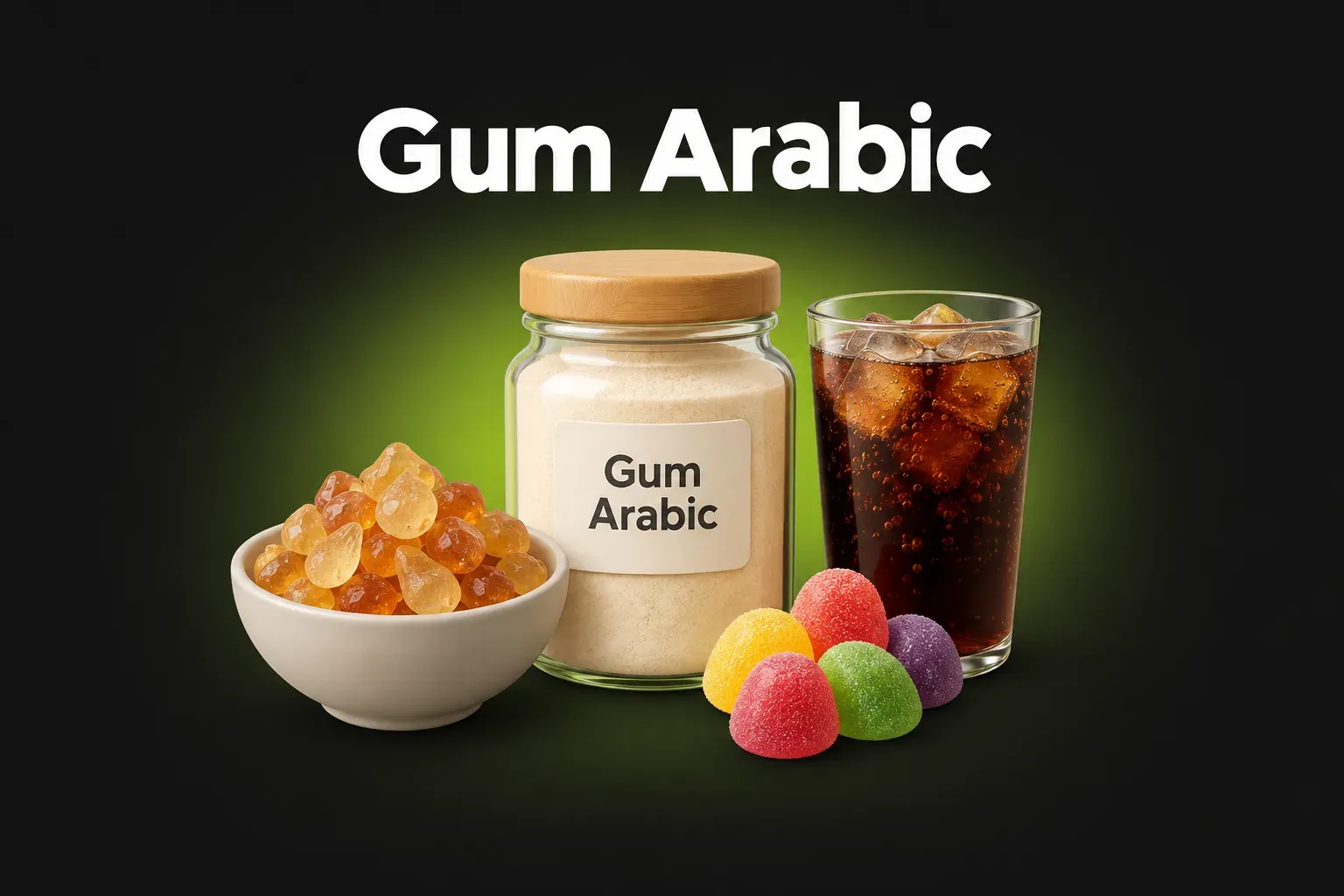
Gum arabic – also called acacia gum or E414 – is one of the oldest food additives in the world. It’s in soft drinks, gum drops and pastilles, candy coatings, icing and fiber supplements. Unlike many additives, it comes straight from a tree.
The short answer: gum arabic is the dried sap of acacia trees. It keeps flavor oils mixed in soft drinks, gives candy its shiny coat and helps thicken foods. It’s mostly soluble fiber, and studies suggest it can feed helpful gut bacteria. The European Food Safety Authority (EFSA) found no safety concern in 2017. The only real side effect is gas and bloating in large amounts – much more than foods contain. NutriSmart rates it at a low risk level.
What is gum arabic?
When the bark of certain acacia trees (mainly Acacia senegal and Acacia seyal) is cut, the tree releases a sticky sap that hardens into amber “tears”. These tears are collected by hand, cleaned, ground and dried into a powder.
Most of the world’s gum arabic comes from Sudan and other countries of Africa’s Sahel, south of the Sahara.
Gum arabic is made of long chains of sugars with a little protein. That bit of protein helps it hold oil and water together.
On labels you’ll see it as gum arabic, acacia gum, gum acacia, acacia fiber or E414.
Where you’ll find gum arabic
- Soft drinks and flavored waters – it keeps citrus and cola flavor oils from floating to the top
- Gum drops, wine gums and pastilles – gives them their chewy texture
- Candy coatings – the shiny shell on coated chocolates and nuts
- Icing, glazes and marshmallows
- Wine and beer – stabilizes color and foam
- Frozen desserts
- Fiber supplements and gummies – as “acacia fiber”
- Medicines and vitamins – as a coating or binder
Gum arabic as a fiber
About 85–90% of gum arabic is soluble fiber. Your body can’t digest it, so it travels to the large intestine. There, gut bacteria break it down slowly (they ferment it). Because this happens slowly, it causes less gas than some other fibers, like inulin.
In a study in healthy adults, about 10 g a day for four weeks increased helpful gut bacteria like bifidobacteria and lactobacilli (Calame et al., British Journal of Nutrition, 2008). In the US, the FDA lets companies count acacia gum as dietary fiber on the Nutrition Facts label (FDA).
The amount in a soft drink or a few candies is small, though – far less than 10 g. You won’t get much fiber from gum arabic in normal foods. Read about high-fiber foods and fiber supplements.
Is gum arabic safe? What the research says
What regulators say
- EU: in 2017, EFSA re-checked gum arabic and found no need for a daily limit and no safety concern at the amounts used in food (EFSA Journal, 2017).
- US: the FDA considers it generally recognized as safe.
Side effects
- Gas and bloating: in large amounts – more than about 10–15 g a day, far more than foods contain – it can cause gas and bloating, like other fibers.
- Allergy: very rare from eating it.
Overall, gum arabic is one of the safest additives on the market. That’s why NutriSmart gives it a low risk level.
Gum arabic vs other gums
| Gum | E number | Comes from | NutriSmart risk |
|---|---|---|---|
| Gum arabic | E414 | Acacia tree sap | Low |
| Guar gum | E412 | Guar beans | Low |
| Xanthan gum | E415 | Fermented by bacteria | Low |
| Gellan gum | E418 | Fermented by bacteria | Low |
| Carrageenan | E407 | Red seaweed | High |
| Cellulose gum (CMC) | E466 | Wood pulp or cotton | Medium |
Check gum arabic in seconds. With NutriSmart, you photograph the ingredient list or scan the barcode, and the app tells you right away if the product has gum arabic (E414) and what its risk level is. Turn on an alert for any additive you want to avoid, and the app warns you every time a product you scan contains it. You’ll also see every other additive, the risks of each one and a health score out of 100.Get the app free
You can also read about pectin and carboxymethylcellulose (cellulose gum).
The bottom line
Gum arabic (E414) is the dried sap of acacia trees. It keeps flavors mixed in soft drinks, coats candy and thickens foods. It’s mostly soluble fiber and may even feed helpful gut bacteria. EFSA found no safety concern, and the only side effect is gas and bloating at large amounts. Of all the additives on a label, gum arabic is one you don’t need to worry about.
FAQ
What is gum arabic?
Gum arabic is a natural gum made from the hardened sap of acacia trees, mostly grown in Sudan and other countries in Africa's Sahel region. It's used in food to keep flavors mixed in drinks, to coat candy and to thicken. Its European code is E414.
Is gum arabic safe to eat?
Yes, for most people. In 2017 the European Food Safety Authority found no safety concern and no need for a daily limit. In large amounts – far more than foods contain – it can cause gas and bloating. NutriSmart rates it at a low risk level.
Is gum arabic a fiber?
Yes. About 85–90% of it is soluble fiber that your gut bacteria ferment slowly. Studies with about 10 g a day found it increased helpful gut bacteria. In the US, companies can count it as dietary fiber on the label.
Is gum arabic the same as acacia gum?
Yes. Gum arabic, acacia gum, gum acacia and E414 are all names for the same ingredient.
Is gum arabic vegan and gluten-free?
Yes. It comes from tree sap, so it's plant-based and naturally free of gluten.
What foods contain gum arabic?
Soft drinks and flavored waters, candy (gum drops, pastilles, coated chocolates), marshmallows, icing, wine and beer, frozen desserts, fiber supplements and some medicines.