Is Crystal Light Bad for You? Sweeteners, Dyes and Water
Is Crystal Light bad for you? Calories, aspartame, acesulfame K and dyes by flavor, Crystal Light Pure, caffeine versions, and whether it counts as water.
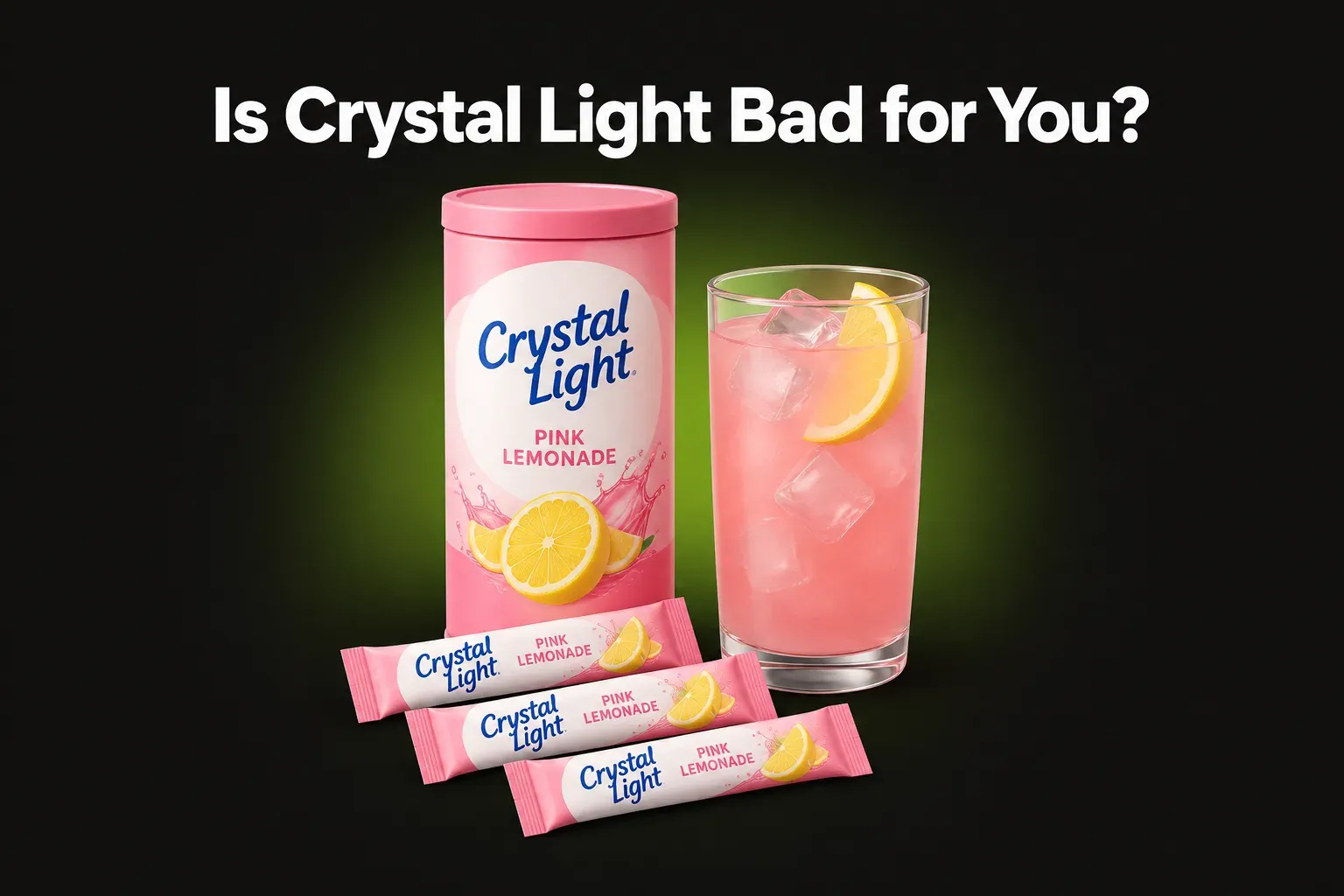
Crystal Light is the powder you stir into water to make lemonade, iced tea or fruit punch. It has almost no calories. But is Crystal Light bad for you?
The short answer: a glass or two a day is not known to harm healthy adults. A 12 oz glass has about 5–10 calories and 0 g of sugar. So it beats soda and juice for your weight and blood sugar. But most flavors use aspartame, acesulfame K and lab-made dyes like Red 40 and Yellow 5. These have open questions from animal and human studies. Crystal Light Pure skips them. And plain water is still the best everyday drink.
What’s in a glass of Crystal Light
Here is the label for three popular mixes, from the official Kraft Heinz site:
| Per serving | Lemonade | Pure Lemonade | Citrus with caffeine |
|---|---|---|---|
| Serving | 1/5 pitcher packet (makes about 12 oz) | 1/5 pitcher packet (makes about 12 oz) | 1 packet (makes 16 oz) |
| Calories | 5 | 10 | 10 |
| Sugar | 0 g | 1 g | 0 g |
| Sodium | 55 mg | 30 mg | 0 mg |
| Potassium | 100 mg | 0 mg | 0 mg |
| Caffeine | 0 mg | 0 mg | 60 mg |
| Sweeteners | Aspartame, acesulfame K | Sugar, stevia | Aspartame |
Source: Kraft Heinz product pages for Lemonade, Pure Lemonade and Citrus with caffeine. Kraft Heinz bases its calorie claim on a 12 fl oz (355 ml) drink.
Lemonade ingredients: citric acid, potassium citrate, sodium citrate, aspartame, magnesium oxide, maltodextrin, natural flavor, acesulfame potassium, soy lecithin, Yellow 5 and artificial color.
What do these do?
- Citric acid gives the sour, lemony taste. It’s the same acid found in lemons.
- Potassium and sodium citrate are salts that soften the sour taste.
- Maltodextrin is a powder made from starch. It adds bulk so the mix pours easily.
- Aspartame and acesulfame K make it sweet with almost no calories.
- Yellow 5 and other dyes give the bright color. They add nothing else.
Sweeteners and dyes by flavor
Not every flavor is the same. Here is what each one uses:
| Flavor | Sweeteners | Colors |
|---|---|---|
| Lemonade | Aspartame, acesulfame K | Yellow 5, artificial color |
| Pink Lemonade | Aspartame, acesulfame K | Red 40, artificial color |
| Raspberry Iced Tea | Aspartame, acesulfame K | Red 40, Yellow 5, Blue 1 |
| Lemon Iced Tea | Aspartame, acesulfame K | Red 40, Yellow 5, Blue 1 |
| Strawberry Orange Banana | Aspartame, acesulfame K | Red 40, Red 40 lake, Blue 1 |
| Classic Orange | Aspartame, acesulfame K, maltitol | Red 40, Yellow 5 |
| Citrus with caffeine | Aspartame | Yellow 5 |
| Berry Sangria (liquid drops) | Sucralose, acesulfame K | Blue 1, Red 40 |
| Pure Lemonade | Sugar, stevia | Turmeric |
| Pure Raspberry Lemonade | Sugar, stevia | Black carrot extract |
Source: ingredient lists on the Kraft Heinz Crystal Light product pages, checked November 2026. A “lake” is a form of the same dye that doesn’t dissolve in water.
Older boxes of some flavors, like fruit punch and lemon iced tea, also list BHA as a preservative (Open Food Facts). In a 2-year study, rats ate BHA as 2% of their food. They got tumors in the forestomach, a part of the stomach people don’t have (Ito et al., Journal of the National Cancer Institute, 1983). The current labels on the Kraft Heinz site don’t list BHA.
Every mix with aspartame carries a warning: “Phenylketonurics: contains phenylalanine.” Phenylketonuria (PKU) is a rare inherited condition. People with it can’t break down phenylalanine, a part of aspartame. They must avoid it.
Is the aspartame in Crystal Light safe?
The FDA and the European Food Safety Authority say aspartame is safe below the daily limit. But independent studies have raised questions. Here is what they found:
- The WHO’s cancer agency. In 2023, the agency (called IARC) labeled aspartame “possibly carcinogenic” to humans. That means it may cause cancer, but the proof is limited (Riboli et al., Lancet Oncology, 2023). Another WHO expert group kept the daily limit the same. It is 40 mg per kg of body weight a day (WHO, 2023).
- A large French study. Researchers followed about 103,000 adults for about 8 years. Heavier sweetener users had a 13% higher risk of cancer than people who used none. Aspartame and acesulfame K showed the clearest link (Debras et al., PLoS Medicine, 2022).
- Heart and stroke. In the same adults, sweeteners were linked to more heart disease and stroke. Aspartame was linked to stroke. Acesulfame K was linked to heart disease (Debras et al., BMJ, 2022).
- A rat study. Rats ate aspartame in their food for their whole lives. More of them got blood cancers, like lymphoma and leukemia. The authors saw this even at 20 mg per kg of body weight a day. That’s less than the daily limit for people (Soffritti et al., Environmental Health Perspectives, 2006).
The label doesn’t say how much aspartame is in a packet. But one glass is very unlikely to reach the daily limit.
What about acesulfame K and gut health?
Acesulfame K is a second sweetener in most Crystal Light flavors. It’s about 200 times sweeter than sugar.
- A small mouse study. Mice got 37.5 mg per kg of body weight a day for 4 weeks. It changed their gut bacteria. The male mice gained more weight (Bian et al., PLoS One, 2017).
- A human trial. 120 healthy adults took packets of saccharin, sucralose, aspartame or stevia for 2 weeks. The doses were below the daily limits. Each sweetener changed their gut bacteria. Saccharin and sucralose also raised blood sugar after a sugar drink. Aspartame didn’t. This trial didn’t test acesulfame K (Suez et al., Cell, 2022).
Why do animal studies matter? Rats and mice share most of our genes and body processes. And testing possible cancer risks on people would put their health at risk. Still, proof in humans is missing. The human studies show links, not cause. But several labs see similar warning signs. So it makes sense to limit sweetened drinks as a precaution. Learn more in our guide to artificial sweeteners.
Red 40 and Yellow 5
Most Crystal Light flavors get their color from lab-made dyes.
- Behavior in kids. In a UK trial, about 300 children drank juice with dyes and a preservative. One dye mix had Yellow 5. The other had Red 40. The children were more hyperactive on the dye drinks than on a plain drink (McCann et al., Lancet, 2007).
- Gut health in mice. Mice got Red 40 every day. The dose matched what is found in common foods. Over time, it caused mild gut inflammation (colitis) and made it worse. The authors say it’s not known if this happens in people (Kwon et al., Nature Communications, 2022).
In 2025, the FDA asked food makers to drop six lab-made dyes, including Red 40 and Yellow 5. The goal is the end of 2026 (FDA, 2025). This is a request, not a ban. Kraft Heinz makes Crystal Light. It said it will remove these dyes from its US products by the end of 2027 (KTVU, 2025). So recipes may change. Check the label on your box.
Crystal Light Pure: the gentler choice
Crystal Light Pure has no artificial sweeteners, flavors or preservatives. It uses sugar and stevia leaf extract. Its colors come from plants, like turmeric and black carrot.
The trade-off is small. A serving of Pure Lemonade has 10 calories and 1 g of added sugar. An On the Go packet of Pure Raspberry Lemonade has 15 calories and 2 g (Kraft Heinz). That’s still far less than a soda.
If you like Crystal Light every day, Pure is the easier swap.
Crystal Light vs water, soda, MiO and Liquid I.V.
| Drink | Serving | Calories | Sugar | Caffeine | Sweetener |
|---|---|---|---|---|---|
| Crystal Light Lemonade | 12 oz | 5 | 0 g | 0 mg | Aspartame + acesulfame K |
| Crystal Light Pure Lemonade | 12 oz | 10 | 1 g | 0 mg | Sugar + stevia |
| Crystal Light Citrus with caffeine | 16 oz | 10 | 0 g | 60 mg | Aspartame |
| MiO Orange Vanilla | 12 oz (½ tsp) | 0 | 0 g | 0 mg | Sucralose + acesulfame K |
| MiO Energy Acai Berry Storm | 12 oz (¾ tsp) | 0 | 0 g | 90 mg | Sucralose + acesulfame K |
| Liquid I.V. Lemon Lime | 1 stick (16 oz) | 50 | 11 g | 0 mg | Cane sugar, dextrose, stevia |
| Diet Coke | 12 oz | 0 | 0 g | 46 mg | Aspartame |
| Coca-Cola | 12 oz | 140 | 39 g | 34 mg | High‑fructose corn syrup |
| Tap water | 12 oz | 0 | 0 g | 0 mg | None |
Crystal Light and MiO: Kraft Heinz product pages (Lemonade, Pure Lemonade, Citrus with caffeine, MiO Orange Vanilla, MiO Energy). Liquid I.V.: Open Food Facts. Coca-Cola and Diet Coke: Coca-Cola and Diet Coke US sites.
What stands out:
- Vs soda: a glass of Crystal Light instead of a can of Coke saves about 135 calories and 39 g of sugar. That’s a real win.
- Vs Diet Coke: both use aspartame. Crystal Light has no fizz and no phosphoric acid. Most flavors have no caffeine. The energy packets and iced tea flavors do.
- Vs MiO: MiO drops use sucralose instead of aspartame. MiO Energy has more caffeine than a can of Diet Coke. Read our guide to Splenda to learn more about sucralose.
- Vs Liquid I.V.: Liquid I.V. adds lots of salt and 11 g of sugar per stick. That helps after heavy sweating. For a normal day, you don’t need it. See is Liquid I.V. good for you.
Compare more flavored drinks in our guide to Vitaminwater.
Does Crystal Light count as water?
Yes. A glass of Crystal Light is almost all water. So it counts toward your daily fluids.
In a UK study, 72 men drank 1 liter (34 oz) of different drinks. Diet cola, cola, tea, coffee and a sports drink worked about as well as still water. They didn’t make more urine than after water (Maughan et al., American Journal of Clinical Nutrition, 2016). Crystal Light wasn’t tested. But it’s also mostly water, so it should work the same way.
The caffeine versions count too. Just keep your total caffeine in mind. Coffee, tea and soda add up.
Can Crystal Light help you lose weight?
It can, if it replaces sugary drinks. Swapping one can of Coke a day for Crystal Light cuts about 135 calories. Over a year, that adds up.
But are diet drinks better than water? Trials disagree:
- One trial favored diet drinks. About 300 adults joined a 12-week weight loss program. Those who drank diet drinks lost a bit more weight than those who drank water. The study was funded by the American Beverage Association (Peters et al., Obesity, 2014).
- Another trial favored water. 89 women with overweight or obesity usually had diet drinks after lunch. Some kept them, and some switched to water. After 24 weeks, the water group lost more weight (Madjd et al., American Journal of Clinical Nutrition, 2015).
In 2023, the WHO advised against using sweeteners for weight control. It said they don’t help much with body fat over time (WHO, 2023). People with diabetes were not part of this advice.
One more thing: Crystal Light is acidic. Acidic soft drinks can wear down tooth enamel, the hard outer layer of your teeth (Tahmassebi et al., Journal of Dentistry, 2006). Sipping it all day is the hardest on teeth. Drinking it with a meal or through a straw is gentler.
How to drink Crystal Light more wisely
- Use it to quit soda or juice, not to replace all your water.
- Keep it to a glass or two a day.
- Pick Crystal Light Pure if you want to skip aspartame and lab-made dyes.
- Mix it weaker. Use more water than the box says. You get fewer sweeteners in each glass.
- Watch the energy packets. Add their caffeine to what you get from coffee and soda.
- Skip aspartame flavors if you have PKU.
See what’s in your Crystal Light. With NutriSmart, you photograph the label or scan the barcode. The app lists the sweeteners, preservatives and colors, explains the risks of each one and gives the product a health score out of 100. It also tells you right away if a drink is ultra-processed and which ingredients make it so. Set an alert for aspartame or Red 40. The app then warns you on every product you scan that contains it.Get the app free
The bottom line
Crystal Light isn’t dangerous for most healthy adults in small amounts. A glass has about 5–10 calories and almost no sugar. That makes it a far better pick than soda or juice. And it counts toward your daily water. But most flavors use aspartame, acesulfame K and dyes like Red 40 and Yellow 5. Animal and human studies raise questions about them, even if proof in people is missing. Use it as a step away from sugary drinks. Keep it to a glass or two a day, and pick Crystal Light Pure when you can. Plain water is still the best drink of all.
FAQ
Is Crystal Light bad for you?
A glass or two a day is not known to harm healthy adults. It has only 5–10 calories and no sugar. But most flavors use aspartame, acesulfame K and lab-made dyes, which have open questions, so plain water is still the better everyday drink.
Does Crystal Light count as water intake?
Yes. A glass of Crystal Light is almost all water, so it counts toward your daily fluids. In one study, diet cola kept people about as hydrated as plain water.
What sweetener is in Crystal Light?
The classic powder mixes use aspartame and, in most flavors, acesulfame K. The liquid drops use sucralose and acesulfame K. Crystal Light Pure uses sugar and stevia leaf extract instead.
Does Crystal Light have caffeine?
Most flavors don't. The energy packets do: Citrus with caffeine has 60 mg, less than a cup of coffee. The iced tea flavors contain instant tea, so they have a little caffeine too.
Is Crystal Light Pure healthier?
It has no artificial sweeteners and no lab-made dyes. It uses sugar, stevia and plant colors like turmeric. It has a bit more sugar – about 1–2 g per serving – which is still very little.
Can Crystal Light help you lose weight?
It can help if it replaces soda or juice, because it cuts about 135 calories per 12 oz. But in one trial, women who swapped diet drinks for water lost more weight. Water is the best long-term habit.