Is Splenda Bad for You? What's Really in the Yellow Packet
Is Splenda bad for you? What's in the yellow packet, why zero calories isn't quite zero, what sucralose studies show, baking risks and how much is too much.
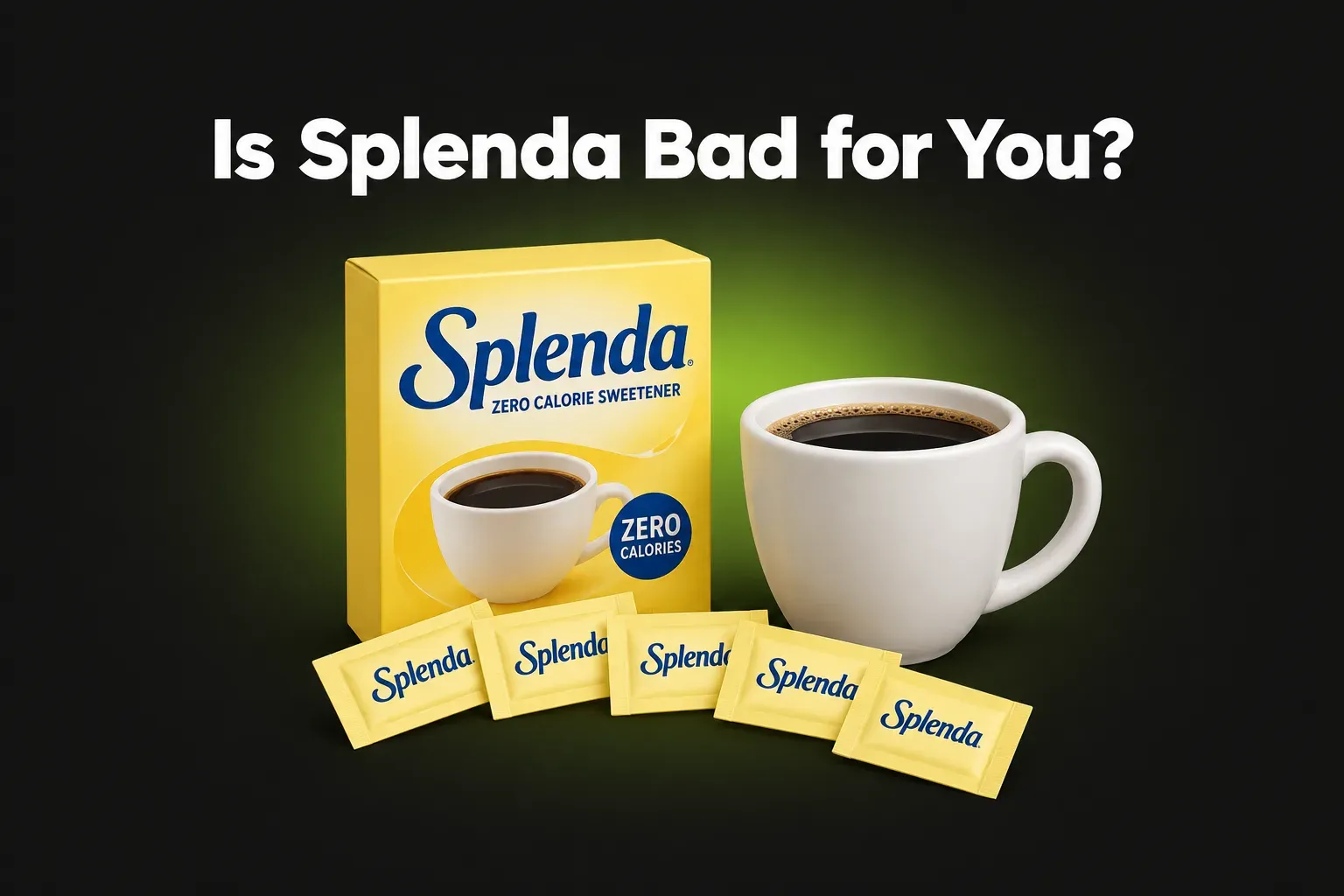
Splenda is the yellow packet you see next to the coffee in diners and offices all over America. It promises the taste of sugar with zero calories. But is Splenda bad for you?
The short answer: one or two packets a day are unlikely to harm a healthy adult. But Splenda is not as harmless as people once thought. Its sweetener, sucralose, has raised blood sugar and changed gut bacteria in people. It was linked to blood cancers in mice. A substance that comes with it damaged DNA in lab tests. Sucralose also breaks down when you bake with it. Proof of harm in people is still missing. So use it now and then, not all day, and don’t bake with it.
What’s in a Splenda packet?
The yellow packet holds 1 g of powder. Splenda lists three ingredients: dextrose, maltodextrin and sucralose (Splenda).
- Dextrose is a simple sugar made from corn. It’s the same sugar as the glucose in your blood.
- Maltodextrin is a white powder made from starch. Your body turns it into sugar very fast.
- Sucralose is the sweet part. It’s about 600 times sweeter than sugar (FDA).
Sucralose is so strong that a packet needs only a pinch. The US box doesn’t say how much. A Mexican Splenda box says each packet has 12 mg of sucralose – about 1.2% of the powder (Open Food Facts). The rest is filler, so you can pour and measure it. Each packet sweetens like 2 teaspoons of sugar (Splenda).
| One yellow packet (1 g) | Amount |
|---|---|
| Calories on the label | 0 |
| Real calories | 3.4 |
| Carbs | 0.9 g |
| Sugars | 0.8 g |
| Sucralose | about 12 mg |
Source: USDA FoodData Central (336 calories per 100 g). Sucralose: Mexican Splenda label on Open Food Facts. Label calories: Open Food Facts US.
Why “zero calories” isn’t quite zero
US labeling rules let a company round any amount under 5 calories down to zero (21 CFR 101.9). A Splenda packet has about 3.4 calories, so the box can say “zero.”
For one packet, that’s no big deal. Two teaspoons of sugar have about 32 calories, so Splenda still saves you a lot (USDA). But it adds up if you use a lot. Ten packets a day add about 34 calories and 9 g of carbs. If you count carbs for diabetes or keto, count the packets too.
Splenda Granulated – the one in the bag for baking – is just maltodextrin and sucralose (Splenda). It measures cup for cup like sugar. So a full cup of it still has some carbs from the maltodextrin.
What studies say about sucralose
The FDA approved sucralose in 1998, and it still calls it safe. But newer studies from independent labs raise questions.
Blood sugar and gut bacteria
- Sugar control. 17 people with obesity drank sucralose or water. Ten minutes later, they drank a sugar drink. After sucralose, their blood sugar went higher. They also made about 20% more insulin (Pepino et al., Diabetes Care, 2013).
- Gut bacteria. 120 healthy adults took sweetener sachets for 2 weeks. The doses were below the official safe limit. Each sweetener changed their gut bacteria. Sucralose and saccharin also made blood sugar control worse. Scientists then moved some of these people’s gut bacteria into mice. The mice’s blood sugar changed in the same way (Suez et al., Cell, 2022).
DNA damage: sucralose-6-acetate
In 2023, a team from North Carolina tested sucralose-6-acetate. It’s a leftover from making sucralose. Store-bought sucralose had up to 0.67% of it. Rat studies suggest the gut can also make it from sucralose. In lab tests, this substance broke DNA strands. Both it and sucralose also weakened the lining of human gut tissue. The authors say one sucralose drink a day may have far more of it than is safe for substances that harm DNA (Schiffman et al., Journal of Toxicology and Environmental Health, 2023).
Cancer in mice
The Ramazzini Institute in Italy fed sucralose to over 850 mice. They got it in their food from before birth until they died. Male mice got more blood cancers, such as leukemia. The rise was clearest at 2,000 ppm and 16,000 ppm (0.2% and 1.6% of their food). The authors called follow-up studies “urgent” (Soffritti et al., International Journal of Occupational and Environmental Health, 2016).
Why do mouse studies matter? Mice share most of our genes and body processes. And testing a possible cancer risk on people for a whole lifetime would not be safe. So animal studies are how we spot danger early.
Heart disease in people
A French study followed 103,388 adults for about 9 years. Those who took in more sucralose had more coronary heart disease – problems with the blood vessels of the heart (Debras et al., BMJ, 2022). This kind of study shows a link, not proof of cause.
What the WHO says
In 2023, the World Health Organization advised people not to use sweeteners like sucralose to control weight. It found no long-term benefit for body fat. Long-term use may even be linked to more type 2 diabetes and heart disease. The advice doesn’t apply to people who already have diabetes (WHO, 2023).
To be fair, many animal studies used higher doses than most people eat. And no study has proven that sucralose causes cancer or heart disease in people. But different labs keep finding warning signs for blood sugar, gut bacteria and the gut lining. That’s a good reason to limit it as a precaution.
Can you bake with Splenda?
Splenda Granulated is sold for baking. But it’s better not to bake with it. Germany’s food safety agency (BfR) reviewed the studies on heating sucralose. Its scientists concluded that sucralose can break down at high heat, such as in baking. This may form harmful substances with chlorine in them, such as chloropropanols and dioxins (Eisenreich et al., Food Chemistry, 2020).
Hot coffee is not as hot as an oven. But if you bake, pick a sweetener without chlorine, or just use less sugar.
How much Splenda is too much?
The FDA sets the acceptable daily intake (ADI) for sucralose at 5 mg per kg of body weight. That’s the amount it considers safe every day for life. The FDA says a 132 lb (60 kg) person would need about 23 packets a day to reach it (FDA).
Most people never get that high from packets alone. But sucralose also hides in diet sodas, protein shakes, yogurts, some chewing gums and drink drops like Crystal Light Liquid. And remember: the gut and blood sugar effects above showed up below the official limit. A careful goal is one or two packets a day, not ten.
Splenda Stevia, Monk Fruit and other versions
Splenda now sells several sweeteners without sucralose. Check the ingredients, because the filler changes too.
| Product | Sweetener | Filler or bulk |
|---|---|---|
| Splenda packets (yellow) | Sucralose | Dextrose, maltodextrin |
| Splenda Granulated | Sucralose | Maltodextrin |
| Splenda Stevia packets | Stevia extract | Dextrose |
| Splenda Stevia pouch | Stevia extract | Maltodextrin |
| Splenda Monk Fruit packets | Monk fruit extract | Dextrose |
| Splenda Monk Fruit jar | Monk fruit extract | Erythritol |
| Equal Original (blue) | Aspartame, acesulfame K | Dextrose with maltodextrin |
| Sweet’N Low (pink) | Saccharin | Dextrose, cream of tartar, calcium silicate |
| Truvia Original | Stevia leaf extract | Erythritol, natural flavors |
| Lakanto Classic | Monk fruit extract | Erythritol |
Splenda: brand site (packets, Granulated, Stevia packets, Stevia pouch, Monk Fruit packets, Monk Fruit jar). Equal. Sweet’N Low and Lakanto: Open Food Facts (Sweet’N Low, Lakanto). Truvia: Target.
What stands out:
- Splenda’s stevia recipe changed. In 2016, Splenda launched Splenda Naturals, made with stevia and erythritol (PR Newswire, 2016). Today’s Splenda Stevia packets list dextrose and stevia extract instead. Older boxes may still differ.
- Stevia and monk fruit come from plants. They have fewer warning signs in studies than sucralose. But they are less studied, and the WHO advice above covers them too.
- Watch for erythritol. The Splenda Monk Fruit jar, Truvia and Lakanto are mostly erythritol. A Cleveland Clinic study looked at people being checked for heart disease. Those with the most erythritol in their blood had about twice the risk of a heart attack, stroke or death within 3 years. Erythritol also made blood platelets clump more easily, which helps clots form (Witkowski et al., Nature Medicine, 2023).
- Equal and Sweet’N Low aren’t better picks. See our guide to artificial sweeteners for aspartame and saccharin.
Better ways to sweeten your coffee
- Cut back slowly. Go from two packets to one, then to half. Your taste buds adjust in a few weeks.
- Try a stevia or monk fruit packet with dextrose, not erythritol, if you need a zero-calorie option.
- Use a little real sugar. One teaspoon has about 16 calories.
- Add flavor without sweetness: cinnamon, vanilla or a splash of milk.
- Check your creamer. Many “zero sugar” creamers use sucralose too. Compare them in our healthiest coffee creamer guide.
See where Splenda’s sucralose hides in your food. With NutriSmart, you photograph the label or scan the barcode. The app lists the sweeteners, preservatives and colors, explains the risks of each one and gives the product a health score out of 100. It also tells you right away if a product is ultra-processed and which ingredients make it so. Set an alert for sucralose, and the app warns you whenever a product you scan contains it.Get the app free
The bottom line
Splenda isn’t poison, and a packet in your coffee now and then is unlikely to hurt you. But it’s not truly zero calories, and its sweetener isn’t as harmless as people once thought. Sucralose raised blood sugar and changed gut bacteria in people. It was linked to blood cancers in mice, and a substance that comes with it damaged DNA in lab tests. It also breaks down when you bake with it. Proof of harm in people is still missing, but different labs keep seeing warning signs. Keep it to one or two packets a day, don’t bake with it, and try to need less sweetness over time.
FAQ
Is Splenda bad for you?
A packet now and then is unlikely to harm a healthy adult. But its sweetener, sucralose, raised blood sugar and changed gut bacteria in some studies, and it was linked to blood cancers in mice. Proof of harm in people is still missing, so it's wise to limit it.
Does Splenda really have zero calories?
Not quite. A yellow packet weighs 1 g and has about 3.4 calories, mostly from dextrose and maltodextrin. US rules let any serving under 5 calories be labeled as zero.
Is it safe to bake with Splenda?
It's better not to. A review by Germany's food safety agency found that sucralose can break down at baking heat. This may form harmful substances that contain chlorine.
How many Splenda packets a day is safe?
The FDA says a 132 lb (60 kg) person would need about 23 packets a day to reach the safe daily limit. But some studies found effects below that limit. One or two packets a day is a more careful habit.
Is Splenda Stevia or Monk Fruit better than regular Splenda?
They don't contain sucralose, and stevia and monk fruit have fewer warning signs in studies. Check the label, though. The Splenda Monk Fruit jar is mostly erythritol, which has been linked to blood clots and heart risk.
Does Splenda raise blood sugar?
One packet has less than 1 g of carbs, so it barely moves blood sugar. But in some studies, sucralose made the body handle sugar worse.