Healthiest Coffee Creamer: What to Pick and What to Skip
What is the healthiest coffee creamer? Popular creamers compared by sugar and additives, the truth about non-dairy creamer, and simple better swaps.
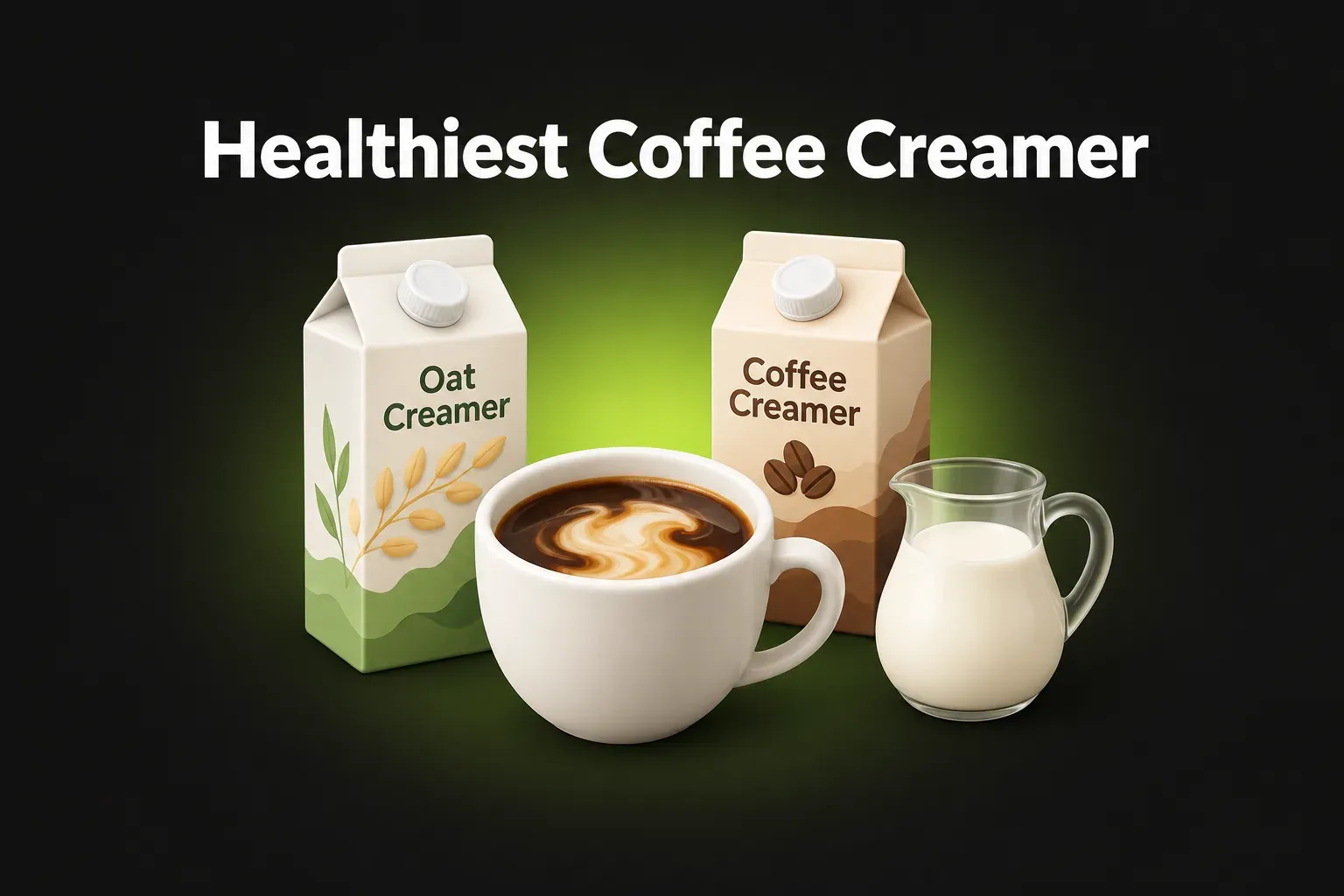
A splash of creamer makes coffee taste like a treat – and that’s exactly the problem. Many coffee creamers are mostly sugar and oil, and most of us pour much more than one tablespoon. So what is the healthiest coffee creamer? It’s often the simplest one in the fridge.
The short answer: the healthiest choice is plain milk or half-and-half: one or two ingredients and no added sugar. If you want a ready-made creamer, pick one with 0–2 g of sugar per tablespoon and a short list – milk, cream, nuts or oats, with few gums and oils. Many flavored and “non-dairy” creamers are made of sugar, corn syrup solids, palm or hydrogenated oil and a long list of additives.
Popular creamers compared
| Creamer | Calories | Sugar | Main ingredients |
|---|---|---|---|
| Whole milk | 9 | 0 g added | Milk |
| Half‑and‑half | 20 | 0 g added | Milk, cream |
| Heavy cream | 51 | 0 g added | Cream |
| Nutpods Original | 10 | 0 g | Water, coconut cream, almonds, acacia gum, gellan gum |
| Califia almond creamer (sweetened) | 20 | 3 g | Almond milk, cane sugar |
| Coffee mate Original powder (1 tsp) | 10 | 0–1 g | Corn syrup solids, hydrogenated oil, sodium caseinate |
| International Delight French Vanilla | 35 | 5 g | Water, cane sugar, palm oil, emulsifiers |
| Flavored dairy creamer | 30–35 | 5 g | Milk, cream, cane sugar |
Per tablespoon (15 ml) unless noted. Milk and cream from USDA FoodData Central; brands from Open Food Facts. Recipes change – check the label.
Watch the serving size. Labels count one tablespoon. Most people pour 2–4 tablespoons per cup. With a flavored creamer, two cups of coffee a day can add 20–30 g of sugar and about 200 calories – close to the sugar in a can of soda.
What’s really in non-dairy creamer
“Non-dairy” sounds lighter, but classic powdered and liquid creamers are built from cheap ingredients:
- Corn syrup solids or sugar – often the first ingredient, so the main thing you’re adding is sugar.
- Hydrogenated oil, palm oil or palm kernel oil – fats high in saturated fat. Older creamers used partially hydrogenated oils, the main source of trans fat; the FDA removed these from US foods in 2018 (FDA). See our article on palm oil.
- Sodium caseinate – a milk protein. So many “non-dairy” creamers are not dairy-free and not safe for a milk allergy.
- Emulsifiers like mono- and diglycerides, polysorbates and sodium stearoyl lactylate, which keep oil and water mixed.
- Thickeners like carrageenan, gellan gum or cellulose gum.
- Phosphates (dipotassium phosphate) to stop the creamer from curdling in hot coffee.
- Artificial flavors and colors like annatto.
Here’s the actual list for Coffee mate Original powder: corn syrup solids, hydrogenated vegetable oil (coconut and/or palm kernel and/or soybean), sodium caseinate, dipotassium phosphate, mono- and diglycerides, sodium aluminosilicate, artificial flavor, annatto color (Open Food Facts).
A teaspoon won’t harm you. But they add up if you use creamer several times a day, every day. Some, like carrageenan and mono- and diglycerides, get the highest risk rating in the NutriSmart app – read why in our articles on carrageenan and mono- and diglycerides.
How to pick the healthiest coffee creamer: 5 checks
| Check | Aim for |
|---|---|
| Sugar | 0–2 g per tablespoon |
| First ingredient | Milk, cream, nuts or oats – not sugar, water or oil |
| Oil | No hydrogenated or palm oil |
| Additives | Few gums, no carrageenan or polysorbates |
| Sweetener | Little sugar and no sucralose |
“Sugar-free” creamers often swap sugar for sucralose or acesulfame K, plus the same oils and emulsifiers. They’re lower in calories, but not cleaner.
The best creamer options, from simplest to sweetest
- Milk (dairy or unsweetened soy/oat/almond) – the lightest choice. See our guide to the healthiest milk.
- Half-and-half – creamy, about 20 calories per tablespoon, just milk and cream.
- Heavy cream – one ingredient, very rich: 51 calories per tablespoon, so use a little.
- Unsweetened plant creamers with short lists (nuts, coconut, oats, a gum or two).
- Lightly sweetened dairy creamers made with milk, cream and cane sugar – fewer additives, but still ~5 g sugar per tablespoon. Chobani Sweet Cream is one example.
- Flavored “non-dairy” creamers with oil, sugar and emulsifiers – the ones to cut back on.
Easy DIY vanilla creamer: mix 1 cup of half-and-half (or unsweetened oat milk) with 1 teaspoon of vanilla extract, a pinch of cinnamon and 1–2 teaspoons of maple syrup. That’s less than 1 g of added sugar per tablespoon and nothing else.
Compare creamers in the store. With NutriSmart, you photograph the label or scan the barcode. The app shows the sugar per serving, flags oils, emulsifiers, thickeners and sweeteners, explains the risks of each one and gives the creamer a health score out of 100. In the app, you can also log your coffee and see how much your creamer adds to your daily calories.Get the app free
You can also read about carrageenan and our guide to the healthiest yogurt. Using almond milk instead? Read whether almond milk is healthy. Buying your coffee out? See the healthiest drinks at Starbucks.
The bottom line
The healthiest coffee creamer is the simplest: milk or half-and-half, with no added sugar. Many flavored and non-dairy creamers are mostly sugar or corn syrup, palm or hydrogenated oil and emulsifiers – and we pour three or four servings at a time. If you buy a creamer, choose one with 0–2 g of sugar per tablespoon and a short ingredient list, or make your own in a minute.
FAQ
What is the healthiest coffee creamer?
Plain milk or half-and-half is the simplest and healthiest choice: no added sugar and only one or two ingredients. If you want a ready-made creamer, pick one with 0–2 g of sugar per tablespoon and a short list – milk, cream or nuts, with few gums and oils. Many flavored creamers are mostly sugar, oil and additives.
Is non-dairy creamer healthy?
Classic non-dairy creamers usually aren't. They're made mostly from sugar or corn syrup solids and vegetable oil, plus emulsifiers and flavors – and many still contain sodium caseinate, a milk protein. Plant-based creamers made from almonds, coconut or oats can be better, if they have little sugar.
How much sugar is in coffee creamer?
Flavored liquid creamers often have about 5 g of sugar per tablespoon. Most people use 2–3 tablespoons, so that's 10–15 g of sugar per cup of coffee – and 20–30 g if you have two cups.
Is half-and-half healthier than creamer?
Usually yes. Half-and-half is just milk and cream, with about 20 calories and no added sugar per tablespoon. Flavored creamers have similar calories but add sugar, oils and additives.
Is coffee creamer bad for weight loss?
It can add up. Three tablespoons of a sweet creamer in two coffees a day is about 200 calories and 30 g of sugar. Switching to milk, a little half-and-half or an unsweetened creamer is an easy way to cut calories.
What should I avoid in coffee creamer?
Look out for sugar or corn syrup as the first ingredients, hydrogenated oils, and long lists of additives like carrageenan, mono- and diglycerides, polysorbates and artificial flavors. A short, recognizable ingredient list is the best sign.