Is Gum Bad for You? Sweeteners, Microplastics and 8 Gums
Is gum bad for you? What sugar-free gum does for your teeth, the sweeteners and BHT inside, microplastics, jaw pain, and 8 popular gums compared.
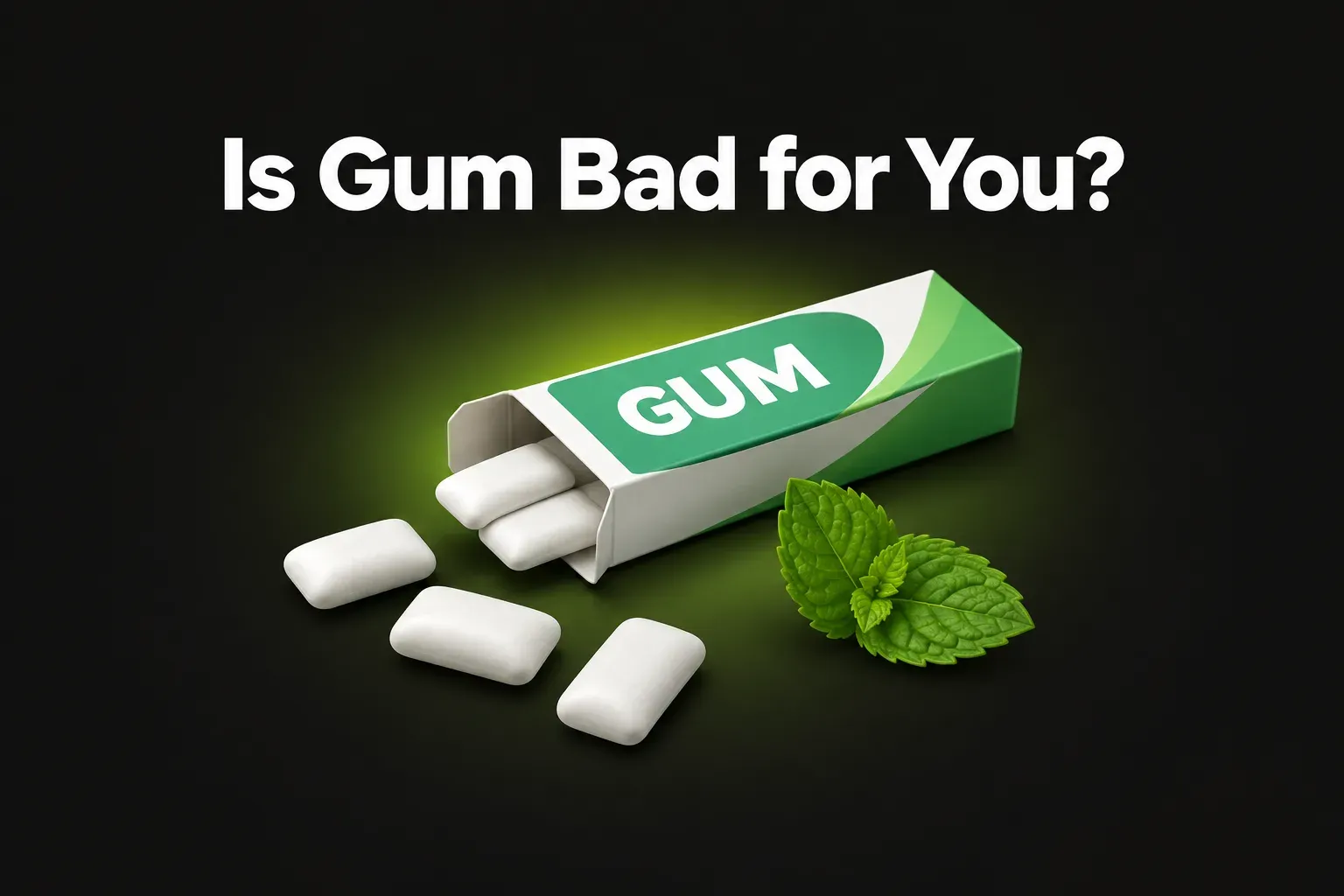
Chewing gum freshens your breath and gives your mouth something to do. Many people chew it every day. But is gum bad for you?
The short answer: for most people, a few pieces of sugar-free gum a day are fine – and they can even help your teeth. The worries are the sweeteners (aspartame, acesulfame K), the preservative BHT, and colors in some brands. Chewing a lot can cause diarrhea, gas, jaw pain and headaches. And early research shows gum can shed microplastics into your saliva.
The good news: sugar-free gum helps your teeth
Chewing makes your mouth produce more saliva. Saliva washes away food and calms down the acids that cause cavities.
- ADA Seal. The American Dental Association gives its Seal of Acceptance to some gums, such as Trident and Orbit. The seal says chewing for 20 minutes after eating helps prevent cavities. It does this by reducing plaque acids and strengthening teeth.
- Research review. Scientists pooled 12 studies on sugar-free gum. People who chewed it got about 28% fewer new cavities. In the studies that used xylitol gum, the drop was about 33%. But the studies varied a lot, so the authors called the proof “tentative” (Newton et al., JDR Clinical & Translational Research, 2020).
This only works for sugar-free gum. And gum is not a swap for brushing and flossing.
Sugar alcohols: good for teeth, hard on the gut
Most sugar-free gums are sweetened with sugar alcohols. These include sorbitol, xylitol, mannitol and maltitol. Some labels also list hydrogenated starch hydrolysate. That’s a syrup made of sugar alcohols. Your body absorbs only part of them. The rest reaches your large intestine, where it can cause gas, bloating and diarrhea. Read more in our guide to sugar alcohols.
Two medical cases from Germany show how far this can go (Bauditz et al., BMJ, 2008):
- A 21-year-old woman had 4 to 12 watery stools a day. She had lost 24 lb (11 kg). She got about 18 to 20 g of sorbitol a day from sugar-free gum.
- A 46-year-old man had lost 48 lb (22 kg) in a year. He chewed 20 sticks a day and ate sugar-free sweets too. That added up to about 30 g of sorbitol.
Both got better after they cut out sorbitol. The doctors say one stick has about 1.25 g of sorbitol. About 20 g can cause diarrhea in roughly half of people.
Xylitol has one more open question. In a Cleveland Clinic study of over 2,000 people, those with the most xylitol in their blood had a 57% higher risk of a heart attack, stroke or death over three years. Then 10 healthy people drank 30 g of xylitol in water. Their platelets (the blood cells that form clots) became more active (Witkowski et al., European Heart Journal, 2024). That’s far more xylitol than a piece of gum has. So the risk from gum is likely small, but nobody has tested it.
If you have a dog, keep xylitol gum out of reach. The FDA warns that xylitol can drop a dog’s blood sugar to a dangerous level within 10 to 60 minutes.
Aspartame and acesulfame K
Many big brands add aspartame and acesulfame K for extra sweetness. Labels don’t say how much. On many packs, they sit in the “less than 2%” part of the list. US regulators say both are safe at these levels. But independent research has raised questions:
- Aspartame in rats. An Italian cancer lab fed rats aspartame from before birth until they died. The doses were about 20 or 100 mg per kg of body weight a day. Rats on the higher dose got more lymphomas, leukemias and breast tumors. The lab says these effects showed up at doses close to the daily limit for people (Soffritti et al., Environmental Health Perspectives, 2007).
- WHO view. In 2023, the WHO’s cancer agency called aspartame “possibly carcinogenic to humans”. Another WHO panel kept the daily limit at 40 mg per kg of body weight (WHO, 2023).
- Acesulfame K in mice. Mice got 37.5 mg per kg of body weight a day for 4 weeks. Their gut bacteria changed, and male mice gained more weight (Bian et al., PLOS ONE, 2017).
- People in France. A study followed over 100,000 adults for about 8 years. People who got the most aspartame had a 15% higher cancer risk. For acesulfame K, it was 13% higher (Debras et al., PLoS Medicine, 2022). This kind of study shows a link, not cause.
Why do animal studies matter? Rats and mice share most of our genes and body processes. And testing a possible cancer risk on people would put their health at risk. Proof in humans is still missing. But several labs see warning signs. So it’s wise to limit these sweeteners as a precaution. Some gums also use sucralose – read whether Splenda is bad for you.
People with phenylketonuria (PKU) must avoid aspartame. That’s why labels say “contains phenylalanine.”
BHT, colors and titanium dioxide
BHT is a lab-made antioxidant. It keeps the gum base from going stale. Most big brands list it “to maintain freshness.” The FDA lets gum base contain up to 0.1% of BHT or BHA (21 CFR 172.615).
- In long-term studies, male rats fed high doses of BHT got more liver cancers.
- In 2012, Europe’s food safety agency reviewed this work. It set a daily limit of 0.25 mg per kg of body weight (EFSA, 2012).
- In May 2026, the FDA started a new safety review of BHT (National Law Review).
The amount in one stick is tiny. But BHT is also in cereals and snacks. See our guide to BHA and BHT.
Colors. Many mint gums use Blue 1 lake, and some use Yellow 5 lake. A “lake” is a dye bound to a mineral so it doesn’t bleed.
Titanium dioxide makes some coated gums bright white. On Open Food Facts, it’s listed in Eclipse Spearmint and Dentyne Fire. Europe banned it as a food additive in 2022. In one French study, rats got 10 mg per kg of body weight a day in their water for 100 days. 4 of 11 rats got early changes in the colon that can lead to cancer. Rats that got plain water had none (Bettini et al., Scientific Reports, 2017). Human proof is missing. Read more about titanium dioxide.
Is there plastic in gum?
Gum is made of a gum base that you chew but don’t digest. It can include man-made plastics and rubbers. US rules allow polyvinyl acetate, polyethylene and butyl rubber (21 CFR 172.615). Labels just say “gum base,” so you can’t tell which ones are inside.
- UCLA pilot study. One person chewed 10 brands of gum – 5 regular and 5 “natural.” On average, each gram of gum released about 100 microplastics into saliva. Some pieces released up to 600 per gram. Natural gums released about as many as regular ones. Most bits came off in the first 2 minutes. The team shared these results at a science meeting in 2025. Meeting results are early, and other experts had not fully checked them (ACS, 2025).
- Belfast study. A team in Northern Ireland also found micro- and nanoplastics in saliva during one hour of chewing (Pant et al., Journal of Hazardous Materials, 2025).
Nobody knows yet if microplastics from gum harm health. To get less of them, chew one piece longer instead of starting new ones.
Jaw pain and headaches
- Jaw pain. In a US study, people chewed bubble gum for just 6 minutes. Jaw muscle pain went up in people with jaw muscle problems (TMD). It also went up in healthy women (Karibe et al., Journal of Dental Research, 2003).
- Headaches in teens. Israeli doctors studied 30 kids and teens with frequent headaches. All of them chewed gum for hours every day. When they stopped chewing for a month, 26 got better and 19 had no more headaches. All 20 who started again had headaches return within days (Watemberg et al., Pediatric Neurology, 2014).
If your jaw clicks or hurts, cut back on gum.
Swallowed gum and gas
Does gum stay in your stomach for seven years? No. Your body can’t digest gum base, but a swallowed piece moves through and leaves in your stool. The real risk is swallowing lots of gum often, mostly in kids. Doctors in Florida described three children whose gut or food pipe got blocked by swallowed gum (Milov et al., Pediatrics, 1998).
Gas. When you chew gum, you swallow more air. The NIDDK lists gum as a cause of extra gas. Add sugar alcohols, and some people bloat even more.
8 popular gums compared
| Gum | Sweeteners | Colors | BHT |
|---|---|---|---|
| Trident Spearmint | Sorbitol, xylitol, mannitol, aspartame, acesulfame K, sucralose | Blue 1 lake, Yellow 5 lake | Yes |
| Extra Polar Ice | Sorbitol, hydrogenated starch hydrolysate, mannitol, aspartame, acesulfame K | Blue 1 lake | Yes |
| Orbit Peppermint | Sorbitol, hydrogenated starch hydrolysate, mannitol, xylitol, aspartame, acesulfame K | None | Yes |
| 5 Gum Peppermint Cobalt | Sorbitol, hydrogenated starch hydrolysate, mannitol, aspartame, acesulfame K | Blue 1 lake | Yes |
| Ice Breakers Ice Cubes | Xylitol, maltitol, mannitol, sorbitol, isomalt, aspartame, acesulfame K, neotame, sucralose | Blue 1, Blue 1 lake | Yes |
| Pür Peppermint | Xylitol | None | No |
| Spry Natural Wintergreen | Xylitol, stevia | None | No |
| Simply Gum Spearmint | Organic cane sugar | None | No |
Source: Open Food Facts labels for Trident, Extra Polar Ice, Orbit, 5 Gum, Ice Breakers Ice Cubes Peppermint, Pür, Spry and Simply Gum. Recipes change by flavor and over time, so check your pack.
What stands out:
- Trident, Extra, Orbit and 5 Gum are very similar. They’re mostly sorbitol, plus aspartame, acesulfame K and BHT.
- Ice Breakers Ice Cubes has the longest list: at least nine sweeteners, blue dyes and BHT. It also has gelatin, so it’s not vegan.
- Pür uses only xylitol. Spry uses xylitol plus a little stevia. Neither has colors or BHT. Pür uses vitamin E (tocopherols) to stay fresh.
- Simply Gum’s original line uses real sugar, so it won’t protect your teeth like sugar-free gum. The brand also sells a sugar-free peppermint gum sweetened with xylitol.
For lower-sugar sweets, see the healthiest candy.
How to chew gum the healthier way
- Pick sugar-free gum, ideally sweetened with xylitol.
- Chew it for about 20 minutes after meals, as the ADA suggests.
- Keep it to a few pieces a day to avoid diarrhea, gas and jaw pain.
- Skip gums with aspartame, colors or BHT if you want fewer additives.
- Chew one piece longer rather than many pieces.
- Teach kids to spit gum out, and keep xylitol gum away from dogs.
See what’s really in your gum. With NutriSmart, you photograph the label or scan the barcode. The app lists the sweeteners, preservatives and colors, explains the risks of each one and gives the product a health score out of 100. It also tells you right away if a gum is ultra-processed and which ingredients make it so. Set an alert for aspartame or BHT. The app then warns you whenever a product you scan contains it.Get the app free
The bottom line
Gum isn’t bad for most people in small amounts. Sugar-free gum after meals can even lower your risk of cavities. The downsides come from what’s inside and how much you chew. Many big brands use aspartame, acesulfame K, BHT and dyes. Animal studies have raised questions about them. Too much gum can cause diarrhea, gas, jaw pain and headaches. Gum base may also shed microplastics, though the health effect is unknown. Your best bet is a few pieces a day of a simple xylitol gum.
FAQ
Is chewing gum bad for you?
Not for most people. Sugar-free gum after meals can even help prevent cavities. The problems come with a lot of gum: stomach trouble from sugar alcohols, jaw pain and headaches.
Is sugar-free gum bad for you?
A few pieces a day are fine for most people. Many brands use aspartame and acesulfame K, which have open questions from animal and population studies. Gums sweetened only with xylitol avoid those.
What happens if you swallow gum?
Your body can't digest gum, but a swallowed piece passes through and leaves in your stool. It does not stay in your stomach for seven years. Kids who swallow a lot of gum often can get a blockage.
Can too much gum give you diarrhea?
Yes. Sugar alcohols like sorbitol pull water into the gut. In two medical cases, people who got 18 to 30 g of sorbitol a day from gum and sweets had diarrhea for months and lost a lot of weight.
Does chewing gum release microplastics?
Early research says yes. A small 2025 pilot study found about 100 tiny plastic bits per gram of gum, in both regular and natural gums. Nobody knows yet if this harms health.
What is the healthiest gum?
A sugar-free gum sweetened with xylitol and without aspartame, colors or BHT is the simplest choice. In our comparison, Pür and Spry fit that best.