Healthiest Candy: 10 Sweets Compared (and What to Avoid)
What is the healthiest candy? 10 popular sweets compared by sugar, calories, dyes and sweeteners, plus dark chocolate, dried fruit and portion tips.
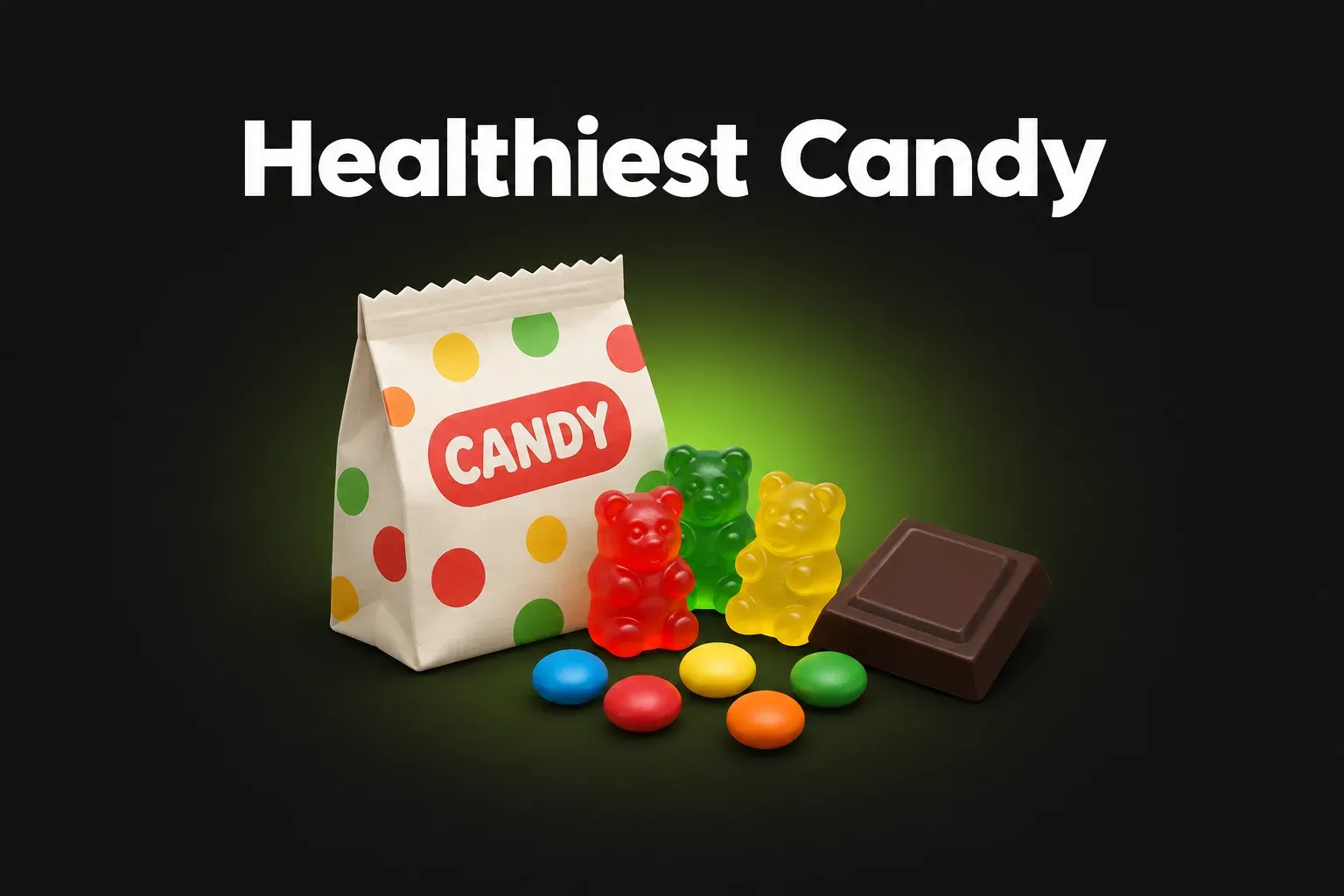
Candy aisles now have “low sugar” gummies, “keto” chocolate and “no artificial colors” labels. So is there such a thing as the healthiest candy?
The short answer: no candy is healthy, but some are much better than others. The best picks are dark chocolate with 70% cocoa or more and dried fruit like apricots or dates. Candy without artificial dyes is also a better choice. Low-sugar brands like SmartSweets, Lily’s and Unreal cut sugar a lot. But some use sugar alcohols that can upset your stomach. Whatever you pick, keep it to about 1 oz (28 g) at a time.
10 popular candies compared
| Candy | Serving | Calories | Sugar | Sweetener | Dyes |
|---|---|---|---|---|---|
| Skittles Original | 29 pieces (30 g) | 120 | 22 g | Sugar, corn syrup | Red 40, Yellow 5, Yellow 6, Blue 1, Blue 2 |
| Sour Patch Kids | 12 pieces (30 g) | 110 | 24 g | Sugar, invert sugar, corn syrup | Red 40, Yellow 5, Yellow 6, Blue 1 |
| Haribo Goldbears (US) | 13 pieces (30 g) | 100 | 14 g | Glucose syrup, sugar, dextrose | Red 40, Yellow 5, Blue 1 |
| M&M’s Milk Chocolate | 32 pieces (28 g) | 140 | 18 g | Sugar | Red 40, Yellow 5, Yellow 6, Blue 1, Blue 2 |
| Reese’s Peanut Butter Cups | 2 cups (42 g) | about 210 | 22 g | Sugar, dextrose | None |
| Reese’s Zero Sugar Miniatures | 3 pieces (26 g) | 110 | 0 g | Maltitol, lactitol, sucralose | None |
| SmartSweets Sweet Fish | 1 bag (50 g) | 130 | 3 g | Stevia | Fruit and vegetable juice |
| Lily’s Creamy Milk Chocolate Style Bar | about 30 g | about 130 | 1 g | Erythritol, isomalt, stevia | None |
| Unreal Dark Chocolate Peanut Butter Cups | 1 cup (15 g) | 80 | 5 g | Cane sugar | None |
| Dark chocolate, 70–85% cocoa | 1 oz (28 g) | about 170 | about 7 g | Sugar | None |
Labels from Open Food Facts (US products, checked November 2026) and the SmartSweets nutrition panel. Dark chocolate from USDA FoodData Central. Recipes change – always check the package.
What stands out:
- Sugar: a 30 g handful of Skittles or Sour Patch Kids has 22–24 g of sugar. That’s about 6 teaspoons. The American Heart Association suggests a daily limit for added sugar. It’s 25 g for women and 36 g for men (Johnson et al., Circulation, 2009).
- Dyes: the brightest candies use four or five lab-made dyes. Chocolate candies without a colored shell usually have none.
- Sweeteners: the “zero sugar” picks swap sugar for sugar alcohols or stevia. Those bring their own trade-offs (more below).
- Calories: low-sugar candy is not low-calorie. A serving of Lily’s has almost as many calories as M&M’s. That’s because chocolate is mostly fat.
The best picks, and why
1. Dark chocolate (70% cocoa or more)
Dark chocolate is the closest thing to a “good” candy. One ounce has about 7 g of sugar, 3 g of fiber and 3.4 mg of iron. It has no dyes. Most bars have only cocoa, sugar and cocoa butter. Some add vanilla or lecithin (an emulsifier that helps it blend).
A large Harvard study followed over 110,000 US nurses and health workers. Some ate dark chocolate 5 or more times a week. They had a 21% lower risk of type 2 diabetes. Milk chocolate didn’t show this benefit. And milk chocolate was linked to more weight gain over time (Liu et al., BMJ, 2024). This kind of study shows a link, not proof.
One catch: heavy metals. Cocoa can pick up lead and cadmium from soil. A study tested 72 dark chocolate and cocoa products. They were bought in the US from 2014 to 2022. In 43% of them, one serving had more lead than California’s strict daily limit. In 35%, it had more cadmium. Organic products were more likely to have higher levels (Hands et al., Frontiers in Nutrition, 2024). The authors said one serving is unlikely to harm most people. But keep it to about an ounce, and switch brands now and then. For test results by brand, read is dark chocolate healthy?
2. Dried fruit
Dried fruit is sweet and chewy like candy, but it also has fiber and potassium.
| Dried fruit (1 oz / 28 g) | Calories | Sugar | Fiber |
|---|---|---|---|
| Dried apricots | 68 | 15 g | 2.1 g |
| Raisins | 84 | 18 g | 1.3 g |
| Medjool dates | 79 | 19 g | 1.9 g |
| Dried mango, sweetened | 90 | 19 g | 0.7 g |
Data: USDA FoodData Central – apricots, raisins, Medjool dates, dried mango.
Ounce for ounce, dried fruit has almost as much sugar as many gummies. But the sugar comes with fiber and nutrients. Pick fruit with no added sugar. Sweetened mango and dried cranberries often have extra sugar. Bright orange apricots are usually treated with sulfites, which some people with asthma react to. Want more on dates? See our guide to calories in dates.
3. Low-sugar brands: SmartSweets, Lily’s and Unreal
These three brands take very different routes:
- SmartSweets cuts sugar to 3 g per bag and uses stevia. Colors come from fruit and vegetable juice. But the bag still has 40 g of carbs and only 6 g of fiber. The first ingredient is IMO (isomalto-oligosaccharides), a starch-like syrup once sold as fiber. In a lab test, rat and human gut enzymes slowly broke IMO down into glucose (blood sugar) (Song et al., Food Chemistry, 2022). So it may raise blood sugar more than “3 g sugar” suggests.
- Lily’s uses erythritol, isomalt (another sugar alcohol) and stevia. It has only 1 g of sugar per serving. Calories stay about the same as regular chocolate.
- Unreal uses real cane sugar, just less of it. Two Unreal peanut butter cups (30 g) have 10 g of sugar. Two Reese’s cups (42 g) have 22 g. Gram for gram, Unreal has about a third less sugar. Unreal also skips dyes and preservatives like TBHQ, which Reese’s uses.
Of the three, Unreal has the simplest recipe. SmartSweets and Lily’s have the least sugar, but both are more processed. If you want a candy that’s not ultra-processed, plain dark chocolate still wins.
Sugar alcohols: why “sugar-free” candy can upset your stomach
Many “zero sugar” candies use sugar alcohols like maltitol, sorbitol, lactitol, isomalt or erythritol. Your small intestine absorbs only part of them. The rest reaches your colon, where gut bacteria ferment it. That can cause gas, bloating, cramps and diarrhea.
How much it takes varies a lot. In a French study, 12 healthy adults ate more and more maltitol or sugar through the day. On average they could handle about 90 g of maltitol a day. But more of them got diarrhea on maltitol than on sugar: 6 people versus 1 (Ruskoné-Fourmestraux et al., European Journal of Clinical Nutrition, 2003). People with IBS (a touchy gut) may react to much less.
Maltitol also raises blood sugar, just less than sugar does. So “zero sugar” doesn’t mean “zero effect” for people with diabetes.
Erythritol is gentler on the gut, but it has another question mark. Cleveland Clinic researchers measured it in the blood of over 4,000 people. Those with the highest levels had about twice the risk of heart attack, stroke or death within 3 years. In lab tests, erythritol made blood clot more easily. Then 8 healthy people had a drink with 30 g of erythritol. Their blood levels stayed high enough for that effect for over 2 days (Witkowski et al., Nature Medicine, 2023). That’s a link, not proof. But it’s a reason not to eat “keto” candy by the bag.
Dyes: Red 40, Yellow 5 and titanium dioxide
Red 40, Yellow 5, Yellow 6 and Blue 1 are lab-made dyes from petroleum. They add color and nothing else.
- In children: a study in Southampton, England, included about 300 children aged 3 and 8–9. Some drinks had a mix of dyes and the preservative sodium benzoate. Other drinks had no additives. Nobody knew which was which. The drinks with additives made the children a bit more hyperactive (McCann et al., The Lancet, 2007). In the EU, foods with Red 40, Yellow 5 or Yellow 6 now need a warning. It says they may affect children’s activity and attention.
- In animals: mice ate Allura Red (Red 40) daily for weeks. The dose was like that in common foods. They got mild colitis (swelling of the gut). They also got colitis more easily when their gut was irritated (Kwon et al., Nature Communications, 2022). A second lab fed mice Red 40 with a high-fat diet for 10 months. They also got mild gut swelling, and the dye damaged DNA (Zhang et al., Toxicology Reports, 2023). Animal studies matter because mice share most of our genes and body processes. Testing this on people would put their health at risk. Human proof is still missing. But two labs saw the same signal, so cutting back is a sensible precaution.
In 2025, the FDA asked food companies to phase out petroleum-based dyes by the end of 2026. It’s a request, not a ban. Mars plans versions of M&M’s and Skittles without synthetic dyes, sold first online in 2026. The classic versions are still in stores, so read the label. We break down the classic bag in Skittles ingredients. In Europe, Haribo Goldbears are already colored with fruit and plant concentrates. The US bears still use Red 40, Yellow 5 and Blue 1.
Titanium dioxide makes candy bright white or helps other colors pop. The EU banned it in food in 2022. EFSA (Europe’s food safety agency) said it could not rule out DNA damage. In one study, rats got it in their water for 100 days. The dose was 10 mg per kg of body weight a day, close to what people eat. They got mild colon inflammation and early changes that can lead to colon cancer (Bettini et al., Scientific Reports, 2017). Human proof is missing here too. Mars removed it from US Skittles at the end of 2024. It’s still in some candies, like Sour Patch Kids Watermelon, so check the list.
How to eat candy without overdoing it
- Buy the small size. Fun-size packs and single bars make it easy to stop. A share-size bag rarely gets shared.
- Aim for about 1 oz (28 g). That’s 2–3 squares of dark chocolate or a small handful of gummies.
- Eat it after a meal. On a full stomach, it’s easier to stop at a little.
- Pair it with protein or nuts. A square of dark chocolate with almonds is more filling than gummies alone. See our low-calorie snacks for more ideas.
- Don’t eat sugar-free candy by the bag. Your stomach will let you know.
- Count it. Candy calories add up fast. Use our calorie calculator to see how a daily treat fits your target.
Looking for other sweet snacks? Compare the healthiest protein bars, the healthiest granola bars and the healthiest ice cream.
Compare candy in the store. With NutriSmart, you photograph the label or scan the barcode. The app lists the sweeteners, preservatives and colors, explains the risks of each one and gives the product a health score out of 100. It also tells you right away if a candy is ultra-processed and which ingredients make it so. You can also set an alert for Red 40, titanium dioxide or maltitol. The app warns you whenever a scanned product contains it.Get the app free
The bottom line
No candy is healthy, but you can pick better ones. Dark chocolate with 70% cocoa or more is the top choice: less sugar, some fiber and no dyes. Unsweetened dried fruit is a good chewy swap. Low-sugar brands like SmartSweets, Lily’s and Unreal cut sugar, but they’re still processed. And the sugar alcohols in many “zero sugar” candies can upset your stomach. Skip candies with Red 40, Yellow 5 and titanium dioxide when you can. Most of all, keep the portion small – about 1 oz at a time.
FAQ
What is the healthiest candy?
No candy is truly healthy. The best picks are dark chocolate with 70% cocoa or more, small portions of candy without artificial dyes, and dried fruit like apricots or dates. Eat about 1 oz (28 g) at a time.
Is dark chocolate healthier than other candy?
Yes, in small amounts. An ounce of 70–85% dark chocolate has about 7 g of sugar, 3 g of fiber and no dyes. A large Harvard study linked eating dark chocolate 5 or more times a week to a lower risk of type 2 diabetes. Milk chocolate was not.
Are sugar-free candies healthier?
They have less sugar, but they're not a free pass. Many use sugar alcohols like maltitol. These can cause gas, bloating and diarrhea, and maltitol still raises blood sugar a little. One study also links erythritol to blood clotting.
Is SmartSweets candy healthy?
SmartSweets has only 3 g of sugar per 50 g bag and uses no artificial dyes. But it's still a processed candy with 130 calories and 40 g of carbs per bag. Most of it is a syrup called IMO, which gut enzymes can slowly turn into glucose.
Which candies have Red 40?
Many bright candies do, including Skittles, Sour Patch Kids, M&M's and US Haribo Goldbears. Check the ingredient list for Red 40, Yellow 5, Yellow 6 and Blue 1. Mars plans dye-free M&M's and Skittles, sold first online in 2026.
How much candy is OK per day?
The American Heart Association suggests no more than 25 g of added sugar a day for women and 36 g for men. One pack of Reese's (2 cups) has 22 g. Keep candy a small treat, not a daily snack.