Skittles Ingredients: What's in Original Skittles?
Skittles ingredients explained: what's in the US bag, Red 40 and other dyes, titanium dioxide, sugar per bag, vegan facts and what studies say.
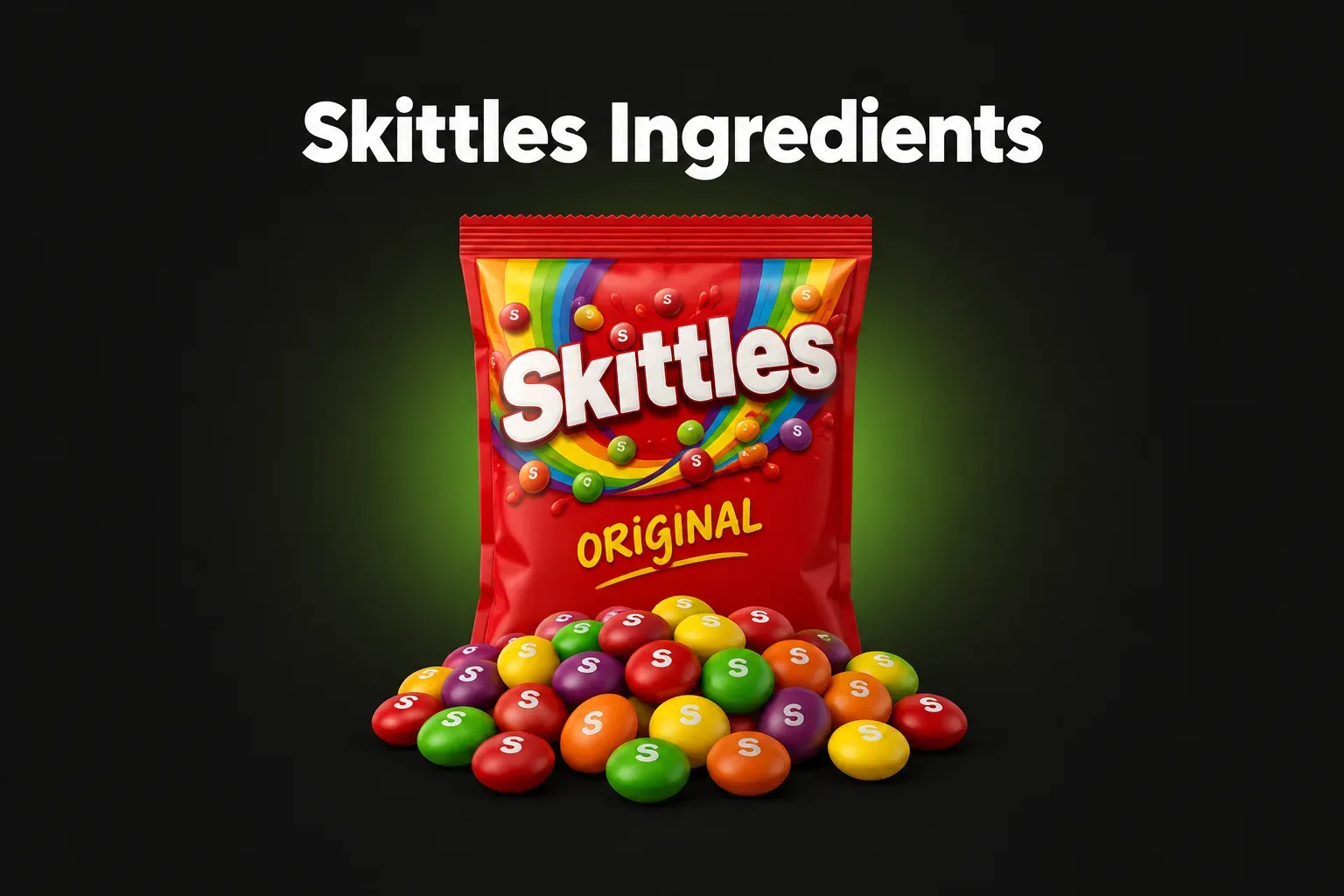
Skittles are one of the most popular candies in the US. The bag says “Taste the Rainbow” – but what is that rainbow made of?
The short answer: US Skittles Original are made of sugar, corn syrup and hydrogenated palm kernel oil, plus small amounts of acids, starches, flavors, five artificial dyes and carnauba wax. The dyes are Red 40, Yellow 5, Yellow 6, Blue 1 and Blue 2. Titanium dioxide is no longer in the US recipe. A 2.17 oz bag has 250 calories and 45 g of sugar. That’s more added sugar than the American Heart Association’s limit for a whole day. Skittles are fine as an occasional treat. But they’re an ultra-processed candy with no fiber and no protein. And studies link some of their dyes to health problems.
Skittles ingredients list (US label)
Here are the ingredients of Skittles Original, in the order on the US label. The first ingredient is the one there’s the most of.
- Sugar – the main ingredient. It makes up most of each piece.
- Corn syrup – a thick, sweet syrup made from corn starch. It helps keep the candy soft and chewy. It is not the same as high fructose corn syrup.
- Hydrogenated palm kernel oil – a fat pressed from the seed of the oil palm. “Hydrogenated” means it was treated to make it firmer. It adds to the chewy texture. The label lists all of the fat in Skittles as saturated fat. More in our guide to palm oil. Oreos use palm oil too – see what’s in Oreos.
- Citric acid – a sour acid, also found in lemons. It gives the fruity tang.
- Tapioca dextrin – a starch from the cassava root, broken into smaller pieces. Candy makers use dextrins to help form thin, hard coatings.
- Modified corn starch – corn starch changed to work better in food. It helps with texture.
- Natural and artificial flavors – these give each color its fruit taste. The label doesn’t say what they are.
- Colors – Red 40, Yellow 5, Yellow 6, Blue 1 and Blue 2. More on these below.
- Sodium citrate – a salt of citric acid. It controls how sour the candy tastes.
- Carnauba wax – a wax from the leaves of a palm tree that grows in Brazil. It makes the shell shiny and keeps pieces from sticking together.
Ingredients: Skittles US, Original 2.17 oz single pack, checked November 2026. Open Food Facts shows the same list on a 4 oz bag. Each ingredient after palm kernel oil makes up less than 2% of the candy.
The five flavors of Skittles Original are strawberry, orange, lemon, grape and lime.
What are the colors in Skittles?
The rainbow comes from five lab-made dyes. The FDA calls them “petroleum-based”, because they are made from chemicals that come from crude oil.
- Red 40 – bright red. Mixed with other dyes, it helps make orange and purple shades.
- Yellow 5 – lemon yellow. It’s also called tartrazine.
- Yellow 6 – orange-yellow.
- Blue 1 – bright blue. Mixed with yellow, it makes green.
- Blue 2 – a deeper, darker blue. It’s also called indigo carmine.
On the label, all five appear as “lakes”, like “Red 40 Lake”. A lake is a dye bound to an aluminum-based powder. It doesn’t dissolve in water. So it can color a candy shell without bleeding. Four of the dyes are also listed in their plain form.
Skittles nutrition facts
Here’s the nutrition label for a standard single bag of Skittles Original:
| Per bag (2.17 oz / 61.5 g) | Amount |
|---|---|
| Calories | 250 |
| Total fat | 2.5 g |
| Saturated fat | 2.5 g (13% of the Daily Value) |
| Sodium | 10 mg |
| Carbohydrates | 56 g |
| Total sugars | 45 g |
| Added sugars | 45 g (90% of the Daily Value) |
| Protein | 0 g |
Source: Skittles US, Original 2.17 oz single pack. Some bags on Open Food Facts say 46 g of sugar.
What these numbers mean:
- 45 g of sugar is about 11 teaspoons. All of it is added sugar.
- The American Heart Association sets a daily limit for added sugar. It’s about 25 g for women and 36 g for men (Johnson et al., Circulation, 2009). One bag goes over both.
- Larger bags list a serving of 29 pieces (30 g). It has 120 calories and 22 g of sugar (Open Food Facts). So a 2.17 oz bag holds about 60 pieces.
- There’s no fiber and no protein. So Skittles don’t fill you up, and it’s easy to eat a whole bag.
Are Skittles bad for you? What studies say about the dyes
For most people, the sugar is the biggest issue. But the dyes get the most attention. The FDA says they are safe in the amounts people eat. Independent studies raise some questions, though.
Behavior in children:
- The Southampton study. About 300 children aged 3 and 8–9 took part. Some weeks they got a drink with a mix of lab-made dyes and a preservative. Other weeks they got a plain drink. No one knew which drink was which. After the dye drinks, the children were more hyperactive (McCann et al., The Lancet, 2007). These were ordinary children, not only children with ADHD. The study could not tell if the dyes or the preservative caused the effect.
- Yellow 5 doses. Researchers in Australia studied 54 children aged 2 to 14. Most had been sent to a hospital for possible hyperactivity. Each morning for 21 days, they got a dose of Yellow 5 or a dummy dose. The doses ranged from 1 to 50 mg. In all, 24 children reacted clearly. They were more irritable and restless, and they slept worse. Doses above 10 mg made the effects last longer (Rowe and Rowe, Journal of Pediatrics, 1994).
- California’s review. Scientists working for the state looked at 27 studies in children, plus studies in animals. In 16 of 25 tests where children were given dyes, there was some sign of a link to behavior. They concluded that lab-made dyes can affect activity and attention in some children (Miller et al., Environmental Health, 2022).
Gut health in animals:
- Red 40 and colitis. Mice ate Red 40 every day for a long time. The dose matched what’s found in common foods. They got mild colitis (swelling of the gut). Their gut also made more serotonin, a chemical messenger (Kwon et al., Nature Communications, 2022).
- Red 40 and DNA. Another lab found that Red 40 damaged DNA in cells and in mice. Mice that ate it for 10 months with a high-fat diet got mild, constant swelling in the colon. Their gut bacteria changed too (Zhang et al., Toxicology Reports, 2023).
Why do animal studies matter? Mice and rats share most of our genes and body processes. And testing a possible harm on people would put their health at risk. These studies don’t prove the same happens in humans. Human proof is missing for the gut effects. But two separate labs saw similar warning signs. So it makes sense to limit dyed candy as a precaution, especially for kids.
Titanium dioxide: gone from US Skittles
For years, US Skittles listed titanium dioxide. It’s a white mineral powder that makes colors look brighter. In 2022, a lawsuit in California claimed it made Skittles unfit to eat. The person who sued dropped the case later that year.
In 2025, Mars said it had removed titanium dioxide from US Skittles by the end of 2024 (Food Safety News, 2025). Mars did not give a reason. The current label on the Skittles website no longer lists it.
Why the worry? In 2021, Europe’s food safety agency (EFSA) said titanium dioxide “can no longer be considered safe” as a food additive. It couldn’t rule out damage to DNA (EFSA, 2021). The EU banned it in food in 2022. In one French study, rats got it in their water for 100 days. The dose was 10 mg per kg of body weight a day. They got mild colon inflammation and early changes that can lead to colon cancer (Bettini et al., Scientific Reports, 2017). Human proof is missing here too. The FDA still allows it in US food. A 2023 request to ban it is still under review (FDA).
Some older bags and other flavors, like Wild Berry, still list titanium dioxide on Open Food Facts. So read the label on your bag.
California, the FDA and Mars: what changed
California’s 2023 law. In 2023, California passed a law that bans four additives in food from 2027. They are Red No. 3, brominated vegetable oil, potassium bromate and propylparaben. The first version of the bill also included titanium dioxide, which was in Skittles at the time. But titanium dioxide was dropped before the final vote, so Skittles were never banned (ABC News, 2023).
The FDA’s 2025 dye plan. In April 2025, the FDA said it would work with food companies to remove six petroleum-based dyes by the end of 2026. Five of them are in Skittles: Red 40, Yellow 5, Yellow 6, Blue 1 and Blue 2 (FDA, 2025). The FDA has not banned these five dyes. It asked companies to drop them.
What Mars did. In August 2026, Mars started selling Skittles Original made without FD&C colors on Amazon. FD&C colors are the lab-made dyes listed above. The press release doesn’t say which colors replace them (Mars, 2026). The classic bags on the Skittles website still list the five dyes.
Skittles in the UK. Skittles sold in the UK and Germany have a different recipe. Most of their colors come from plants, like beet red, curcumin (from turmeric), beta-carotene and anthocyanins (colors from fruits and vegetables). They still use two lab-made blues (Open Food Facts).
Are Skittles vegan?
Skittles Original have no animal ingredients on the US label. There’s no gelatin, milk or eggs. Skittles used to contain gelatin. But Wrigley, the Mars company that makes them, says it stopped using it in early 2009 (Vegetarian Resource Group, 2010).
Two things to keep in mind:
- Skittles Gummies contain gelatin, so they are not vegan (Skittles US).
- Some strict vegans avoid white sugar. That’s because some cane sugar is filtered with bone char (burned animal bones). The label doesn’t say where the sugar comes from.
Skittles vs other popular candies
| Candy | Serving | Calories | Sugar | Gelatin | Dyes |
|---|---|---|---|---|---|
| Skittles Original | 29 pieces (30 g) | 120 | 22 g | No | Red 40, Yellow 5, Yellow 6, Blue 1, Blue 2 |
| Skittles Sour | 30 g | 120 | 21 g | No | Red 40, Yellow 5, Yellow 6, Blue 1, Blue 2 |
| Skittles Original Gummies | 14 pieces (28 g) | 90 | 18 g | Yes | Red 40, Yellow 5, Yellow 6, Blue 1 |
| Starburst Original | 1 pack (58.7 g) | 240 | 33 g | Yes | Red 40, Yellow 5, Yellow 6, Blue 1 |
| Starburst Minis | 19 pieces (28 g) | 110 | 19 g | No | Red 40, Yellow 5, Yellow 6, Blue 1 |
| Sour Patch Kids | 12 pieces (30 g) | 110 | 24 g | No | Red 40, Yellow 5, Yellow 6, Blue 1 |
| Haribo Goldbears (US) | 13 pieces (30 g) | 100 | 14 g | Yes | Red 40, Yellow 5, Blue 1 |
| M&M’s Milk Chocolate | 32 pieces (28 g) | 140 | 18 g | No | Red 40, Yellow 5, Yellow 6, Blue 1, Blue 2 |
Labels from Skittles US (Gummies) and Open Food Facts (Skittles Original, Skittles Sour, Starburst Original (1, 2), Starburst Minis, Sour Patch Kids, Haribo Goldbears, M&M’s). Checked November 2026. Recipes change – always check the package.
What stands out:
- Most of these candies have 18–24 g of sugar in a 1 oz serving (28–30 g). That’s about 4–6 teaspoons.
- Haribo Goldbears have the least sugar per serving here. But they contain gelatin.
- Every candy in the table uses Red 40, Yellow 5 and Blue 1. In this group, dyes are the rule, not the exception.
For better picks, like dark chocolate or candy without dyes, see our guide to the healthiest candy.
See what’s really in your Skittles. With NutriSmart, you photograph the label or scan the barcode. The app lists the sweeteners, preservatives and colors, explains the risks of each one and gives the product a health score out of 100. It also tells you right away if a candy is ultra-processed and which ingredients make it so. Set an alert for Red 40 or titanium dioxide. The app then warns you whenever a product you scan contains it.Get the app free
The bottom line
Skittles Original are mostly sugar, corn syrup and palm kernel oil. A small bag has 45 g of sugar. That’s more than the daily limit for added sugar the American Heart Association suggests. The five dyes – Red 40, Yellow 5, Yellow 6, Blue 1 and Blue 2 – are legal in the US. But studies link some of them to hyperactivity in children, and Red 40 to gut problems in mice. Titanium dioxide is gone from the US recipe. And Mars now sells a version without these dyes online. Skittles Original have no gelatin, but the Gummies do. Enjoy them now and then, keep the portion small and read the label.
FAQ
What are the ingredients in Skittles?
US Skittles Original are made of sugar, corn syrup, hydrogenated palm kernel oil, citric acid, tapioca dextrin, modified corn starch, natural and artificial flavors, colors, sodium citrate and carnauba wax. The colors are Red 40, Yellow 5, Yellow 6, Blue 1 and Blue 2.
Do Skittles still have titanium dioxide?
Not in the current US recipe. Mars says it took titanium dioxide out of US Skittles by the end of 2024. Older bags and some other flavors may still list it, so check the label.
How much sugar is in a bag of Skittles?
A 2.17 oz (61.5 g) bag of Skittles Original has 45 g of sugar, all of it added. That's about 11 teaspoons and 90% of the daily value for added sugar.
Are Skittles vegan?
Skittles Original have no gelatin, milk or eggs on the US label. Mars says it stopped using gelatin in early 2009. Skittles Gummies are different – they contain gelatin, so they are not vegan.
Are Skittles banned in California or Europe?
No. California's 2023 food additive law dropped titanium dioxide before it passed, so Skittles were never banned there. In the UK and Germany, Skittles are sold with a different recipe that uses mostly plant-based colors.
Are there Skittles without artificial dyes?
Yes. In August 2026, Mars started selling Skittles Original made without FD&C colors on Amazon. The classic bags still list Red 40, Yellow 5, Yellow 6, Blue 1 and Blue 2.