Is Dark Chocolate Healthy? Benefits, Sugar and Heavy Metals
Is dark chocolate healthy? What cocoa studies show, sugar by % cacao, lead and cadmium test results, and 10 popular bars compared per ounce.
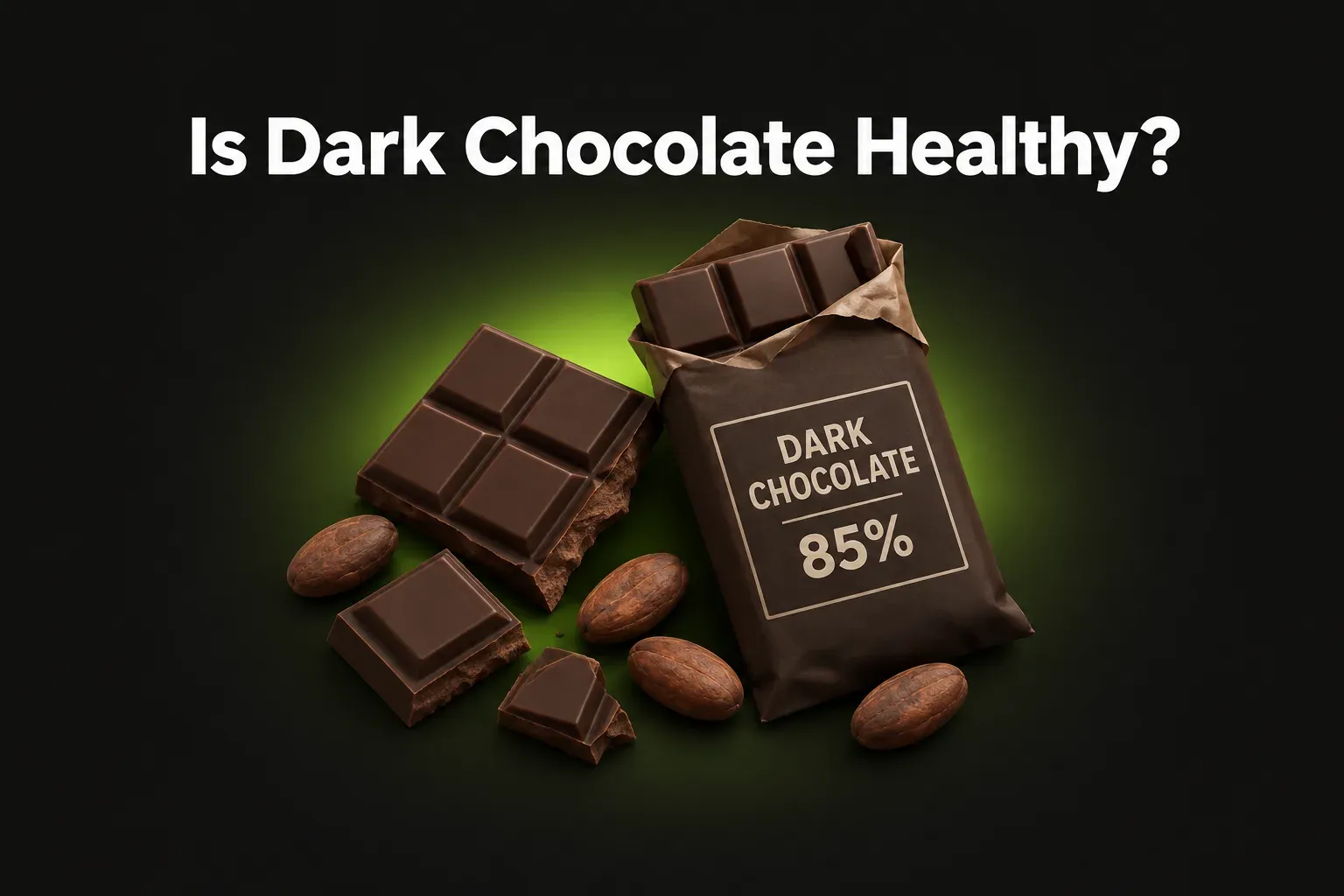
Dark chocolate has a healthy image. Some people call it a “superfood” and eat a square a day for their heart. But is dark chocolate healthy?
The short answer: in small amounts, it can be. An ounce of 70–85% dark chocolate has about 7 g of sugar, 3 g of fiber and some iron and magnesium. Cocoa also has flavanols, plant compounds that may help your blood vessels. But the proof in people is modest, and a bar is still high in calories. Many bars also carry small amounts of lead and cadmium. Keep it to about 1 oz (28 g) a day, pick 70% cacao or more, and switch brands now and then.
What’s in an ounce of dark chocolate
The “% cacao” on the wrapper tells you how much of the bar comes from the cacao bean. The rest is mostly sugar. So the higher the number, the less sugar you get.
| Chocolate (1 oz / 28 g) | Calories | Sugar | Fiber | Iron |
|---|---|---|---|---|
| Milk chocolate | 152 | 15 g | 1 g | 0.7 mg |
| Dark, 45–59% cacao | 155 | 14 g | 2 g | 2.3 mg |
| Dark, 60–69% cacao | 164 | 10 g | 2 g | 1.8 mg |
| Dark, 70–85% cacao | 170 | 7 g | 3 g | 3.4 mg |
| Unsweetened baking chocolate (100%) | 182 | under 1 g | 5 g | 4.9 mg |
Source: USDA FoodData Central – milk chocolate, dark 45–59%, dark 60–69%, dark 70–85%, unsweetened baking chocolate.
What stands out:
- Going from milk chocolate to 70–85% dark cuts the sugar in half.
- But calories barely change. Less sugar means more cocoa butter, and fat has more than twice the calories of sugar.
- An ounce of 70–85% dark chocolate gives about 19% of the Daily Value for iron and 15% for magnesium. It also has more than half your daily copper.
- It has 7 g of saturated fat – about a third of the Daily Value.
- It has a little caffeine: about 23 mg per ounce. That’s about a quarter of what’s in a cup of coffee. It also has about 230 mg of theobromine, a milder cousin of caffeine.
What studies say about cocoa flavanols
Flavanols are natural compounds found in some plants. Cocoa beans are rich in them. They seem to help blood vessels relax. That may lower blood pressure. Here is what the bigger studies found.
- Blood pressure. A Cochrane review pooled 35 trials with 1,804 mostly healthy adults. People ate cocoa products rich in flavanols for 2 to 18 weeks. Their blood pressure dropped by about 2 points (mmHg) on average. In people with high blood pressure, the top number fell by about 4 points. In people with normal blood pressure, there was no clear change (Ried et al., Cochrane Database of Systematic Reviews, 2017).
- Heart attacks and strokes. The COSMOS trial followed 21,442 older US adults. Half took a cocoa extract pill with 500 mg of flavanols a day. The other half took a placebo (a dummy pill). After about 3.6 years, there was no clear drop in total heart events. But deaths from heart disease and stroke were 27% lower in the cocoa group (Sesso et al., American Journal of Clinical Nutrition, 2022).
- Memory. A sister trial gave 3,562 older adults the same pill or a placebo. After one year, memory didn’t improve overall. But people with a poor diet or few flavanols at the start did better on a memory test (Brickman et al., PNAS, 2023).
- Type 2 diabetes. A Harvard study followed about 111,000 US nurses and other health workers. People who ate dark chocolate 5 or more times a week had a 21% lower risk of type 2 diabetes. Milk chocolate showed no benefit and was linked to more weight gain (Liu et al., BMJ, 2024). This kind of study shows a link, not proof.
Note two things. First, the biggest trials used pills, not candy bars. A pill has no sugar, no fat and almost no calories. Second, Mars, the candy company that makes the extract, helped fund COSMOS. It also gave the pills.
How much flavanol is left in your bar
Raw cacao beans are full of flavanols. But many are lost as the beans are fermented, roasted and turned into chocolate.
One big loss is Dutch processing, also called alkalizing. Makers treat cocoa with an alkali, a mineral salt that makes it less acidic. This gives a darker color and a milder taste. One study tested cocoa powders. Natural cocoa had about 35 mg of flavanols per gram. Heavily alkalized cocoa had about 4 mg – about 90% less (Miller et al., Journal of Agricultural and Food Chemistry, 2008). That study came from the Hershey Center for Health and Nutrition. On the label, look for the words “cocoa processed with alkali.”
Labels don’t list flavanols. And the cacao % is only a rough guide. A UK study tested 12 brands of dark chocolate. Flavanols ranged from about 94 to 651 mg per 100 g. A higher cacao % on the label didn’t always mean more flavanols (Langer et al., Journal of Agricultural and Food Chemistry, 2011).
That’s about 26 to 185 mg per ounce. To match the 500 mg pill in COSMOS, you’d need roughly 3 to 19 oz of chocolate a day. That’s about 500 to over 3,000 calories. So a bar is a treat, not a way to get the trial dose.
Lead and cadmium in dark chocolate
In December 2022, Consumer Reports tested 28 dark chocolate bars sold in the US. Every bar had some lead and cadmium. For 23 of them, eating 1 oz a day would put an adult over a strict limit for at least one of the two metals.
The limit Consumer Reports used is California’s MADL (maximum allowable dose level). It comes from a state law called Prop 65. The MADL is 0.5 micrograms (µg) of lead and 4.1 µg of cadmium a day. That’s much stricter than the FDA. The FDA’s guide for lead from food is 2.2 µg a day for children and 8.8 µg a day for women who could become pregnant (Flannery and Middleton, Regulatory Toxicology and Pharmacology, 2022).
Why it matters:
- Lead harms the growing brain. The FDA set its guide to help protect children’s IQ. Unborn babies and young kids are most at risk.
- Cadmium builds up in the body. Your body needs 10 to 30 years to clear just half of it (Maddela et al., Science of the Total Environment, 2020).
Where the metals come from:
- Cadmium is in the soil. Cacao trees take it up through their roots (Maddela et al., 2020).
- Lead mostly gets on the beans after harvest. A study on Nigerian cocoa farms found almost no lead inside the beans. But finished cocoa products had far more. The authors think most of it gets in during drying, shipping and processing (Rankin et al., Environmental Health Perspectives, 2005).
A larger study tested 72 dark chocolate and cocoa products. They were bought in the US from 2014 to 2022. In 43%, one serving had more lead than California’s limit. In 35%, it had more cadmium. Organic products were more likely to have higher levels. Still, 70 of the 72 were under the FDA’s lead guide (Hands et al., Frontiers in Nutrition, 2024). The authors said a single serving of most products is unlikely to harm the average person. The risk grows if you eat more servings a day or get these metals from other foods too.
10 dark chocolate bars compared
Here are 10 bars you can find in US stores. All values are for 1 oz (28 g).
| Bar | Cacao | Calories | Sugar | Fat | Alkalized cocoa |
|---|---|---|---|---|---|
| Lindt Excellence 70% | 70% | about 180 | 9 g | 13 g | No |
| Lindt Excellence 85% | 85% | about 160 | 4 g | 13 g | No |
| Lindt Excellence 90% | 90% | about 190 | 2 g | 15 g | Yes |
| Ghirardelli Intense Dark Twilight Delight | 72% | about 150 | 7 g | 13 g | No |
| Hershey’s Special Dark | Not stated | about 140 | 15 g | 8 g | Yes |
| Hu Simple Dark Chocolate | 70% | about 180 | about 8 g | 13 g | No |
| Alter Eco Classic Blackout | 85% | about 180 | 4 g | 16 g | No |
| Taza Deliciously Dark | 70% | about 160 | 8 g | 9 g | No |
| Endangered Species Bold + Silky Dark | 72% | about 170 | 8 g | 11 g | No |
| Trader Joe’s 72% Cacao Dark Chocolate Bar | 72% | about 150 | 7 g | 11 g | No |
Calculated per ounce from each US label’s serving size and rounded. Open Food Facts: Lindt 70%, Lindt 85%, Lindt 90%, Hu, Trader Joe’s. USDA FoodData Central: Ghirardelli, Hershey’s, Alter Eco, Taza, Endangered Species. Checked November 2026. Recipes change – always check the package.
What stands out:
- Hershey’s Special Dark has about twice the sugar of most 70% bars. Sugar is its first ingredient. It also has milk fat, alkalized cocoa and PGPR, an emulsifier that helps chocolate flow.
- 85% and 90% bars cut sugar to 2–4 g per ounce. Calories stay about the same.
- Most other bars have short lists: cacao, sugar, cocoa butter, and sometimes vanilla or soy lecithin. Hu uses coconut sugar, which is still sugar.
Now the metals. These are Consumer Reports’ 2022 results for the same brands. Each number is the share of California’s daily limit in 1 oz. Over 100% means over the limit.
| Bar tested in 2022 | Lead | Cadmium |
|---|---|---|
| Taza Organic Deliciously Dark 70% | 33% | 74% |
| Ghirardelli Intense Dark 86% | 36% | 39% |
| Ghirardelli Intense Dark Twilight Delight 72% | 61% | 96% |
| Lindt Excellence 70% | 48% | 116% |
| Alter Eco Organic Classic Blackout 85% | 49% | 204% |
| Lindt Excellence 85% | 166% | 80% |
| Endangered Species Bold + Silky Dark 72% | 181% | 31% |
| Trader Joe’s Dark Chocolate 72% | 192% | 36% |
| Hu Organic Simple Dark 70% | 210% | 56% |
| Hershey’s Special Dark Mildly Sweet | 265% | 30% |
Source: Consumer Reports, December 2022, figures as reported by FOX 6 and Mamavation. Bars bought in 2022 – newer batches may differ. Lindt 90% was not tested.
What stands out:
- No bar was free of metals. Taza and both Ghirardelli bars were among Consumer Reports’ safer picks. Mast Organic 80% had the least lead of all 28 bars (14%).
- A higher cacao % didn’t mean more metals. Ghirardelli 86% had less of both than most 70% bars.
- Hershey’s 265% is about 1.3 µg of lead per ounce. That’s well under the FDA’s guide for women who could become pregnant. But it’s more than half of the FDA’s daily guide for a child.
Want to compare dark chocolate with gummies and other sweets? See our guide to the healthiest candy.
How to eat dark chocolate the healthier way
- Stick to about 1 oz (28 g) a day. That’s 2 to 3 squares and about 150–190 calories. Use our calorie calculator to see how it fits your day.
- Pick 70% cacao or more. You get less sugar and more cocoa.
- Skip “processed with alkali” if you want flavanols. Natural cocoa keeps more of them.
- Switch brands now and then. That way, one high-metal bar doesn’t add up over months.
- Go easy for kids and during pregnancy. Lead matters most for growing brains.
- Pair it with nuts or fruit. A square with a few almonds is more filling. Find more ideas in our guide to low-calorie snacks.
- Don’t count on chocolate for health. Some fruits and vegetables also have flavanols, with far fewer calories.
Like chocolate spreads? Read whether Nutella is healthy before you grab a jar.
See what’s really in your dark chocolate. With NutriSmart, you photograph the label or scan the barcode. The app lists the sweeteners, preservatives and colors, explains the risks of each one and gives the product a health score out of 100. It also tells you right away if a bar is ultra-processed, and which ingredients make it so. Set an alert for an ingredient like PGPR or soy lecithin, and the app warns you whenever a product you scan contains it.Get the app free
The bottom line
Dark chocolate can be a healthy treat in small amounts. Bars with 70% cacao or more have less sugar, some fiber and useful minerals. Cocoa flavanols may lower blood pressure a little, but the big trials used pills, not bars. Calories stay high at every cacao level. Most bars also carry some lead or cadmium. So keep it to about 1 oz a day, choose 70% or higher, and switch brands now and then. Be extra careful with kids and during pregnancy.
FAQ
Is dark chocolate healthy?
In small amounts, it can fit a healthy diet. An ounce of 70–85% dark chocolate has about 7 g of sugar, 3 g of fiber and some iron and magnesium. But it's high in calories, and many bars contain small amounts of lead and cadmium.
How much dark chocolate should I eat a day?
About 1 oz (28 g) is a sensible limit. That's 2 to 3 squares and about 150–190 calories. Eating several ounces a day adds a lot of calories and more heavy metals.
Is there lead in dark chocolate?
Yes, in small amounts. Consumer Reports found lead and cadmium in all 28 dark chocolate bars it tested in 2022. For 23 of them, 1 oz a day would go over California's strict limit for at least one metal.
Which dark chocolate has the least heavy metals?
In Consumer Reports' 2022 test, Mast 80%, Taza 70%, Ghirardelli Intense Dark 86% and 72%, and Valrhona Abinao 85% had lower levels. Levels can change from batch to batch, so switch brands now and then.
Is 85% dark chocolate healthier than 70%?
It has less sugar – about 4 g per ounce, compared with 7–9 g in most 70% bars. Calories stay about the same. A higher cacao number doesn't always mean less lead or cadmium.
Does dark chocolate lower blood pressure?
Only a little. A Cochrane review of 35 trials found that flavanol-rich cocoa lowered blood pressure by about 2 points on average. The drop was bigger in people who already had high blood pressure.