Is Nutella Healthy? Ingredients, Sugar and Palm Oil
Is Nutella healthy? Nutella ingredients, sugar and palm oil per 2 tbsp, the balanced breakfast lawsuit, and 9 spreads compared with peanut butter.
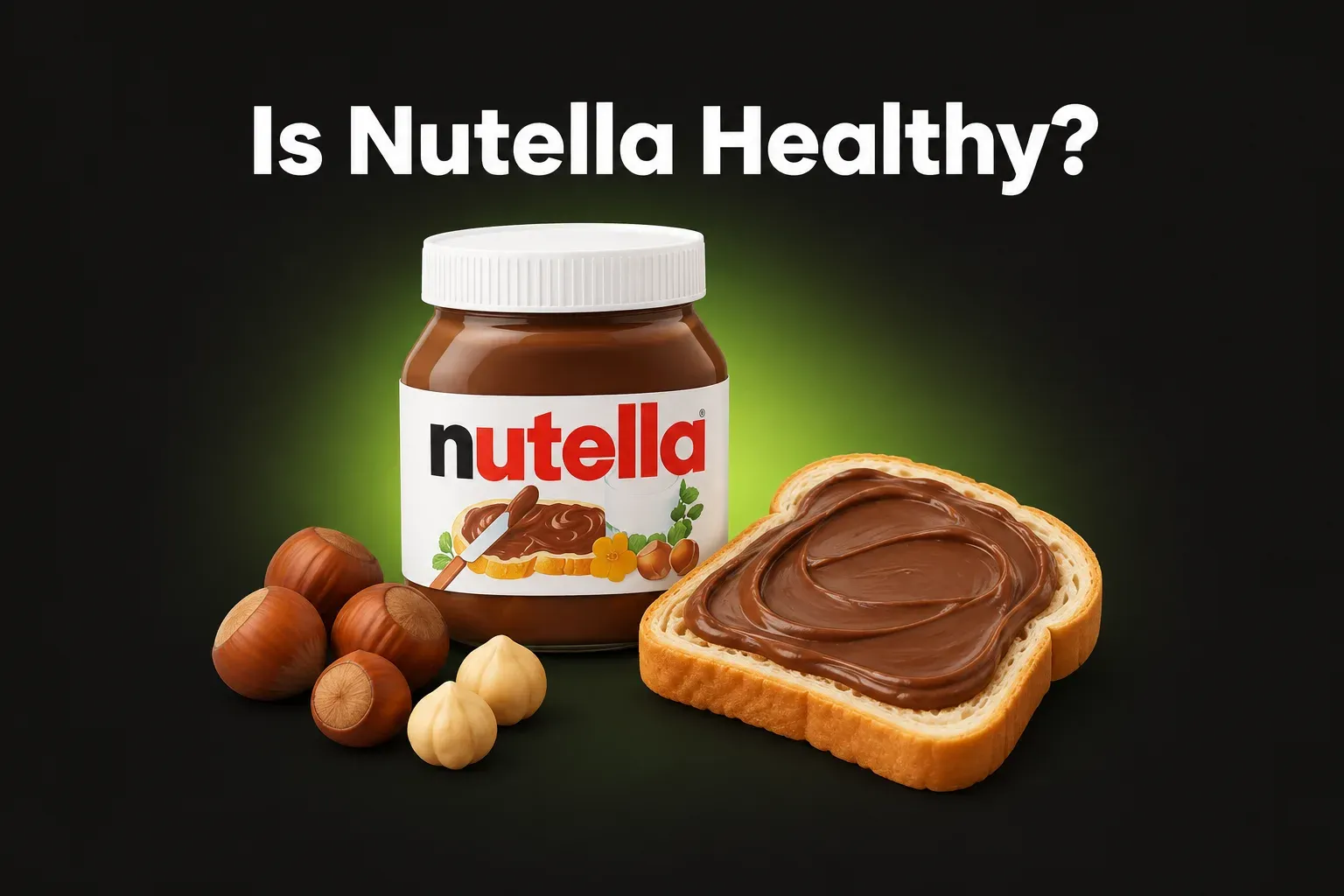
Nutella is the chocolate hazelnut spread almost everyone knows. It shows up on toast, crepes and pancakes. But is Nutella healthy, or is it closer to candy?
The short answer: Nutella is a treat, not a health food. Two tablespoons have 200 calories and 21 g of sugar – about 5 teaspoons. Sugar is the first ingredient, and palm oil is the second. Hazelnuts come third. A thin layer now and then is fine for most people. But as a daily breakfast, it adds a lot of sugar and little protein. Plain peanut or almond butter is a much better everyday spread.
Nutella ingredients: what’s in a jar
The US jar of Nutella Hazelnut Spread with Cocoa has seven ingredients. Here they are in label order:
- Sugar – the main ingredient. It makes the spread sweet and is more than half of the jar.
- Palm oil – a plant oil that stays soft at room temperature. It keeps the spread smooth so it doesn’t separate. Read more about palm oil.
- Hazelnuts – the nuts that give Nutella its nutty taste.
- Skim milk – milk with most of the fat removed, dried into a powder. It adds a creamy, milky taste.
- Cocoa – the chocolate part. Ferrero says it uses fat-reduced cocoa, which has some of its natural fat taken out.
- Lecithin – an emulsifier made from soy. It helps the oil and the solids stay mixed. Read more in our guide to soy lecithin.
- Vanillin – an artificial flavor that tastes like vanilla. It’s made in a factory, not taken from vanilla beans. See natural vs artificial flavors.
Source: ingredient list on the Nutella US product page. The FAQ on that page says the milk is skim milk powder and the lecithin comes from soy. Open Food Facts shows the same list for the 13 oz jar. An older label photo there also lists whey, with cocoa before milk. We follow Ferrero’s current US label. Labels change, so check your jar.
Here is the US label for Nutella Hazelnut Spread with Cocoa, per 2 tablespoons:
| Per 2 tbsp (37 g) | Amount |
|---|---|
| Calories | 200 |
| Total fat | 11 g |
| Saturated fat | 4 g (20% of the Daily Value) |
| Total sugars | 21 g |
| Added sugars | 19 g |
| Protein | 2 g |
| Sodium | 15 mg |
Source: Nutella US and Open Food Facts.
Ingredients are listed from most to least by weight. So the jar has more sugar than anything else. In fact, more than half of Nutella is sugar – about 57 g in every 100 g (Open Food Facts).
How many hazelnuts? The US label doesn’t give a percentage. Ferrero’s US FAQ page lists 13% hazelnuts (Nutella US FAQ). If that’s right, 2 tablespoons hold about 5 g of hazelnuts. That’s less than one-fifth of a 1 oz (28 g) handful.
The sugar problem
The American Heart Association suggests a daily limit for added sugar. It’s about 25 g for women and 36 g for men (Johnson et al., Circulation, 2009). For children, it’s 25 g or less, and none at all for kids under 2 (Vos et al., Circulation, 2017).
One serving of Nutella has 19 g of added sugar. That’s about three-quarters of a child’s daily limit. And most people don’t measure. A thick layer on two slices of toast can easily be more than 2 tablespoons.
Why does it matter? One large US study followed about 11,700 adults for nearly 15 years. People who got 25% or more of their calories from added sugar were nearly three times as likely to die of heart disease. That was compared with people who got less than 10% (Yang et al., JAMA Internal Medicine, 2014). This kind of study shows a link, not proof of cause. But it fits with many other studies on sugar and health.
The “healthy breakfast” lawsuit
In 2011, the mother of a 4-year-old sued Ferrero USA, the company that makes Nutella. Her lawsuit said the ads showed Nutella as a healthy breakfast for kids. She said she was shocked to learn it was “the next best thing to a candy bar.”
In 2012, Ferrero USA agreed to settle. It set aside $3 million for buyers (FoodNavigator, 2012). Here is what changed:
- Buyers could claim $4 per jar, up to $20.
- The back label had said “An example of a tasty yet balanced breakfast.” It was changed to “Turn a balanced breakfast into a tasty one.”
- Ferrero agreed to stop running the TV ads named in the lawsuit.
- Ferrero said it would add calories, saturated fat, sodium and sugar per serving to the front of the jar.
The new wording is more honest. Nutella can sit next to a balanced breakfast. It isn’t one on its own.
Palm oil: the second ingredient
Palm oil is popular in spreads for two reasons. It has almost no taste, and it stays semi-solid at room temperature. That keeps the spread from separating like natural nut butters do. Ferrero says all its palm oil is RSPO certified as segregated. RSPO is a group that certifies more sustainable palm oil. “Segregated” means the oil is kept apart from regular palm oil all the way from the farm. The company also says it processes the oil at controlled temperatures (Nutella US).
Still, palm oil raises two health questions.
1. Saturated fat and cholesterol. Palm oil is about half saturated fat. A review pooled clinical trials in people. Palm oil raised LDL cholesterol (the “bad” kind) more than oils low in saturated fat, like olive or sunflower oil (Sun et al., Journal of Nutrition, 2015). High LDL is a main cause of heart attacks.
2. Substances formed during refining. Refined oils are heated to remove smells. This forms glycidyl esters (fats linked to a substance called glycidol). In 2016, the European Food Safety Authority (EFSA) looked at these substances. Palm oil and palm fat had the highest levels of all oils and fats. In the body, the esters release glycidol. EFSA said glycidol can damage DNA and cause cancer, so it could not set a safe level (EFSA, 2016).
EFSA is a regulator. But independent labs, including animal studies, point the same way:
- Rats and mice. In a US government study, rats got 37.5 or 75 mg of glycidol per kg of body weight. Mice got 25 or 50 mg/kg. They got it 5 days a week for 2 years. Both had more tumors in many organs as the dose went up (Irwin et al., Journal of Applied Toxicology, 1996).
- From fat to glycidol. Rats got either glycidyl esters or pure glycidol by mouth, in matching doses. Their bodies freed the glycidol from the esters. Both groups ended up with about the same amount in their blood (Appel et al., Archives of Toxicology, 2013).
- In people. Eleven healthy adults ate about 36 g of store-bought palm fat a day for four weeks. The fat was high in glycidyl esters. Markers of glycidol in their blood went up about three times (Abraham et al., Archives of Toxicology, 2019). This shows people absorb it. It doesn’t show that anyone got sick.
Why do rodent studies matter? Rats and mice share most of our genes and body processes. And testing a possible cancer risk on people would put their health at risk. The doses in these animal studies were far higher than what you get from food. Proof of harm in humans is missing. But several labs see the same signal. So it makes sense to limit refined palm fat as a precaution.
There’s also a 2021 mouse study on palmitic acid, the main fat in palm oil. A diet rich in it made mouth and skin cancers spread more in mice (Pascual et al., Nature, 2021). This hasn’t been shown in people. Read more in our full guide to palm oil.
Nutella vs peanut butter, almond butter and other spreads
Here is how Nutella compares with other spreads sold in the US, per 2 tablespoons:
| Spread (2 tbsp) | Calories | Sugar (added) | Sat fat | Protein | Main sweetener and fat |
|---|---|---|---|---|---|
| Nutella (37 g) | 200 | 21 g (19 g) | 4 g | 2 g | Sugar, palm oil |
| Nutella Peanut (37 g) | 200 | 14 g (13 g) | 4 g | 5 g | Sugar, palm oil |
| Nocciolata Organic (34 g) | 190 | 18 g (not listed) | 2 g | 3 g | Cane sugar, sunflower oil |
| Justin’s Chocolate Hazelnut & Almond Butter (32 g) | 200 | 8 g (8 g) | 3 g | 4 g | Cane sugar, palm oil |
| ChocZero Milk Cocoa Hazelnut Spread (37 g) | 160 | 1 g (0 g) | 4 g | 2 g | Monk fruit, palm oil |
| Jif Creamy Peanut Butter (33 g) | 190 | 3 g (2 g) | 3.5 g | 7 g | Sugar, hydrogenated oils |
| Skippy Creamy Peanut Butter (32 g) | 190 | 3 g (2 g) | 3 g | 7 g | Sugar, hydrogenated oil |
| Smucker’s Natural Creamy Peanut Butter (32 g) | 190 | 2 g (0 g) | 3 g | 8 g | None – just peanuts and salt |
| Justin’s Classic Almond Butter (32 g) | 220 | 1 g (0 g) | 3 g | 6 g | No sugar, palm oil |
Sources: Nutella US (Nutella, Nutella Peanut). Justin’s: Justin’s (almond butter). ChocZero: ChocZero. Smucker’s: USDA FoodData Central. Nocciolata, Jif, Skippy: Open Food Facts (Nocciolata, Jif, Skippy). Labels change, so check your jar.
What stands out:
- Calories are about the same. Most spreads have 190–220 calories per 2 tablespoons. Nuts and oil are rich in calories either way. So swapping spreads won’t cut calories much. It changes what those calories bring.
- Sugar is the big gap. Nutella has about 7 times the sugar of Jif or Skippy and 10 times that of natural peanut butter.
- Protein: peanut butter has 3–4 times the protein of Nutella. Protein helps you feel full longer.
- Nocciolata uses sunflower oil instead of palm oil and has less saturated fat. But it still has 18 g of sugar. It’s a better-sourced treat, not a low-sugar one.
- Justin’s chocolate hazelnut butter is made mostly of nuts, so it has less than half the sugar of Nutella.
- ChocZero has almost no sugar. It uses corn fiber and monk fruit instead. One serving has 21 g of fiber. That much can cause gas if you’re not used to it.
Nuts themselves are good for you. A review of 61 trials found that eating tree nuts daily lowered total and LDL cholesterol. The effect was stronger at 2 oz (60 g) a day or more (Del Gobbo et al., American Journal of Clinical Nutrition, 2015). A spread made mostly of nuts gives you more of that benefit. Nutella gives you only a little.
For more choices, see our guide to the healthiest peanut butter and how many calories are in peanut butter. For a ready-made PB&J, see are Uncrustables healthy?
How to enjoy Nutella as a treat
You don’t have to give it up. Just treat it like dessert, not like a nut butter.
- Measure it. One level tablespoon has about 100 calories and 10–11 g of sugar. That’s half the label serving.
- Spread it thin. A thin layer on one slice of toast is a treat. Two thick slices are a sugar bomb.
- Pair it with protein and fiber. Use whole grain bread and add banana or strawberries. Or have it with Greek yogurt or eggs on the side.
- Mix it. Stir 1 teaspoon of Nutella into plain peanut butter. You keep the chocolate taste with much less sugar.
- Keep it off the daily menu. Make it a weekend thing, not an everyday breakfast. For better morning ideas, see our healthy breakfast ideas.
Nutella is also an ultra-processed food. It’s made mostly from refined sugar and refined oil, plus an emulsifier and an artificial flavor. If you want chocolate with less sugar, a square of dark chocolate is a better pick. Read is dark chocolate healthy?
See what’s really in your Nutella. With NutriSmart, you photograph the label or scan the barcode. The app lists the sweeteners, preservatives and colors, explains the risks of each one and gives the product a health score out of 100. It also tells you right away if a spread is ultra-processed and which ingredients make it so. Set an alert for palm oil. The app then warns you whenever a product you scan contains it.Get the app free
The bottom line
Nutella is a tasty treat, but it isn’t healthy. Two tablespoons have 200 calories, 21 g of sugar and only 2 g of protein. Sugar and palm oil make up most of the jar, and hazelnuts are only about 13%. Palm oil raises LDL cholesterol, and refining it forms substances that cause cancer in rodents at high doses. After the 2012 settlement, Ferrero changed its “balanced breakfast” label and ads. Enjoy a thin layer now and then. For everyday use, pick natural peanut or almond butter, or a nut-based chocolate spread with less sugar.
FAQ
Is Nutella healthy?
Not really – it's a dessert spread. Two tablespoons have 200 calories and 21 g of sugar, and sugar is the first ingredient. A thin layer now and then is fine, but it's not a healthy breakfast.
What are the ingredients in Nutella?
US Nutella has seven ingredients: sugar, palm oil, hazelnuts, skim milk, cocoa, soy lecithin and vanillin (an artificial flavor). They're listed from most to least by weight, so sugar makes up the biggest part of the jar.
How much sugar is in Nutella?
Two tablespoons (37 g) have 21 g of sugar, and 19 g of that is added sugar. That's about 5 teaspoons. More than half of the jar is sugar by weight.
Is Nutella better than peanut butter?
No. Plain peanut butter has about 2–3 g of sugar and 7–8 g of protein per 2 tablespoons. Nutella has 21 g of sugar and only 2 g of protein, for about the same calories.
Is the palm oil in Nutella bad for you?
Palm oil is about half saturated fat, and it raises LDL cholesterol more than oils like olive or sunflower. Refining it can also form glycidyl esters. In the body, these release glycidol, which causes cancer in rodents at high doses. The amount in one serving is small, so it's one more reason to keep Nutella as a treat.
Can kids eat Nutella for breakfast?
Now and then, as a thin layer on whole grain toast. But one 2-tablespoon serving has 19 g of added sugar. The American Heart Association suggests kids get no more than 25 g of added sugar a day.
What is a healthier alternative to Nutella?
Plain peanut or almond butter has almost no sugar and more protein. If you want the chocolate taste, Justin's Chocolate Hazelnut & Almond Butter has 8 g of sugar per 2 tablespoons. ChocZero has 1 g. It uses fiber and monk fruit instead of sugar.