Are Uncrustables Healthy? Sugar, Ingredients and Swaps
Are Uncrustables healthy? Calories, added sugar, protein and ingredients in each version, how they compare to a homemade PB&J, and better swaps.
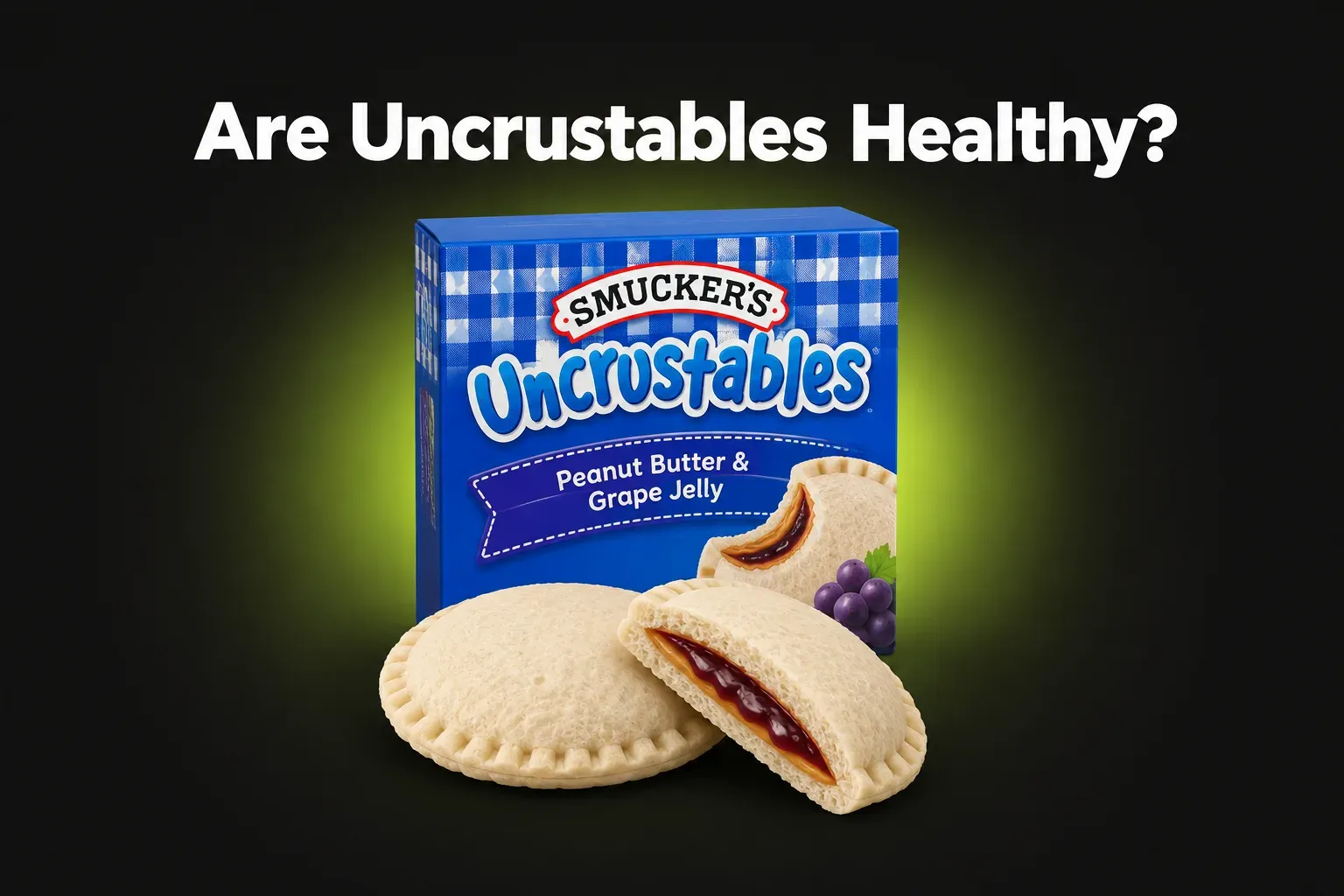
Smucker’s Uncrustables are the round, sealed, crustless sandwiches in the freezer aisle. Kids love them. Parents love that they thaw in under an hour. But are Uncrustables healthy?
The short answer: they’re fine as a snack now and then, but they’re not a health food. The classic peanut butter and grape jelly sandwich has 210 calories, 8 g of added sugar, only 6 g of protein and 2 g of fiber. The bread is made mostly from white flour. Some versions also contain emulsifiers with open questions. Current labels have no high-fructose corn syrup. A homemade PB&J on whole wheat bread gives you more protein and fiber for the same calories.
What’s in an Uncrustable
Here is the label of the classic 2 oz (58 g) Peanut Butter & Grape Jelly sandwich:
| Per sandwich (2 oz / 58 g) | Amount |
|---|---|
| Calories | 210 |
| Total fat | 9 g |
| Saturated fat | 2 g |
| Sodium | 220 mg |
| Carbohydrates | 28 g |
| Fiber | 2 g |
| Total sugars | 10 g |
| Added sugars | 8 g |
| Protein | 6 g |
Source: Smucker’s Uncrustables, checked November 2026.
What does this mean?
- 210 calories is snack size, not lunch size. Most kids and adults will be hungry again soon.
- 8 g of added sugar is about 2 teaspoons. Most of it comes from the jelly.
- 6 g of protein is low. It’s about what you get from one egg.
- 2 g of fiber is low too, because the bread is mostly refined flour.
The ingredients, explained
Ingredients (classic grape):
- Bread: enriched unbleached flour, water, unbleached whole wheat flour, sugar, yeast, soybean oil, and 2% or less of wheat gluten, salt, guar gum and a dough conditioner (enzymes, ascorbic acid, calcium peroxide).
- Peanut butter: peanuts, sugar, and 2% or less of fully hydrogenated vegetable oils (rapeseed and soybean), salt and molasses.
- Grape jelly: sugar, grape juice, and 2% or less of pectin, citric acid and potassium sorbate (a preservative).
Source: Smucker’s Uncrustables.
Here’s what stands out:
- White flour comes first. “Enriched flour” is white flour with a few vitamins and iron added back. Whole wheat flour is only the third ingredient.
- The dough conditioner helps the bread stay soft. Ascorbic acid is vitamin C. Calcium peroxide makes the dough stronger.
- Sugar shows up three times – in the bread, the peanut butter and the jelly. In the jelly, sugar comes before grape juice.
- Fully hydrogenated oils keep the peanut butter from separating. This is not the same as partially hydrogenated oil, the main source of artificial trans fat. The label lists 0 g of trans fat.
Is there high-fructose corn syrup?
No. The current labels list plain sugar, not high-fructose corn syrup. Several product pages, like the peanut butter sandwich, even say “No High Fructose Corn Syrup.” To your body, though, sugar and HFCS act in a very similar way. What matters most is how much you eat.
Mono- and diglycerides: which versions have them?
Uncrustables got an improved recipe that lets the bread stay soft in the fridge for up to five days. The current classic label no longer lists mono- and diglycerides. But older boxes did. One older grape box listed them in both the bread and the peanut butter, plus DATEM (Open Food Facts).
Here’s the surprise. Many versions on wheat bread still use them. The honey, reduced sugar, 2.7 oz wheat and 12 g protein sandwiches list mono- and diglycerides in the bread. Their bread also has DATEM and sodium stearoyl lactylate (SSL). The reduced sugar and protein versions add mono- and diglycerides to the peanut butter too. All of these are emulsifiers – additives that help oil and water mix and keep bread soft (Smucker’s Uncrustables).
The FDA calls mono- and diglycerides “generally recognized as safe”. But independent research has found warning signs:
- Cancer. French researchers tracked 92,000 adults for almost 7 years. They used detailed food diaries. People who ate the most mono- and diglycerides had a 15% higher risk of cancer overall. Their risk of breast cancer was 24% higher. Their risk of prostate cancer was 46% higher (Sellem et al., PLOS Medicine, 2024).
- Heart disease. In the same group of over 95,000 adults, people who ate more of these emulsifiers had a higher risk of heart disease and stroke (Sellem et al., BMJ, 2023).
- Mice. In a Taiwanese lab, mice ate food that was 5.5% mono- and diglycerides for 14 weeks. That’s a large dose. The mice handled blood fat and blood sugar worse. Their gut bacteria changed. Bacteria also tended to move into the gut’s protective mucus layer. Signs of inflammation went up (Panyod et al., Communications Biology, 2024).
Why do mouse studies matter? Rodents share most of our genes and body processes. And testing a possible cancer risk on people would put their health at risk. Still, proof in humans is missing. The studies in people show links, not cause. But several labs see similar signals. So it makes sense to limit emulsifiers as a precaution. Read more in our guide to mono- and diglycerides.
Uncrustables flavors compared
| Sandwich | Weight | Calories | Added sugar | Protein | Fiber |
|---|---|---|---|---|---|
| PB & Grape Jelly (classic) | 2 oz (58 g) | 210 | 8 g | 6 g | 2 g |
| PB & Strawberry Jam | 2 oz (58 g) | 210 | 9 g | 6 g | 2 g |
| PB & Honey Spread | 2 oz (58 g) | 200 | 9 g | 6 g | 3 g |
| Chocolate Flavored Hazelnut | 1.8 oz (52 g) | 210 | 10 g | 4 g | 1 g |
| Peanut Butter (no jelly) | 1.8 oz (52 g) | 210 | 2 g | 8 g | 2 g |
| Reduced Sugar PB & Grape on Wheat | 2 oz (58 g) | 190 | 5 g | 6 g | 3 g |
| PB & Grape Jelly on Wheat, single serve | 2.7 oz (76 g) | 300 | 12 g | 9 g | 4 g |
| Bright-Eyed Berry (12 g protein) | 2.8 oz (80 g) | 320 | 10 g | 12 g | 4 g |
| Up & Apple (12 g protein) | 2.8 oz (80 g) | 320 | 11 g | 12 g | 4 g |
| SunWise SunButter & Strawberry (nut-free) | 2.8 oz (79 g) | 310 | 12 g | 9 g | 4 g |
Uncrustables: product pages on smuckersuncrustables.com (classic grape, strawberry, honey, hazelnut, peanut butter, reduced sugar, single serve on wheat, Bright-Eyed Berry, Up & Apple), checked November 2026. SunWise: Open Food Facts.
What stands out:
- The Peanut Butter sandwich is the best pick on sugar. It has just 2 g of added sugar and the most protein of the small sizes.
- The Chocolate Flavored Hazelnut sandwich is the weakest of the small sizes. It has the most added sugar and the least protein and fiber. Its filling starts with sugar, then palm and canola oil (Smucker’s Uncrustables) – much like Nutella.
- The 12 g protein versions are bigger sandwiches, not just higher in protein. They have about 50% more calories than the classic.
- Store brands are close. Kroger’s crustless PB&J has 230 calories, 9 g of total sugar and 8 g of protein in 2.2 oz (62 g) (Open Food Facts).
At Target in November 2026, a 4-pack cost $3.99, or about $1 a sandwich. The 8-packs of the 12 g protein versions cost $9.99, or about $1.25 each (Target). Prices vary by store.
Uncrustables vs homemade PB&J
A homemade PB&J is about twice as big as an Uncrustable. So it’s fair to compare half a homemade sandwich too. Ours uses 2 slices of whole wheat bread, 2 tablespoons of peanut butter and 1 tablespoon of grape jelly.
| Sandwich | Weight | Calories | Protein | Fiber | Sugar | Sodium |
|---|---|---|---|---|---|---|
| Uncrustables classic grape | 2 oz (58 g) | 210 | 6 g | 2 g | 10 g | 220 mg |
| Homemade PB&J, whole | 4.1 oz (117 g) | about 410 | 15 g | 6 g | 17 g | 430 mg |
| Homemade PB&J, half | 2 oz (59 g) | about 205 | 7.5 g | 3 g | 8 g | 215 mg |
Uncrustables: Smucker’s Uncrustables. Homemade: our math from USDA FoodData Central values for whole wheat bread, peanut butter and jelly. Sugar is total sugar.
Weight for weight, the homemade version wins. It has more protein, more fiber and a bit less sugar. And you choose what goes in. You can use 100% whole wheat bread, peanut butter made from just peanuts and salt, and less jelly.
Are Uncrustables OK for kids’ lunches?
One Uncrustable in a lunch box is not a problem. But a few things are worth knowing.
Added sugar adds up. The American Heart Association suggests kids aged 2 to 18 eat no more than 25 g of added sugar a day. Children under 2 should have none (Vos et al., Circulation, 2017). One classic Uncrustable uses 8 g – about a third of that. Add a juice box or flavored yogurt, and a child can pass the limit by lunchtime.
It’s an ultra-processed food. Factory-made foods with additives like dough conditioners count as ultra-processed. In a US government study, 20 adults lived in a clinic for 4 weeks. For two weeks, they ate ultra-processed meals. For two weeks, they ate unprocessed meals. On the ultra-processed diet, they ate about 500 more calories a day and gained about 2 lb (0.9 kg) (Hall et al., Cell Metabolism, 2019). One sandwich isn’t the issue. A diet full of these foods is.
Make it a full lunch. On its own, 210 calories and 6 g of protein won’t carry most kids to the end of the school day. Pair it with:
- fruit, like apple slices or grapes
- crunchy veggies, like carrots or snap peas
- milk, plain yogurt or a cheese stick for protein
Other tips:
- Nut-free school? Uncrustables contain peanuts. SunWise makes a crustless sandwich with sunflower seed butter instead. Check the label against your school’s rules.
- Thaw it right. Smucker’s says to thaw it for 30 to 60 minutes at room temperature, or keep it in the fridge for up to five days. Eat it within 8 hours once it’s out. Don’t microwave it, and don’t refreeze it.
Better swaps
- Make your own and freeze them. Build PB&Js on 100% whole wheat bread, wrap them and freeze them. They thaw by lunch, just like Uncrustables.
- Pick a simple peanut butter. Look for just peanuts and salt. Our guide to the healthiest peanut butter explains what to check.
- Use less jelly. Try a thin layer, sliced banana, mashed berries or a low-sugar fruit spread.
- If you buy Uncrustables, pick the Peanut Butter sandwich for the least sugar. Pick a 12 g protein version when you need a small meal, not a snack.
- Need more protein? See our list of high-protein snacks.
Whole grains and nuts are worth the effort. A large review of 45 studies looked at whole grains. For every three servings a day, the risk of dying during the studies was 17% lower (Aune et al., BMJ, 2016). In US studies of over 118,000 adults, people who ate nuts seven or more times a week were 20% less likely to die during follow-up than people who ate none (Bao et al., New England Journal of Medicine, 2013). These show links, not proof. But they point the same way.
See what’s really in your Uncrustables. With NutriSmart, you photograph the label or scan the barcode. The app lists the sweeteners, preservatives and colors, explains the risks of each one and gives the product a health score out of 100. It also tells you right away if a sandwich is ultra-processed and which ingredients make it so. Set an alert for mono- and diglycerides, and the app warns you whenever a product you scan contains them.Get the app free
The bottom line
Uncrustables are a handy snack, but not a healthy one. The classic grape sandwich has 210 calories, 8 g of added sugar, only 6 g of protein and 2 g of fiber. The bread is mostly white flour. Today’s labels have no high-fructose corn syrup. But most versions on wheat bread, including the protein ones, still use mono- and diglycerides. Independent studies have found warning signs for this emulsifier. The Peanut Butter sandwich has the least sugar. A homemade PB&J on whole wheat bread beats them all on protein and fiber. If your kids love Uncrustables, keep them as an occasional treat and add fruit, veggies and milk to the lunch box.
FAQ
Are Uncrustables healthy?
They're an OK snack now and then, but not a health food. The classic grape sandwich has 210 calories, 8 g of added sugar and only 6 g of protein. Half of a homemade PB&J on whole wheat bread gives you more protein and fiber for the same calories.
How many calories are in an Uncrustable?
The classic 2 oz peanut butter and grape jelly sandwich has 210 calories. The reduced sugar wheat versions have 190. The 12 g protein versions weigh 2.8 oz and have 320 calories.
Do Uncrustables have high-fructose corn syrup?
Not today. Current labels list sugar in the bread, the peanut butter and the jelly. Several Uncrustables product pages say 'No High Fructose Corn Syrup.'
Are Uncrustables good for kids' lunches?
One sandwich is fine in a lunch box with fruit, veggies and milk. It has 8 g of added sugar – about a third of the 25 g daily limit the American Heart Association suggests for kids. The peanut butter only version has just 2 g.
Are the protein Uncrustables healthier?
They have 12 g of protein and 4 g of fiber, so they keep you full longer. But they also have 320 calories and 10–11 g of added sugar. They work better as a small meal than as a snack.
Which Uncrustable has the least sugar?
The Peanut Butter sandwich with no jelly has 4 g of total sugar and 2 g of added sugar. The reduced sugar wheat versions have 7 g of total sugar and 5 g added.