Is Liquid IV Good for You? Ingredients, Sugar and Salt
Is Liquid IV good for you? Its ingredients, sugar and sodium, the Sugar-Free version, when electrolytes help and how it compares to LMNT and Pedialyte.
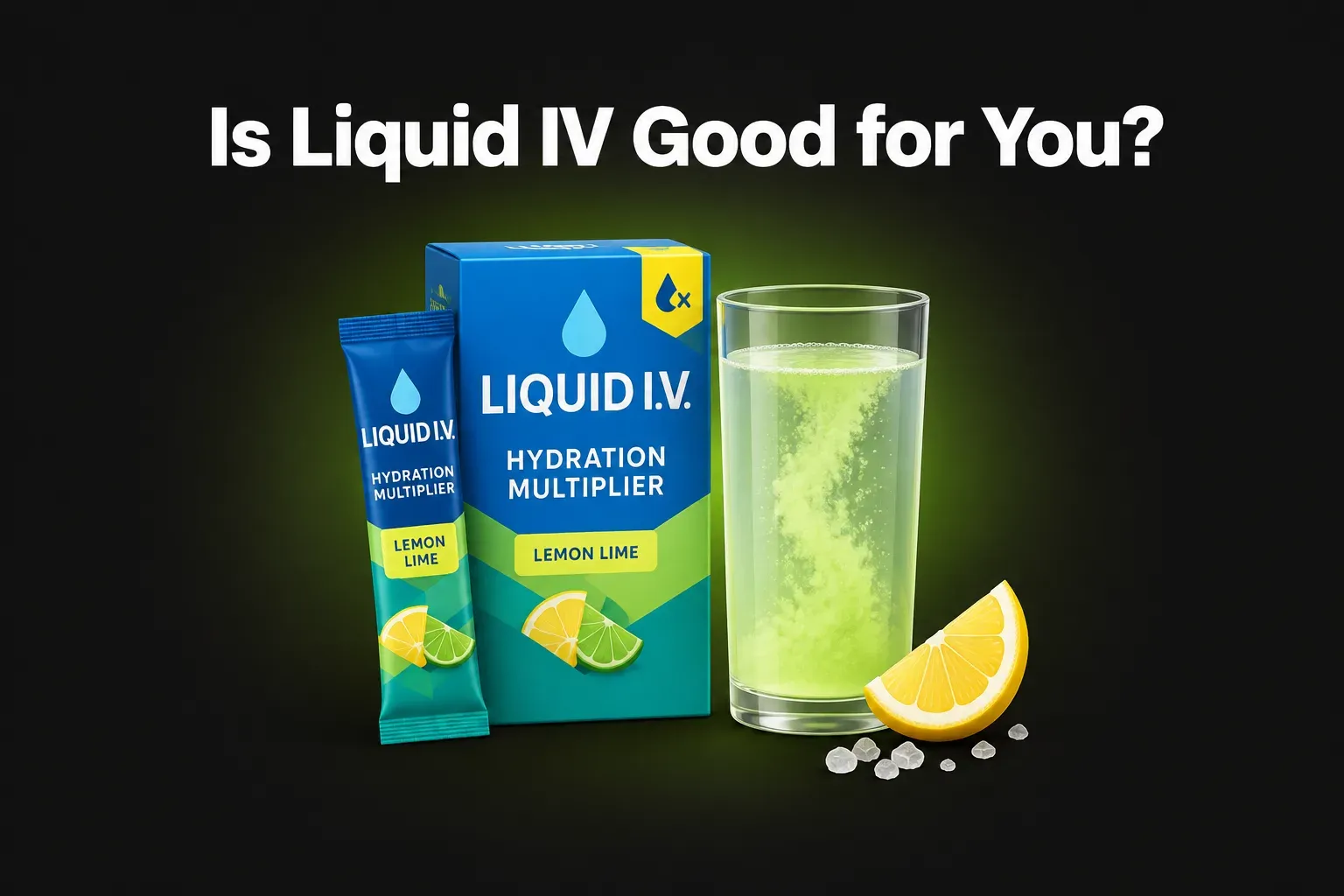
Liquid I.V. is a powder in a small stick. You pour it into a bottle of water and get a salty-sweet drink. The brand calls it a “Hydration Multiplier”, and many people drink it every day.
The short answer: Liquid I.V. is useful when you lose a lot of water and salt. That happens with long, sweaty exercise, hot days, vomiting or diarrhea. For a normal day at a desk, it’s not needed. One classic stick has 11 g of added sugar (almost 3 teaspoons). It also has 560 mg of sodium – about a quarter of the daily limit. The Sugar-Free version drops the sugar but keeps the salt. If you have high blood pressure, the sodium matters most.
Liquid I.V. ingredients: what’s in a stick
You mix one stick with 16 oz (473 ml) of water, says the brand’s FAQ. Here is one stick of each version (Lemon Lime):
| Per stick | Classic | Sugar Free |
|---|---|---|
| Calories | 50 | about 20 |
| Sugar | 11 g (all added) | 0 g |
| Allulose | 0 g | about 4 g |
| Sodium | 560 mg | about 500–530 mg |
| Potassium | 370 mg | 370 mg |
| Vitamins | C, B3, B5, B6, B12 | C, B3, B5, B6, B12 |
Labels from Open Food Facts: Classic and Sugar-Free. Sugar-Free sodium differs a little by retailer listing.
Classic Lemon Lime ingredients, in label order:
- Cane sugar – regular table sugar. It sweetens the drink. The brand says it also helps your gut take in water and salt.
- Dextrose – a simple sugar, the same as glucose. It adds sweetness and works with sodium to help you absorb water.
- Citric acid – the sour acid found in lemons and limes. It gives the drink its tart taste.
- Salt – plain table salt (sodium chloride). It is the main source of sodium.
- Potassium citrate – a salt made of potassium and citric acid. It adds the electrolyte potassium.
- Sodium citrate – a salt made of sodium and citric acid. It adds more sodium and softens the sour taste.
- Dipotassium phosphate – a potassium and phosphate salt. It adds more potassium.
- Silicon dioxide – a fine mineral powder (silica). It keeps the powder from clumping.
- Stevia leaf extract (rebaudioside A) – a sweetener from a plant, with no calories. It adds sweetness without more sugar.
- Natural flavors – flavor mixes from natural sources. The label doesn’t say what is in them.
- Vitamins C, B3, B5, B6 and B12 – added as ascorbic acid, niacinamide, calcium D-pantothenate, pyridoxine hydrochloride and cyanocobalamin. These are common vitamin forms used in supplements.
Sugar-Free Lemon Lime ingredients, in label order: allulose, citric acid, L-glutamine, L-alanine, potassium citrate, salt, natural flavors, sodium citrate, silicon dioxide, stevia leaf extract (rebaudioside A) and the same five vitamins. It has no cane sugar, dextrose or dipotassium phosphate. Allulose is a rare sugar with almost no calories. L-glutamine and L-alanine are amino acids (building blocks of protein).
Ingredients from the Liquid I.V. US site: Lemon Lime and Sugar-Free Lemon Lime, checked November 2026. Open Food Facts shows the same ingredients in the same order.
Electrolytes are salts like sodium and potassium. Your body uses them to keep the right amount of water in your cells. You lose them in sweat, vomit and diarrhea.
The sugar: 11 g per stick
The sugar in Liquid I.V. isn’t only there for taste. The brand says it helps your gut absorb water and salt. That part is real science. In your gut, sugar (glucose) and sodium are taken in together. Water follows them. This is how oral rehydration solutions (ORS) work. These are the drinks doctors use for diarrhea.
But Liquid I.V. is not the same as a medical ORS. The World Health Organization’s ORS has about 800 mg of sodium in 16 oz. It has about 6 g of glucose (CDC, 2003). Liquid I.V. has less sodium (560 mg) and almost twice the sugar (11 g).
11 g of added sugar is not a lot for one drink. A 20 oz bottle of Gatorade has 34 g. But it adds up if you drink two or three sticks a day. The American Heart Association suggests a limit for added sugar. It’s about 25 g a day for women and 36 g for men (Johnson et al., Circulation, 2009). Two sticks are almost the full limit for a woman.
Does it hydrate better than water?
The brand’s FAQ says one stick can give “the same hydration as drinking 2–3 bottles of water”. It doesn’t cite a study for that claim.
What research shows:
- Salt helps you keep water. One study gave 72 healthy men 1 liter (34 oz) of different drinks. After an ORS, they peed out less and kept more water than after plain water. A sports drink did no better than water (Maughan et al., American Journal of Clinical Nutrition, 2016).
- A study paid for by Liquid I.V. tested 20 active adults. One author worked for the company. The adults first lost water by exercising in the heat. Then they drank as much as they liked for 4 hours. A sugar-free drink with allulose and amino acids kept about 47% of the fluid. A sugar drink kept about 40%. Plain water kept about 25% (Rezaei et al., Nutrients, 2026).
So after heavy sweating, an electrolyte drink can help. But these studies are about people who lost water or drank a lot at once. On a normal day, your kidneys keep your salt and water in balance. Water and normal meals do the job.
When electrolytes help – and when water is enough
The American College of Sports Medicine studied drinking during exercise. It says drinks with electrolytes and carbs can work better than water in some cases (ACSM, 2007). This mostly means long or hard exercise, often in the heat. For shorter workouts, water is usually enough. Flavored waters like Propel add some salt with no sugar, but they use sweeteners – read is Propel healthy? Some athletes sip pickle juice for cramps, but a small shot won’t rehydrate you.
| Situation | Best choice |
|---|---|
| Desk work, normal day | Water |
| Gym or walk under 60 minutes | Water |
| Running, cycling or sports over 60–90 minutes | Electrolyte drink can help |
| Heavy sweating in the heat (work, hiking) | Electrolyte drink or water + salty snack |
| Vomiting or diarrhea | Oral rehydration solution |
| Hangover | Water + a meal |
When you’re sick: for vomiting or diarrhea, try a pharmacy ORS like Pedialyte or DripDrop. They are closer to what doctors use. The CDC says to avoid very sugary drinks during diarrhea. The sugar can make it worse (CDC, 2003). For a baby or small child with diarrhea, ask your doctor which drink to use. Liquid I.V.’s FAQ also says to ask a doctor before giving it to kids under 2.
Liquid I.V. Sugar-Free: allulose and stevia
The Sugar-Free version uses allulose and stevia. It also adds two amino acids (building blocks of protein): L-glutamine and L-alanine. They are meant to do the sugar’s job of helping your gut take in sodium and water.
Allulose is a rare sugar your body barely uses. It has almost no calories and doesn’t raise blood sugar. The FDA lets companies leave it out of “sugars” on the label. It is not approved in the EU. Europe’s food safety agency said the data it got wasn’t enough to confirm it’s safe (EFSA, 2025).
- Stomach upset: a study in young adults raised the dose step by step. Up to about 0.4 g per kg of body weight at once, there were no serious stomach problems. At 0.5 g per kg, people got bad diarrhea (Han et al., Nutrients, 2018). For a 154 lb (70 kg) adult, 0.4 g per kg is about 28 g. One stick has about 4 g, far below that.
- In rats: rats ate food with 3% allulose for up to 18 months. That’s about 1.3 g per kg of body weight a day. They had no signs of poisoning. Their liver and kidneys were a bit heavier, but looked normal (Yagi and Matsuo, Journal of Clinical Biochemistry and Nutrition, 2009).
- In pregnant rats: very high doses, up to 5 g per kg a day, caused no birth defects. This study was run by a company that makes allulose (Sa et al., Toxicology Reports, 2022).
Stevia (rebaudioside A) is in both versions, even the classic one. One study gave sweeteners to 120 adults for two weeks. Stevia changed some of their gut bacteria. It didn’t clearly hurt their blood sugar (Suez et al., Cell, 2022). Another study gave young rats low doses of the same stevia in their water. After 9 weeks, their gut bacteria had changed too. Two genes linked to dopamine were also less active in the brain’s reward area. Dopamine is the brain’s “feel good” chemical (Nettleton et al., Nutrients, 2019).
Why animal studies matter: rats share most of our genes and body processes. Testing years of high doses on people would put their health at risk. So animal studies are often the first warning sign. Here, two labs saw gut bacteria change – one in people and one in rats. Long-term proof in humans is missing. Using stevia drinks in moderation, not all day, is a sensible precaution. Read more in our guide to artificial sweeteners.
Sodium and high blood pressure
The US Dietary Guidelines say adults should eat less than 2,300 mg of sodium a day. Most Americans already eat about 3,400 mg (FDA). One stick of Liquid I.V. adds 560 mg. Two sticks add over 1,100 mg – about half the daily limit.
Cutting sodium works fast. A study followed 213 adults aged 50 to 75. They spent one week on a high-salt diet and one week on a very low-salt diet. After the first week, the low-salt group had a top blood pressure number (systolic) about 8 points lower than the high-salt group. Blood pressure dropped on the low-salt diet in about 3 in 4 people. This was true with or without high blood pressure (Gupta et al., JAMA, 2023).
If you have high blood pressure, heart failure or kidney disease, ask your doctor before drinking any electrolyte mix. People with kidney disease may also need to limit potassium. If you don’t sweat much, the salt in Liquid I.V. is salt you don’t need. For potassium from food instead, see our list of foods high in potassium.
Liquid I.V. vs other electrolyte drinks
| Drink (serving) | Calories | Sugar | Sodium | Potassium | Sweetener |
|---|---|---|---|---|---|
| Liquid I.V. classic (1 stick) | 50 | 11 g | 560 mg | 370 mg | Cane sugar, dextrose, stevia |
| Liquid I.V. Sugar-Free (1 stick) | about 20 | 0 g | about 500–530 mg | 370 mg | Allulose, stevia |
| LMNT (1 stick) | 5–10 | 0 g | 1,000 mg | 200 mg | Stevia |
| Gatorade Thirst Quencher (20 oz) | 140 | 34 g | 270 mg | about 80 mg | Sugar, dextrose |
| Pedialyte Classic, flavored (12 oz) | 25 | 5 g | 390 mg | 280 mg | Dextrose, sucralose, acesulfame K |
| Nuun Sport (1 tablet) | 15 | 1 g | 300 mg | 150 mg | Dextrose, stevia |
| DripDrop (1 stick) | 35 | 7 g | 330 mg | 180 mg | Sugar, fructose, dextrose, sucralose |
Labels from Open Food Facts (Liquid I.V., Liquid I.V. Sugar-Free, LMNT, Gatorade, Nuun, DripDrop); Pedialyte from Abbott. Each powder is mixed with a different amount of water. Recipes change – check the box.
What stands out:
- LMNT has the most salt by far – almost twice Liquid I.V. That can suit very heavy sweaters. It’s not a good fit for people watching their blood pressure.
- Gatorade has the most sugar and the least salt. Read more in is Gatorade healthy.
- Pedialyte and DripDrop are made for when you’re sick. They have less sugar than Gatorade but use sucralose. Read about sucralose and acesulfame K.
- Nuun has just 1 g of sugar and less salt than Liquid I.V. It’s enough for most normal workouts.
Check your electrolyte mix in seconds. With NutriSmart, you photograph the label or scan the barcode. The app lists the sweeteners, preservatives and colors, explains the risks of each one and gives the product a health score out of 100. You can set an alert for sucralose or stevia. The app then warns you every time a product you scan contains it. It also tells you right away if a product is ultra-processed and which ingredients make it so.Get the app free
You can also read whether Vitamin Water is healthy, whether coconut water is healthy and how to choose the healthiest energy drink. Comparing sports drinks? See is BodyArmor good for you?
The bottom line
Liquid I.V. is a useful tool, not a daily health drink. It helps when you lose a lot of water and salt. Think long, sweaty exercise, hot days or a stomach bug. For a normal day, water hydrates you just as well. One classic stick has 11 g of added sugar and 560 mg of sodium. The Sugar-Free version cuts the sugar but keeps the salt. If you have high blood pressure or kidney problems, talk to your doctor first. For everyone else, save it for the days you really sweat.
FAQ
Is Liquid IV good for you?
It can help when you lose a lot of water and salt – after a long, sweaty workout, on a hot day or when you're sick. For everyday drinking, water is enough. One stick has 11 g of added sugar and 560 mg of sodium, about a quarter of the daily sodium limit.
What are the ingredients in Liquid I.V.?
The classic Lemon Lime stick has cane sugar, dextrose, citric acid, salt, potassium citrate, sodium citrate, dipotassium phosphate, silicon dioxide, stevia, natural flavors and five vitamins (C, B3, B5, B6 and B12). The Sugar-Free version has no cane sugar, dextrose or dipotassium phosphate. It uses allulose instead, keeps the stevia and adds two amino acids, L-glutamine and L-alanine.
How much sugar is in Liquid IV?
The classic Hydration Multiplier has 11 g of sugar per stick, all of it added sugar. That's almost 3 teaspoons. The Sugar-Free version has 0 g of sugar and is sweetened with allulose and stevia.
Is it OK to drink Liquid IV every day?
One stick a day is fine for most healthy adults who sweat a lot. If you sit most of the day, you don't need the extra salt and sugar. Two sticks add over 1,100 mg of sodium, about half the daily limit.
Is Liquid IV bad if you have high blood pressure?
It can be a problem. One stick has 560 mg of sodium, and eating less sodium lowers blood pressure in most people. If you have high blood pressure, heart or kidney disease, ask your doctor before using it.
Is Liquid IV Sugar-Free healthy?
It has no sugar, about 20 calories and almost the same salt as the classic stick. It uses allulose and stevia, which look safe in small amounts, but long-term human studies are missing. It's a better daily choice than the sugar version, but water is still the best.
Does Liquid IV hydrate better than water?
After heavy sweating, drinks with salt help the body keep more of the water you drink. A study paid for by the company found a sugar-free allulose drink kept more fluid than water after exercise in the heat. For normal days, plain water hydrates you just fine.