Is BodyArmor Good for You? Sugar, Electrolytes and More
Is Body Armor good for you? Sugar, potassium, vitamins and stevia in BodyArmor, plus Lyte, Zero and Flash I.V. compared with Gatorade, Propel and water.
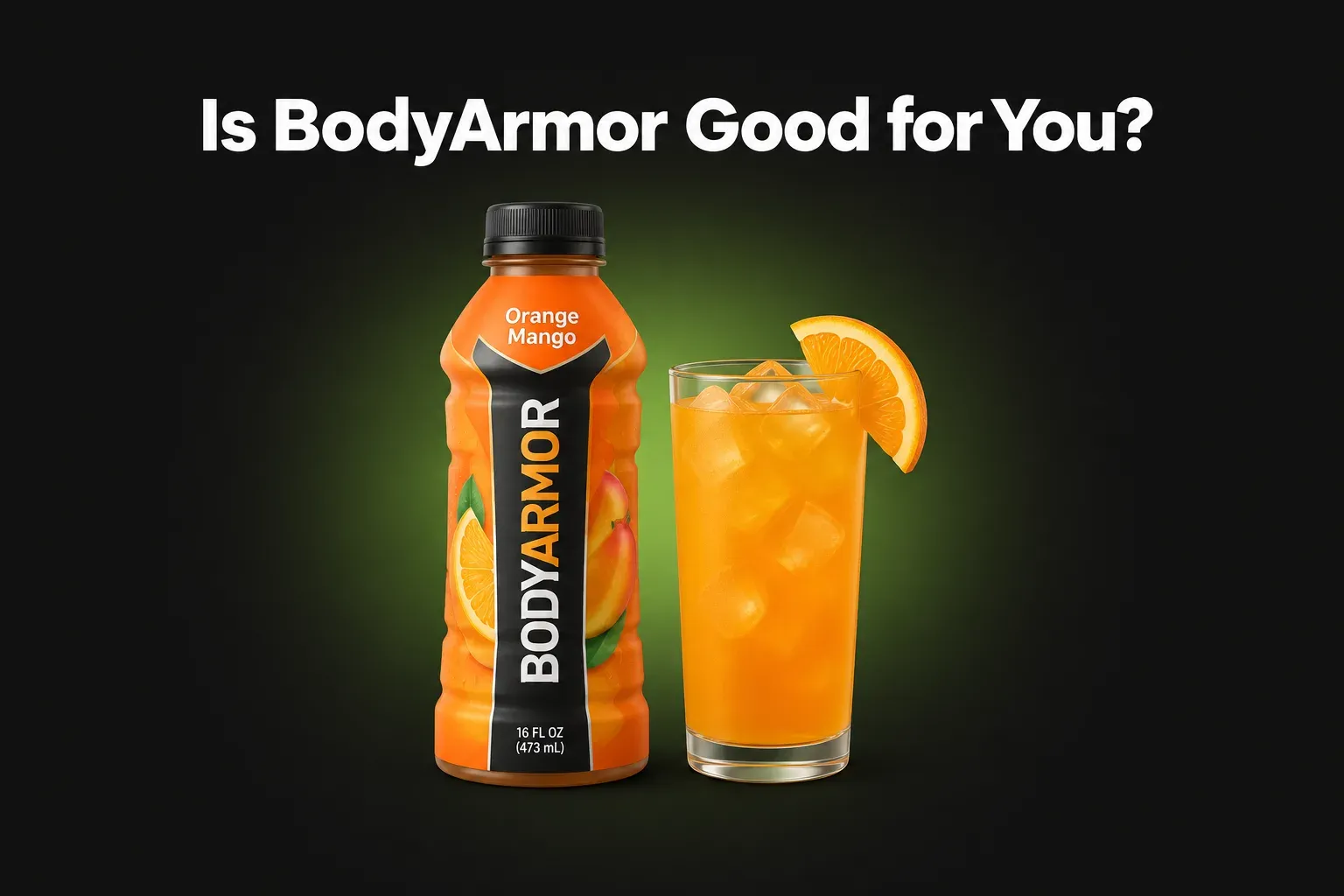
BODYARMOR is the sports drink with the bold, colorful bottles you see at games and gyms. It promises coconut water, electrolytes and vitamins. But is BodyArmor good for you?
The short answer: BodyArmor is better than soda, but for everyday drinking it’s still a sugary drink. A 16 oz bottle has 110 calories and 25 g of sugar (23 g added). It’s packed with potassium and vitamins, but it has very little sodium – the salt you lose most in sweat. It makes sense during long, sweaty exercise. For most people on most days, water is better. The low-sugar Lyte and Zero Sugar versions are better everyday picks, but they use sweeteners.
What’s in a bottle of BodyArmor?
BodyArmor’s main drink used to be called SuperDrink. Today the brand just calls it BodyArmor Sports Drink. Here’s what’s in the 16 oz (473 ml) Orange Mango bottle, roughly in label order. After filtered water, the list goes:
- Cane sugar – this is where almost all the calories come from.
- Coconut water concentrate – coconut water with most of the water taken out. It comes after the sugar.
- Citric acid – a sour acid, also found in lemons.
- Electrolyte blend – dipotassium phosphate (a potassium salt), magnesium oxide and zinc oxide. Electrolytes are minerals that help your body hold on to water.
- Vitamins – C, B5, B3, E, B6, A, folic acid (B9) and B12.
- Gum arabic and ester gum – they keep the flavor oils mixed in the drink.
- Natural flavors – the label doesn’t say what they are.
- Steviol glycosides – a sweetener made from the stevia plant.
- Beta-carotene and beta-apo-8’-carotenal – orange colors. Beta-carotene is the color of carrots. The second one is a similar color made in a lab.
Some flavors, like Fruit Punch, use “fruit and vegetable juice (color)” instead. BodyArmor says its drinks have no artificial dyes.
Here is the nutrition label of the same bottle, with the share of the Daily Value (DV):
| Per bottle (16 oz) | Amount | % Daily Value |
|---|---|---|
| Calories | 110 | – |
| Total sugar | 25 g | – |
| Added sugar | 23 g | 46% |
| Sodium | 30 mg | about 1% |
| Potassium | 680 mg | 14% |
| Vitamin C | 63 mg | 70% |
| Niacin (B3), B6, B12, B5, folate | – | 100% each |
| Zinc | 7.7 mg | 70% |
| Vitamins A and E | – | 33% each |
Source: BodyArmor US website, checked November 2026. % Daily Value worked out by us from the FDA Daily Values. Fruit Punch and Blackout Berry list 25 mg of sodium.
The BodyArmor line-up compared
BodyArmor now sells several drinks. They differ a lot in sugar, salt and caffeine.
| Drink (per bottle) | Calories | Sugar (added) | Sodium | Potassium | Sweetener |
|---|---|---|---|---|---|
| Sports Drink (16 oz) | 110 | 25 g (23 g) | 25–30 mg | 680 mg | Cane sugar + stevia |
| Sports Drink (20 oz) | 130 | 31 g (29 g) | 35 mg | 860 mg | Cane sugar + stevia |
| Sports Drink (28 oz) | 190 | 43–44 g (41 g) | 50 mg | 1,200 mg | Cane sugar + stevia |
| Lyte (16 oz) | 15–20 | 1–2 g (0 g) | 25–30 mg | 680 mg | Allulose + stevia* |
| Zero Sugar (16 oz) | 10 | 0 g | 0–10 mg | 620 mg | Stevia |
| Flash I.V. (20 oz) | 80 | 15–16 g (15 g) | 530 mg | 720 mg | Cane sugar + stevia |
| Flash I.V. Zero Sugar (20 oz) | 15–20 | 0 g | 530 mg | 720–730 mg | Allulose + stevia |
| FIT, sparkling (1 can) | 5 | 0 g | 140 mg | 150 mg | Stevia |
| SportWater (1 bottle) | 0 | 0 g | 0 mg | not listed | None |
Source: BodyArmor US product pages for Sports Drink, Lyte, Zero Sugar, Flash I.V., FIT and SportWater, checked November 2026. Values differ a little by flavor. 28 oz values are for the whole bottle. *Lyte Tropical Coconut lists erythritol and stevia instead. Older 16 oz Sports Drink bottles on Open Food Facts list 120 calories and 29 g of sugar, with no stevia.
What stands out:
- The regular drink got a bit less sugary. Older 16 oz bottles had about 29 g of sugar. The new recipe has 25 g and adds stevia to keep it sweet. Check the label on your bottle.
- Lyte and Zero Sugar cut the sugar to almost nothing. Most Lyte flavors use allulose, a rare sugar with very few calories, plus stevia. Zero Sugar uses only stevia.
- Flash I.V. has by far the most salt: 530 mg of sodium per bottle. Two zero-sugar flavors (Pineapple Passionfruit and Watermelon Punch) also have 95 mg of caffeine – about as much as a cup of coffee. Two Flash I.V. drink-mix sticks (Blue Raspberry and Dragonfruit Berry) have 95 mg too.
- FIT is a newer sparkling drink in a can. It has no sugar, but it has 60 mg of caffeine per 12 oz, plus green tea extract and two preservatives (sodium benzoate and potassium sorbate).
- SportWater is alkaline water (pH 9 or higher) with small amounts of added minerals. Read more in our guide to alkaline water.
Sugar: the biggest catch
23 g of added sugar is almost 6 teaspoons. The American Heart Association advises no more than 25 g of added sugar a day for women and 36 g for men (Johnson et al., Circulation, 2009). So one 16 oz bottle uses up almost all of a woman’s daily limit. A 20 oz bottle (29 g added) goes over it.
If you drink one at your desk, the sugar is just extra calories. A daily 16 oz bottle adds 770 calories a week. Use our calorie calculator to see how much energy you really need.
BodyArmor is also acidic, because it contains citric acid. In a lab test, researchers soaked tooth enamel in many sports and energy drinks. Sports drinks wore away less enamel than energy drinks, but they still wore some away (Jain et al., General Dentistry, 2012). Sipping slowly for hours gives the acid more time to work on your teeth.
Lots of potassium, very little sodium
BodyArmor’s big selling point is potassium. A 16 oz bottle has 680 mg – more than a medium banana, which has about 420 mg (USDA). But it has only 30 mg of sodium.
That’s the opposite of what you lose in sweat. Sweat has about 10–90 mmol of sodium per liter (about 230–2,070 mg). It has only 2–8 mmol of potassium (about 80–310 mg) (Baker, Temperature, 2019). So when you sweat a lot, sodium is the salt you need to replace most. A 20 oz Gatorade has 270 mg of sodium. Even ounce for ounce, that’s about seven times more than BodyArmor. If you need salt during a long workout, Flash I.V. fits better.
Extra potassium is fine for most healthy people. But people with kidney disease or on some blood pressure pills may need to limit potassium. If that’s you, ask your doctor before drinking BodyArmor often.
Do the added vitamins help?
One bottle gives you a full day’s worth of five B vitamins, plus 70% of the daily vitamin C and zinc. But most people who eat a varied diet already get enough of these.
B vitamins help your body turn food into energy. They don’t give you energy on their own. If you also take a multivitamin, you may be doubling up. The vitamins are a bonus, but they don’t make a sugary drink healthy.
Stevia, allulose and erythritol
Almost every BodyArmor drink now contains stevia. Even the regular sugared version has it. Most Lyte flavors and the zero-sugar Flash I.V. flavors also use allulose. US regulators allow both. But independent studies have raised some questions about stevia:
- In people: 120 healthy adults took sweetener packets for 2 weeks. The doses were below the official safe limits. Each sweetener, stevia included, changed their gut bacteria. Stevia didn’t clearly harm their blood sugar, but saccharin and sucralose did (Suez et al., Cell, 2022).
- In rats: young male rats got a low dose of stevia (rebaudioside A) in their water for 9 weeks. The dose was 2–3 mg per kg of body weight a day. Their gut bacteria changed. Two signals linked to dopamine were also lower in the brain’s reward area. Dopamine is a “feel good” brain chemical. Stevia didn’t change their weight or blood sugar (Nettleton et al., Nutrients, 2019).
Why animal studies matter: rats share most of our genes and body processes. Testing years of high doses on people would put their health at risk. So animal studies are often the first warning sign. Here, two labs saw gut bacteria change – one in people and one in rats. Long-term proof of harm in humans is missing. Still, drinking stevia drinks in moderation, not all day, is a sensible precaution.
What about erythritol? It’s a sugar alcohol used in many zero-sugar drinks. Most BodyArmor labels don’t list it, but Lyte Tropical Coconut does. A 2023 study looked at about 4,000 people who were being checked for heart disease. Those with the highest erythritol blood levels had about twice the risk of heart attack, stroke or death over 3 years. This shows a link, not proof that erythritol caused it. In 8 healthy people, one erythritol drink kept blood levels high for more than 2 days (Witkowski et al., Nature Medicine, 2023). If you want to avoid erythritol, read the label of each Lyte flavor.
Does BodyArmor hydrate better than water?
Not really. Here is what studies show:
- At rest, sports drinks don’t beat water. In the UK, 72 healthy men drank 1 liter (34 oz) of different drinks. A sports drink kept no more water in the body than plain water. Only a much saltier rehydration drink and milk did better (Maughan et al., American Journal of Clinical Nutrition, 2016).
- After exercise, coconut water works about as well as water. 12 trained men ran on a treadmill for an hour. They lost about 2% of their body weight in sweat. Then they drank water, coconut water or a sports drink. All the drinks rehydrated them about the same. Coconut water caused more bloating and stomach upset (Kalman et al., Journal of the International Society of Sports Nutrition, 2012).
- During long, hard exercise, electrolytes and carbs can help. The American College of Sports Medicine says these drinks can work better than water “under certain circumstances” (ACSM, Medicine & Science in Sports & Exercise, 2007). This mostly means workouts over an hour, often in the heat.
So the coconut water in BodyArmor doesn’t give it special powers. Read more about coconut water.
BodyArmor vs Gatorade, Propel, Liquid I.V. and water
| Drink (serving) | Calories | Sugar | Sodium | Potassium | Sweetener |
|---|---|---|---|---|---|
| BodyArmor Sports Drink (16 oz) | 110 | 25 g | 30 mg | 680 mg | Cane sugar + stevia |
| BodyArmor Lyte (16 oz) | 20 | 2 g | 30 mg | 680 mg | Allulose + stevia |
| BodyArmor Flash I.V. (20 oz) | 80 | 15 g | 530 mg | 720 mg | Cane sugar + stevia |
| Gatorade Thirst Quencher (20 oz) | 140 | 34 g | 270 mg | 80 mg | Sugar + dextrose |
| Gatorade Zero (20 oz) | 5 | 0 g | 270 mg | 80 mg | Sucralose + acesulfame K |
| Propel Fitness Water (20 oz) | 0 | 0 g | 270 mg | 70 mg | Sucralose + acesulfame K |
| Liquid I.V. (1 stick) | 50 | 11 g | 560 mg | 370 mg | Cane sugar, dextrose, stevia |
| Vita Coco coconut water (1 bottle) | 90 | 22 g | 120 mg | 940 mg | Fructose (less than 1%) |
| Plain water | 0 | 0 g | 0 mg | 0 mg | None |
BodyArmor: BodyArmor US (Lyte: Peach Mango; Flash I.V.: Strawberry Kiwi). Others: labels on Open Food Facts for Gatorade, Gatorade Zero, Propel, Liquid I.V. and Vita Coco (label serving 480 ml). Checked November 2026.
What stands out:
- Per ounce, BodyArmor and Gatorade have about the same sugar. BodyArmor just comes in a smaller bottle.
- BodyArmor has no artificial dyes. Many Gatorade flavors use dyes like Yellow 5. That’s a real plus for BodyArmor. Read more: is Gatorade healthy?
- Gatorade, Propel and Liquid I.V. have far more sodium than regular BodyArmor. For heavy sweating, that matters more than potassium. See our guides to Propel and Liquid I.V..
- Lyte and Zero Sugar skip sucralose and acesulfame K, which Gatorade Zero and Propel use. They use stevia instead.
Is BodyArmor good for kids?
BodyArmor is popular at youth games. But kids rarely need it.
- Doctors’ advice: the American Academy of Pediatrics (AAP) says drinking sugary sports drinks often can raise kids’ risk of becoming overweight. It also says caffeine has no place in kids’ diets (Committee on Nutrition, Pediatrics, 2011). A 2018 study in the same journal repeats the AAP’s advice: normal teen activity doesn’t call for sports drinks (Cordrey et al., Pediatrics, 2018). For most kids, water is enough.
- Sugar limit: the American Heart Association says children should have no more than 25 g of added sugar a day (Vos et al., Circulation, 2017). One 16 oz bottle has 23 g.
- Weight gain: a US study followed about 7,500 kids aged 9 to 16. Each daily serving of sports drinks was linked to a bigger gain in BMI (body mass index, a weight-for-height measure) over 2–3 years (Field et al., Obesity, 2014).
Keep the caffeine drinks away from kids. The caffeinated Flash I.V. flavors have 95 mg per bottle, and FIT has 60 mg per 12 oz.
Better for kids: water during practice, and fruit like orange slices or watermelon at halftime.
When BodyArmor makes sense
BodyArmor can fit if you:
- Exercise hard for more than an hour, especially in the heat.
- Want a sports drink without artificial dyes.
Water is better if you:
- Are sitting at a desk or doing a short workout.
- Are watching your weight or blood sugar.
- Have kidney disease or take medicine that raises potassium. Ask your doctor first.
Tips: pick Lyte or Zero Sugar for everyday sipping. If you sweat a lot, add a salty snack or pick a drink with more sodium.
See what’s really in your BodyArmor. With NutriSmart, you photograph the label or scan the barcode. The app lists the sweeteners, preservatives and colors, explains the risks of each one and gives the product a health score out of 100. It also tells you right away if a drink is ultra-processed and which ingredients make it so. Set an alert for stevia or allulose, and the app warns you whenever a product you scan contains it.Get the app free
The bottom line
BodyArmor is a cleaner sports drink than many. It has no artificial dyes, some coconut water and lots of potassium and vitamins. But the regular version is still a sugary drink, with 23 g of added sugar in 16 oz. It also has very little sodium, the salt you lose most in sweat. It makes sense during long, hard exercise. For everyday drinking, water is best, and Lyte or Zero Sugar beats the regular bottle. Keep it as an occasional drink for kids, and skip the caffeine drinks for them.
FAQ
Is BodyArmor good for you?
It's better than soda, but it's still a sugary drink. A 16 oz bottle has 110 calories and 25 g of sugar, and 23 g of that is added. It makes sense after long, sweaty exercise. On most days, water is the better choice.
How much sugar is in BodyArmor?
The current 16 oz bottle has 25 g of sugar, and 23 g of it is added – almost 6 teaspoons. The 20 oz bottle has 31 g. Older 16 oz bottles still in some stores list about 29 g.
Is BodyArmor better than Gatorade?
It has more potassium, more vitamins and no artificial dyes. But it has far less sodium – about 30 mg per 16 oz, while a 20 oz Gatorade has 270 mg. Sodium is the main salt you lose in sweat. Per ounce, both have about the same sugar.
Is BodyArmor Lyte healthy?
Lyte has 15–20 calories and 1–2 g of sugar per 16 oz bottle. Most flavors are sweetened with allulose and stevia, but Tropical Coconut lists erythritol. It's a better everyday pick than the regular drink, but plain water is still best.
Is BodyArmor good for kids?
Not as an everyday drink. Children's doctors say most kids don't need sports drinks. One 16 oz bottle has 23 g of added sugar, close to the 25 g daily limit for kids. Water and milk are better choices.
Does BodyArmor hydrate better than water?
No. In studies, sports drinks and coconut water hydrate about as well as plain water. Extra salt and sugar help mainly during long, hard exercise, especially in the heat.