Is Vitamin Water Healthy? Sugar, Vitamins and Better Drinks
Is vitamin water healthy? How much sugar is in a bottle, whether you need the added vitamins, what's in Vitaminwater Zero, and better drinks to pick.
Vitaminwater has a healthy-sounding name and bright colors. The bottles say words like “power-c”, “focus” and “essential”. Many people pick it over soda. But is vitamin water healthy? It mostly depends on which bottle you grab.
The short answer: regular Vitaminwater is not a health drink. A 20 oz bottle has 100 calories and 26–27 g of added sugar – almost 7 teaspoons. The added vitamins are mostly B vitamins most people already get from food. Vitaminwater Zero has no sugar and is a better pick. But plain water is still the healthiest choice. Add fruit if you want flavor.
What’s in a bottle of Vitaminwater
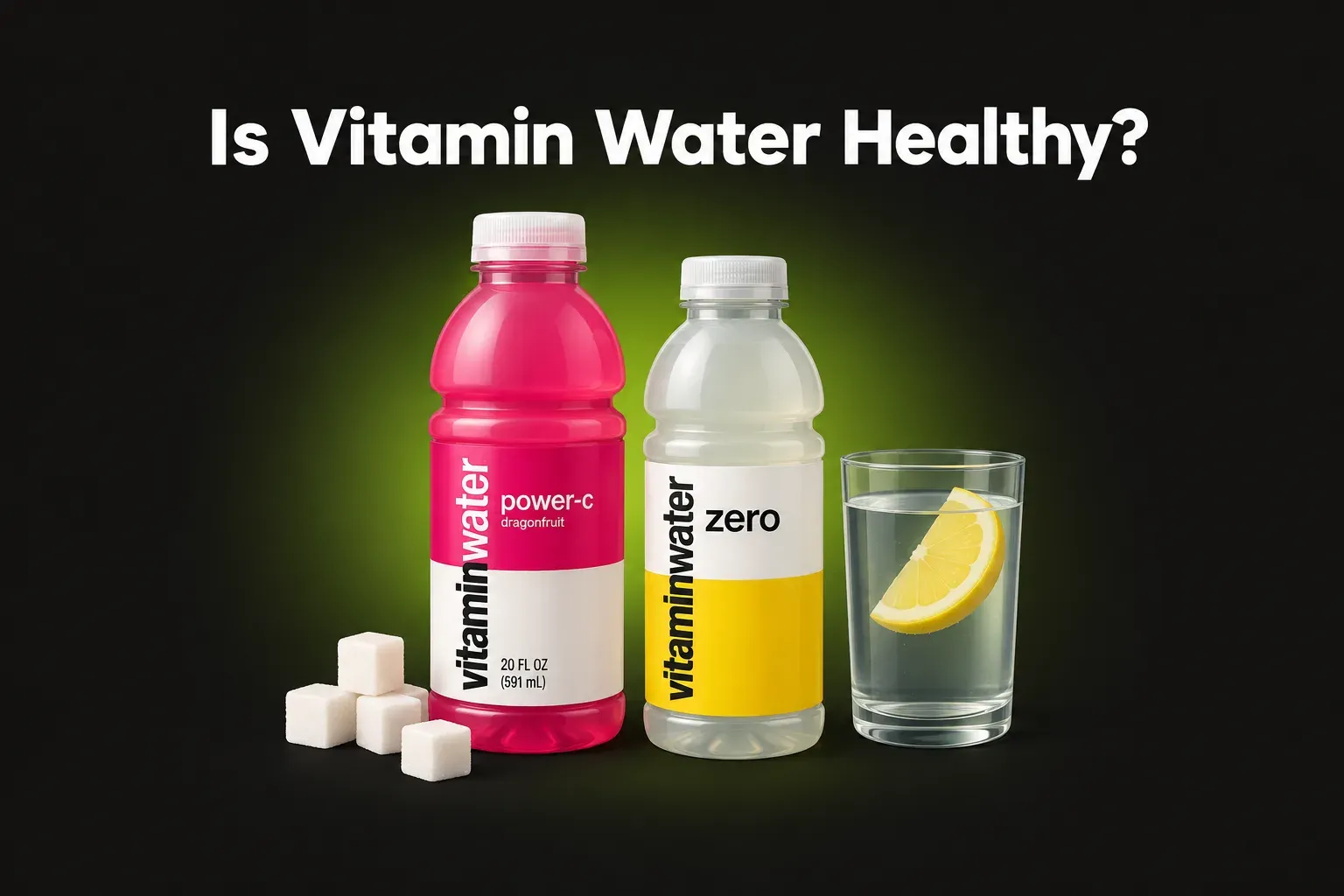
Vitaminwater is made by Coca-Cola. Here’s the label of Power-C Dragonfruit, a typical flavor, from the brand’s US site:
Ingredients: reverse osmosis water (filtered water), crystalline fructose, and less than 0.5% of: vitamins C, B5, B6, B12, electrolytes (calcium and magnesium lactates, potassium phosphate), taurine, zinc, chromium, cane sugar, citric acid, natural flavors and vegetable juices for color.
Crystalline fructose is almost pure fructose – the sugar found in fruit, but usually made from corn. It’s the second ingredient, right after water. Other flavors are very similar:
| Flavor | Size | Calories | Sugar | Extras |
|---|---|---|---|---|
| Power-C Dragonfruit | 20 oz | 100 | 27 g | Vitamin C 200% DV |
| XXX Açaí Blueberry Pomegranate | 20 oz | 100 | 26 g | Selenium, manganese |
| Essential Orange-Orange | 20 oz | 100 | 27 g | Vitamin C 250% DV |
| Refresh Tropical Mango | 20 oz | 100 | 27 g | 240 mg sodium |
| Focus Kiwi-Strawberry | 20 oz | 100 | 26 g | 6 mg caffeine |
| Energy Tropical Citrus | 20 oz | 100 | 27 g | 60 mg caffeine |
| Elevate Blue Raspberry Limeade | 16.9 oz | 90 | 22 g | Zinc, selenium |
Labels from Coca-Cola’s Vitaminwater product page, checked November 2026. DV = daily value.
All the sugar in these bottles is added sugar. Older labels showed about 120 calories and 32 g of sugar per 20 oz, so today’s recipe has a bit less. The label says “electrolytes” (salts like sodium and potassium). Still, most flavors have 0 mg of sodium.
The real problem: sugar you drink
The American Heart Association says women should have no more than 25 g of added sugar a day. For men, the limit is about 36 g (Johnson et al., Circulation, 2009). One bottle has 26–27 g. For women, that uses up the whole day.
Sugar in drinks doesn’t fill you up. In one study, 15 adults got 450 extra calories a day for four weeks. One time it came from soda, the other time from jelly beans. With jelly beans, people ate less at meals to make up for it. With soda, they didn’t – and they gained weight (DiMeglio & Mattes, International Journal of Obesity, 2000).
Sugary drinks are linked to diabetes. A review pooled 8 studies with over 300,000 people. Some had 1–2 sugary drinks a day. Others rarely had any. The first group had a 26% higher risk of type 2 diabetes (Malik et al., Diabetes Care, 2010). The authors named “vitamin water drinks” as one of the sugary drinks. These studies show a link, not proof.
Fructose may be harder on the liver. In one trial, overweight adults drank fructose-sweetened or glucose-sweetened drinks for 10 weeks. Those drinks gave a quarter of their daily calories – much more than one bottle. Both groups gained similar weight. But only the fructose group gained more belly fat around the organs. They also became less sensitive to insulin (the hormone that moves sugar from the blood into cells) (Stanhope et al., Journal of Clinical Investigation, 2009).
If you’re watching your weight, one bottle a day adds about 700 calories a week. Use our calorie calculator to see how that fits your daily needs.
Do you need the added vitamins?
Most flavors add vitamins C, B3, B5, B6 and B12. Some also add vitamins A and E, zinc or selenium. But most people already get enough B vitamins.
A large US survey looked at what over 16,000 people ate and took as supplements. Only about 8% fell short on vitamin B6. Fewer than 6% fell short on niacin (B3) and B12 (Fulgoni et al., Journal of Nutrition, 2011). The same survey found that 10% of people already got too much niacin. Fortified foods and supplements add up.
Vitamin C is different: about 25% of people got less than they need. But you can get it from food. A 5 oz (140 g) orange has about 75 mg of vitamin C. It also has fiber and no added sugar (USDA FoodData Central).
Vitamin pills don’t seem to prevent disease either. The US Preventive Services Task Force reviewed the research on vitamin pills. It found not enough proof that multivitamins prevent heart disease or cancer (USPSTF, JAMA, 2022). There’s no reason to think a sugary drink with vitamins does better.
The lawsuit over “vitamins + water = all you need”
In 2009, the Center for Science in the Public Interest (CSPI), a consumer group, sued Coca-Cola. The lawsuit said Vitaminwater labels were misleading. It pointed to lines like “vitamins + water = all you need” (CSPI).
Coca-Cola asked the court to throw out the case. In 2010, a federal judge in New York let most of it go ahead. He said the name could mislead shoppers. It names vitamins and water, but not sugar.
The case ended in a settlement in 2016. Coca-Cola agreed to stop using those health claims. It also agreed to show sweeteners and calories more clearly on the front of the bottle.
Is Vitaminwater Zero healthy?
Vitaminwater Zero Sugar has 0 calories and 0 g of sugar. It has the same kinds of added vitamins. According to the brand’s site, all six US flavors are sweetened with stevia and monk fruit extract. Until 2023, it used erythritol and stevia. Older bottles or other countries may still list erythritol, so check the label.
What does research say about these sweeteners?
- Blood sugar. In a study, 30 healthy men had drinks sweetened with monk fruit, stevia, aspartame or sugar. Monk fruit and stevia didn’t spike blood sugar like sugar did. But the men ate more at lunch. The calories they saved were made up later (Tey et al., International Journal of Obesity, 2017).
- Gut and brain in rats. Young rats drank a low dose of stevia (2–3 mg per kg of body weight a day) for 9 weeks. Their weight and blood sugar didn’t change. But their gut bacteria changed. Brain signals linked to reward changed too (Nettleton et al., Nutrients, 2019). Rat studies matter because rats share most of our genes and body processes. Testing this on people could put their health at risk. Still, proof in people is missing.
- Erythritol and the heart. Researchers followed about 4,000 people being checked for heart problems. Those with the most erythritol in their blood had more heart attacks, strokes and deaths over 3 years. In lab and mouse tests, erythritol made blood clot more easily. Then 8 healthy people had a drink with 30 g of erythritol. For over 2 days, their blood levels stayed above the amount linked to faster clotting in lab tests (Witkowski et al., Nature Medicine, 2023). This shows a link, not proof. Still, it’s a reason to check older bottles.
- Weight. The World Health Organization advises not to use sweeteners for weight control. Long-term studies don’t show they help (WHO, 2023).
Vitaminwater Zero is a fine swap for regular Vitaminwater or soda. But it’s not something you need every day.
Vitaminwater vs other drinks
| Drink | Size | Calories | Sugar | Sodium | Sweetened with |
|---|---|---|---|---|---|
| Vitaminwater (most flavors) | 20 oz | 100 | 26–27 g | 0 mg | Fructose + cane sugar |
| Vitaminwater Zero Sugar (most flavors) | 20 oz | 0 | 0 g | 0 mg | Stevia + monk fruit |
| Gatorade Thirst Quencher | 20 oz | 140 | 34 g | 270 mg | Sugar + dextrose |
| Gatorade Zero | 20 oz | 5 | 0 g | 270 mg | Sucralose + acesulfame K |
| Propel Fitness Water | 20 oz | 0 | 0 g | 270 mg | Sucralose + acesulfame K |
| Liquid I.V. (1 stick in 16 oz water) | 16 oz | 50 | 11 g | 520–560 mg | Cane sugar, dextrose, stevia |
| Coconut water, unsweetened | 16.9 oz | 90 | 20 g | 130 mg | None (natural sugar) |
| Coca-Cola | 20 oz | 240 | 65 g | 75 mg | High fructose corn syrup |
| Water + 1 oz (28 g) lemon | 20 oz | 8 | under 1 g | 0 mg | None |
Vitaminwater and Coca-Cola from Coca-Cola’s US site (Vitaminwater, Coca-Cola); Gatorade, Gatorade Zero, Propel and Liquid I.V. from Open Food Facts (Gatorade Zero, Propel, Liquid I.V. Lemon Lime and other flavor); Liquid I.V. mixed as the brand directs, with sodium varying by flavor; coconut water and lemon from USDA FoodData Central, scaled to the size shown.
A few things stand out:
- Vitaminwater vs soda: it has less than half the sugar of a 20 oz Coke. That’s better, but still a lot.
- Vitaminwater vs Gatorade: Gatorade has more sugar, but it also has salt. That makes it more useful during long, sweaty exercise. Read more in is Gatorade healthy?
- Propel and Gatorade Zero replace salt with no sugar, but use sucralose and acesulfame K. Read more in is Propel healthy?
- Liquid I.V. has the most salt per serving and less sugar than Vitaminwater. Read more in is Liquid IV good for you?
- Crystal Light has almost no calories and no sugar, but most flavors use aspartame and dyes. Read more in is Crystal Light bad for you?
- Coconut water has natural sugar and lots of potassium – about 825 mg in 16.9 oz. Read more in is coconut water healthy?
- Water with fruit wins for everyday drinking.
Want a fizzy drink instead? See our guide to the healthiest soda. You can also read whether Olipop is healthy and whether LaCroix is bad for you. BodyArmor is another Coca-Cola drink with added vitamins – see is BodyArmor good for you?
Who should skip regular Vitaminwater
- Kids. The American Heart Association suggests kids have no more than 25 g of added sugar a day (Vos et al., Circulation, 2017). One bottle goes over that. The Energy flavor also has 60 mg of caffeine.
- People with diabetes or prediabetes. 27 g of sugar in one drink is a lot of carbs at once.
- Anyone trying to lose weight. Drink calories add up without filling you up.
- People who already take a multivitamin. You may be doubling up on niacin and B6.
Better ways to get flavor and vitamins
- Add fruit to water. Lemon, lime, orange slices, berries or cucumber.
- Try sparkling water if you miss the fizz.
- Eat your vitamin C. An orange, a kiwi or a handful of strawberries.
- Choose the Zero version if you love the taste.
- For long, sweaty workouts, pick a drink with sodium, or have water with a salty snack.
See what’s really in your Vitaminwater. With NutriSmart, you photograph the label or scan the barcode. The app lists the sweeteners, preservatives and colors, explains the risks of each one and gives the product a health score out of 100. It also tells you right away if a drink is ultra-processed and which ingredients make it so. Set an alert for an ingredient like crystalline fructose, and the app warns you whenever a product you scan contains it.Get the app free
The bottom line
Regular Vitaminwater is closer to a soft drink than to water. A 20 oz bottle has 100 calories and 26–27 g of added sugar. Most people already get its B vitamins from food. It’s better than soda, but not a health drink. Vitaminwater Zero cuts the sugar and is a fine swap now and then. For everyday drinking, water with a slice of lemon or orange is the best choice.
FAQ
Is vitamin water healthy?
Not really. A 20 oz bottle of regular Vitaminwater has 100 calories and 26–27 g of added sugar – almost 7 teaspoons. Most people already get the added B vitamins from food. Plain water or Vitaminwater Zero is a better everyday choice.
How much sugar is in Vitaminwater?
A 20 oz bottle of regular Vitaminwater has 26–27 g of sugar, all of it added. It comes from crystalline fructose and cane sugar. That's more than the American Heart Association's daily limit for women (25 g).
Is Vitaminwater Zero healthy?
It's better than regular Vitaminwater: 0 calories and 0 g of sugar. The current US recipe is sweetened with stevia and monk fruit. Older bottles used erythritol, so check the label. It's fine now and then, but plain water is still the best drink.
Is Vitaminwater better than soda?
It has less sugar: about 27 g per 20 oz bottle, compared with 65 g in a 20 oz Coca-Cola. But it's still a sugary drink. The added vitamins don't cancel out the sugar.
Does Vitaminwater hydrate you?
Yes, about as well as water, because it's mostly water. But most flavors have 0 mg of sodium, so it doesn't replace the salt you lose in heavy sweat. For long, sweaty exercise, a sports drink or water with a salty snack works better.
Can you drink Vitaminwater every day?
One bottle a day adds about 700 calories and 190 g of added sugar a week. That makes it hard to stay under daily sugar limits. If you like the taste, the Zero version or water with fruit is a better daily habit.