Dr Pepper Ingredients: What's in a Can and Is It Bad?
Dr Pepper ingredients explained one by one: the 23 flavors, 39 g of sugar, 41 mg of caffeine, Zero Sugar vs Diet, and how it compares to Coke and Pepsi.
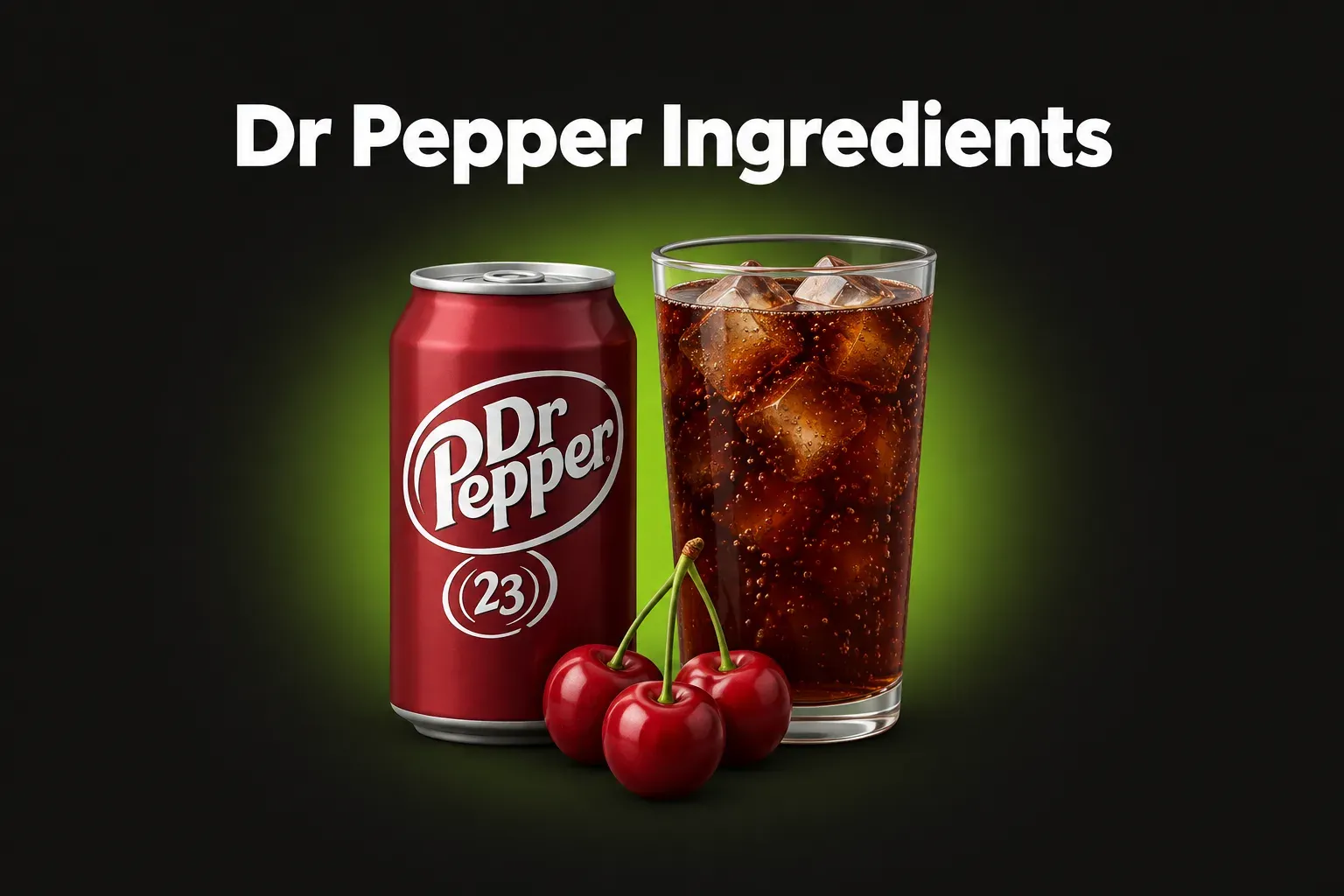
Dr Pepper is one of the oldest sodas in America. It was first sold in 1885 in Waco, Texas. Its cherry-like, slightly spicy taste is hard to name, so many people wonder what’s actually in it.
The short answer: a 12 oz can of Dr Pepper has seven ingredients: carbonated water, high fructose corn syrup, caramel color, phosphoric acid, natural and artificial flavors, sodium benzoate and caffeine. It has 150 calories, 39 g of added sugar and about 41 mg of caffeine. The famous “23 flavors” are part of the brand story, but the list is a secret. The sugar is the biggest health issue. The acid, caramel color and preservative are smaller ones.
Dr Pepper ingredients, one by one
Here is the ingredient list of a 12 oz (355 ml) can sold in the US, in label order:
- Carbonated water – water with carbon dioxide gas. It makes the bubbles.
- High fructose corn syrup (HFCS) – the sweetener. It’s made from corn starch. It’s roughly half fructose and half glucose, a lot like table sugar.
- Caramel color – makes the drink dark reddish-brown. Dark sodas use a type made with ammonia.
- Phosphoric acid – a sour acid. It gives the drink a sharp, tangy bite.
- Natural and artificial flavors – this one line covers the famous flavor blend. The label doesn’t say what’s in it.
- Sodium benzoate – a preservative. It stops mold and yeast from growing.
- Caffeine – a mild stimulant. A can has about 41 mg.
Source: Keurig Dr Pepper Product Facts, checked November 2026. USDA FoodData Central shows the same list.
Here is the nutrition label of the same can:
| Per can (12 oz) | Amount |
|---|---|
| Calories | 150 |
| Total carbohydrates | 40 g |
| Total sugar | 39 g (all added) |
| Sodium | 55 mg |
| Caffeine | about 41 mg |
| Fat | 0 g |
| Protein | 0 g |
Source: Keurig Dr Pepper Product Facts. A 20 oz bottle has 240 calories, 65 g of sugar and about 68 mg of caffeine (Keurig Dr Pepper).
The 23 flavors: myth or secret?
Dr Pepper’s can carries a small “23”. The brand links its unique taste to 23 fruit flavors, says the Dr Pepper Museum in Waco. The museum names a young pharmacist, Charles Alderton, as the likely inventor. He worked at Morrison’s Old Corner Drug Store. He loved how the fruit syrups there smelled. So he mixed syrups until he found a taste he liked.
The number is part of the brand story. But the company has never shared the list. Fans guess cherry, vanilla or licorice, but those are only guesses.
One old rumor says Dr Pepper contains prune juice. There’s no proof of that. The US label lists no juice at all. Every flavor, whatever it is, sits inside one line: “natural and artificial flavors.”
For your health, the exact flavors don’t matter much. Flavors make up a tiny part of the drink. The sugar does not.
Sugar: the biggest problem
39 g of sugar is almost 10 teaspoons. The American Heart Association suggests a daily limit for added sugar. It’s about 25 g for women and 36 g for men (Johnson et al., Circulation, 2009). One can goes over both. A 20 oz bottle has 65 g – almost twice the men’s limit.
Sugar in a drink doesn’t fill you up, so you don’t eat less later. Here is what studies show:
- Type 2 diabetes. A review pooled studies of over 310,000 people. Those who drank 1–2 sugary drinks a day had a 26% higher risk of type 2 diabetes. They were compared with people who drank almost none (Malik et al., Diabetes Care, 2010).
- Early death. Over 118,000 US health workers were followed for about 30 years. Those who drank 2 or more sugary drinks a day had a 21% higher risk of dying during the study (Malik et al., Circulation, 2019).
What about the corn syrup itself? Most experts say HFCS acts about the same as table sugar. The amount matters most. Dr Pepper also sells a Made with Real Sugar mini can. It swaps HFCS for sugar, but it’s not healthier per ounce.
One daily can adds 1,050 calories a week. Want to see how that fits your day? Try our calorie calculator.
Is Dr Pepper bad for you? The other ingredients
Phosphoric acid: teeth and bones
Teeth. Researchers measured the acidity of 379 US drinks. Dr Pepper had a pH of 2.88. Coca-Cola was 2.37. Anything below 4 can wear away tooth enamel, the hard outer layer of your teeth (Reddy et al., Journal of the American Dental Association, 2016). Diet Dr Pepper measured 3.20. So the diet version is hard on teeth, too.
Bones. The Framingham study measured bone density in over 2,500 adults. Women who drank cola every day had about 3.7% lower bone density at the hip. They were compared with women who drank less than one a month. Other fizzy drinks showed no clear link (Tucker et al., American Journal of Clinical Nutrition, 2006). The authors think phosphoric acid or caffeine may play a role. Dr Pepper isn’t a cola, and it wasn’t studied on its own. But it has both phosphoric acid and caffeine. It’s a link, not proof.
Caramel color and 4-MEI
Dark caramel color can contain 4-MEI, a byproduct that forms when sugar is heated with ammonia. In a two-year US government study, mice ate feed with 625 to 1,250 ppm of 4-MEI. That’s 0.06% to 0.125% of their food, or about 80 to 170 mg per kg of body weight a day. They got more lung tumors (Chan et al., Archives of Toxicology, 2008). That’s a very high dose.
How much is in Dr Pepper? Researchers tested 12 drinks bought in 2013 in California and the New York area. Dr Pepper had about 28 micrograms per liter. That’s about 10 micrograms per can. Coca-Cola had less, about 10 to 12 per liter. Some Pepsi samples had over 500 (Smith et al., PLOS ONE, 2015). California requires a cancer warning above 29 micrograms a day. So one can stays well under it. About three cans a day would reach it.
Why do mouse studies matter? Mice share most of our genes and body processes. And testing a possible cancer cause on people would put their health at risk. Human proof is missing. Recipes may also have changed since 2013. Still, cutting back on dark soda is a sensible precaution.
Sodium benzoate and benzene
Sodium benzoate plus vitamin C can form small amounts of benzene, a chemical that causes cancer. Heat and light speed this up. An FDA survey tested 199 drinks. Most had no benzene or very little. Makers changed the recipes of the drinks that had more (Nyman et al., Journal of Agricultural and Food Chemistry, 2008).
The good news: Dr Pepper’s label lists no vitamin C (ascorbic acid). So this risk is low for the classic can.
Sodium benzoate has other open questions. In a British study, about 300 children drank a mix of food dyes plus sodium benzoate. On average, they became more hyperactive (McCann et al., The Lancet, 2007). The dyes may have played a part, so the effect of benzoate alone isn’t clear. In another study, mice drank water with sodium benzoate (0.56 to 2.25 mg per ml) for 4 weeks. They had worse memory and more cell stress in the brain (Khoshnoud et al., Journal of Biochemical and Molecular Toxicology, 2018). Those doses are much higher than one soda gives you.
Caffeine
About 41 mg per can is a modest amount. An 8 oz cup of brewed coffee has about 95 mg (USDA). The FDA says up to 400 mg a day is usually safe for healthy adults (FDA). It matters more for kids and for a late-night can.
Dr Pepper Zero Sugar and Diet Dr Pepper
Both have 0 calories, 0 g of sugar and about 41 mg of caffeine per 12 oz can. The difference is the sweeteners.
- Diet Dr Pepper uses only aspartame.
- Dr Pepper Zero Sugar uses aspartame and acesulfame K. It also adds sodium phosphate, a salt that helps control acidity.
Source: Keurig Dr Pepper Product Facts – Diet Dr Pepper and Dr Pepper Zero Sugar.
Both still have caramel color, phosphoric acid and sodium benzoate. Because of aspartame, US labels must warn people with PKU, a rare inherited condition. People with PKU can’t break down phenylalanine, a part of aspartame.
Regulators like the FDA allow these sweeteners. But independent studies raise questions:
- Aspartame in rats. Rats ate aspartame in their food for their whole lives. More of them got blood cancers (lymphomas and leukemias). This showed up even at 20 mg per kg of body weight a day. That’s less than the daily amount allowed for people (Soffritti et al., Environmental Health Perspectives, 2006). In 2023, the WHO’s cancer agency called aspartame “possibly carcinogenic.” That means it may cause cancer, but the proof is limited (Riboli et al., Lancet Oncology, 2023).
- Acesulfame K in mice. Mice got 37.5 mg per kg a day for 4 weeks. It changed their gut bacteria, and the males gained more weight (Bian et al., PLoS One, 2017).
- In people. A French study followed over 100,000 adults. Those who had more aspartame had more strokes (Debras et al., BMJ, 2022). Aspartame and acesulfame K were also linked to more cancer (Debras et al., PLoS Medicine, 2022).
The human studies show links, not cause. But several labs see similar warning signs. So it makes sense to limit diet sodas too, as a precaution.
Dr Pepper vs Coke, Pepsi and Mountain Dew
| Drink | Calories | Sugar | Caffeine | Sweetener |
|---|---|---|---|---|
| Dr Pepper (12 oz) | 150 | 39 g | 41 mg | HFCS |
| Dr Pepper (20 oz) | 240 | 65 g | 68 mg | HFCS |
| Dr Pepper Cherry (12 oz) | 160 | 42 g | 40 mg | HFCS |
| Dr Pepper Made with Real Sugar (7.5 oz) | 90 | 24 g | 26 mg | Sugar |
| Diet Dr Pepper (12 oz) | 0 | 0 g | 41 mg | Aspartame |
| Dr Pepper Zero Sugar (12 oz) | 0 | 0 g | 41 mg | Aspartame, acesulfame K |
| Coca-Cola (12 oz) | 140 | 39 g | 34 mg | HFCS |
| Pepsi (12 oz) | 150 | 41 g | 38 mg | HFCS + sugar |
| Mountain Dew (12 oz) | 170 | 46 g | 54 mg | HFCS |
Dr Pepper products: Keurig Dr Pepper Product Facts (20 oz, Cherry, Real Sugar), caffeine “approx.” as listed. Coca-Cola: Coca-Cola US. Pepsi: USDA FoodData Central and PepsiCo Product Facts (caffeine). Mountain Dew: PepsiCo Product Facts and Open Food Facts.
What stands out:
- Dr Pepper, Coke and Pepsi are very close. All have 39–41 g of sugar per can.
- Dr Pepper has a bit more caffeine than Coke or Pepsi, but less than Mountain Dew.
- Mountain Dew has the most sugar and caffeine of the group. See Is Mountain Dew bad for you?
- The 7.5 oz mini can cuts the sugar by more than a third. That’s the easiest swap.
For a closer look at Coke, see Is Coke bad for you? For drinks with less sugar, see our guide to the healthiest soda.
How to enjoy Dr Pepper more wisely
- Make it a treat. Not a daily habit.
- Go small. Pick the 7.5 oz mini can over a 20 oz bottle. You save 41 g of sugar.
- Drink it with a meal. Then rinse with water. Sipping all day keeps your teeth in acid.
- Use zero sugar as a step down. It cuts the sugar, but keep it limited too.
See what’s really in your Dr Pepper. With NutriSmart, you photograph the label or scan the barcode. The app lists the sweeteners, preservatives and colors, explains the risks of each one and gives the product a health score out of 100. It also tells you right away if a soda is ultra-processed and which ingredients make it so. Set an alert for caramel color or aspartame. The app then warns you whenever a product you scan contains it.Get the app free
The bottom line
Dr Pepper has seven ingredients: carbonated water, high fructose corn syrup, caramel color, phosphoric acid, natural and artificial flavors, sodium benzoate and caffeine. The “23 flavors” are a well-kept secret, but they’re a tiny part of the drink. The real issue is the 39 g of added sugar per can – more than a full day’s limit. The acid is hard on teeth, and caramel color adds a small dose of 4-MEI. Caffeine is modest at about 41 mg. Zero Sugar and Diet cut the sugar but add sweeteners with open questions. Enjoy Dr Pepper now and then, choose small cans, and drink water most of the time.
FAQ
What are the ingredients in Dr Pepper?
A US can of Dr Pepper has seven ingredients: carbonated water, high fructose corn syrup, caramel color, phosphoric acid, natural and artificial flavors, sodium benzoate and caffeine. The corn syrup gives a 12 oz can its 39 g of sugar.
What are the 23 flavors in Dr Pepper?
Nobody outside the company knows for sure. Dr Pepper says its taste comes from a blend of 23 flavors, but it has never published the list. On the label, they all hide behind one line: natural and artificial flavors.
How much caffeine is in Dr Pepper?
A 12 oz can has about 41 mg of caffeine, and a 20 oz bottle has about 68 mg. That's a bit more than a can of Coke (34 mg) and less than half of an 8 oz cup of brewed coffee (about 95 mg).
How much sugar is in a can of Dr Pepper?
A 12 oz can has 39 g of sugar, all of it added – almost 10 teaspoons. That's more than the American Heart Association's daily limit for both women (25 g) and men (36 g).
Is Dr Pepper Zero Sugar better for you than regular Dr Pepper?
It has no sugar and no calories, so it's easier on your weight, blood sugar and cavities. But it keeps the acid, caramel color and caffeine. It's sweetened with aspartame and acesulfame K, which have open questions.
Does Dr Pepper have prune juice in it?
There's no proof of that. It's an old rumor. The US label lists no prune juice or any other juice. The fruity taste comes from the secret flavor blend.