Is Sauerkraut Healthy? Probiotics, Salt and 8 Brands
Is sauerkraut healthy? Fiber, vitamin C and salt per 1/4 cup, live cultures vs canned, what studies show, and 8 brands compared.
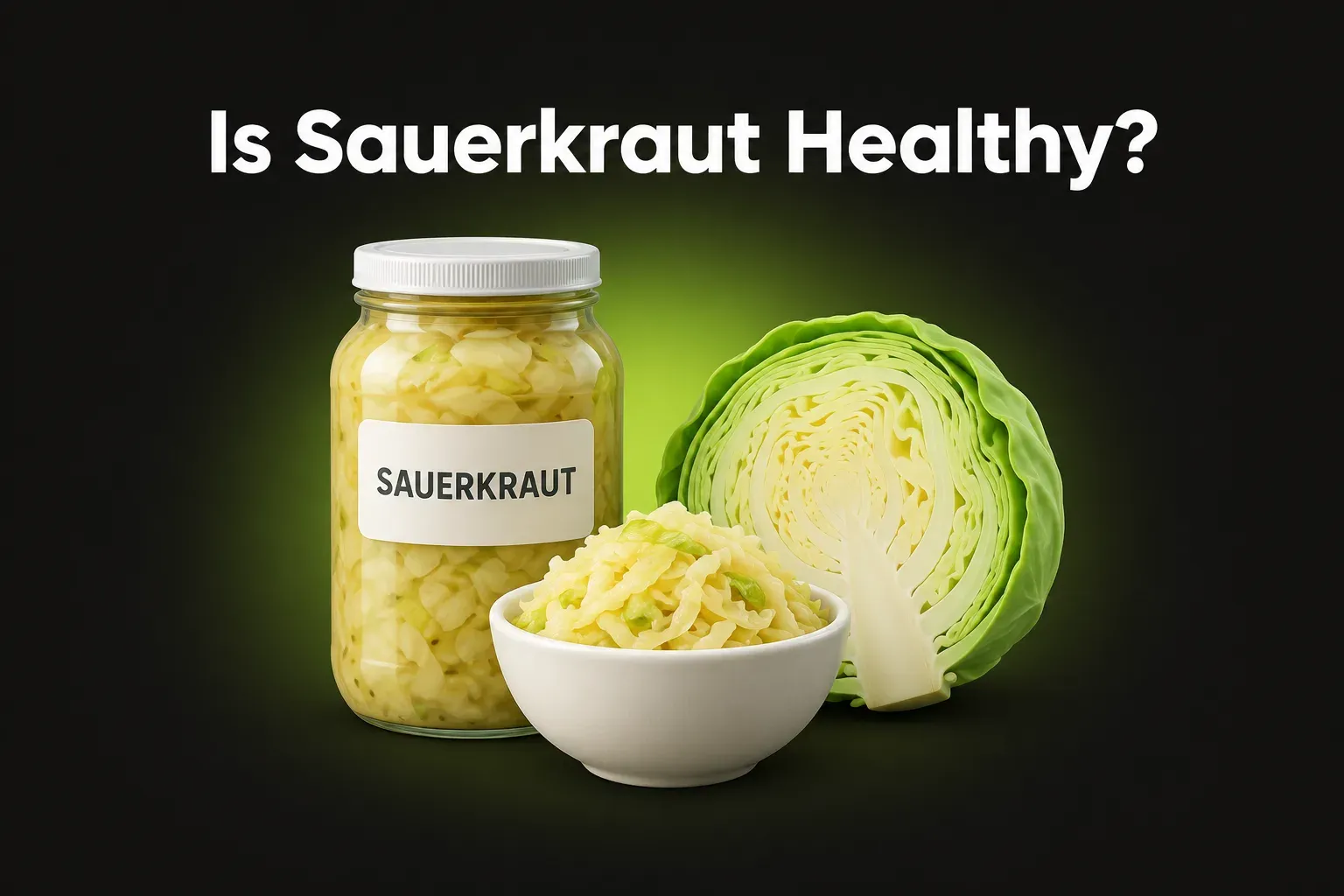
Sauerkraut is just cabbage and salt, left to ferment for a few weeks. It’s sour, crunchy and very low in calories. But is the jar in your fridge good for you?
The short answer: yes, sauerkraut is healthy for most people. A 1/4 cup has about 7 calories, 1 g of fiber, and a little vitamin C and vitamin K. Raw sauerkraut from the fridge also has live bacteria. Canned and shelf-stable sauerkraut doesn’t, and some brands add preservatives. Human studies on its gut benefits are small. The biggest catch is salt – about 230 mg of sodium in a 1/4 cup.
Sauerkraut nutrition per 1/4 cup
Here are the numbers for plain sauerkraut from the USDA food database. Most people eat 2 tablespoons to 1/4 cup at a time. We also show a full cup.
| Nutrient | 1/4 cup (35 g) | 1 cup (142 g) | Daily Value (1/4 cup) |
|---|---|---|---|
| Calories | 7 | 27 | – |
| Fiber | 1.0 g | 4.1 g | 4% |
| Sodium | 230 mg | 939 mg | 10% |
| Vitamin C | 5.1 mg | 21 mg | 6% |
| Vitamin K | 4.6 mcg | 18 mcg | 4% |
| Iron | 0.5 mg | 2.1 mg | 3% |
Source: USDA FoodData Central – sauerkraut, canned, solids and liquids. USDA values per 100 g, scaled to 1/4 cup (35 g) and to one drained cup (142 g), then rounded. Daily Values are the ones used on US labels.
What stands out:
- Calories: almost none. You can pile it on a sandwich and barely notice it.
- Fiber: a cup has about 4 g. That’s about 15% of the 28 g you need each day. A small serving gives you about 1 g. For bigger amounts, see our list of high-fiber foods.
- Vitamin C: cabbage keeps some of its vitamin C after fermenting. A cup has about a quarter of your daily need.
- Sodium: this is the weak spot. A full cup has about 40% of the daily limit of 2,300 mg.
Raw vs canned sauerkraut: why it matters
Fermenting is what makes sauerkraut sour. Lactic acid bacteria (friendly bacteria that also live on cabbage leaves) eat the cabbage’s sugar. They turn it into acid. That acid gives the tang and keeps the cabbage from spoiling.
But not every jar still has those bacteria when you open it.
- Raw, refrigerated sauerkraut is never heated. Its bacteria are still alive. You find it in the fridge section, next to pickles and kimchi. Look for words like “raw”, “unpasteurized” or “live cultures”.
- Shelf-stable sauerkraut comes in cans, jars and pouches in the canned food aisle. It is heated so it stays safe at room temperature. The heat kills the live bacteria. It’s still fermented cabbage, with the same fiber. It just has no living cultures.
There is one more trap. Fridge sauerkraut is not always raw. Some brands sold cold, like Silver Floss, add preservatives and don’t claim live cultures. So read the label, not just the shelf.
8 sauerkraut brands compared
Here are 8 brands sold in US stores. Serving sizes differ a little, but most are about 1 oz (28–30 g).
| Brand | Aisle | Serving | Calories | Sodium | Ingredients | Live cultures |
|---|---|---|---|---|---|---|
| Bubbies Sauerkraut | Fridge | 1/4 cup (28 g) | 0 | 270–290 mg | Cabbage, water, salt | Brand says probiotic |
| Cleveland Kitchen Classic | Fridge | 1 oz (28 g) | 10 | 230 mg | Cabbage, salt, caraway seed | Yes, on label |
| Wildbrine Organic Green Kraut | Fridge | 2 Tbsp | 5 | 220 mg | Organic green cabbage, water, sea salt, organic garlic | Yes, sold raw |
| Farmhouse Culture Sea Salt Caraway | Fridge | 2 Tbsp (30 g) | 5 | 170 mg | Organic cabbage, water, sea salt, organic caraway | Yes, never pasteurized |
| Silver Floss Shredded Kraut | Fridge | 30 g | 5 | 180 mg | Cabbage, water, salt, sodium benzoate, sodium bisulfite | Not claimed |
| Libby’s Crispy Sauerkraut | Shelf | 2 Tbsp (30 g) | 5 | 200 mg | Cabbage, water, salt, sodium sulfite | No |
| Frank’s Quality Kraut | Shelf | 2 Tbsp (30 g) | 5 | 180 mg | Cabbage, water, salt, sodium benzoate, sodium metabisulfite | No |
| Great Value Sauerkraut | Shelf | 2 Tbsp (30 g) | 5 | 200 mg | Prepared cabbage, water, salt | No |
Sources: brand sites for Cleveland Kitchen, Wildbrine and Bubbies (ingredients); for Bubbies nutrition, a retailer label (290 mg) and Open Food Facts (270 mg); Publix listing for Farmhouse Culture (never pasteurized); Open Food Facts for Farmhouse Culture, Silver Floss, Libby’s, Frank’s and Great Value, checked November 2026. Silver Floss values are worked out from its per-100 g data. Recipes change by size and over time – always check the label.
What to notice:
- Calories and fiber are about the same in every brand. Fermented cabbage is fermented cabbage.
- Salt differs. Farmhouse Culture has about 170 mg per serving. Bubbies has 270–290 mg, depending on the label, in a slightly smaller serving. That makes it the saltiest here.
- Four fridge brands have the shortest lists. Bubbies, Cleveland Kitchen, Wildbrine and Farmhouse Culture use only cabbage, salt, water and spices. All four are sold raw or say they have live cultures or probiotics.
- Three brands add preservatives. Silver Floss, Libby’s and Frank’s list sulfites, and two of them also list sodium benzoate. Another Frank’s kraut lists only cabbage, water and salt (Open Food Facts), so check the can or jar you pick up.
- Great Value has a clean list. But it’s a shelf product, so it has no live cultures.
Some brands outside this list add vinegar too. Vlasic Polish Sauerkraut lists distilled vinegar, two preservatives, natural flavors and polysorbate 80 (Open Food Facts). Vinegar makes cabbage sour without a true ferment.
Preservatives in shelf-stable sauerkraut
Sodium benzoate
Sodium benzoate stops mold and yeast. The FDA allows it in foods at up to 0.1% of the product’s weight. At that level, 2 tablespoons would have at most about 30 mg.
Independent labs have seen warning signs. In one study, mice drank water with sodium benzoate for 4 weeks. The doses were 0.56 to 2.25 mg per mL of water. The mice had worse memory and coordination. Their brains also showed more oxidative stress (a kind of cell damage) (Khoshnoud et al., Journal of Biochemical and Molecular Toxicology, 2018).
A lab in India saw a similar signal. Young zebrafish kept in water with sodium benzoate grew with body defects. They also showed cell damage and acted anxious. The authors warned against using too much of it in processed foods (Gaur et al., Biochemical and Biophysical Research Communications, 2018).
Why do animal studies matter? Mice share most of our genes and body processes, and zebrafish share many. Giving people an additive for years to look for harm would put their health at risk. Proof of harm in people is still missing. And the doses in these studies were far higher than a forkful of sauerkraut. But more than one lab has seen the same kind of signal. So it makes sense to pick brands without it when you can – there are plenty.
Sulfites
Sulfites (like sodium bisulfite and sodium metabisulfite) keep sauerkraut pale and stop it from turning brown. Most people handle them fine. But most studies find that 3–10% of people with asthma react to sulfites in food. Reactions range from hives and stomach pain to serious asthma attacks (Vally et al., Clinical & Experimental Allergy, 2009). If you have asthma, check the label.
Does sauerkraut help your gut?
Sauerkraut has a big reputation as a “probiotic” food. Probiotics are live microbes that may help your health. The research on sauerkraut itself is promising but small.
The IBS trial. Danish scientists tested sauerkraut in 34 people with IBS in Norway. IBS (irritable bowel syndrome) causes belly pain, gas and bloating. Some patients ate raw sauerkraut every day for 6 weeks. Others ate pasteurized sauerkraut, with no live bacteria. Both groups felt better. There was no clear difference between the two groups. The authors think the cabbage’s prebiotics (parts that feed your gut bacteria) did more of the work than the live bacteria. They also said the study was too small to be sure (Nielsen et al., Food & Function, 2018).
The German trial. In 2026, a team in Freiburg gave 87 healthy adults 100 g (about 3.5 oz) of sauerkraut a day. Each person ate fresh sauerkraut for 4 weeks and pasteurized sauerkraut for 4 weeks. Both types led to a small drop in systolic blood pressure (the top number). There was no change in markers of a “leaky gut”. Overall, the authors found no clear health benefit in these healthy people. They also concluded that live bacteria were not needed for the blood pressure effect (Schropp et al., European Journal of Clinical Nutrition, 2026).
Fermented foods in general. At Stanford, 36 healthy adults were split into two groups for 17 weeks. One group ate more fiber. The other ate more fermented foods, like yogurt, kefir, kombucha and fermented vegetables such as kimchi. The fermented-food group had more kinds of gut bacteria and lower signs of inflammation (the body’s alarm response) (Wastyk et al., Cell, 2021). This study did not test sauerkraut alone.
So what does this mean? Sauerkraut may help your gut, raw or not. The live bacteria may add something, but that’s not proven yet. Much of the benefit may come from the cabbage and its fiber. Want another fermented choice? Read our guides to kombucha and kefir.
Downsides: salt, gas and histamine
Salt
Salt is part of how sauerkraut is made. It keeps bad bacteria out while the good ones work. That means every brand is fairly salty. A 1/4 cup has about 230 mg of sodium. If you eat a cup with a sausage and a bun, the salt adds up fast. Eat it in small amounts if you have high blood pressure or follow a low-salt diet. Our guides to pickles and hot dogs cover two other salty foods that often share the plate.
Gas and bloating
Cabbage is full of fiber. Your gut bacteria break that fiber down and make gas. If you’re not used to fermented foods, a big serving can leave you bloated. Start with a forkful a day and build up slowly.
Histamine and tyramine
Fermented foods like sauerkraut can contain histamine and other compounds called biogenic amines. They form while the cabbage ferments (Stratton et al., Journal of Food Protection, 1991). Most people break histamine down easily. But some people can’t, which is called histamine intolerance. Histamine-rich foods can then cause headaches, a runny nose, flushing, itching or diarrhea (Maintz and Novak, American Journal of Clinical Nutrition, 2007).
Levels vary a lot from jar to jar. In a Polish test of store-bought sauerkraut, four samples went over an estimated safe limit for these compounds (Choińska et al., Environmental Microbiology Reports, 2025).
Sauerkraut also has tyramine. This matters if you take an MAOI (an older type of antidepressant). With these drugs, tyramine can raise blood pressure to dangerous levels. Toronto scientists found about 8 mg of tyramine in a 9 oz (250 g) serving of sauerkraut. They called that dangerously high for people on MAOIs (Walker et al., Journal of Clinical Psychopharmacology, 1996). If you take one, ask your doctor before eating it.
How to pick a healthy sauerkraut
- Shop the fridge aisle if you want live cultures. Look for “raw”, “unpasteurized” or “live cultures”.
- Read the ingredients. The best list is short: cabbage, salt, maybe water and spices.
- Skip vinegar and preservatives like sodium benzoate and sulfites.
- Compare sodium. Brands range from about 170 to 290 mg per serving.
- Don’t cook raw sauerkraut if you want the bacteria. Add it to food after cooking. Heat kills them.
- Keep portions small – a forkful to 1/4 cup a day is plenty. Sauerkraut juice is salty too. Here’s what to know about pickle juice.
See what’s really in your sauerkraut. With NutriSmart, you photograph the label or scan the barcode. The app lists the sweeteners, preservatives and colors, explains the risks of each one and gives the product a health score out of 100. It also tells you right away if a jar is ultra-processed and which ingredients make it so. Set an alert for sodium benzoate or sulfites. The app then warns you whenever a product you scan contains them.Get the app free
The bottom line
Sauerkraut is a healthy food for most people. It has almost no calories, some fiber, and a bit of vitamin C and K. Raw sauerkraut from the fridge also has live bacteria, while canned and shelf-stable kinds don’t. Small studies suggest sauerkraut may ease IBS symptoms and lower blood pressure slightly, even when pasteurized. The main downside is salt, so keep servings small. Pick a brand with just cabbage and salt, and skip the ones with preservatives. If you have histamine intolerance, take an MAOI or react to sulfites, be careful.
FAQ
Is sauerkraut healthy?
Yes, for most people. A 1/4 cup has about 7 calories, 1 g of fiber and some vitamin C and K. The main downside is salt – about 230 mg of sodium in that small serving.
Does canned sauerkraut have probiotics?
No. Shelf-stable cans and jars are heated so they keep at room temperature, and the heat kills the live bacteria. For live cultures, buy sauerkraut from the fridge that says raw, unpasteurized or live cultures.
How much sauerkraut should I eat a day?
A forkful to 1/4 cup a day is a good amount for most people. That gives you some fiber and bacteria without too much salt. Start small if you are new to it, since it can cause gas.
Is sauerkraut good for your gut?
It may help, but the proof is still thin. In a small trial, people with IBS felt better on sauerkraut. But pasteurized sauerkraut worked about as well as raw sauerkraut.
Who should not eat sauerkraut?
People on a low-salt diet should keep portions small. People with histamine intolerance and people who take MAOI antidepressants may need to avoid it. If you react to sulfites, check shelf-stable brands for them.
Is sauerkraut the same as pickled cabbage?
Not always. Real sauerkraut is fermented with just cabbage and salt. Some brands add vinegar instead, which gives a sour taste without fermentation.