Are Pickles Healthy? Sodium, Additives and 9 Brands
Are pickles healthy? Calories and sodium per spear, fermented vs vinegar pickles, additives like Yellow 5, and 9 brands compared.
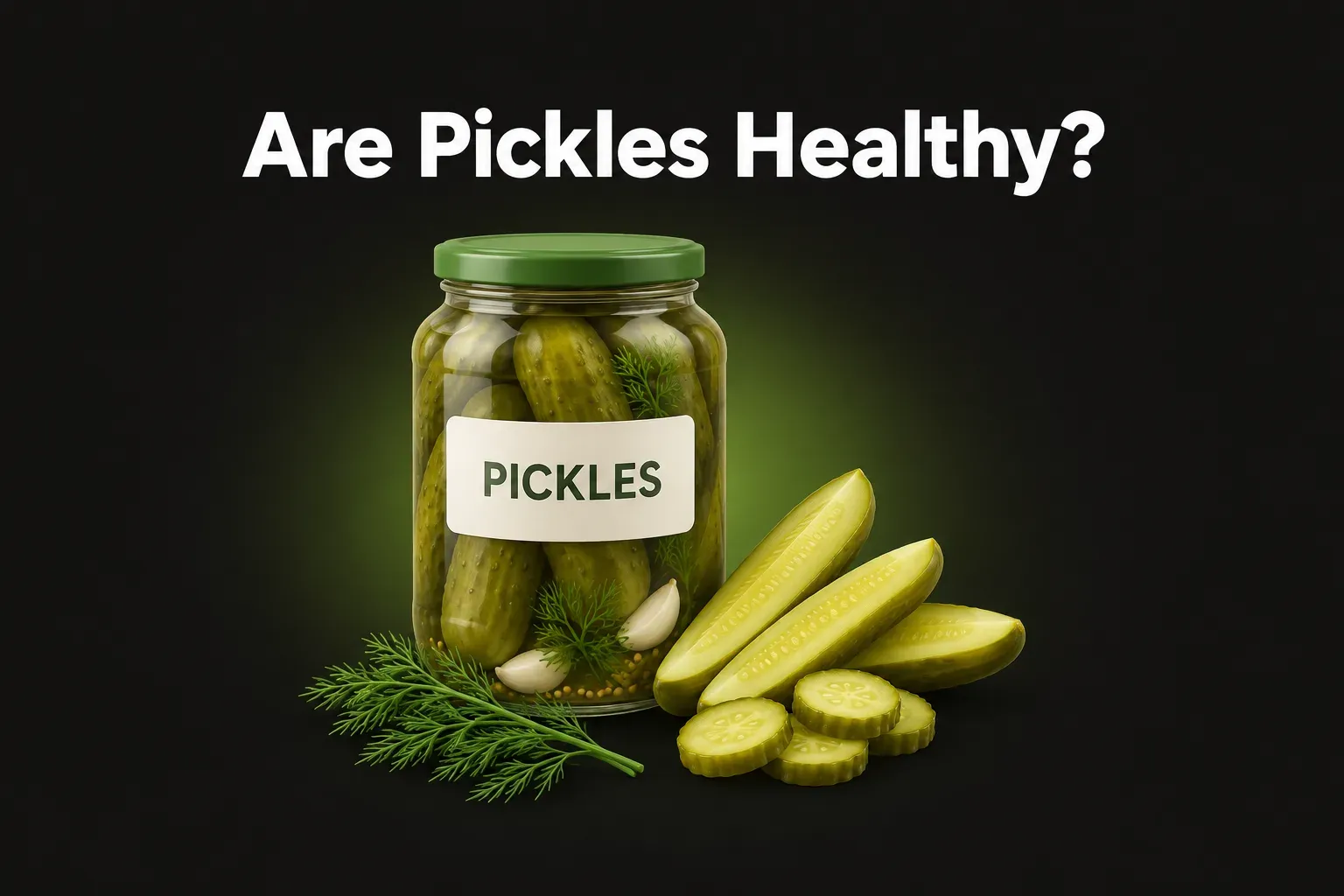
Pickles go great with sandwiches and burgers, and many people eat them straight from the jar. But with all that salt, are pickles healthy?
The short answer: dill pickles are a healthy snack in small amounts. A small spear has only about 4 calories. But it also has about 200–300 mg of sodium, and a large whole pickle has about 1,090 mg. That’s almost half your daily limit. Sweet pickles add 2–7 g of sugar per ounce. Many jars also add Yellow 5, polysorbate 80 or sodium benzoate. The best picks have a short ingredient list. Fermented pickles sold cold may add live bacteria too.
Pickle nutrition per spear and per pickle
Here are the numbers from the USDA food database. The USDA lists dill and kosher dill pickles together.
| Pickle | Calories | Sodium | Sugar | Fiber |
|---|---|---|---|---|
| Dill, 1 slice (7 g) | 1 | 57 mg | 0.1 g | 0.1 g |
| Dill, 1 small spear (35 g) | 4 | 283 mg | 0.4 g | 0.4 g |
| Dill, 1 large whole, 4” (135 g) | 16 | 1,092 mg | 1.4 g | 1.4 g |
| Dill, 1 cup of slices (155 g) | 19 | 1,254 mg | 1.7 g | 1.6 g |
| Sour, 1 medium (65 g) | 7 | 787 mg | 0.7 g | 0.8 g |
| Sweet / bread and butter, 1 oz (28 g) | 25 | 128 mg | 5.1 g | 0.3 g |
| Sweet / bread and butter, 1 cup of slices (153 g) | 139 | 699 mg | 28 g | 1.5 g |
Source: USDA FoodData Central – dill or kosher dill, sour, sweet, including bread and butter. Values per 100 g, multiplied to each portion and rounded.
What stands out:
- Calories are tiny. A large whole dill pickle has only about 16 calories. See more snacks like this in our list of zero-calorie foods.
- Sodium is huge. The FDA sets the daily value at 2,300 mg (FDA). One large pickle uses up about 47% of it. The American Heart Association says 1,500 mg a day is ideal for most adults (American Heart Association).
- Sweet pickles have about 7 times the calories of dill pickles, ounce for ounce. Most of it comes from sugar.
- Vitamin K. A large dill pickle has about 23 micrograms of vitamin K. That’s about 20% of the daily value. Vitamin K helps your blood clot.
Vinegar pickles vs fermented pickles
Not all pickles are made the same way. There are three main kinds in US stores.
- Shelf-stable vinegar pickles. These sit on the regular shelf, like Vlasic, Mt. Olive and Great Value. They are packed in a vinegar brine. They are heat-treated (pasteurized), so they keep for months. Heat kills bacteria, so they have no live cultures. Mt. Olive says it pasteurizes all its products. That’s true even for the pickles it ferments first (Mt. Olive).
- Fresh refrigerated vinegar pickles. These sit in the cold case, like Claussen and Grillo’s. Claussen says its pickles are made cold and are never heated or pasteurized (Kraft Heinz, 2020). Grillo’s uses vinegar too. Its FAQ says its pickles are not fermented and have no active cultures (Grillo’s). So “refrigerated” does not mean “probiotic”.
- Fermented pickles. These sit in salt water instead of vinegar. Good bacteria slowly turn the cucumber’s sugar into a sour acid. Bubbies is the best-known brand. It says its pickles have no vinegar and calls them “naturally-fermented raw” (Bubbies). The brine looks cloudy, which is normal.
Do fermented pickles help your gut? There are no good studies on pickles alone. But one Stanford trial gives a clue. Researchers split 36 healthy adults into two groups for 17 weeks. One group ate more fiber. The other ate more fermented foods, like yogurt, kefir and fermented vegetables. In the fermented-food group, gut bacteria became more varied. Their signs of inflammation (the body’s alarm response) also went down (Wastyk et al., Cell, 2021).
So a raw fermented pickle may add a little to a healthy gut. Other fermented foods include sauerkraut and kombucha. Read is sauerkraut healthy? and is kombucha good for you?
Can pickles help your blood sugar?
Vinegar may slow the rise in blood sugar after a meal. The proof comes from small, short studies.
- Vinegar with bread. 12 healthy adults ate white bread for breakfast. On some days, they had vinegar with it. The biggest dose had about 1.7 g of acetic acid (the sour part of vinegar). That’s the acid in a little over 2 tablespoons of regular 5% vinegar. The more vinegar they had, the less their blood sugar and insulin rose. They also felt fuller (Ostman et al., European Journal of Clinical Nutrition, 2005).
- Pickled cucumber. 10 healthy adults ate a white bread breakfast. Researchers added yogurt and pickled cucumber to it. Blood sugar and insulin rose less than with bread alone. Fresh cucumber and regular milk did not have this effect (Ostman et al., American Journal of Clinical Nutrition, 2001).
- Pooled trials. A review pooled several trials. People who had vinegar with a meal had lower blood sugar and insulin afterward (Shishehbor et al., Diabetes Research and Clinical Practice, 2017).
These studies looked at single meals. They don’t show that pickles prevent diabetes. Still, a dill pickle with a starchy meal is a fine habit, as long as the salt fits your day.
The downside: sodium
Salt is the main problem with pickles. Too much sodium raises blood pressure. High blood pressure raises the risk of heart attack and stroke.
A big review pooled 34 trials with 3,230 people. Eating about 4.4 g less salt a day (about 1,700 mg of sodium) lowered the top blood pressure number by about 4 points. In people with high blood pressure, it fell by about 5 points (He et al., BMJ, 2013).
Three large dill pickles add about 3,300 mg of sodium. That’s more than the full daily limit, before any other food.
What about stomach cancer? A review pooled 60 studies on pickled foods. People who ate them had about a 50% higher risk of stomach cancer (Ren et al., Cancer Epidemiology, Biomarkers and Prevention, 2012). Many studies came from China, Korea and Japan. People there often eat a lot of salty pickled vegetables. The link was strongest in Korea and China. In studies from other countries, it was weak and not clear. These studies show a link, not proof.
Additives in pickle jars
Many pickles have more than cucumbers, water, vinegar and salt. Here is what you’ll see on labels.
- Calcium chloride keeps pickles crunchy. It’s a simple salt made of calcium and chloride. It’s not a concern at these amounts.
- Alum is an older firming salt made with aluminum. You’ll still see it on some relish jars. The National Center for Home Food Preservation says it’s safe in fermented pickles, but not needed (NCHFP).
- Yellow 5 (tartrazine) is a lab-made dye. It makes pickles look bright green-yellow. Many brands use turmeric for color instead. Vlasic says its dill spears and bread and butter chips have no artificial dyes (Vlasic).
- Polysorbate 80 is an emulsifier. In pickles, it helps mix the flavor oils into the brine.
- Sodium benzoate is a preservative that stops mold and yeast.
- High fructose corn syrup sweetens many bread and butter pickles. Some “no sugar added” sweet pickles use sucralose (Splenda) instead.
Regulators like the FDA allow all of these. But independent studies raise questions about three of them:
- Yellow 5 and sodium benzoate. Nearly 300 children aged 3 and 8–9 took part in a UK trial. On some weeks, they drank juice with sodium benzoate and a mix of dyes. One of the mixes included tartrazine. On other weeks, they drank the same juice with no additives. With the additive drinks, the children became more hyperactive (McCann et al., The Lancet, 2007). Some pickle jars contain both.
- Yellow 5 in rats. Rats got tartrazine by mouth for 7 or 21 days. The low dose was 3.75 mg per kg of body weight a day. That’s half the daily limit set in the EU (7.5 mg per kg). The dye changed the rats’ blood counts, more so at the higher dose and over more days. Tests also found DNA breaks, mostly when tartrazine was mixed with another yellow dye (Hayat et al., Journal of Applied Toxicology, 2026).
- Polysorbate 80 in mice. Mice drank water with 1% polysorbate 80 for 12 weeks. They got mild gut inflammation, gained weight and had higher blood sugar. Even 0.1% caused some of these signs (Chassaing et al., Nature, 2015).
- Sodium benzoate in mice. Mice got it in their water for 4 weeks, at 0.56–2.25 mg per ml. They had worse memory and more cell damage in the brain (Khoshnoud et al., Journal of Biochemical and Molecular Toxicology, 2018).
Why do animal studies matter? Rats and mice share most of our genes and body processes. Testing possible harm on people for years would put their health at risk. Proof of harm in humans is still missing for these doses. But several labs see similar warning signs. And a good pickle doesn’t need these additives. So it makes sense to pick jars without them as a precaution.
9 pickle brands compared
All numbers are per 1 oz (28 g), the serving on most US labels. That’s about one small spear.
| Product | Type | Calories | Sodium | Sugar | Additives of note |
|---|---|---|---|---|---|
| Grillo’s Classic Dill Spears | Fresh, refrigerated | 5 | 200 mg | 0 g | None |
| Bubbies Kosher Dills | Fermented, refrigerated | 0 | 300 mg | 0 g | None |
| Claussen Kosher Dill Spears | Fresh, refrigerated | 5 | 280 mg | 0 g | Sodium benzoate, polysorbate 80 |
| Vlasic Kosher Dill Spears | Shelf‑stable | 0 | 220 mg | 0 g | Polysorbate 80 (turmeric for color) |
| Mt. Olive Kosher Dills | Shelf‑stable | 5 | 260 mg | 0 g | Sodium benzoate, polysorbate 80, Yellow 5 |
| Great Value Kosher Dill Spears | Shelf‑stable | 0 | 280 mg | 0 g | Sodium benzoate, polysorbate 80 |
| Vlasic Bread & Butter Chips | Sweet | 10 | 170 mg | 2 g (1 g added) | High fructose corn syrup |
| Famous Dave’s Sweet ’n Spicy Chips | Sweet | 30 | 160 mg | 7 g (6 g added) | High fructose corn syrup, artificial flavors, polysorbate 80 |
| Wickles Original | Sweet | about 30 | 150 mg | 7 g | None (sugar, turmeric for color) |
Sources: Open Food Facts labels for Grillo’s, Bubbies, Claussen, Vlasic Kosher Dill, Mt. Olive, Great Value, Vlasic Bread & Butter and Famous Dave’s; Vlasic for its turmeric color; Wickles for its ingredients; Publix for Wickles sodium and sugar. Checked November 2026. Recipes change – always check the jar.
What stands out:
- Grillo’s and Bubbies have the shortest lists. Grillo’s is just cucumbers, water, vinegar, salt, garlic, dill and grape leaves. Bubbies is the only fermented one here.
- Sodium is close across dill brands (200–300 mg per ounce). The real difference is how much you eat.
- Watch the serving size. Mt. Olive counts a quarter of a whole pickle as one serving. Eat the whole pickle and you get about 1,040 mg of sodium. Bubbies counts half a pickle, so a whole one has about 600 mg.
- Sweet pickles have less sodium, but 2–7 g of sugar per ounce, mostly added. Vlasic has the least sugar here. Wickles and Famous Dave’s have the most.
- Lower-salt option: Vlasic says its Reduced Sodium Kosher Dill Spears have 50% less sodium than its regular spears (Vlasic).
Who should limit pickles
- People with high blood pressure, heart failure or kidney disease, or anyone on a low-sodium diet. Ask your doctor how much sodium fits your day.
- People who take blood thinners like warfarin. Pickles have vitamin K, which affects these drugs. Keep the amount steady from day to day.
- Parents of young kids who react to dyes. Pick jars without Yellow 5 and sodium benzoate.
How to enjoy pickles in a healthy way:
- Stick to one or two spears a day, and count the sodium.
- Pick dill over sweet to skip the sugar.
- Read the list. Look for cucumbers, water, vinegar or brine, salt and spices – no Yellow 5 or polysorbate 80.
- Try a raw fermented pickle from the cold case if you want live cultures.
- Don’t drink the brine every day. It’s mostly salt water. Read is pickle juice good for you? to learn when it helps.
Check your pickle jar in seconds. With NutriSmart, you photograph the label or scan the barcode. The app lists the sweeteners, preservatives and colors, explains the risks of each one and gives the product a health score out of 100. It also tells you right away if a jar of pickles is ultra-processed, and which ingredients make it so. Set an alert for Yellow 5 or polysorbate 80. The app then warns you whenever a product you scan contains it.Get the app free
The bottom line
Dill pickles are a healthy, crunchy snack in small amounts. They have almost no calories, a little fiber and some vitamin K. But they are very salty – a large pickle has almost half the daily sodium limit. Sweet pickles add 2–7 g of sugar per ounce. Many jars also add Yellow 5, polysorbate 80 or sodium benzoate, which are worth avoiding. Pick dill pickles with a short ingredient list, like Grillo’s or Bubbies. Keep it to a spear or two, and skip them if your doctor has you on a low-sodium diet.
FAQ
Are pickles healthy?
Dill pickles are very low in calories, but very high in sodium. One small spear has about 4 calories and 200–300 mg of sodium. A few spears a day is fine for most people. Sweet pickles also add sugar.
How much sodium is in a pickle?
A small dill spear has about 280 mg of sodium. A large whole dill pickle has about 1,090 mg. That's almost half of the 2,300 mg daily limit.
Are pickles good for weight loss?
Dill pickles can help, because a large whole one has only about 16 calories. They make a crunchy, low-calorie snack. Sweet pickles have about 2–7 g of sugar per ounce, so they help less.
Do pickles have probiotics?
Only fermented pickles that are sold cold and never heated, like Bubbies. Most pickles are made with vinegar, and shelf-stable jars are heated, so they have no live bacteria. Grillo's says its pickles are not fermented and have no live cultures.
Are pickles bad for your blood pressure?
They can be, if you eat a lot of them. Too much sodium raises blood pressure. If you have high blood pressure, pick reduced-sodium pickles and keep it to one spear.
Which pickles are the healthiest?
Dill pickles with a short ingredient list: cucumbers, water, vinegar or brine, salt and spices. Grillo's and Bubbies have no dyes or preservatives. Reduced-sodium dills help if you watch your salt.