Is Premier Protein Healthy? What's Really in the Shake
Is Premier Protein healthy? 30 g protein and 1 g sugar, but also sucralose, acesulfame K and carrageenan. See how it compares and who it suits.
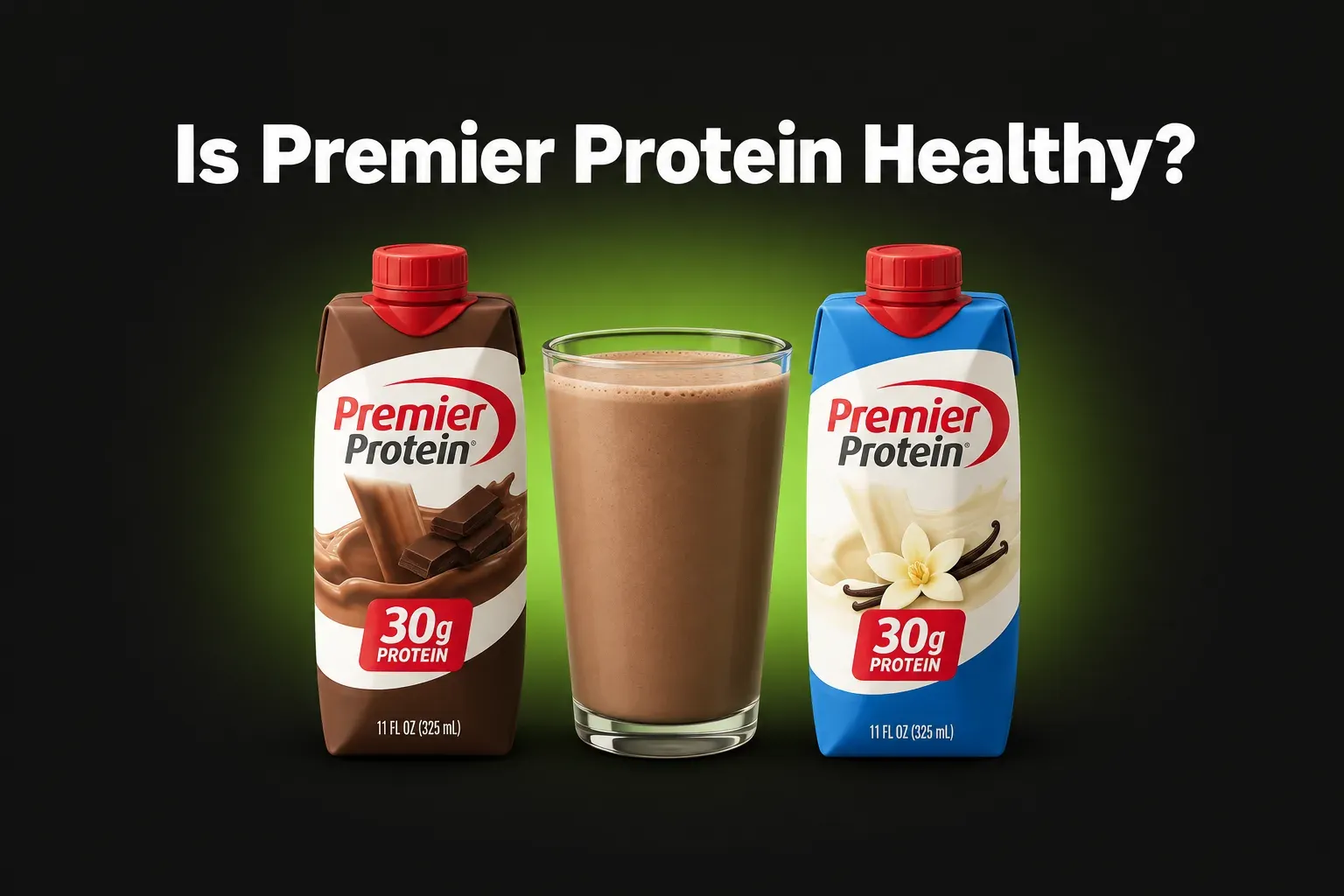
Premier Protein shakes are some of the most popular protein drinks in the US. They promise a lot of protein, few calories and almost no sugar. But is Premier Protein healthy, or just a well-made sweet drink?
The short answer: Premier Protein is a good protein source but not a health food. One 11 oz shake has 30 g of protein, 160 calories and only 1 g of sugar. That’s great for hitting a protein goal. But the shake is ultra-processed and sweetened with sucralose and acesulfame K. It also contains carrageenan, a thickener with mixed research. One shake a day is fine for most healthy adults. It shouldn’t replace real meals.
What’s in a Premier Protein shake
Here is the label of the Chocolate shake (11 oz / 325 ml). Other flavors are very close. Numbers come from the Premier Protein website.
| Per shake (11 oz) | Amount | Daily value |
|---|---|---|
| Calories | 160 | – |
| Protein | 30 g | 60% |
| Fat | 3 g (1 g saturated) | 4% |
| Carbs | 4 g (2 g fiber) | 1% |
| Sugar | 1 g (0 g added) | – |
| Sodium | 230 mg | 10% |
| Calcium | 650 mg | 50% |
| Vitamins and minerals | More than 20 added, most at 15–30% of daily value | – |
Source: Premier Protein Chocolate shake label, checked November 2026.
Ingredients: filtered water, milk protein concentrate, calcium caseinate, cocoa powder, sunflower or soybean oil, natural and artificial flavors, cellulose gel, cellulose gum, salt, sucralose, acesulfame potassium, carrageenan, potassium phosphates, sodium hexametaphosphate, a vitamin and mineral blend, magnesium phosphate and sodium ascorbate (vitamin C). It contains milk and soy.
The protein comes from milk. Milk protein concentrate and calcium caseinate are milk proteins with most of the sugar and fat removed. That’s why the shake is so low in sugar.
The good parts
A lot of protein for few calories. 30 g of protein is about as much as in 3.5 oz (100 g) of roasted chicken breast. The shake gives it to you for 160 calories.
Good quality protein. Milk protein is “complete”. That means it has all nine essential amino acids (protein building blocks your body can’t make). It’s also rich in leucine, which helps build muscle.
Almost no sugar. With 1 g of sugar and 0 g added, it’s far better than a milkshake or a sweet coffee drink.
Easy and filling. You can drink it in a car or at your desk. Protein helps you feel full longer than the same calories from carbs or fat.
It helps if you lift weights. A big review combined 49 trials with 1,863 adults. People who did strength training and took extra protein gained a bit more muscle and strength. But muscle gains stopped growing at about 1.6 g of protein per kg of body weight a day. That’s about 0.7 g per pound (Morton et al., British Journal of Sports Medicine, 2018). So the shake helps only if you’re short on protein.
Not sure how much protein you need? Use our protein calculator.
The not-so-good parts
It’s ultra-processed
Premier Protein is an ultra-processed food. It’s made mostly from refined parts of food plus additives you wouldn’t use at home. Open Food Facts puts it in the highest processing group (NOVA 4).
Does that matter for a protein shake? We don’t have studies on protein shakes alone. But in one well-known trial, 20 adults lived in a clinic for four weeks. For two weeks they ate ultra-processed meals, and for two weeks unprocessed meals. On the ultra-processed diet they ate about 500 more calories a day and gained weight (Hall et al., Cell Metabolism, 2019). One shake won’t do that. But a diet built on shakes and bars can push out real food.
Two artificial sweeteners
Premier uses sucralose (Splenda) and acesulfame K. The FDA and EFSA say both are safe at normal doses. Independent studies are less sure:
- Sucralose in mice. Male mice drank sucralose for 6 months at a dose equal to the human safe daily limit. Their gut bacteria changed, and their livers showed more signs of inflammation (Bian et al., Frontiers in Physiology, 2017).
- Acesulfame K in mice. Mice got acesulfame K for 4 weeks. Their gut bacteria changed, and the male mice gained more weight (Bian et al., PLOS ONE, 2017).
- Sucralose in people. 120 healthy adults took sweetener packets for 2 weeks, below the safe daily limit. Sucralose and saccharin made blood sugar rise more after a sugar drink. The effect was very different from person to person (Suez et al., Cell, 2022). Acesulfame K was not tested.
- A large French study. It followed 103,388 adults for years. People who had more acesulfame K and sucralose had a higher risk of heart disease (Debras et al., BMJ, 2022). This shows a link, not proof.
Why do mouse studies matter? Mice share most of our genes and body processes. And testing a possibly harmful dose on people for months would put their health at risk. So animal studies are often our first warning. Still, human proof of harm is missing. Since several labs see the same gut signal, it’s wise to limit sweeteners as a precaution. One shake a day is a small dose. Diet sodas, gum and sweetener packets add to it.
Carrageenan
Carrageenan is a thickener made from red seaweed. It keeps the shake smooth so the cocoa doesn’t settle.
- Mice got a small amount of carrageenan in their drinking water. They became worse at handling sugar. Their bodies also responded less to insulin (the hormone that moves sugar into cells) (Bhattacharyya et al., Diabetologia, 2012).
- In a small trial, 20 young men took 250 mg of carrageenan twice a day for 2 weeks. Overall there was no clear change. But in the men with extra weight, insulin worked less well. They also had more signs of inflammation. And the gut became a bit leakier (Wagner et al., BMC Medicine, 2024).
- A tiny trial looked at 12 people with ulcerative colitis (a bowel disease). Three who took carrageenan capsules had a flare-up. No one who took a placebo (a fake pill) did (Bhattacharyya et al., Nutrition and Healthy Aging, 2017).
These studies are small. But do you have a bowel disease or blood sugar problems? Then a shake without carrageenan is a safer pick.
Added phosphates
The shake has several phosphate additives. One shake gives 550 mg of phosphorus, or 45% of the daily value. The body absorbs added phosphate more easily than the natural kind in food. That’s fine for most people. But people with kidney disease are often told to limit it. Ask your doctor.
Premier Protein vs other protein shakes
| Shake | Calories | Protein | Sugar | Sweeteners | Carrageenan |
|---|---|---|---|---|---|
| Premier Protein (11 oz) | 160 | 30 g | 1 g | Sucralose, acesulfame K | Yes |
| Fairlife Core Power 26g (14 oz) | 170 | 26 g | 5 g (0 g added) | Sucralose, acesulfame K, monk fruit, stevia | Yes |
| Fairlife Core Power Elite 42g (14 oz) | 230 | 42 g | 7 g | Sucralose, acesulfame K, monk fruit, stevia | Yes |
| Fairlife Nutrition Plan (11.5 oz) | 150 | 30 g | 2 g | Sucralose, acesulfame K, monk fruit, stevia | Yes |
| Ensure Max Protein (11 oz) | 150 | 30 g | 1 g | Sucralose, acesulfame K | Yes |
| Muscle Milk (11 oz, 2026 recipe) | 160 | 26 g | 0 g added | Stevia | Not confirmed |
| Orgain 30g Protein Shake (11 oz) | 160 | 30 g | 1 g | Monk fruit, stevia | No |
| Homemade: 1 cup skim milk, 6 oz Greek yogurt, 1 tbsp cocoa | about 195 | about 27 g | about 18 g (natural, 0 g added) | None | No |
Chocolate flavors. Labels from Premier Protein, fairlife (Core Power, Core Power Elite, Nutrition Plan), Ensure (brand page, Abbott product sheet) and Open Food Facts (Orgain). Muscle Milk from the brand page, which does not give total sugar or the full ingredient list. Homemade shake from USDA FoodData Central: skim milk, nonfat Greek yogurt, cocoa powder.
What stands out:
- Premier and Ensure Max Protein are almost twins. Same protein, same sweeteners, both with carrageenan.
- Fairlife shakes are made from filtered milk, so they’re closer to real milk. But they use the same two artificial sweeteners and carrageenan. Read more in our guide on whether fairlife milk is healthy.
- Orgain’s 30 g shake skips artificial sweeteners and carrageenan, with the same protein.
- Muscle Milk changed its recipe in 2026 and now uses stevia instead of artificial sweeteners. We could not find the full chocolate ingredient list, so check the carton for carrageenan.
- The homemade shake has no additives at all. Its sugar is lactose (the natural sugar in milk), not added sugar. For more brands ranked, see the healthiest protein shakes.
Who Premier Protein suits – and who should skip it
It can be a good choice for:
- People who lift weights and struggle to eat enough protein.
- Older adults with a small appetite who need protein to keep their muscles.
- People losing weight who want a filling, low-calorie snack.
- Busy days, when the other choice is a pastry or fast food.
Be careful or skip it if you:
- Have kidney disease – ask your doctor about protein and phosphate first.
- Have a milk allergy, or a soy allergy (the label lists soy).
- Have ulcerative colitis, Crohn’s disease or a sensitive gut.
- Want to avoid artificial sweeteners.
- Are a child or teen – kids rarely need protein shakes. Food is better.
How to drink it smarter
- Stick to one shake a day. Get the rest of your protein from food. See our list of high-protein foods.
- Use it as a snack or a meal add-on, not as a full meal. A shake has no vegetables, whole grains or fruit. The label itself says to use it “as a food supplement only.”
- Pair it with real food. A shake with a banana or oats makes a better breakfast. Eggs, yogurt and fruit work well too.
- Try a powder you mix yourself if you want fewer additives. Our guide to the healthiest protein powder shows what to look for.
- Mix up your snacks. Protein bars often have the same sweeteners, so don’t stack them all day.
See what’s really in your protein shake. With NutriSmart, you photograph the label or scan the barcode. The app lists the sweeteners, preservatives and colors, explains the risks of each one and gives the product a health score out of 100. It also tells you right away if a product is ultra-processed and which ingredients make it so. You can also set an alert for carrageenan or sucralose. Then the app warns you every time a scanned product contains it.Get the app free
The bottom line
Premier Protein is a handy way to get 30 g of protein for 160 calories and almost no sugar. That makes it useful for muscle, a filling snack and busy days. But it’s ultra-processed, with two artificial sweeteners, carrageenan and added phosphates. Research on these is mixed, and human proof of harm is missing. So keep it to about one shake a day, and get most of your protein from real food. If you want fewer additives, pick a shake without artificial sweeteners or make your own.
FAQ
Is Premier Protein healthy?
It's a useful protein source, but not a health food. One shake has 30 g of protein, 160 calories and 1 g of sugar. It is also ultra-processed, with two artificial sweeteners and carrageenan. One a day is a sensible limit.
Is it OK to drink a Premier Protein shake every day?
For most healthy adults, one shake a day is fine. Two or more a day adds up the sweeteners and additives. Try to get most of your protein from foods like eggs, fish, beans, yogurt and meat.
Is Premier Protein good for weight loss?
It can help. Protein keeps you full, and one shake has only 160 calories. But it doesn't burn fat. The label also says to use it as a food supplement only, not for weight reduction. You still need to eat a bit less than you burn.
What sweeteners are in Premier Protein?
Sucralose and acesulfame potassium (acesulfame K). Both are approved in the US and EU. Some animal studies and large human studies have raised questions. So it's wise not to have them all day long.
Does Premier Protein have carrageenan?
Yes. The current chocolate shake label lists carrageenan, a thickener made from seaweed. In mice it made blood sugar control worse. A small human trial saw similar early signs in men with extra weight.
What is a healthier alternative to Premier Protein?
A homemade shake with milk, plain Greek yogurt and cocoa has about 27 g of protein and no sweeteners. Among ready-to-drink shakes, Orgain's 30 g shake skips sucralose, acesulfame K and carrageenan.