Is Chocolate Milk Healthy? Sugar, Protein and 7 Brands
Is chocolate milk healthy? Sugar, protein and calcium vs plain milk, the recovery drink research, school milk rules and 7 brands compared.
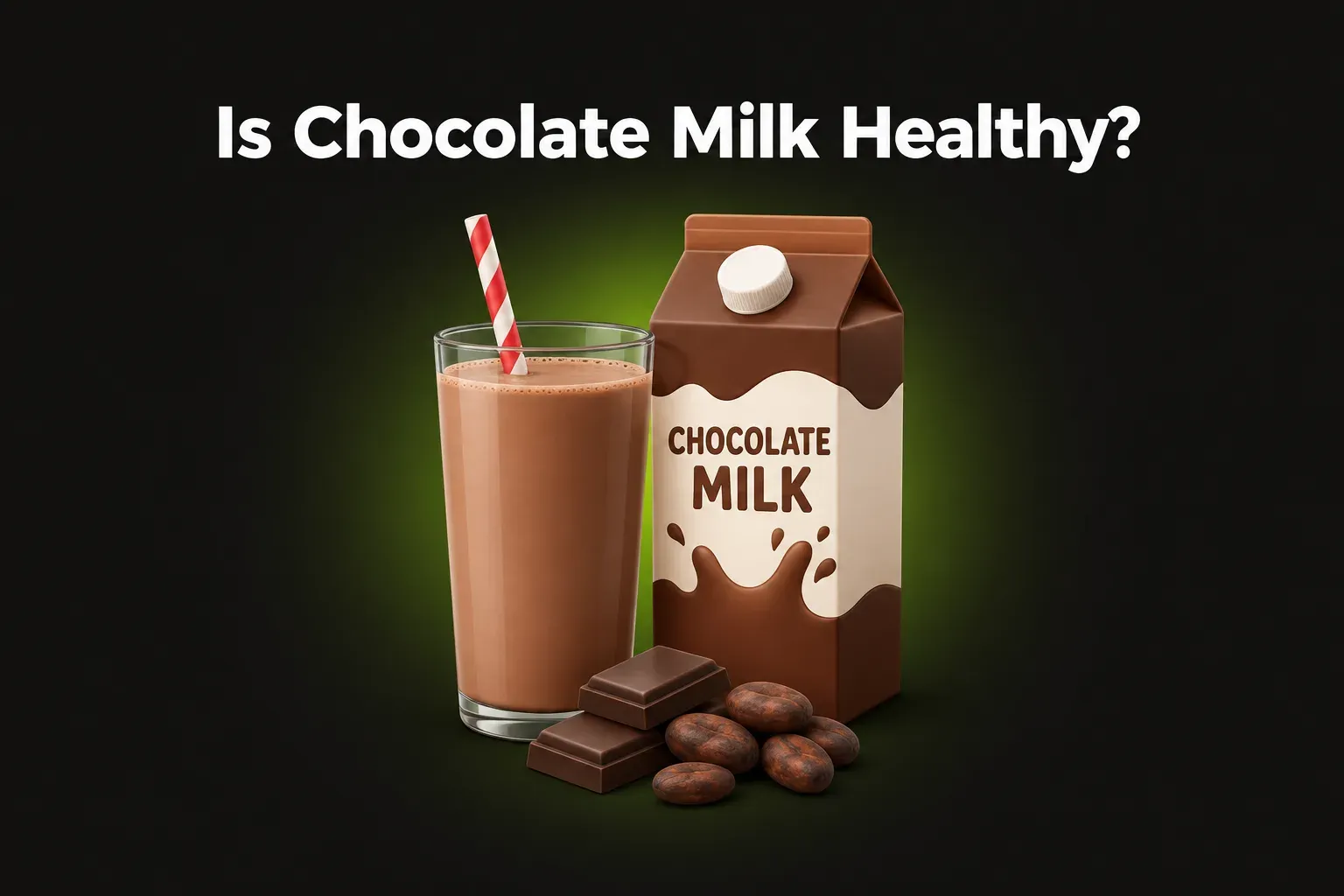
Chocolate milk is a lunchbox classic, a school cafeteria staple and a favorite after-practice drink. But is chocolate milk healthy, or is it closer to a soda?
The short answer: chocolate milk is somewhere in between. A cup has the same 8 g of protein, calcium and vitamin D as plain milk. But most brands add about 10 g of sugar, and some add up to 16 g. That makes it a fine occasional drink or recovery drink after a long, hard workout. It’s not the best choice every day. Pick brands with less added sugar and no carrageenan, and keep it out of toddlers’ cups.
Chocolate milk vs plain milk per cup
Here is how one cup (8 oz / 240 ml) of chocolate milk compares with plain milk. The numbers are from the USDA food database.
| Milk (1 cup) | Calories | Protein | Sugar | Calcium | Saturated fat | Sodium |
|---|---|---|---|---|---|---|
| Whole milk | 149 | 7.7 g | 12 g | 276 mg | 4.5 g | 105 mg |
| Whole chocolate milk | 208 | 7.9 g | 24 g | 280 mg | 5.3 g | 150 mg |
| 2% milk | 122 | 8.1 g | 12 g | 293 mg | 3.1 g | 115 mg |
| 2% chocolate milk | 190 | 7.5 g | 24 g | 273 mg | 3.0 g | 165 mg |
| 1% chocolate milk | 160 | 8.7 g | 25 g | 323 mg | 1.5 g | 163 mg |
| Skim milk | 83 | 8.3 g | 12 g | 299 mg | 0.1 g | 103 mg |
Source: USDA FoodData Central – whole milk, whole chocolate, 2% milk, 2% chocolate, 1% chocolate, skim. Values per 100 g, multiplied to one cup (244–250 g) and rounded.
What stands out:
- Protein and calcium stay the same. Chocolate milk is still milk. You get about 8 g of protein and about 270–320 mg of calcium per cup.
- Sugar doubles. Plain milk has about 12 g of lactose, the natural sugar in milk. Chocolate milk adds about 12 g more. That’s about 3 teaspoons.
- Calories go up by about 60–70 per cup.
- Sodium goes up a little, because many brands add salt.
How much is 10–12 g of added sugar? The American Heart Association says women should stay under 25 g a day and men under 36 g (Johnson et al., Circulation, 2009). Kids aged 2–18 should also stay under 25 g a day (Vos et al., Circulation, 2017). So one cup of chocolate milk uses up about 40% of a child’s daily limit.
9 chocolate milks and mixes compared
Brands differ more than you might think. Here are 7 ready-to-drink chocolate milks and 2 mixes, per 1 cup.
| Product | Calories | Sugar (added) | Protein | Thickeners and other additives |
|---|---|---|---|---|
| Nesquik Chocolate Lowfat Milk | about 145 | 23 g (10 g) | 8 g | Carrageenan, gellan gum, cellulose gel and gum |
| TruMoo Chocolate 1% Lowfat Milk | 150 | 22 g (10 g) | 8 g | Carrageenan |
| fairlife Chocolate 2% | 140 | 12 g (6 g) | 13 g | Carrageenan, sucralose, acesulfame K |
| Horizon Organic Lowfat Chocolate (box) | 150 | 22 g (10 g) | 8 g | Gellan gum |
| Hershey’s a2 Milk Chocolate (reduced fat) | 150 | 21 g (not listed) | 8 g | Gellan gum, guar gum |
| Organic Valley Lowfat 1% Chocolate (lactose-free) | 150 | 21 g (10 g) | 8 g | Gellan gum |
| Darigold Old Fashioned Chocolate (reduced fat) | 220 | 31 g (16 g) | 11 g | Gellan gum |
| Nesquik Chocolate Powder (2 tbsp) + 2% milk | about 170 | 22 g (10 g) | 8 g | Carrageenan, soy lecithin |
| Hershey’s Syrup (2 tbsp) + 2% milk | about 210 | 32 g (20 g) | 8 g | Xanthan gum, polysorbate 60, potassium sorbate |
Sources: brand sites for TruMoo, fairlife, Horizon, Hershey’s a2 Milk, Organic Valley, Darigold and Hershey’s Syrup; Open Food Facts for Nesquik Lowfat Milk (14 oz bottle: 250 calories, 39 g sugar, 18 g added, 14 g protein – shown here per cup) and Nesquik Powder. Mixes add 1 cup of 2% milk from USDA. The Hershey’s a2 site lists only total sugar. Since plain 2% milk has about 12 g of lactose, its added sugar is likely about 9 g. Checked November 2026 – recipes change, so check the carton.
A few things to notice:
- Most brands land at about 10 g of added sugar. That matches the new limit for school milk (more on that below).
- fairlife has the least sugar and the most protein. It’s ultra-filtered, which removes some lactose and keeps more protein. But it gets part of its sweetness from sucralose and acesulfame K. Read more: is fairlife milk healthy?
- Darigold Old Fashioned has the most added sugar: 16 g per cup.
- Horizon, Organic Valley, Hershey’s a2 and Darigold use gellan gum instead of carrageenan.
- Mixes aren’t automatically better. Nesquik powder adds the same 10 g of sugar as the bottles. Two tablespoons of Hershey’s Syrup add 20 g, mostly from high fructose corn syrup and corn syrup.
- The big upside of a mix: you control the dose. One tablespoon instead of two cuts the added sugar in half.
Is chocolate milk a good recovery drink?
Chocolate milk became famous as a sports drink after a few small studies. It has carbs to refuel your muscles, protein to repair them, plus water and salts.
- Karp 2006. Nine trained male cyclists did a hard workout and then rested for 4 hours. During the rest, they drank chocolate milk, a sports drink or a high-carb recovery drink. Then they rode until they were exhausted. With chocolate milk or the sports drink, they rode longer than with the carb drink (Karp et al., International Journal of Sport Nutrition and Exercise Metabolism, 2006). The study was partly funded by the Dairy & Nutrition Council (SupplySide).
- Thomas 2009. Another group tested nine trained male cyclists in the UK. After chocolate milk, they rode about 32 minutes. After two other recovery drinks, they rode about 21 and 23 minutes (Thomas et al., Applied Physiology, Nutrition, and Metabolism, 2009).
- Amiri 2019. This review looked at 12 studies in trained athletes. Overall, chocolate milk worked about as well as other sports drinks. Compared with a placebo (a fake drink), it helped people last a bit longer. The authors said the evidence is limited. Most studies were small, and only two were high quality (Amiri et al., European Journal of Clinical Nutrition, 2019).
So chocolate milk is a decent recovery drink. But it isn’t magic. These studies tested long, hard endurance workouts. After a 30-minute walk or a light gym session, you don’t need extra sugar. Water and your next meal are enough. Compare it with sports drinks in is Gatorade healthy?
The school milk debate
Chocolate milk is a big part of school lunch in the US. In one comment to the USDA, a school district said 90% of the milk it serves is flavored. That’s why flavored milk is at the center of the school sugar debate.
Here is where things stand:
- The 2024 rule. The USDA set a limit for flavored milk in school meals. Starting in the 2025–26 school year, it can have no more than 10 g of added sugar per 8 oz. For flavored milk sold separately in middle and high schools, the limit is 15 g per 12 oz (Federal Register, 2024).
- The dairy pledge. In 2023, school milk makers promised to meet the same 10 g limit. They said they make more than 90% of US school milk (same source).
- The 2026 law. In January 2026, the Whole Milk for Healthy Kids Act became law. Schools can now offer whole and 2% milk again, flavored or plain (IDFA).
Why not just ban chocolate milk? Some school districts say kids won’t drink milk without it. A review of 53 studies found the same pattern. When flavored milk was taken away, children drank less plain milk and less milk overall. The review found no link between flavored milk and weight in normal-weight kids (Fayet-Moore, Nutrition Reviews, 2016). Critics answer that kids already eat too much added sugar. Both points are fair. A 10 g cap is a middle path.
Chocolate milk for kids
Experts agree on the youngest kids:
- Under 2: no added sugar at all, says the American Heart Association (Vos et al., Circulation, 2017).
- Up to age 5: in 2019, a panel of experts gave advice on drinks for young kids. It included the American Academy of Pediatrics, the American Heart Association and two other health groups. The panel advised against flavored milk for children in this age group (Healio, 2019).
- Older kids: a small glass now and then is fine. It’s a better choice than soda or fruit punch, because it brings protein and calcium.
Tips for parents:
- Mix half and half. Pour half chocolate milk and half plain milk. Over a few weeks, use less chocolate milk.
- Make your own. Stir 1 teaspoon of unsweetened cocoa and 1 teaspoon of sugar or maple syrup into a cup of warm milk. That’s about 4 g of added sugar instead of 10.
- Keep it as a treat, not with every meal.
Which plain milk is best for your family? See our guide to the healthiest milk.
Carrageenan, gellan gum and sweeteners
Cocoa powder doesn’t dissolve in milk. Without help, it sinks to the bottom. So most brands add a thickener to keep it mixed.
Carrageenan is the most common one. It’s made from red seaweed. Nesquik, TruMoo, fairlife and Nesquik powder list it. Regulators in the US and EU allow it. But independent labs have found warning signs:
- In mice. Mice got carrageenan in their drinking water (10 mg per liter). Their blood sugar stayed higher after a sugar test. Their bodies also responded less to insulin, the hormone that lowers blood sugar (Bhattacharyya et al., Diabetologia, 2012).
- In people. 20 young men took 250 mg of carrageenan twice a day for two weeks. Overall, insulin worked just as well. But in the overweight men, insulin worked less well. Their signs of inflammation (the body’s alarm response) also went up (Wagner et al., BMC Medicine, 2024).
Why do mouse studies matter? Mice share most of our genes and body processes. And testing a food additive on people for years would put their health at risk. Clear proof of harm in people is still missing. But several labs see the same signal, and carrageenan only adds texture. So it makes sense to limit it as a precaution.
Gellan gum looks gentler. In one study, 10 volunteers ate large amounts every day for 23 days. It acted like fiber. Their blood tests, blood sugar and insulin didn’t change (Anderson et al., Food Additives and Contaminants, 1988).
Sucralose and acesulfame K in fairlife cut the sugar. But they have open questions too:
- Mice drank sucralose for six months, at the daily limit allowed for people. Their gut bacteria changed, and their livers showed signs of inflammation (Bian et al., Frontiers in Physiology, 2017).
- Mice got acesulfame K (37.5 mg per kg of body weight a day) for four weeks. Their gut bacteria changed, and the males gained more weight (Bian et al., PLoS One, 2017).
- A French study followed over 100,000 adults. People who took in more acesulfame K or sucralose had a higher risk of heart disease (Debras et al., BMJ, 2022). This kind of study shows a link, not proof.
How to pick a healthier chocolate milk
- Check the added sugar. Aim for 10 g or less per cup. Skip brands with 15 g or more.
- Look at the serving size. A 14 oz bottle is almost two cups. The Nesquik bottle has 18 g of added sugar.
- Look for gellan gum instead of carrageenan.
- Decide how you feel about sweeteners. Low-sugar brands often use sucralose or acesulfame K.
- Pick lowfat or 2% if you’re watching calories. Whole chocolate milk has about 210 calories per cup.
- Drink it after hard exercise, when your muscles can use the carbs.
Need to know how much protein you need each day? Try our protein calculator.
Check your chocolate milk before you buy it. With NutriSmart, you photograph the label or scan the barcode. The app lists the sweeteners, preservatives and colors, explains the risks of each one and gives the product a health score out of 100. It also tells you right away if a chocolate milk is ultra-processed, and which ingredients make it so. Set an alert for carrageenan or sucralose. The app then warns you whenever a product you scan contains one of them.Get the app free
The bottom line
Chocolate milk is not junk food, but it’s not plain milk either. A cup has the same protein, calcium and vitamin D as plain milk. It also has about 10 g of added sugar, or about 2.5 teaspoons. It’s a good recovery drink after long, hard workouts, and a better choice than soda. For everyday drinking, plain milk is healthier. Keep it away from kids under 2, and limit it for kids under 5. In the store, choose 10 g of added sugar or less and gellan gum instead of carrageenan. Or make your own with unsweetened cocoa and a little sugar.
FAQ
Is chocolate milk healthy?
It's a mix of good and not so good. A cup has the same protein, calcium and vitamin D as plain milk. But most brands add about 10 g of sugar, so it works best as an occasional drink, not an everyday one.
How much sugar is in chocolate milk?
Most chocolate milks have about 21–25 g of sugar per cup. About 12 g is lactose, the natural sugar in milk. The rest, usually about 10 g, is added sugar. One brand we checked adds 16 g.
Is chocolate milk good after a workout?
It can be, after long or hard workouts. Small studies in trained cyclists found it worked as well as sports drinks, or a bit better. Some of this research was paid for by the dairy industry, and the evidence is still limited.
Is chocolate milk better than soda?
Yes, in most ways. A cup has about 8 g of protein, plus calcium, vitamin D and potassium. A soda has none of these. But both contain added sugar, so neither should be an everyday drink.
Can kids drink chocolate milk?
Children under 2 should have no added sugar at all. A panel that included the American Academy of Pediatrics advised against flavored milk for children up to age 5. Older kids can have a small glass now and then.
Does chocolate milk have caffeine?
Only a tiny amount. The USDA lists about 2–3 mg of caffeine per cup. That's a small fraction of the caffeine in a cup of coffee.