Nitrates and Nitrites in Food: Bad for You or Not?
Why nitrates and nitrites in bacon and ham (E249–E252) are linked to cancer, while nitrates in vegetables like beets and spinach are good for you.
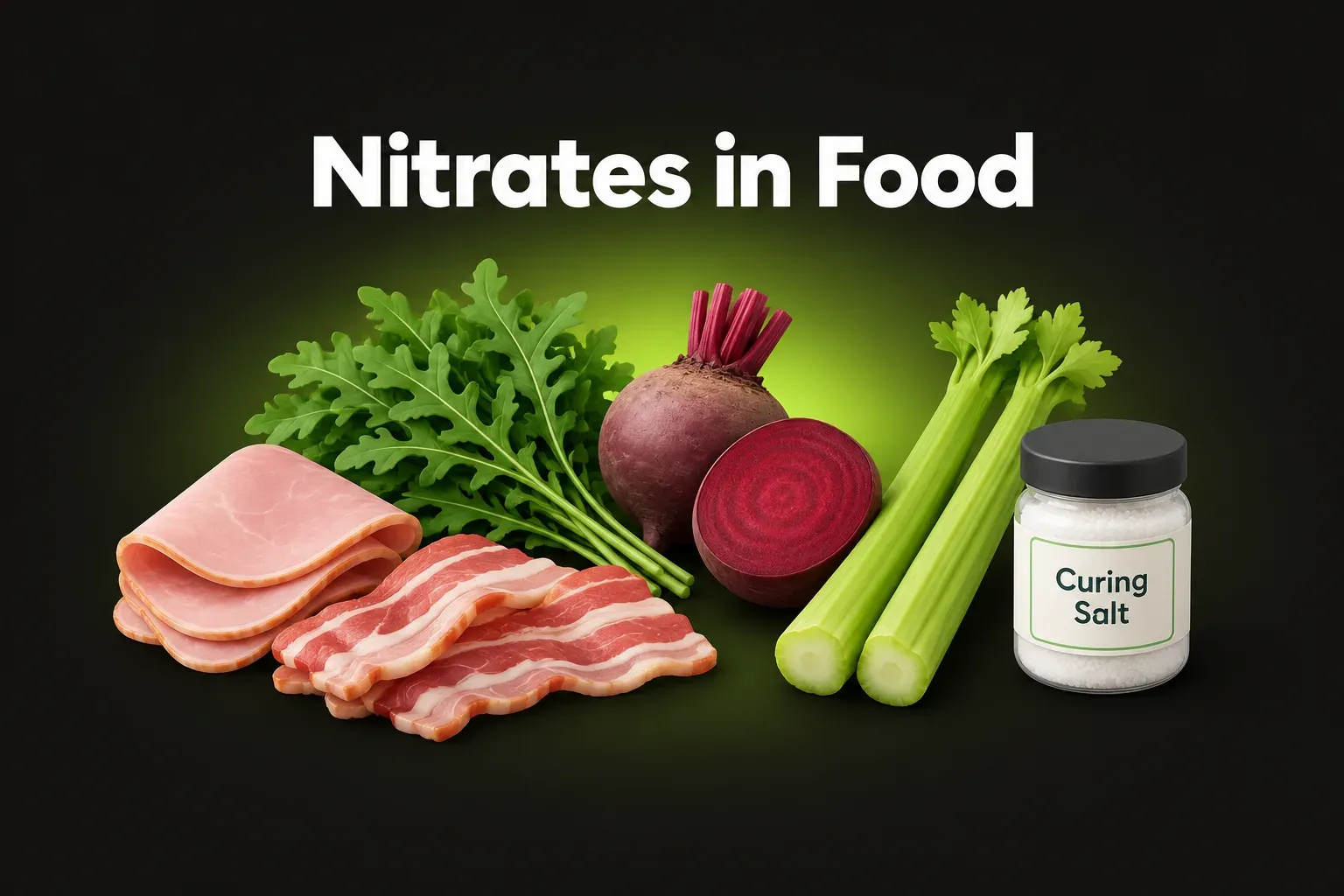
You’ve probably seen “no nitrates added” on bacon packs, and maybe also heard that beet juice is full of nitrates – and good for you. So are nitrates in food harmful or healthy?
The short answer: it depends on where they come from. Nitrates and nitrites added to processed meat – bacon, ham, hot dogs, salami – can turn into nitrosamines, which are linked to cancer. The WHO cancer agency calls processed meat a cause of colorectal cancer. Nitrates in vegetables like spinach, arugula and beets are a different story: they come with vitamin C and plant compounds that block nitrosamines, and they can even lower blood pressure. Limit cured meat; don’t worry about vegetables.
Nitrates vs nitrites
- Nitrate (NO₃) is a natural compound found in soil, water and plants.
- Nitrite (NO₂) has one less oxygen atom. Bacteria in your mouth and gut turn nitrate into nitrite.
- In meat, nitrite is the active form: it stops the bacteria that cause botulism, keeps meat pink and gives cured meat its taste.
The problem starts when nitrite meets amines, small pieces of protein. This happens most in the stomach, which is acidic, or at high heat, like when you fry bacon. Then it can form nitrosamines. Many nitrosamines cause cancer in animals.
The four nitrate and nitrite additives
| Additive | E number | Used in | NutriSmart risk |
|---|---|---|---|
| Potassium nitrite | E249 | Cured meat | High |
| Sodium nitrite | E250 | Bacon, ham, hot dogs, deli meat, sausages | High |
| Sodium nitrate | E251 | Dry-cured ham and sausages, some cheeses | High |
| Potassium nitrate | E252 | Dry-cured ham and salami, some cheeses, pickled herring | High |
In Europe, sodium nitrite is often sold as curing salt – regular salt with a little nitrite mixed in.
Where nitrates and nitrites come from
| Source | Examples | Comes with |
|---|---|---|
| Vegetables (about 80% of the nitrate we eat) | Arugula, spinach, lettuce, beets, celery, radishes | Vitamin C, polyphenols, fiber |
| Processed meat (added nitrite and nitrate) | Bacon, ham, hot dogs, salami, deli meat | Protein, fat, salt |
| Drinking water | Wells near farmland | – |
Nitrites in processed meat: what the research says
Cancer
- In 2015, the WHO’s cancer agency (IARC) classed processed meat as a cause of colorectal cancer. Every 50 g a day – about two slices of ham – raises the risk by about 18% (Bouvard et al., Lancet Oncology, 2015). Nitrites and nitrosamines are thought to be one of the main reasons.
- IARC also says that nitrates and nitrites are “probably carcinogenic” (probably cause cancer) when they form nitrosamines in the body (IARC Monographs, volume 94, 2010).
- In the French NutriNet-Santé study of over 100,000 adults, nitrates from additives were linked to more breast cancer, and nitrites from additives to more prostate cancer. Nitrates from vegetables were not linked to cancer (Chazelas et al., International Journal of Epidemiology, 2022).
Type 2 diabetes
In the same French group, people who ate the most nitrites from additives had about a 50% higher risk of type 2 diabetes (Srour et al., PLOS Medicine, 2023).
Too much at once
In large amounts, nitrites stop the blood from carrying oxygen. Doctors call this methemoglobinemia. Babies are the most sensitive – mainly from well water high in nitrate. In meat, the amounts are far too small for this, but there have been poisonings when pure curing salt was mistaken for table salt.
What regulators are doing
In 2023, the EU lowered the maximum amounts of nitrites and nitrates allowed in meat products, to reduce nitrosamines (EU Regulation 2023/2108). The new limits apply from October 2025.
Nitrates in vegetables: why they’re different
Vegetables give us most of our nitrate, yet diets rich in vegetables are linked to less cancer and heart disease, not more. Why?
- Vitamin C and polyphenols in vegetables block nitrosamines from forming.
- Vegetables have little protein, so there are fewer amines for nitrite to react with.
- Some of the nitrite turns into nitric oxide, which relaxes blood vessels. In studies, beet juice and other nitrate-rich vegetables lowered blood pressure (Siervo et al., Journal of Nutrition, 2013).
So there’s no reason to avoid spinach, arugula or beets.
What about “uncured” and “no nitrates added” meat?
These products are usually cured with celery powder or celery juice, which is naturally rich in nitrate. Bacteria turn it into nitrite – the same compound as in regular cured meat. In the US, the label must say “no nitrates or nitrites added except those naturally occurring in celery powder”. They aren’t clearly safer.
How to eat fewer nitrites
- Eat processed meat less often – bacon, ham, hot dogs, salami and deli meat. See our guides to the healthiest deli meat and calories in a hot dog.
- Don’t burn or char cured meat – cook bacon at medium heat and don’t let it blacken.
- Choose fresh meat, fish, eggs or beans for sandwiches.
- Eat vegetables and fruit with your meals – vitamin C helps block nitrosamines.
- Don’t trust “uncured” labels – check for celery powder.
Spot nitrites and nitrates on any label in seconds. With NutriSmart, you photograph the ingredient list or scan the barcode, and the app tells you right away if the product has E249, E250, E251 or E252. Turn on an alert for them, and the app warns you every time a product you scan contains them. You’ll also see every other additive, the risks of each one and a health score out of 100.Get the app free
You can also read about ultra-processed food and E numbers.
The bottom line
Nitrates and nitrites aren’t all the same. Those added to processed meat (E249–E252) can form nitrosamines and are linked to colorectal, breast and prostate cancer and to type 2 diabetes – NutriSmart rates them all at its highest risk level. Nitrates in vegetables come with vitamin C and other compounds that block nitrosamines, and they can even lower blood pressure. Cut back on cured meat, and keep eating your greens and beets.
FAQ
Are nitrates in food bad for you?
It depends on where they come from. Nitrates and nitrites added to processed meat (E249–E252) can form nitrosamines, which are linked to cancer. Nitrates in vegetables come with vitamin C and other plant compounds that block nitrosamines, and they can even lower blood pressure.
What foods have nitrates?
Most nitrates in our diet come from vegetables like arugula, spinach, lettuce, beets and celery. Added nitrates and nitrites are found in bacon, ham, hot dogs, salami, sausages and deli meats, and in some cheeses and pickled fish.
What is the difference between nitrates and nitrites?
Nitrate has one more oxygen atom than nitrite. Your body and bacteria turn nitrate into nitrite. Nitrite is the active form that preserves meat and keeps it pink – and the form that can make nitrosamines.
Are uncured or no nitrates added meats better?
Not really. "Uncured" bacon and ham are usually cured with celery powder or celery juice, which is naturally rich in nitrate. It turns into nitrite just like the added kind. The label is legal, but the meat still contains nitrite.
How can I reduce nitrosamines from bacon?
Eat processed meat less often, don't burn or char it, cook bacon at medium heat, and eat it with vegetables or fruit rich in vitamin C. Choosing fresh meat over cured meat is the biggest step.
What risk level does NutriSmart give nitrites and nitrates?
NutriSmart rates sodium nitrite (E250), potassium nitrite (E249), sodium nitrate (E251) and potassium nitrate (E252) at its highest risk level, because they can form nitrosamines that may cause cancer.