How Many Calories in an Orange? Small, Medium & Large
How many calories are in a small, medium or large orange and per 100 g, plus sugar, fiber and vitamin C, orange vs orange juice, and oranges for weight loss.
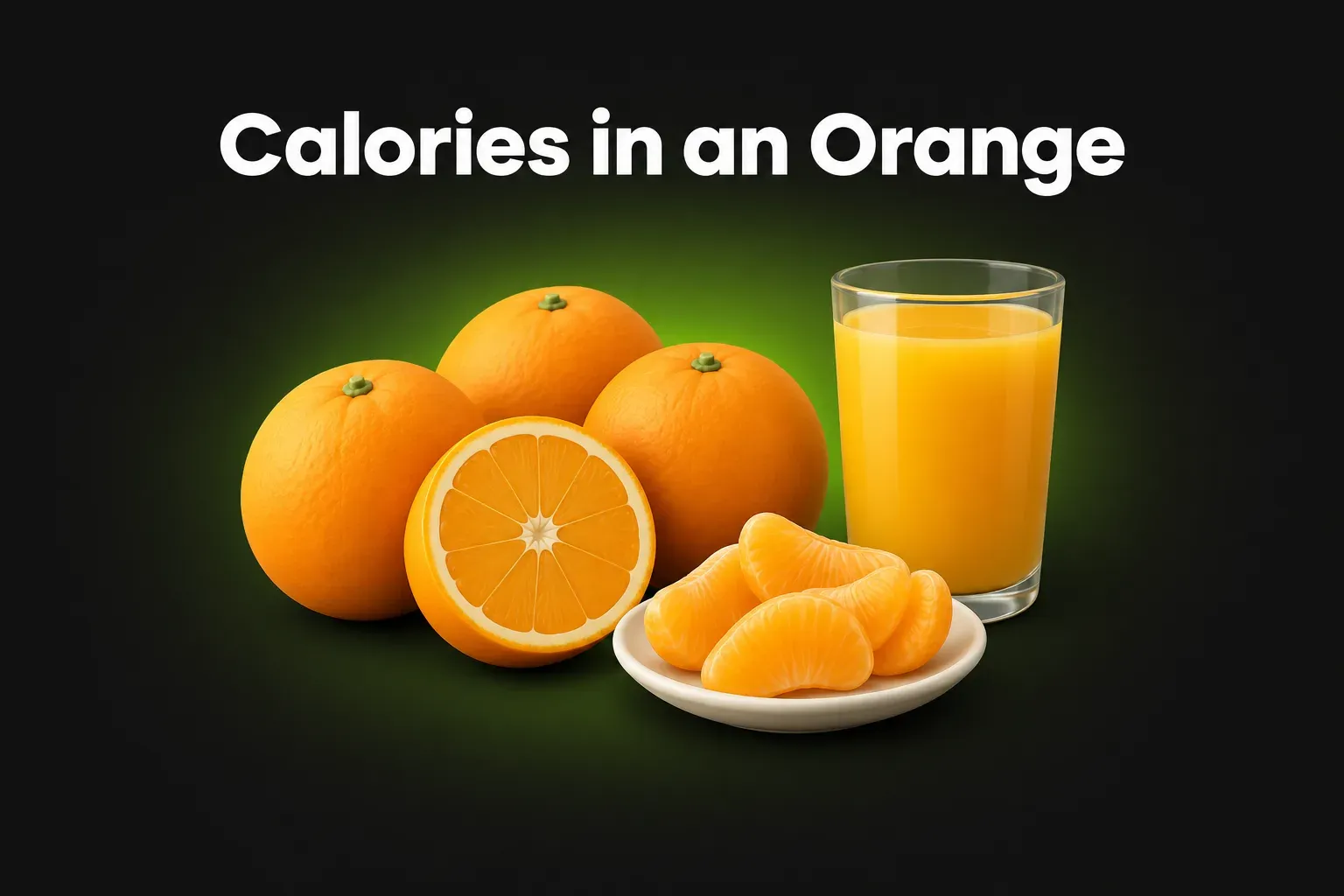
Oranges are sweet, juicy and packed with vitamin C – and they come in their own wrapper. If you’re counting calories, you might wonder how many calories an orange has, and whether a glass of orange juice is just as good.
The short answer: a medium orange (131 g without the peel) has about 62 calories, and 100 g of orange has 47 calories. Oranges are 87% water, have a good amount of fiber and a low glycemic index, and a medium one gives you about 75% of your daily vitamin C. Orange juice has more calories per serving and much less fiber.
Calories in an orange by size
Values are for raw orange without the peel, from the US Department of Agriculture (USDA FoodData Central):
| Size (width) | Weight | Calories |
|---|---|---|
| Small (2.4 in) | 96 g | 45 kcal |
| Medium (2.6 in) | 131 g | 62 kcal |
| Navel orange (2.9 in) | 140 g | 69 kcal |
| Large (3.1 in) | 184 g | 86 kcal |
| 1 cup, sections | 180 g | 85 kcal |
| 100 g | 100 g | 47 kcal |
Tip: the peel is about a quarter to a third of an orange’s weight. If you weigh a whole orange, the part you eat is roughly 70–75% of that.
Orange nutrition facts
| Nutrient | Per 100 g | Per medium orange (131 g) |
|---|---|---|
| Calories | 47 kcal | 62 kcal |
| Carbohydrates | 11.8 g | 15.4 g |
| – of which sugars | 9.4 g | 12.2 g |
| Fiber | 2.4 g | 3.1 g |
| Protein | 0.9 g | 1.2 g |
| Fat | 0.1 g | 0.2 g |
| Water | 87 g | 114 g |
| Vitamin C | 53 mg | 70 mg |
| Folate | 30 µg | 39 µg |
| Potassium | 181 mg | 237 mg |
An orange is mostly water and natural sugar, with about 3 g of fiber – much of it soluble fiber in the white pith and the thin skin around each segment. And of course there’s vitamin C: a medium orange covers about three quarters of your daily needs, a large one almost all of it.
Orange vs orange juice
| Per serving | Calories | Sugar | Fiber |
|---|---|---|---|
| 1 medium orange (131 g) | 62 kcal | 12 g | 3.1 g |
| Fresh orange juice, 1 cup (8 fl oz) | 112 kcal | 21 g | 0.5 g |
| Store-bought orange juice, 1 cup | about 110–120 kcal | about 21 g | about 0.5 g |
| Orange soda, 12 fl oz can | about 170–190 kcal | about 45 g | 0 g |
A cup of orange juice takes 2–3 oranges to make, so it has almost twice the calories of one orange – but almost none of the fiber. You drink it in seconds, and it doesn’t fill you up. If you love juice, keep it to a small glass, or dilute it with sparkling water.
Calories in other citrus fruits
| Fruit | Portion | Calories |
|---|---|---|
| Mandarin (tangerine) | 1 medium (88 g) | 47 kcal |
| Clementine | 1 small (about 70 g) | about 35 kcal |
| Grapefruit | ½ medium (123 g) | about 52 kcal |
| Canned mandarin oranges in juice | ½ cup | about 46 kcal |
| Canned mandarin oranges in syrup | ½ cup | about 80 kcal |
Are oranges good for weight loss?
Yes. Oranges have few calories, lots of water and some fiber, and you need a few minutes to peel and eat them – which helps you feel satisfied. A whole orange is a good swap for candy, cookies or juice.
Remember that you lose weight only when you eat fewer calories than you burn. Read more about the calorie deficit and find your number with our calorie calculator. For more ideas, see our list of low calorie snacks.
Oranges and blood sugar
Whole oranges have a low glycemic index of about 40–45, thanks to their fiber and water. Orange juice raises blood sugar faster, because the fiber is gone and you take in more sugar at once. If you have diabetes, a whole orange is usually a better choice than juice – ask your doctor or dietitian what fits your plan. Read more about low glycemic fruits.
How to eat oranges when you’re losing weight
- Eat the whole fruit instead of drinking juice.
- Keep some of the white pith – it’s where much of the fiber is.
- Have one as a snack or dessert instead of sweets.
- Add segments to salads with spinach, chicken or fish.
- Pair it with protein – Greek yogurt, cottage cheese or a handful of nuts.
Count the calories in your orange without guesswork. With NutriSmart, you snap a photo of what you eat, and the app counts your calories, protein, carbs and fat and shows how much you have left for the day. In the food library, you can also see the glycemic index of each food.Get the app free
You can also read how many calories are in an apple and a banana.
The bottom line
A medium orange has about 62 calories, and 100 g of orange about 47. Oranges are mostly water, give you about 3 g of fiber and three quarters of your daily vitamin C, and have a low glycemic index. Eat the whole fruit rather than the juice, and it’s an easy, filling snack when you’re losing weight.
FAQ
How many calories are in an orange?
A medium orange (about 2.6 inches across, 131 g without the peel) has about 62 calories. A small orange (96 g) has about 45 calories, and a large one (184 g) about 86. A medium navel orange (140 g) has about 69.
How many calories are in 100 g of orange?
About 47 calories. 100 g of orange has 11.8 g of carbs (9.4 g of sugar), 2.4 g of fiber, 0.9 g of protein, almost no fat and about 53 mg of vitamin C.
Is orange juice as healthy as an orange?
Not quite. A cup of orange juice (8 fl oz) has about 112 calories – almost two medium oranges' worth – but only a fraction of the fiber, so it fills you up much less. Eat the whole fruit most of the time.
Are oranges good for weight loss?
Yes. An orange has few calories, lots of water and fiber, and takes time to peel and eat. It's a good swap for sweets or juice. Pair it with some protein, like yogurt or nuts, to stay full longer.
How much vitamin C is in an orange?
A medium orange has about 70 mg of vitamin C, roughly 75% of what an adult needs in a day. A large orange or a navel orange gives you close to a full day's worth.
How many calories are in a mandarin or clementine?
A medium mandarin (tangerine) of about 88 g has around 47 calories, and a small clementine about 35. They have a little more sugar per 100 g than oranges, but they're smaller.