Is Ghost Energy Bad for You? Caffeine, Sweeteners and Risks
Is Ghost Energy bad for you? What's in a can – 200 mg caffeine, sucralose, acesulfame K, Alpha-GPC – what studies show and who should skip it.
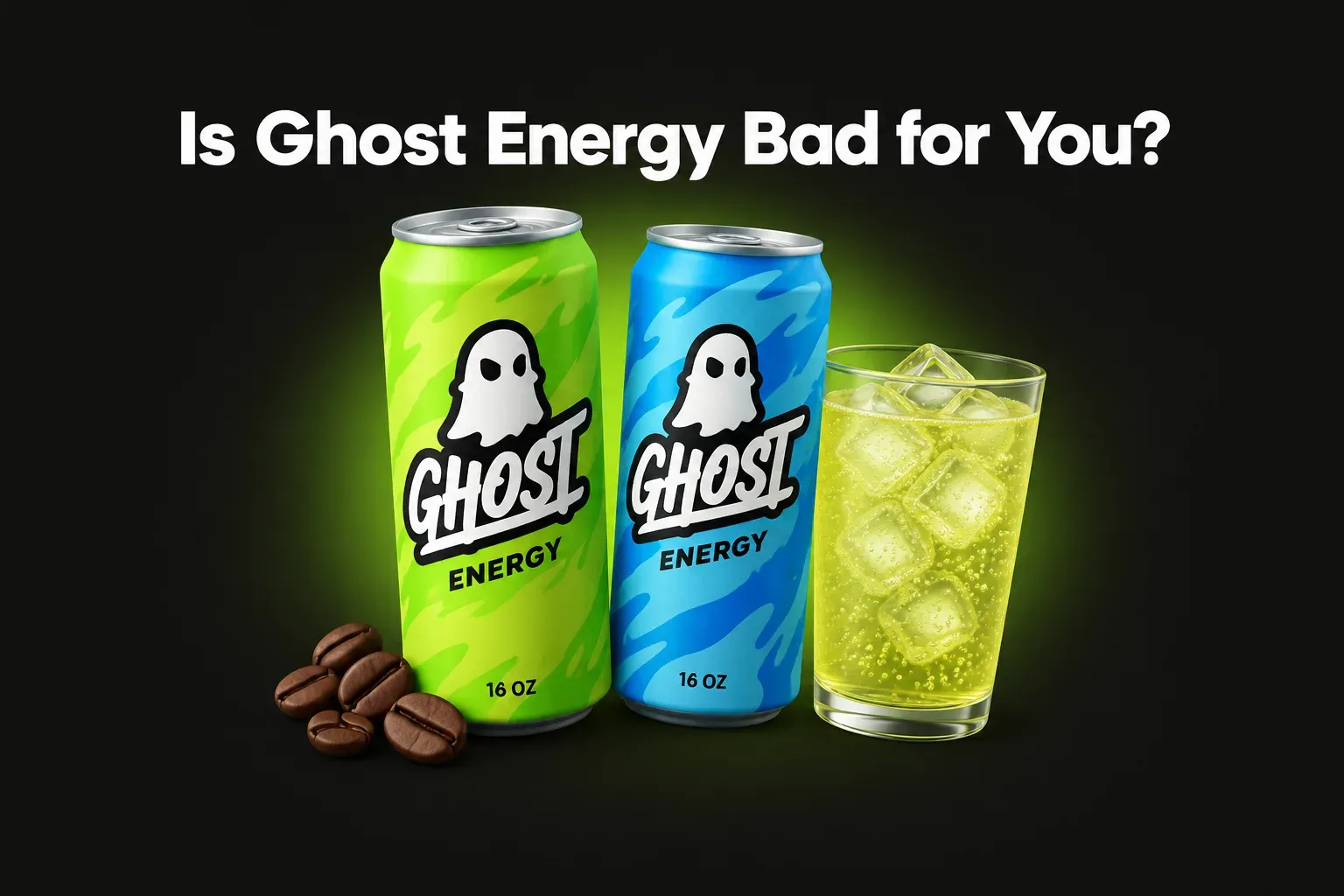
Ghost Energy is a popular energy drink in bright cans. It comes in candy flavors like Sour Patch Kids and Swedish Fish. But is Ghost Energy bad for you?
The short answer: for most healthy adults, one can a day is unlikely to cause harm. A 16 oz can has 200 mg of caffeine – about two cups of coffee. It has no sugar, but it has two sweeteners: sucralose and acesulfame K. Problems start with two or more cans a day. Skip it if you’re under 18, pregnant or have heart problems. Newer studies also give reasons to limit the sweeteners.
What’s in a can of Ghost Energy
Here is the label of a 16 oz (473 ml) can. The numbers are almost the same in every flavor.
| Per can (16 oz) | Amount | What it is |
|---|---|---|
| Calories | 5–10 | Almost none |
| Sugar | 0 g | Sweetened with sucralose and acesulfame K |
| Caffeine | 200 mg | From coffee beans |
| Taurine | 1,000 mg | An amino acid your body also makes |
| L‑carnitine L‑tartrate | 1,000 mg | Helps your cells burn fat for energy |
| Alpha‑GPC | 150 mg | A form of choline, sold for focus |
| NeuroFactor | 100 mg | Coffee fruit extract |
| AstraGin | 25 mg | Two herbal root extracts |
| Sodium | 30–35 mg | Very little |
| Vitamins | 100% DV | C, B3, B6 and B12 |
Label data from the Ghost Energy supplement panel shown on PricePlow and Open Food Facts. DV = daily value.
Ingredients (Tropical Mango): carbonated water, natural and artificial flavor, citric acid, L-carnitine L-tartrate, taurine, caffeine, sucralose, alpha-glyceryl phosphoryl choline, sodium benzoate (preservative), potassium sorbate (preservative), ascorbic acid (vitamin C), acesulfame potassium, coffee fruit extract, niacinamide, astragalus and panax notoginseng root extracts, pyridoxal-5-phosphate (vitamin B6), methylcobalamin (vitamin B12).
A few special flavors are different. The Bubblicious Cotton Candy can, for example, lists 15 calories, 2 g of sugar and no acesulfame K. Some reviews online mention NooLVL, but it is not on the current can labels we checked. A single can costs about $3 in US stores.
How much caffeine is too much?
Caffeine is the main thing to watch in Ghost Energy. One can has 200 mg.
| Who | Safe limit | Ghost cans |
|---|---|---|
| Healthy adults | Up to 400 mg a day | 2 cans = the limit |
| In one go | About 200 mg | 1 can |
| Pregnant or breastfeeding | Up to 200 mg a day | Label says don’t drink |
| Children and teens | Energy drinks not advised | 0 |
Limits from the FDA and the European Food Safety Authority. Teens: American Academy of Pediatrics.
So one Ghost plus two cups of coffee already puts you near 400 mg. Too much caffeine can cause a racing heart, jitters, anxiety, headaches, stomach upset and poor sleep. Caffeine stays in your body for hours. A can at 4 pm can still keep you up at midnight.
Large amounts of energy drink can also affect the heart. In one trial, 34 healthy young adults drank 32 oz of an energy drink within an hour. That’s the size of two Ghost cans. Their blood pressure went up. Their heart also took longer to “reset” between beats. Doctors call this a longer QT interval. A fake drink caused a smaller change (Shah et al., Journal of the American Heart Association, 2019).
A Mayo Clinic team studied 144 people who survived a sudden cardiac arrest. That’s when the heart suddenly stops. Seven of them had drunk an energy drink shortly before. Four of the seven had an inherited heart rhythm problem (Martinez et al., Heart Rhythm, 2024). This doesn’t prove energy drinks caused it. But people with heart rhythm problems should stay away from them.
Are the sweeteners in Ghost bad?
Ghost uses two sweeteners: sucralose (Splenda) and acesulfame K (also called Ace-K). The FDA and the European Union approve both. But newer independent studies raise questions:
- Sucralose and DNA. A lab team tested sucralose-6-acetate. It’s a compound found in small amounts in sucralose. Rat studies suggest it may also form in the gut. It broke DNA in human cells. In human gut tissue, both it and sucralose made the gut lining leakier (Schiffman et al., Journal of Toxicology and Environmental Health, 2023). These were lab tests, not studies in people.
- Heart disease in people. A French study followed over 100,000 adults for about 9 years. Those who had more acesulfame K had a 40% higher risk of coronary heart disease (narrowed heart arteries). For sucralose, the risk was 31% higher (Debras et al., BMJ, 2022).
- Cancer in people. The same team also looked at cancer. People who had more acesulfame K had a 13% higher risk of cancer (Debras et al., PLoS Medicine, 2022). These studies watched what people ate. They show a link, not proof.
- Gut and weight in mice. Male mice got sucralose in their water for 6 months. The dose matched the daily amount seen as safe for people. Their gut bacteria changed. Their livers showed signs of inflammation (Bian et al., Frontiers in Physiology, 2017). In another study, mice got acesulfame K each day for 4 weeks. The dose was 37.5 mg per kg of body weight. The male mice gained more weight (Bian et al., PLoS One, 2017).
Why do mouse studies matter? Rodents share most of our genes and body processes. And testing a possible harm on people on purpose would put their health at risk. Proof in people is still missing. But several labs see similar warning signs. So it makes sense to limit these sweeteners, not drink them all day.
Ghost also has sodium benzoate and vitamin C together. In some drinks, these two can form small amounts of benzene. Benzene is known to cause cancer. Most drinks the FDA tested had little or none. Read more in our guide to sodium benzoate.
What about Alpha-GPC, L-carnitine and taurine?
These extras make Ghost sound like a brain and gym drink. Here’s what we know:
- Taurine (1,000 mg). It’s an amino acid found in meat and fish. Your body makes it too. European experts found no safety concern at the amounts used in energy drinks (EFSA, 2009).
- L-carnitine (1,000 mg of L-carnitine L-tartrate). Gut bacteria can turn carnitine into TMAO, a compound linked to clogged arteries. Mice fed extra carnitine for a long time built up more plaque (fatty buildup) in their arteries. The same team also checked 2,595 heart patients. More carnitine in the blood was linked to more heart attacks and strokes. But this was true only for people who also had high TMAO (Koeth et al., Nature Medicine, 2013). One can is a modest dose. But it’s not a reason to drink more.
- Alpha-GPC (150 mg). It’s a form of choline, a nutrient the brain uses. A study looked at 12 million adults aged 50 and older in South Korea. Those prescribed Alpha-GPC had a 43% higher risk of stroke over 10 years. The more they took, the higher the risk (Lee et al., JAMA Network Open, 2021). These were prescribed doses in older adults. And the study shows a link, not proof. Ghost lists 150 mg of a 50% Alpha-GPC powder, so a can has about 75 mg. There is no good proof that the amount in a can sharpens your focus.
Ghost vs other energy drinks and coffee
| Drink | Calories | Sugar | Caffeine | Caffeine per oz | Sweetener |
|---|---|---|---|---|---|
| Ghost Energy (16 oz) | 5–10 | 0 g | 200 mg | 12.5 mg | Sucralose + acesulfame K |
| Celsius (12 oz) | 10 | 0 g | 200 mg | 16.7 mg | Sucralose |
| Alani Nu Energy (12 oz) | 10 | 0 g | 200 mg | 16.7 mg | Sucralose + acesulfame K |
| Bang (16 oz) | 0 | 0 g | 300 mg | 18.8 mg | Sucralose + acesulfame K |
| Monster Zero Ultra (16 oz) | 10 | 0 g | 150 mg | 9.4 mg | Erythritol + sucralose |
| Red Bull (8.4 oz) | 110 | 26 g | 80 mg | 9.5 mg | Sugar |
| Brewed coffee (8 oz) | 2 | 0 g | about 95 mg | 11.9 mg | None |
Labels from Open Food Facts (Ghost, Celsius, Bang, Monster, Red Bull), Alani Nu, Red Bull and Caffeine Informer (Bang caffeine); coffee from USDA FoodData Central.
Ghost sits in the middle of the pack. It has less caffeine than Bang. It has less per ounce than Celsius or Alani Nu. But it has more per can than Monster Zero Ultra or Red Bull. And unlike Red Bull, it has no sugar – it uses two sweeteners instead.
Want to compare them in more detail? Read is Celsius bad for you, is Red Bull bad for you and is Monster bad for you. Or see our picks for the healthiest energy drink.
Who should skip Ghost Energy
- Kids and teens. The can says it’s for adults 18 and older. The American Academy of Pediatrics says energy drinks are not for children or teens.
- People who are pregnant, nursing or trying to get pregnant. The label says not to use it.
- People with heart rhythm problems, high blood pressure or anxiety.
- Anyone who takes prescription drugs or has a health condition. Ask a doctor first.
- Anyone sensitive to caffeine, or who already drinks several coffees a day.
How to drink Ghost more safely
- Stick to one can a day. Count your coffee, tea and pre-workout too.
- Not after 2 pm, so it doesn’t hurt your sleep.
- Don’t mix it with alcohol. Caffeine hides how drunk you feel.
- Sip it slowly instead of drinking the whole can at once.
- Want caffeine without sweeteners? Plain coffee or tea gives you caffeine with nothing added.
See what’s really in your Ghost Energy. With NutriSmart, you photograph the label or scan the barcode. The app lists the sweeteners, preservatives and colors, explains the risks of each one and gives the drink a health score out of 100. It also tells you right away if a product is ultra-processed and which ingredients make it so. You can also set an alert for sucralose or acesulfame K. The app then warns you whenever a scanned product contains one.Get the app free
The bottom line
Ghost Energy isn’t dangerous for most healthy adults who stick to one can a day. It has no sugar and almost no calories. But each can has 200 mg of caffeine – about two cups of coffee. It also has two sweeteners that newer studies link to heart and gut problems. Extras like Alpha-GPC and L-carnitine add little proven benefit. Keep it to one can a day, and not late in the day. Skip it if you’re under 18, pregnant or have heart problems.
FAQ
Is Ghost Energy bad for you?
For most healthy adults, one can a day is unlikely to cause harm. A 16 oz can has 200 mg of caffeine, no sugar and the sweeteners sucralose and acesulfame K. The risks grow with two or more cans a day. They are also higher for teens, pregnant women and people with heart problems.
How much caffeine is in Ghost Energy?
A 16 oz (473 ml) can of Ghost Energy has 200 mg of caffeine from coffee beans. That's about as much as two 8 oz cups of brewed coffee. It's half of the 400 mg daily limit the FDA gives for healthy adults.
Does Ghost Energy have sugar?
Most flavors have 0 g of sugar and 5 to 10 calories. They are sweetened with sucralose and acesulfame K instead. A few special flavors differ, so check the label of the can you buy.
Is Ghost Energy healthier than Monster or Red Bull?
It has much less sugar than regular Monster or Red Bull. But it has more caffeine per can than both, and it uses sweeteners that some studies link to health risks. It's lower in sugar, not a health drink.
Can you drink Ghost Energy every day?
One can a day fits within the caffeine limit for most healthy adults. Just count your coffee and tea too. Avoid it late in the day. Stop if you get a racing heart, jitters or trouble sleeping.
Who should not drink Ghost Energy?
The can says it's for healthy adults 18 or older. It is not for people who are pregnant, nursing or trying to get pregnant. People with heart problems, high blood pressure or anxiety should skip it too. If you take prescription drugs, ask a doctor first.