Is Red Bull Bad for You? Ingredients, Sugar and Caffeine
Is Red Bull bad for you? Red Bull ingredients explained: caffeine and sugar per can, Sugarfree vs Zero, heart risks, alcohol and who should skip it.
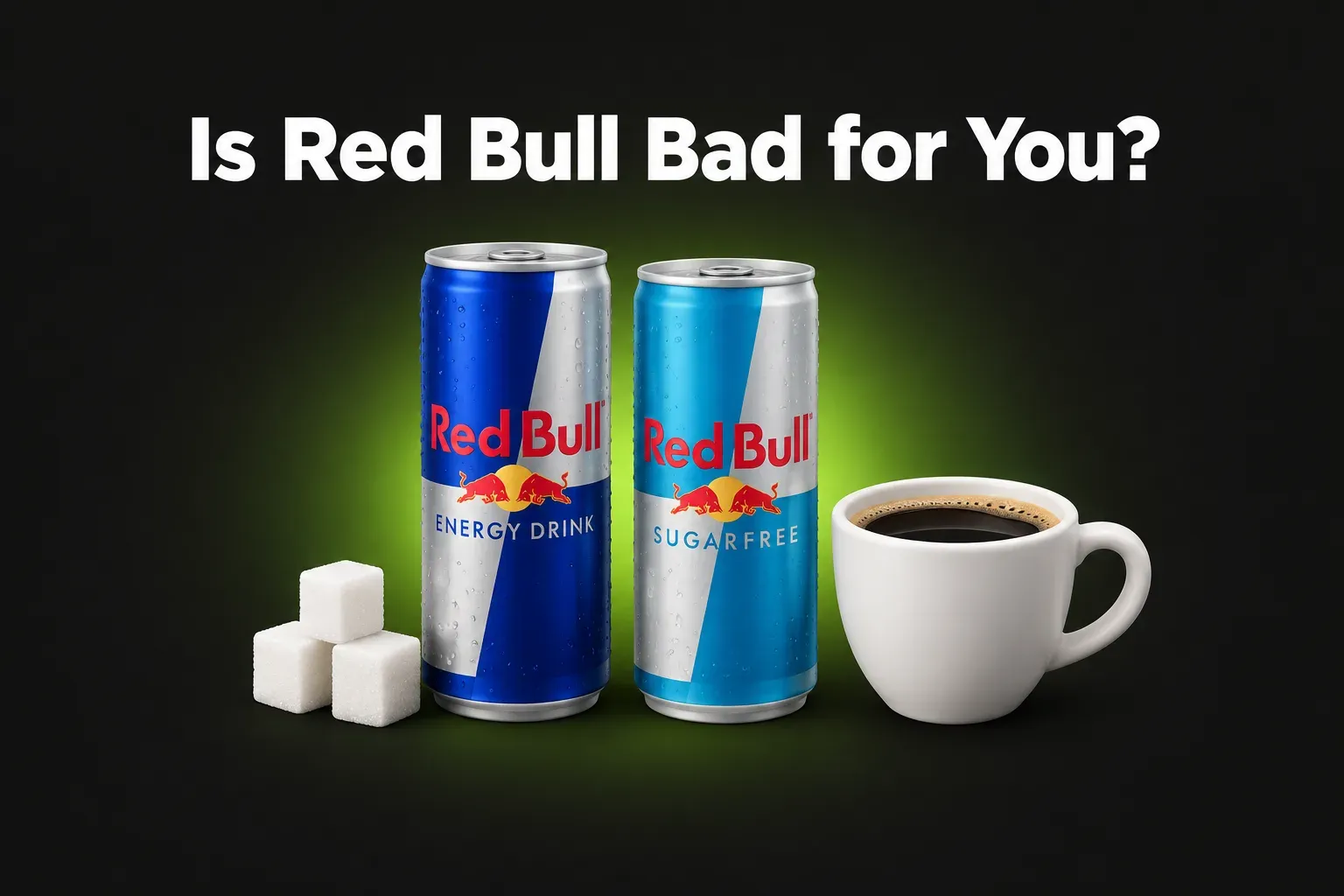
Red Bull is the energy drink that made the slim can famous. Millions of people drink it to get through a shift, a drive or an exam. But is Red Bull bad for you?
The short answer: one 8.4 oz can now and then is fine for most healthy adults. It has 80 mg of caffeine – a bit less than a cup of coffee – and 26 g of sugar. The trouble starts with bigger cans, several cans a day, or mixing it with alcohol. Kids, teens, pregnant women and people with heart problems should skip it.
Red Bull ingredients: what’s in a can
Here are the ingredients of the classic 8.4 oz (250 ml) Red Bull Energy Drink, in the order on the US label:
- Carbonated water – water with bubbles. It’s the main ingredient.
- Sugar and glucose – two kinds of sugar. Glucose is also called dextrose. A can has 26 g of sugars in total.
- Citric acid – a sour acid, also found in lemons. It gives the drink its tangy taste.
- Taurine – a natural substance called an amino acid. Your body makes it too. More about it below.
- Natural and artificial flavors – give Red Bull its typical taste. The label doesn’t say what they are.
- Sodium bicarbonate and magnesium carbonate – mineral salts. Sodium bicarbonate is baking soda. They help control how sour the drink is.
- Colors – give the drink its color. The US label doesn’t name them.
- Caffeine – 80 mg per can. It’s what makes you feel more awake.
- Niacinamide, pyridoxine HCl, calcium pantothenate and vitamin B12 – added forms of vitamins B3, B6, B5 and B12. Your body uses them to turn food into energy.
Ingredients: Walmart listing for the 8.4 oz can, which matches Open Food Facts. Red Bull’s US site names the main ingredients but doesn’t show the full list. Some 12 oz and 16 oz labels on Open Food Facts say “sucrose” (table sugar) and list flavors and colors last.
Here is the nutrition label of the same can, from the Red Bull US website:
| Per can (8.4 oz) | Amount |
|---|---|
| Calories | 110 |
| Sugar | 26 g |
| Caffeine | 80 mg |
| Sodium | 105 mg |
| Vitamin B6 | 250% of the Daily Value |
| Niacin (B3) | 100% of the Daily Value |
| Vitamin B12 | 80% of the Daily Value |
| Pantothenic acid (B5) | 50% of the Daily Value |
Source: Red Bull US. Some cans and Open Food Facts show 27 g of sugar.
A closer look at the ingredients that matter most:
- Caffeine wakes you up. It’s the main reason you feel the “kick”.
- Taurine is a natural substance your body makes. You also get it from meat and fish. Red Bull’s Malaysian site lists 1,000 mg per 250 ml can. The US site doesn’t give the amount. The European Food Safety Authority looked at it in 2009. It found no safety concern at the amounts people get from energy drinks (EFSA, 2009).
- B vitamins help your body turn food into energy. But they don’t give you energy on their own. If you already eat enough of them, extra doses add nothing you can feel.
- Sugar and glucose give quick calories. This is the part most people should worry about.
How much caffeine is too much?
Red Bull has the same caffeine in every ounce – about 32 mg per 100 ml. So the bigger the can, the more you get.
| Can size | Calories | Sugar | Caffeine |
|---|---|---|---|
| 8.4 oz (250 ml) | 110 | 26 g | 80 mg |
| 12 oz (355 ml) | 160 | 38 g | 114 mg |
| 16 oz (473 ml) | 210 | 50 g | 151 mg |
| 20 oz (591 ml) | 270 | 63 g | 189 mg |
8.4 oz: Red Bull US. 12 oz and 16 oz: Open Food Facts labels (12 oz, 16 oz). 20 oz: retailer labels (FoodMaxx, Dollar General). Some store listings differ by a few calories or grams.
Now compare that with the safe limits:
- Healthy adults: up to 400 mg a day is usually safe, says the FDA.
- In one go: about 200 mg is fine for most adults (EFSA, 2015). A 20 oz can gets close to that.
- Pregnant or breastfeeding women: up to 200 mg a day in total (EFSA, 2015).
- Children and teens: energy drinks are not appropriate for them (American Academy of Pediatrics, Pediatrics, 2011).
Too much caffeine can cause a racing heart, jitters, anxiety, headaches and upset stomach. It also stays in your body for hours. A can at 4 pm can still keep you awake at midnight. Then you feel tired the next day and reach for another can.
Is Red Bull bad for your heart?
Caffeine raises your heart rate and blood pressure a little for a few hours. In healthy people, that’s usually not a problem. But a few studies suggest energy drinks may do more than caffeine alone.
- Red Bull and stress. 20 healthy young adults drank a 12 oz Red Bull or water. Then they did a stressful math test. Red Bull alone raised their top blood pressure number by 7 points. With the test on top, it rose about 10 points. Their heart rate rose about 20 beats a minute. Blood flow to the brain also dropped a little (Grasser et al., American Journal of Cardiology, 2015).
- Energy drink vs plain caffeine. 18 healthy young adults drank 32 oz of an energy drink one day. On another day, they drank a drink with the same caffeine (320 mg). Two hours after the energy drink, their QT interval was a bit longer. That’s the time the heart needs to reset between beats. Their top blood pressure number also stayed higher for longer (Fletcher et al., Journal of the American Heart Association, 2017).
- Blood and blood vessels. 50 healthy young adults drank one 250 ml can of a sugar-free energy drink. One hour later, their blood platelets (cells that help blood clot) stuck together more. Their blood vessels also relaxed less well (Worthley et al., American Journal of Medicine, 2010).
These were small, short studies. They don’t prove that Red Bull causes heart disease. But they are a good reason to be careful. If you have heart problems or high blood pressure, avoid energy drinks.
Sugar, weight and teeth
26 g of sugar is about 6 teaspoons. The American Heart Association sets a daily limit for added sugar. It’s 25 g for women and 36 g for men (Johnson et al., Circulation, 2009). One small can already reaches the women’s limit. A 12 oz can goes over both.
Sugary drinks don’t fill you up, so it’s easy to gain weight from them. A daily small Red Bull adds 770 calories a week. A large review pooled studies of over 300,000 people. Some drank 1–2 sugary drinks a day. They had a 26% higher risk of type 2 diabetes than people who rarely drank them (Malik et al., Diabetes Care, 2010).
Your teeth pay too. Energy drinks are very acidic. In a lab test, researchers soaked tooth enamel in sports and energy drinks. Enamel is the hard outer layer of your teeth. Energy drinks wore away more than twice as much enamel as sports drinks. Red Bull Sugar Free was among the most acidic drinks tested (Jain et al., General Dentistry, 2012). So sugar-free doesn’t mean tooth-friendly. Drink it with a meal, use a straw and rinse with water after.
Red Bull Sugarfree and Red Bull Zero
Both have 80 mg of caffeine per 8.4 oz can and no sugar. The difference is the sweeteners.
- Red Bull Sugarfree (10 calories): Red Bull’s US site lists sucralose and acesulfame K (Red Bull). Some older cans in stores still list aspartame and acesulfame K. Check the label on your can.
- Red Bull Zero (0 calories): sweetened with monk fruit extract, sucralose and erythritol (Red Bull).
Regulators like the FDA and EFSA allow all of these. But independent studies raise questions:
- Aspartame: in a lifelong study, rats ate aspartame in their food. More of them got blood cancers (lymphomas and leukemias), especially the females. The authors saw cancer effects even at 20 mg per kg of body weight a day. That’s less than the daily amount allowed for people (Soffritti et al., Environmental Health Perspectives, 2006). In 2023, the WHO’s cancer agency called aspartame “possibly carcinogenic” to humans. That means it may cause cancer, but the proof is limited (Riboli et al., Lancet Oncology, 2023).
- Sucralose: mice got sucralose in their food from before birth until they died. More of the males got blood cancers. This started at 2,000 ppm in their feed (0.2% of the food) (Soffritti et al., International Journal of Occupational and Environmental Health, 2016).
- Acesulfame K: mice got 37.5 mg per kg of body weight a day for 4 weeks. It changed their gut bacteria, and males gained more weight (Bian et al., PLoS One, 2017).
- In people: a French study followed over 100,000 adults. Those who ate more acesulfame K and sucralose had more heart disease. Those who ate more aspartame had more strokes (Debras et al., BMJ, 2022). Aspartame and acesulfame K were also linked to more cancer (Debras et al., PLoS Medicine, 2022).
Why do animal studies matter? Rats and mice share most of our genes and body processes. And testing possible cancer risks on people would put their health at risk. Still, proof in humans is missing. The studies in people show links, not cause. But several labs see similar warning signs. So it makes sense to limit sweetened drinks as a precaution. Read more in our guide to artificial sweeteners.
Red Bull and alcohol: a risky mix
Red Bull and vodka is a popular bar drink. But caffeine can make you feel less drunk than you are. Your body is just as drunk, though.
- College survey. Over 4,000 students in North Carolina took a survey. Students who mixed alcohol with energy drinks binge drank more often. They were also more likely to get hurt or need medical care. This was true even when they drank the same amount of alcohol (O’Brien et al., Academic Emergency Medicine, 2008).
- Lab test. 80 students got one of four drinks. Some got vodka alone, and some got vodka mixed with an energy drink. Those who had the mix wanted more alcohol than those who had vodka alone (Marczinski et al., Alcoholism: Clinical and Experimental Research, 2013).
If you drink alcohol, keep Red Bull out of it.
Red Bull vs coffee, Monster and Celsius
| Drink | Calories | Sugar | Caffeine | Sweetener |
|---|---|---|---|---|
| Red Bull (8.4 oz) | 110 | 26 g | 80 mg | Sugar |
| Red Bull Sugarfree (8.4 oz) | 10 | 0 g | 80 mg | Sucralose + acesulfame K* |
| Red Bull Zero (8.4 oz) | 0 | 0 g | 80 mg | Monk fruit, sucralose, erythritol |
| Red Bull (12 oz) | 160 | 38 g | 114 mg | Sugar |
| Monster Energy (16 oz) | 230 | 54 g | 160 mg | Sugar + sucralose |
| Celsius (12 oz) | 10 | 0 g | 200 mg | Sucralose |
| Diet Coke (12 oz) | 0 | 0 g | 46 mg | Aspartame |
| Brewed coffee (8 oz) | 2 | 0 g | about 95 mg | None |
Red Bull: Red Bull US and Open Food Facts. Monster, Celsius and Diet Coke: Open Food Facts (Monster, Celsius, Diet Coke). Coffee: USDA FoodData Central. *Older Sugarfree cans: aspartame + acesulfame K.
What stands out:
- A small Red Bull has less caffeine than a cup of coffee, a Monster or a Celsius.
- But per ounce, it has about as much sugar as Monster. A 12 oz Red Bull has more sugar than the men’s daily limit.
- Black coffee gives you more caffeine than a small Red Bull, with no sugar and no sweeteners.
Compare more drinks in our guide to the healthiest energy drink. You can also read whether Monster, Celsius and Ghost Energy are bad for you.
Who should skip Red Bull
- Children and teens. The can itself says it’s not recommended for children.
- Pregnant or breastfeeding women. The label warns against it too.
- People with heart rhythm problems or high blood pressure.
- People with anxiety or sleep problems.
- Anyone sensitive to caffeine or taking medicines that interact with it. Ask your doctor or pharmacist.
- People with diabetes, unless they pick a sugar-free version and talk to their doctor.
How to drink Red Bull more safely:
- Stick to one small can a day and count your coffee, tea and soda too.
- Not after 2 pm, so it doesn’t steal your sleep.
- Never mix it with alcohol.
- Pick the 8.4 oz can, not the 16 or 20 oz.
- Drink water too, especially when you exercise or it’s hot.
See what’s really in your Red Bull. With NutriSmart, you photograph the label or scan the barcode. The app lists the sweeteners, preservatives and colors, explains the risks of each one and gives the product a health score out of 100. It also tells you right away if a drink is ultra-processed and which ingredients make it so. Set an alert for aspartame or sucralose. The app then warns you whenever a product you scan contains it.Get the app free
The bottom line
Red Bull isn’t dangerous for most healthy adults in small amounts. A small can has 80 mg of caffeine – less than a cup of coffee – but also 26 g of sugar. The risks grow with bigger cans, several cans a day and mixing it with alcohol. They hit your heart, teeth, weight and sleep. Sugarfree and Zero cut the sugar but add sweeteners with open questions. If you drink it, keep it to one small can early in the day. Skip it if you’re a teen, pregnant or have heart problems.
FAQ
Is Red Bull bad for you?
One small can now and then is fine for most healthy adults. An 8.4 oz can has 80 mg of caffeine and 26 g of sugar. Several cans a day can strain your heart, teeth and sleep.
What are the ingredients in Red Bull?
Red Bull Energy Drink is made of carbonated water, sugar, glucose, citric acid, taurine, flavors, baking soda, magnesium carbonate, colors, caffeine and four B vitamins (B3, B6, B5 and B12). An 8.4 oz can has 80 mg of caffeine and 26 g of sugar.
How much caffeine is in a Red Bull?
An 8.4 oz can has 80 mg of caffeine – a bit less than a cup of brewed coffee. A 12 oz can has 114 mg, a 16 oz can 151 mg and a 20 oz can 189 mg.
How much sugar is in a Red Bull?
An 8.4 oz can has about 26 g of sugar, or about 6 teaspoons. A 12 oz can has 38 g. That's more than the American Heart Association's daily limit for men (36 g).
Is Red Bull Sugarfree better for you?
It has no sugar and only 10 calories, so it's easier on your weight. But it has the same caffeine and is still acidic, which is hard on teeth. Red Bull lists sucralose and acesulfame K as sweeteners, and some older cans list aspartame.
How many Red Bulls a day is safe?
For healthy adults, the FDA says up to 400 mg of caffeine a day is usually safe. That's five small cans in theory, but coffee, tea and soda count too. One can a day is a much safer habit.
Can you mix Red Bull with alcohol?
It's best not to, because caffeine can make you feel less drunk than you are. In one survey, students who mixed the two binge drank more and got hurt more often.