McDonald's Fries Ingredients: What's Really in Them
McDonald's fries ingredients explained: natural beef flavor, dextrose, oil blend and additives, US vs UK fries, calories by size and healthier swaps.
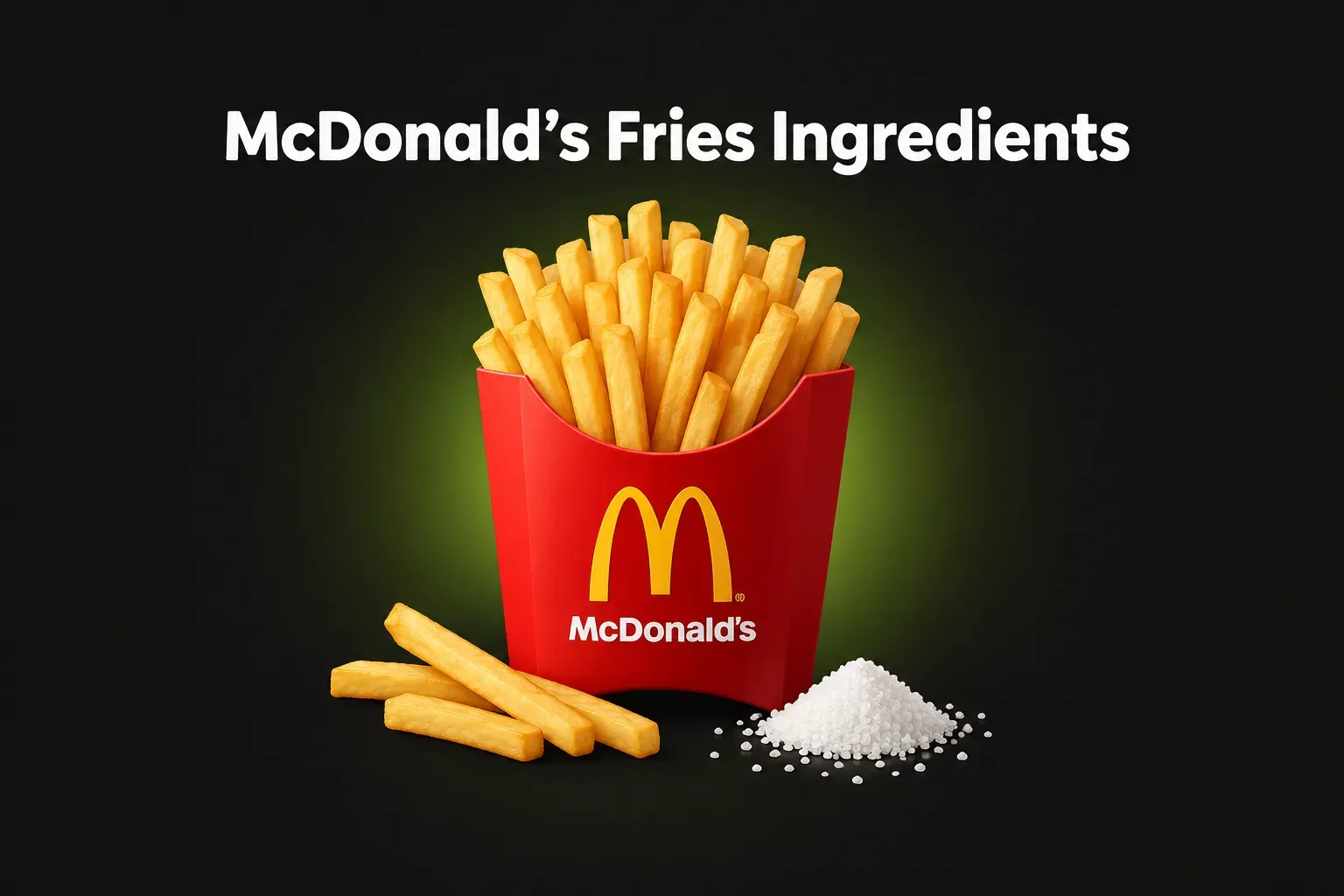
McDonald’s fries may be the most famous fries in the world. But the ingredient list is longer than “potatoes, oil and salt.” Here’s what each ingredient is and what it does.
The short answer: US McDonald’s fries are made of potatoes, a vegetable oil blend (canola, corn, soybean and hydrogenated soybean oil), natural beef flavor, dextrose, sodium acid pyrophosphate and salt. The beef flavor is made with wheat and milk. So the fries are not vegan, vegetarian or gluten-free. A medium order has 320 calories, 15 g of fat and 260 mg of sodium. UK fries are much simpler and have no beef flavor.
McDonald’s fries ingredients: the full US list
Here is the official US ingredient list for World Famous Fries, in label order:
Potatoes, Vegetable Oil (Canola Oil, Corn Oil, Soybean Oil, Hydrogenated Soybean Oil, Natural Beef Flavor [Wheat and Milk Derivatives]), Dextrose, Sodium Acid Pyrophosphate (Maintain Color), Salt.
Source: McDonald’s US, checked November 2026. The label adds that the natural beef flavor “contains hydrolyzed wheat and hydrolyzed milk as starting ingredients.”
Here’s what each ingredient means, in plain words:
- Potatoes – McDonald’s names varieties like Russet Burbank and Shepody. Suppliers cut them and partly fry them before they reach the restaurant.
- Vegetable oil blend – canola, corn and soybean oil, plus hydrogenated soybean oil. “Hydrogenated” means the oil was made more solid in a factory process. The supplier fries the potatoes in this blend first. The restaurant fries them again. Read more about seed oils.
- Natural beef flavor – a flavoring in the supplier’s frying oil. It’s made by breaking down wheat and milk into small pieces (“hydrolyzed”). McDonald’s says it gives the fries their well-known taste. See our guide to natural flavors.
- Dextrose – a simple sugar, usually made from corn. It helps the fries brown evenly. The amount is tiny: the label shows 0 g of sugar.
- Sodium acid pyrophosphate – a phosphate salt. It keeps cut potatoes from turning gray. It’s one of the sodium phosphate additives.
- Salt – added in the restaurant, right after frying.
What about TBHQ and dimethylpolysiloxane?
In 2015, news reports shared a longer McDonald’s list of 19 ingredients. It included the oil used in the restaurant. That oil had TBHQ and citric acid to keep it fresh. It also had dimethylpolysiloxane. This is a type of silicone that stops hot oil from foaming and splattering (Global News, 2015).
Today’s US website doesn’t name these two. We could not confirm whether US restaurants still use them. McDonald’s Canada still lists dimethylpolysiloxane and citric acid in its frying oil. In Canada, the flavor is listed as “natural flavour (vegetable source)” (McDonald’s Canada). Other US chains, like In-N-Out and Chick-fil-A, also list dimethylpolysiloxane (see the table below).
Are McDonald’s fries vegan or vegetarian?
No, not in the US. The beef flavor contains milk. McDonald’s USA also says it doesn’t promote any US menu item as vegetarian, vegan or gluten-free (McDonald’s US).
There’s a long story behind this. Until 1990, McDonald’s cooked its fries in a blend that included beef tallow (beef fat). Then it switched to 100% vegetable oil. This came after a public health campaign against saturated fat (The Week, 2025). Beef flavoring in the oil kept some of the old taste.
Many vegetarians did not know this. In 2001, three vegetarians sued McDonald’s in Seattle. Two of them were Hindus who don’t eat meat for religious reasons. More lawsuits followed in other states. In 2002, McDonald’s agreed to give $10 million to Hindu, vegetarian and other groups. It also posted an apology. It said the oil had not been pure vegetable oil, but contained beef essence for flavor (Entrepreneur, 2002).
Today, McDonald’s says its suppliers partly fry the potatoes in “an oil blend that contains beef flavoring” (McDonald’s US FAQ). Because the flavor is made with wheat, the fries are not gluten-free either. People with a wheat or milk allergy should skip them.
US vs UK McDonald’s fries
The UK recipe is much shorter:
Potatoes, Blend of Non-Hydrogenated Vegetable Oils (Sunflower, Rapeseed), Dextrose (predominantly added at beginning of the potato season). Prepared in the restaurants using a non-hydrogenated vegetable oil. Salt is added after cooking.
Source: McDonald’s UK, checked November 2026.
The main differences:
- No beef flavor, no milk and no wheat. McDonald’s UK says its frying oil is suitable for vegans (McDonald’s UK FAQ).
- No hydrogenated oil.
- No sodium acid pyrophosphate on the list.
- No dimethylpolysiloxane, McDonald’s UK says (McDonald’s UK FAQ).
So the same “World Famous Fries” name can hide two different recipes. Always check the list for your country.
McDonald’s fries nutrition by size
| Size | Calories | Fat | Saturated fat | Sodium | Carbs | Protein |
|---|---|---|---|---|---|---|
| Kids | 110 | 5 g | 0.5 g | 90 mg | 14 g | 2 g |
| Small | 230 | 11 g | 1.5 g | 190 mg | 31 g | 3 g |
| Medium | 320 | 15 g | 2 g | 260 mg | 43 g | 5 g |
| Large | 480 | 23 g | 3 g | 400 mg | 65 g | 7 g |
Source: McDonald’s US product pages (kids, small, medium, large), checked November 2026. All sizes list 0 g trans fat and 0 g sugar.
What stands out:
- Sodium is lower than you might expect. A medium has 260 mg. That’s about 11% of the daily value (2,300 mg).
- The bigger issue is calories from oil. A large has 23 g of fat. That fat supplies over 40% of its calories.
- Fries add up fast in a meal. A large adds 480 calories before you count the burger and the drink. See how many calories are in french fries in general.
What about the hydrogenated soybean oil? Older, partially hydrogenated oils were the main source of artificial trans fat. The FDA banned them from foods, with a final deadline of January 1, 2021 (FDA). The fries label now shows 0 g of trans fat.
Are the additives safe?
US and European regulators allow all of these additives. But independent studies, many of them in animals, raise some questions.
TBHQ. Researchers at Michigan State University tested TBHQ on mouse immune cells in a dish. Low doses of 1 to 5 µM weakened natural killer cells. These cells help the body fight viruses and cancer cells (Boss et al., Food and Chemical Toxicology, 2018).
The same lab later fed mice food with 0.0014% TBHQ. That’s the amount normally added to lab animal food. The authors say it’s the same as or less than in many human foods. The mice became more sensitive to an egg protein. They also had worse allergic reactions than mice without TBHQ. Lower doses had smaller effects (Jin et al., Frontiers in Immunology, 2025).
Dimethylpolysiloxane. In 2020, the European Food Safety Authority reviewed it again. It found no safety concern at current uses. It set a safe daily limit of 17 mg per kg of body weight (EFSA, 2020). The body absorbs very little of it. Rats in feeding studies had eye problems, but the experts linked these to direct contact with the food, not to eating it. We found no independent studies that point to harm from eating it.
Sodium acid pyrophosphate. The body absorbs phosphate from additives much more easily than the phosphorus in whole foods (Ritz et al., Deutsches Ärzteblatt International, 2012). This matters most for people with kidney disease. A US study followed 9,686 healthy adults. Above 1,400 mg of phosphorus a day, eating more was linked to a higher risk of dying during the study (Chang et al., American Journal of Clinical Nutrition, 2014). Fries are only a small part of that total.
Why do animal studies matter? Mice and rats share most of our genes and body processes. And testing whether an additive weakens the immune system or causes allergies in people would put their health at risk. Still, proof in humans is missing for TBHQ. Both TBHQ studies also come from one lab, so other labs need to confirm them. Until then, cutting back on foods with TBHQ is a careful choice, especially for children.
Acrylamide: the bigger worry in fries
Acrylamide is a chemical that forms when starchy foods like potatoes are fried, baked or roasted at high heat. Boiling and steaming usually don’t make it. The FDA says it caused cancer in animals, but only at very high doses (FDA).
- Animal study. US government scientists gave mice and rats acrylamide in their drinking water for 2 years. The amounts were about 6 to 50 mg per liter. The animals got more tumors in many organs, including the breast, thyroid and lungs (Beland et al., Food and Chemical Toxicology, 2013).
- In people. A Dutch study followed 62,573 women aged 55 to 69 for 11 years. Women who ate the most acrylamide had a 78% higher risk of ovarian cancer than those who ate the least. Among women who never smoked, the risk of endometrial (womb) cancer was about twice as high. There was no link with breast cancer (Hogervorst et al., Cancer Epidemiology, Biomarkers & Prevention, 2007).
These results show a link, not proof. The FDA does not tell people to stop eating fried food. But it does advise cooking fries to a golden yellow, not brown. Brown parts have more acrylamide (FDA).
Fried potatoes and your health
The potato itself is fine. The way it’s cooked matters.
- Diabetes. Harvard researchers followed about 199,000 US health workers for over 20 years. Each extra 3 servings of french fries a week was linked to a 19% higher risk of type 2 diabetes. Baked, boiled or mashed potatoes showed a much smaller link (Muraki et al., Diabetes Care, 2016).
- Early death. A study followed 4,440 US adults aged 45 to 79 for 8 years. Those who ate fried potatoes 2 to 3 times a week had about double the risk of dying in that time. Potatoes that were not fried showed no link (Veronese et al., American Journal of Clinical Nutrition, 2017).
Both are observational studies. People who eat lots of fries may also eat more fast food and move less. But the pattern is a good reason to keep fries as an occasional side, not a daily habit.
McDonald’s fries vs other fries
| Fries | Calories | Fat | Sodium | Ingredients |
|---|---|---|---|---|
| McDonald’s, medium | 320 | 15 g | 260 mg | Potatoes, oil blend with beef flavor (wheat, milk), dextrose, sodium acid pyrophosphate, salt |
| McDonald’s, large | 480 | 23 g | 400 mg | Same as above |
| In‑N‑Out, 125 g | 360 | 15 g | 150 mg | Potatoes, sunflower oil (with dimethylpolysiloxane), seasoning (salt, black pepper, a little oil) |
| Chick‑fil‑A Waffle Potato Fries, 1 serving | 420 | 24 g | 240 mg | Potatoes, canola oil (with dimethylpolysiloxane), vegetable oil, food starch, rice flour, salt, phosphates, baking soda, dextrin, xanthan gum, dextrose |
| Five Guys, Little (227 g) | 526 | 23 g | 531 mg | Potatoes, refined peanut oil, salt |
| Five Guys, Regular (411 g) | 953 | 41 g | 962 mg | Potatoes, refined peanut oil, salt |
| Homemade air fryer fries (7 oz potato + 1 tsp oil) | about 195 | about 5 g | about 12 mg + salt | Potatoes, oil, salt |
| Baked potato (7 oz / 200 g) | 186 | 0.3 g | 20 mg | Potato |
Sources: McDonald’s US, In-N-Out, Chick-fil-A and the Five Guys US nutrition guide (September 2026), checked November 2026. Homemade fries: our estimate from USDA values for raw potato and canola oil. Baked potato: USDA FoodData Central.
What stands out:
- Five Guys and In-N-Out have the shortest lists. But a Regular order at Five Guys has 953 calories. That’s about three medium McDonald’s fries.
- McDonald’s has a longer list. But its portions are smaller, and its sodium is moderate.
- Chick-fil-A’s waffle fries have the longest list. One serving has 24 g of fat, a bit more than a McDonald’s large.
- Air fryer fries at home have fewer calories and much less fat than a McDonald’s medium. In one lab test, air frying also cut acrylamide by about 90% compared with deep frying (Sansano et al., Journal of Food Science, 2015).
Tips for better fries at home:
- Soak cut potatoes in water for 15 to 30 minutes, then pat them dry. The FDA says this lowers acrylamide.
- Use 1 to 2 teaspoons of oil in an air fryer or a hot oven.
- Stop at golden, not brown.
- Keep potatoes out of the fridge. The FDA says cold storage can raise acrylamide when you cook them later.
At McDonald’s, order a small or kids’ size, or swap the fries for apple slices. For more ideas, see our guides to the healthiest food at McDonald’s and the healthiest fast food.
Track your McDonald’s fries in seconds. With NutriSmart, you photograph what you eat. The app counts the calories, protein, carbs and fat. It shows how much of your daily target is left. So you know if a medium or large order of fries still fits your day.Get the app free
The bottom line
US McDonald’s fries contain potatoes, a vegetable oil blend, natural beef flavor, dextrose, sodium acid pyrophosphate and salt. The beef flavor is made with wheat and milk. So in the US, the fries are not vegan, vegetarian or gluten-free. UK fries are simpler and suitable for vegans. Sodium is moderate, but the oil adds a lot of calories: 230 in a small and 480 in a large. The bigger health questions are acrylamide and eating fried potatoes often. TBHQ, once listed in the restaurant oil, has raised concerns in mouse studies from one lab. Enjoy McDonald’s fries now and then, pick a small, and make golden air fryer fries at home.
FAQ
What are the ingredients in McDonald's fries?
In the US, McDonald's lists potatoes, a vegetable oil blend (canola, corn, soybean and hydrogenated soybean oil), natural beef flavor, dextrose, sodium acid pyrophosphate and salt. The beef flavor is made with hydrolyzed wheat and hydrolyzed milk.
Are McDonald's fries vegan or vegetarian?
Not in the US. The natural beef flavor contains milk, and McDonald's USA does not call any menu item vegetarian or vegan. In the UK, the fries are cooked in a sunflower and rapeseed oil blend that McDonald's UK calls suitable for vegans.
Is there real beef in McDonald's fries?
McDonald's says its suppliers partly fry the potatoes in an oil blend that contains beef flavoring. The label lists wheat and milk as its starting ingredients. The US site doesn't say whether the flavor also contains beef.
Are McDonald's fries gluten-free?
No. The natural beef flavor is made with hydrolyzed wheat, and the US allergen list says the fries contain wheat and milk.
How many calories are in McDonald's fries?
A small order has 230 calories, a medium 320 and a large 480. A kids' order has 110. A large also has 400 mg of sodium.
Why do McDonald's fries taste different in the UK?
The recipe is different. UK fries are made of potatoes, sunflower and rapeseed oil, dextrose and salt. They have no beef flavor and no milk or wheat.