Healthiest Oatmeal: Steel-Cut vs Rolled vs Instant
What is the healthiest oatmeal? Steel-cut, rolled and instant oats compared, 8 brands by sugar, fiber and protein, glyphosate tests and the best toppings.
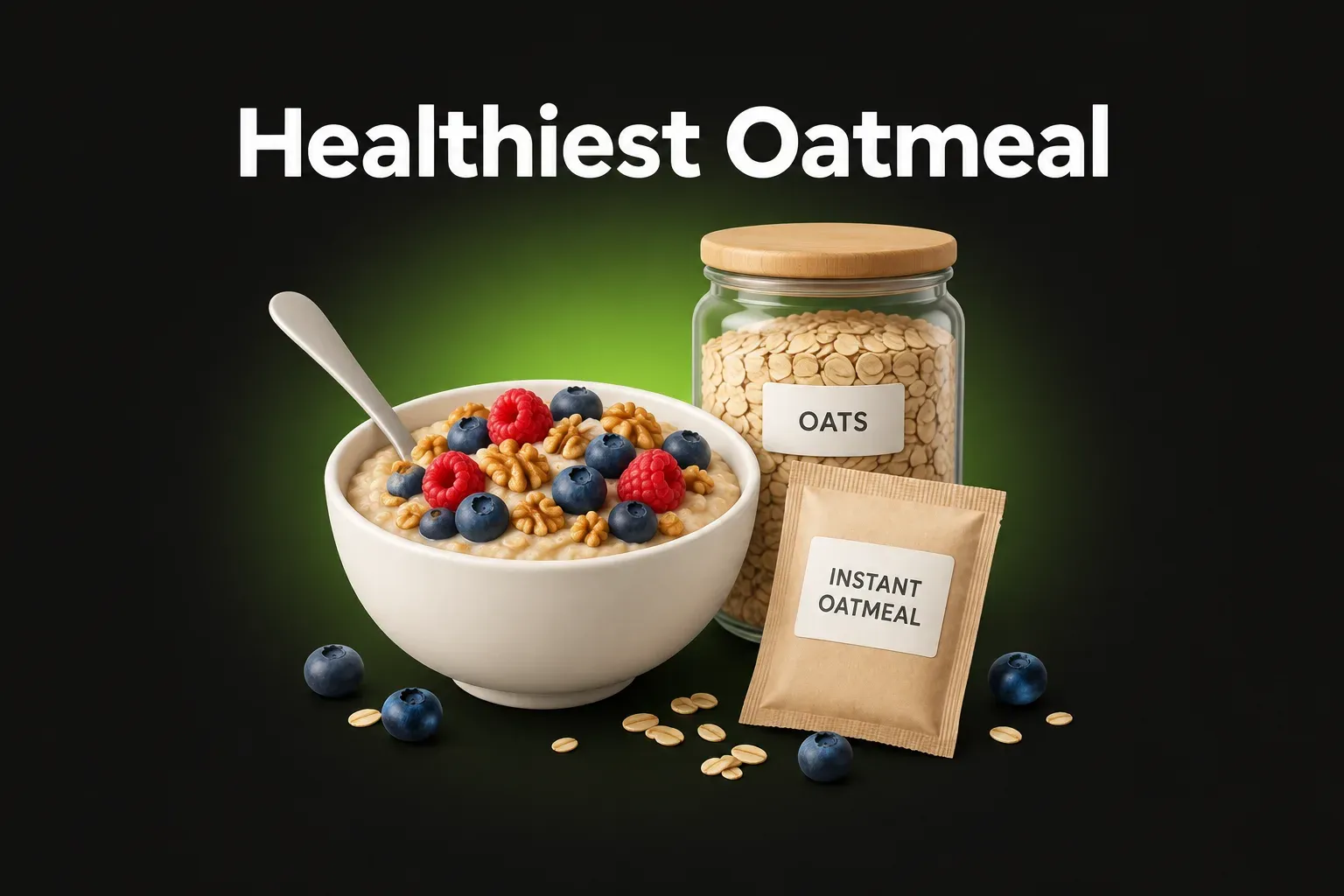
Oatmeal is one of the simplest healthy breakfasts. But the oat aisle now has steel-cut oats, rolled oats, instant packets, protein cups and ready-to-eat overnight oats. So which is the healthiest oatmeal?
The short answer: the healthiest oatmeal is plain steel-cut or old-fashioned rolled oats with no added sugar. Both are 100% whole grain. They raise blood sugar more slowly than instant oats. Their beta-glucan fiber can lower “bad” cholesterol. Plain instant oats are a fine backup. The ones to limit are flavored instant packets, with up to 12 g of added sugar. Add fruit, nuts or yogurt yourself instead.
Steel-cut vs rolled vs instant oats
All oatmeal starts as the same whole oat grain, called a groat. The difference is how much it gets cut, steamed and flattened.
- Steel-cut oats are groats chopped into small pieces. They take the longest to cook and stay chewy.
- Old-fashioned rolled oats are groats that are steamed and pressed into flat flakes. They cook in a few minutes.
- Quick oats are rolled thinner and cut smaller.
- Instant oats are cooked, dried and rolled very thin. Just add hot water.
The more an oat is processed, the faster your body turns it into blood sugar. Scientists measure this with the glycemic index (GI). GI shows how fast a food raises blood sugar, on a scale up to 100. A GI of 55 or less is low.
| Oat type | Average GI | GI level |
|---|---|---|
| Steel-cut oats | 55 | Low |
| Old-fashioned (large-flake) rolled oats | 53 | Low |
| Quick oats | 71 | High |
| Instant oatmeal | 75 | High |
Source: Tosh & Chu, British Journal of Nutrition, 2015 – a review of 72 GI tests. Only two of them were for steel-cut oats. One author works for Quaker.
A trial backs this up. Thirty healthy adults ate steel-cut, old-fashioned or instant oats on different days. Steel-cut oats gave the smallest rise in blood sugar. Instant oats gave a higher rise (Wolever et al., British Journal of Nutrition, 2019). A Quaker scientist co-wrote this study too. But the results match other research on low-glycemic foods.
Per serving, the nutrition is almost the same. One cup (8 oz / 234 g) of oatmeal cooked with water has about 166 calories, 4 g of fiber and 6 g of protein (USDA). So steel-cut oats may be a bit better for blood sugar, but only by a little. Rolled oats scored just as low in the GI review, and they cook much faster.
Oats, beta-glucan and cholesterol
Oats are one of the best high-fiber foods for breakfast. Their key fiber is beta-glucan. It is a soluble fiber, which means it turns into a thick gel in your gut. That gel traps some cholesterol and carries it out of the body.
The FDA lets oat foods carry a heart health claim. You’ve likely seen it on a box of Cheerios. The rule covers diets low in saturated fat and cholesterol. If such a diet includes 3 g or more of oat beta-glucan a day, it “may” lower the risk of heart disease. A food needs at least 0.75 g of soluble fiber per serving to use the claim (FDA, 21 CFR 101.81).
The research supports it. A review pooled 28 trials. People who ate 3 g or more of oat beta-glucan a day lowered their LDL (“bad”) cholesterol by about 10 mg/dL (0.25 mmol/L). HDL (“good”) cholesterol did not change. People with higher cholesterol at the start saw bigger drops (Whitehead et al., American Journal of Clinical Nutrition, 2014).
Beta-glucan also slows the blood sugar rise after a meal. A review of 103 tests found that adding oat beta-glucan to a meal cut the rise by about 23% (Zurbau et al., European Journal of Clinical Nutrition, 2021).
The healthiest oatmeal brands compared
Here are 8 popular oatmeals sold in the US. The numbers are for one serving, as listed on the label.
| Product (serving) | Calories | Fiber | Added sugar | Protein | Sodium |
|---|---|---|---|---|---|
| Quaker Old Fashioned Oats (½ cup dry, 40 g) | 150 | 4 g | 0 g | 5 g | 0 mg |
| Bob’s Red Mill Steel Cut Oats (¼ cup dry, 44 g) | 170 | 5 g | 0 g | 5 g | 0 mg |
| Bob’s Red Mill Gluten Free Old Fashioned Rolled Oats (½ cup dry, 48 g) | 190 | 5 g | 0 g | 6 g | 0 mg |
| Nature’s Path Organic Original Instant Oatmeal (1 packet, 50 g) | 190 | 6 g | 0 g | 8 g | 0 mg |
| Mush Vanilla Bean Overnight Oats (5 oz / 141 g cup) | about 210 | 5 g | 0 g* | 6 g | 120 mg |
| Oats Overnight Chocolate Peanut Butter Banana (1 pouch, before milk) | 300 | 8 g | 6 g | 20 g | 110 mg |
| Kodiak Maple & Brown Sugar Oatmeal Cup (60 g) | 230 | 4 g | 9 g | 14 g | 220 mg |
| Quaker Instant Oatmeal Maple & Brown Sugar (1 packet, 43 g) | 160 | 3 g | 12 g | 4 g | about 220–260 mg |
Sources: brand sites for Bob’s Steel Cut, Bob’s Gluten Free Rolled Oats, Kodiak (full label) and Oats Overnight (protein, sugar); Open Food Facts label data for Quaker Old Fashioned, Nature’s Path, Mush, Oats Overnight and Quaker Instant. Checked November 2026; labels can change. *Mush has 10 g of total sugar, mostly from dates.
What stands out:
- Best everyday picks: Quaker Old Fashioned, Bob’s Red Mill steel-cut and Bob’s gluten-free rolled oats. Each has one ingredient: whole grain oats. No sugar, no salt.
- Best instant pick: Nature’s Path Organic Original. It is just organic rolled oats, with 6 g of fiber and 0 g of added sugar.
- Most protein: Oats Overnight (20 g) and Kodiak (14 g). They add milk, whey or pea protein. But they also add sugar, and Oats Overnight’s pouch gets more calories once you mix in milk.
- Ready-to-eat: Mush has no added sugar. It is sweetened with dates and made with almond milk.
- Most added sugar: Quaker Instant Maple & Brown Sugar, with 12 g per packet and the least fiber.
The trouble with flavored instant packets
A flavored packet is quick, but you pay for it in sugar. On the Quaker Maple & Brown Sugar label, sugar comes right after oats. The list also includes salt and natural flavor. Its 12 g of added sugar is about 3 teaspoons.
The American Heart Association advises most women to keep added sugar under 100 calories a day – about 25 g. One packet uses up about half of that (Johnson et al., Circulation, 2009).
Protein oatmeals are a step up for staying full. Kodiak’s cup lists oats, pea protein, cane sugar, milk protein, brown sugar and whey. Oats Overnight adds protein powder, maple sugar and monk fruit extract. They are fine if you need more protein. But plain oats with Greek yogurt or natural peanut butter get you close, with no added sugar. For more ideas, see our high-protein breakfast guide.
Simple fix: buy plain packets and sweeten them yourself. A mashed banana or a few berries add sweetness, plus fiber. A teaspoon of maple syrup adds less sugar than the packet does.
Glyphosate and chlormequat in oats
Oats can carry traces of farm chemicals. Two get the most attention.
Glyphosate is the weed killer in Roundup. Some farmers spray it on oats just before harvest to dry the crop. In 2018, the Environmental Working Group (EWG), an advocacy group, paid a lab to test oat foods from US stores.
- Glyphosate showed up in 43 of 45 samples made with regular oats (EWG, 2018).
- 31 of the 45 had 160 parts per billion (ppb) or more. That is EWG’s own limit for children’s health.
- Two samples of Quaker Old Fashioned Oats had the highest levels: 1,100 and 1,300 ppb.
- Bob’s Red Mill steel-cut oats (regular, not organic) had 300 ppb in one sample and none in another.
- About one-third of 16 organic samples had glyphosate, all well below EWG’s benchmark.
These numbers are far under the legal limit. The EPA allows up to 30 parts per million (30,000 ppb) in oats (eCFR, 40 CFR 180.364). Quaker said its oats are safe and meet all federal rules. EWG’s benchmark is much stricter than the government’s. Keep in mind that these tests are from 2018. Levels today may be different.
Experts disagree on the risk. In 2017, the EPA found glyphosate not likely to cause cancer in people. It is now updating that review (EPA). The World Health Organization’s cancer agency (IARC) calls it “probably carcinogenic”. That rating rests on “limited” evidence in people and “sufficient” evidence in lab animals (IARC). One review pooled studies of people who worked with these weed killers. Those with the highest exposure had a 41% higher risk of non-Hodgkin lymphoma, a blood cancer (Zhang et al., Mutation Research, 2019). But that is heavy exposure on the job, not a bowl of oatmeal.
Chlormequat is a newer worry. It keeps grain stalks short and sturdy. Farmers in Canada and Europe use it on oats. Since 2018, the US has allowed imported grain treated with it. An EWG-led study found it in 23 of 25 regular oat foods bought in US stores in 2022 and 2023. It was found in only 1 of 8 organic oat foods (Temkin et al., Journal of Exposure Science & Environmental Epidemiology, 2024). Urine tests in the same study suggest people took in far less than the EPA’s safe daily dose.
So why do scientists still care? Animal studies:
- Male mice got chlormequat in their feed or water. In lab tests, their sperm fertilized eggs less well. The dose was about 0.024 mg per kg of body weight a day. That is below the safe daily dose. Industry tests did not find harm at such low doses (Sørensen & Danielsen, International Journal of Andrology, 2006).
- Young male rats got 75 to 300 mg per kg a day. They made less testosterone (Hou et al., Toxicology Letters, 2018). At the top dose, their bones grew shorter (Huang et al., Toxicology, 2017). These doses are far higher than what people get from food.
Animal studies matter. Mice and rats share most of our genes and body processes. Testing farm chemicals on people for years would put their health at risk. Proof of harm in people from oats is missing. But several labs see similar signals. So if you eat oats every day, choosing organic oats is a sensible precaution. They had much lower levels in both tests.
Gluten-free oats: who needs them
Oats do not contain gluten. But they are often grown, moved and milled next to wheat, barley and rye. A Health Canada study tested 133 regular oat samples. About 88% had more than 20 ppm of gluten, the gluten-free limit (Koerner et al., Food Additives & Contaminants, 2011).
If you have celiac disease (an immune reaction to gluten) or gluten sensitivity, buy oats labeled gluten-free. Bob’s Red Mill tests its gluten-free oats to stay at 19 ppm or less. It packs them in a separate facility. Bob’s also notes that a small share of people can’t handle even pure oats. Ask your doctor first.
Healthy oatmeal toppings
The healthiest oatmeal is the one you build yourself. Try one from each group:
- Fruit for sweetness: berries, sliced banana, grated apple or a few chopped dates. They add fiber and vitamins.
- Protein to stay full: Greek yogurt, milk or soy milk, an egg on the side, or a scoop of protein powder.
- Healthy fat: walnuts, almonds, chia seeds, ground flaxseed or a spoon of peanut butter. These add calories fast, so measure them.
- Flavor without sugar: cinnamon, vanilla, a pinch of salt or cocoa powder.
Go easy on brown sugar, syrups, chocolate chips and dried fruit with added sugar. If you swap dairy, check the carton – some oat milks have added sugar too. For more breakfast ideas, see our healthy breakfast ideas and healthiest cereal guides.
Pick the healthiest oatmeal in the store. With NutriSmart, you photograph the label or scan the barcode. The app lists the sweeteners, preservatives and colors, explains the risks of each one and gives the product a health score out of 100. It also tells you right away if a flavored oatmeal is ultra-processed, and which ingredients make it so. You can even set an alert for an ingredient like natural flavors. The app then warns you whenever a scanned product contains it.Get the app free
The bottom line
The healthiest oatmeal is plain steel-cut or old-fashioned rolled oats. They are 100% whole grain, with no added sugar, and they have a low glycemic index. Plain instant oats, like Nature’s Path Original, are a good quick option. Flavored instant packets can add 12 g of sugar each, so use plain ones and add fruit. Protein oatmeals help you stay full, but read the sugar line. Oats often carry traces of glyphosate and chlormequat. They are under legal limits, but organic oats have much less. If you have celiac disease, choose oats labeled gluten-free. Top your bowl with fruit, nuts and yogurt for a breakfast that keeps you full until lunch.
FAQ
What is the healthiest type of oatmeal?
Plain steel-cut oats or plain old-fashioned rolled oats. Both are 100% whole grain with no added sugar, salt or flavors. They also raise blood sugar more slowly than instant oats.
Is instant oatmeal healthy?
Plain instant oats are still whole grain, but they raise blood sugar faster. Flavored packets are the bigger problem. A packet of Quaker Maple & Brown Sugar has 12 g of added sugar.
Are steel-cut oats healthier than rolled oats?
Only a little. They have almost the same calories, fiber and protein per serving. Steel-cut and old-fashioned rolled oats both have a low glycemic index of about 55 or less.
Does oatmeal lower cholesterol?
Yes, a little. Oats contain beta-glucan, a soluble fiber. In a review of 28 trials, 3 g of oat beta-glucan a day lowered LDL cholesterol by about 10 mg/dL.
Do oats contain glyphosate?
Often, in small amounts. In 2018 tests by EWG, 43 of 45 samples made with regular oats had glyphosate. All were under the legal limit. Organic oats had far less.
Is oatmeal gluten-free?
Oats have no gluten, but regular oats often get mixed with wheat, barley or rye. If you have celiac disease, buy oats labeled gluten-free.