Are Cheerios Healthy? Original, Honey Nut and 6 More
Are Cheerios healthy? Sugar, fiber and protein in 8 Cheerios flavors, the heart health claim, iron, glyphosate tests and the best pick for kids.
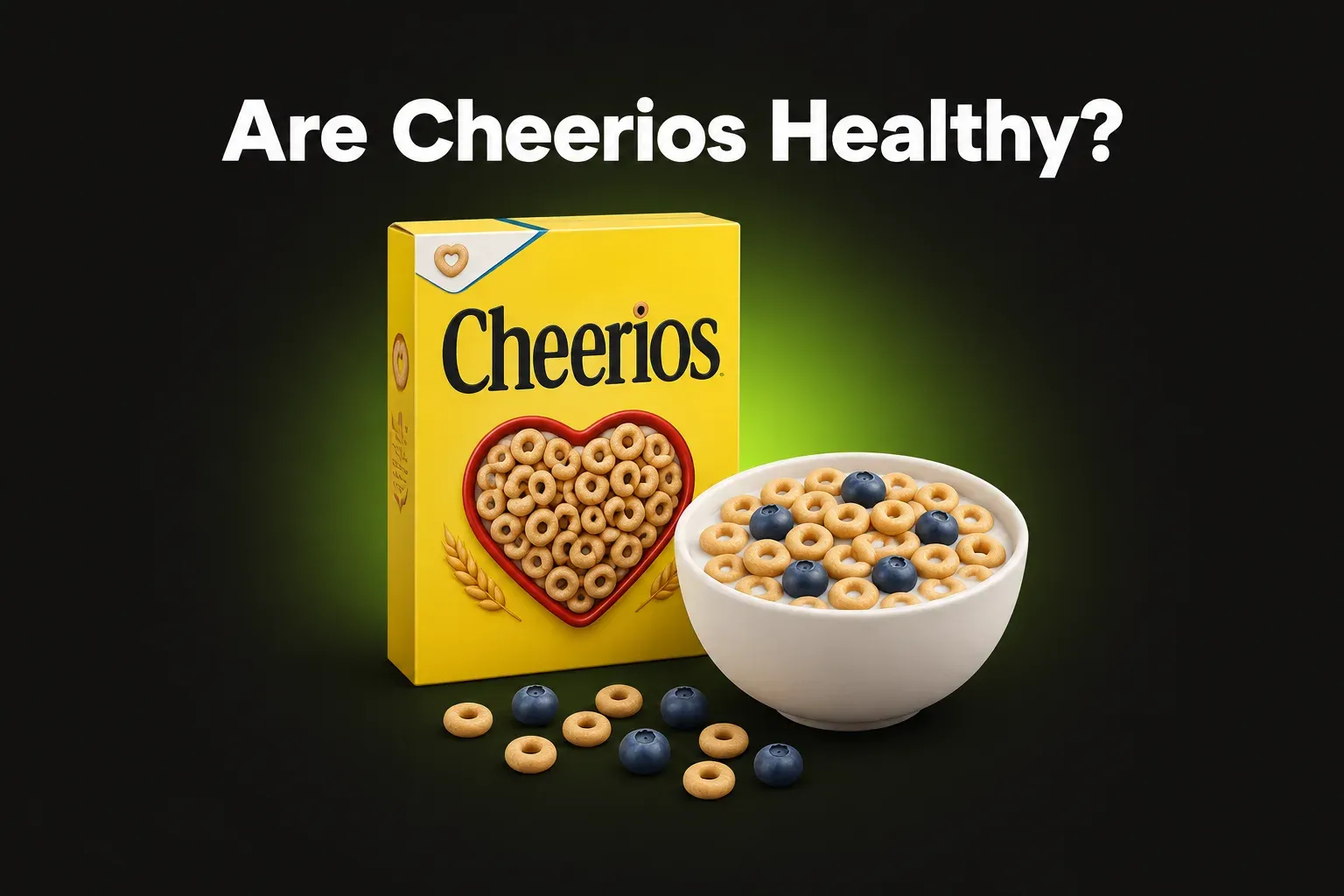
Cheerios have been a breakfast staple in the US for decades. The yellow box even has a big heart on the front. But are Cheerios healthy, and does that go for every flavor?
The short answer: Original Cheerios are a good cereal choice. A 1½ cup serving has 140 calories, only 1 g of added sugar, 4 g of fiber and 5 g of protein. The first ingredient is whole grain oats. But most other flavors are much sweeter. A 1-cup serving of Honey Nut Cheerios has 12 g of added sugar – twelve times as much as a serving of Original. The heart health claim is real, but you need two servings of Original a day to get the full effect.
What’s in Original Cheerios
Here is the label of the yellow box, from the Cheerios website:
| Per 1½ cups (39 g) | Amount |
|---|---|
| Calories | 140 |
| Fat | 2.5 g |
| Sodium | 190 mg |
| Fiber | 4 g |
| Total sugars | 2 g |
| Added sugars | 1 g |
| Protein | 5 g |
| Iron | 12.6 mg (70% of the Daily Value) |
Source: Cheerios US and Open Food Facts.
Note the serving size. The box used to list 1 cup. Now it lists 1½ cups, so older numbers you see online are for a smaller bowl.
Ingredients: whole grain oats, corn starch, sugar, salt, tripotassium phosphate, vitamin E (to keep it fresh), plus added vitamins and minerals (Cheerios).
That’s a short list. Tripotassium phosphate is a mineral salt that helps control acidity. Corn starch is refined, but the main ingredient is still whole oats.
Honey Nut Cheerios: tasty, but sweet
Here is one cup (37 g), from the Cheerios website:
- 140 calories
- 12 g of added sugar – about 3 teaspoons
- 3 g of fiber
- 3 g of protein
- 210 mg of sodium
Sugar is the second ingredient. Honey and brown sugar syrup come a bit later. So there are three kinds of sugar in one cereal.
What about the “nut” part? There are no whole nuts in the ingredient list. The nutty taste comes from natural almond flavor. The label also says “contains almond ingredients” (Cheerios). Keep that in mind if someone in your home has a tree nut allergy. You can read more about what natural flavors are.
On the plus side, Honey Nut has no artificial colors or flavors, and it is labeled gluten free (Cheerios FAQ).
8 Cheerios flavors compared (plus 2 other cereals)
| Cereal (serving) | Calories | Added sugar | Fiber | Protein | Sodium |
|---|---|---|---|---|---|
| Original Cheerios (1½ cups, 39 g) | 140 | 1 g | 4 g | 5 g | 190 mg |
| Multi Grain Cheerios (1⅓ cups, 39 g) | 150 | 8 g | 3 g | 3 g | 150 mg |
| Chocolate Cheerios (1 cup) | 140 | 10 g | 3 g | 3 g | 180 mg |
| Honey Nut Cheerios (1 cup, 37 g) | 140 | 12 g | 3 g | 3 g | 210 mg |
| Frosted Cheerios (1 cup) | 140 | 12 g | 3 g | 3 g | 180 mg |
| Apple Cinnamon Cheerios (1 cup) | 140 | 12 g | 3 g | 3 g | 150 mg |
| Fruity Cheerios (1 cup) | 140 | 12 g | 3 g | 3 g | 150 mg |
| Honey Nut Cheerios Protein (1 cup) | 140 | 12 g | 2 g | 8 g | 210 mg |
| Post Grape-Nuts (½ cup, 58 g) | 200 | 0 g | 7 g | 6 g | 270 mg |
| Quaker Old Fashioned Oats (½ cup dry, 40 g) | 150 | 0 g | 4 g | 5 g | 0 mg |
Cheerios: product pages on cheerios.com (Original, Multi Grain, Chocolate, Honey Nut, Frosted, Apple Cinnamon, Fruity, Protein). Grams: Open Food Facts (Original, Multi Grain) and the Cheerios FAQ (Honey Nut). Grape-Nuts: Open Food Facts. Quaker: Open Food Facts and Quaker (“sodium free”).
What stands out:
- Original wins easily. It has the least sugar, the most fiber and the most protein of the regular flavors. And its serving is half a cup bigger.
- Five flavors tie at 12 g of added sugar: Honey Nut, Frosted, Apple Cinnamon, Fruity and Protein.
- The Protein version has 8 g of protein, partly from added pea protein. But it still has 12 g of added sugar and less fiber than Original.
- Chocolate and Multi Grain add caramel color. Chocolate, Frosted, Apple Cinnamon and Fruity also add corn syrup.
- Plain oats and Grape-Nuts have no added sugar at all. For more options, see our list of the healthiest cereals.
The heart health claim: what it really means
The box says Cheerios “can help lower cholesterol as part of a heart healthy diet” (Cheerios). The FDA allows this claim. The rule is in the federal code at 21 CFR 101.81 (Cornell Law).
Here is how it works:
- Oats have a kind of soluble fiber called beta-glucan. In your gut, it forms a gel. That gel helps your body get rid of some cholesterol.
- The FDA rule says you need 3 g or more of beta-glucan a day for the effect.
- A food can use the claim if it has at least 0.75 g per serving. It must also be low in fat, saturated fat and cholesterol.
- Original Cheerios gives 1.5 g per serving. So you need two servings a day – that’s 3 cups.
- Honey Nut gives only 0.75 g per serving (Cheerios). You would need 4 cups a day, with 48 g of added sugar.
Does it work? A review pooled 28 trials in people. Eating at least 3 g of oat beta-glucan a day lowered LDL (“bad”) cholesterol by 0.25 mmol/L. That’s about 10 mg/dL (Whitehead et al., American Journal of Clinical Nutrition, 2014). It’s a real but modest effect.
The 2009 FDA warning letter. In May 2009, the FDA sent General Mills a warning letter about the Cheerios box. The box said you could “Lower Your Cholesterol 4% in 6 weeks.” It also said Cheerios was “clinically proven” to lower cholesterol. The FDA said claims like these made the cereal sound like a drug meant to treat high cholesterol (FDA Law Blog, 2009). General Mills said the science behind the claim was not in question. The fight was about the wording (Foley & Lardner, 2009). Today’s box uses the approved wording.
Keep in mind: plain oats give you the same beta-glucan with no added sugar. Our guide to the healthiest oatmeal compares them.
Glyphosate in Cheerios
Glyphosate is the weed killer in Roundup. Some farmers spray it on oats right before harvest to dry the crop. In 2018, the Environmental Working Group (EWG), an advocacy group, paid a lab to test oat foods.
- In August 2018, three samples of Original Cheerios had 470–530 parts per billion (ppb) of glyphosate (Fortune, 2018).
- In October 2018, EWG tested 10 more Cheerios samples and 18 Quaker products. Glyphosate showed up in all 28. All but two were above 160 ppb. That’s EWG’s own benchmark for children’s health (EWG press release, 2018).
- The US legal limit for cereal grains is 30 parts per million. That’s 30,000 ppb (40 CFR 180.364). So every sample was far under the law.
General Mills said: “Our products are safe and without question, they meet regulatory safety levels” (Food Ingredients First, 2018).
Is glyphosate harmful? Experts don’t agree. The WHO’s cancer agency calls it “probably carcinogenic” to humans (Guyton et al., Lancet Oncology, 2015). The US EPA says it is not likely to cause cancer. Independent studies add to the debate:
- Rats. An Italian lab gave rats glyphosate in their water. Exposure started before birth and lasted two years. The doses were 0.5, 5 and 50 mg per kg of body weight a day. The lowest dose is the EU’s “safe” daily amount. All three groups had more tumors, including leukemia. Many of these tumors are rare in this type of rat (Panzacchi et al., Environmental Health, 2025).
- People. A review pooled studies of people exposed to these weed killers, mostly on farms. Those with the most exposure had a 41% higher risk of non-Hodgkin lymphoma, a blood cancer (Zhang et al., Mutation Research, 2019).
Why do rat studies matter? Rats share most of our genes and body processes. And testing a possible cancer cause on people would put their health at risk. But the dose matters too. Say a 40 lb (18 kg) child eats 39 g of Cheerios with 500 ppb. That’s about 0.001 mg per kg of body weight. It’s about 450 times less than the lowest rat dose. And the human studies were about heavy exposure, mostly at work. Proof of harm from cereal in people is missing.
Still, several labs see the same warning signs. If your family eats oats every day, organic oats are a sensible precaution. In EWG’s first round, only about a third of 16 organic oat foods had any glyphosate.
Vitamins and iron
Cheerios are fortified. That means vitamins and minerals are added at the factory.
One serving of Original has 12.6 mg of iron – 70% of the Daily Value. It also has 20% of the Daily Value for zinc, folate and vitamins B6, B12 and D (Cheerios). Multi Grain has even more iron: 18 mg, or 100% of the Daily Value (Cheerios).
That helps many people. Women aged 19–50 need 18 mg of iron a day (MedlinePlus). The iron added to cereal is the same kind found in plants. Your body absorbs it less well than iron from meat. Eat it with vitamin C, like berries or orange slices, to help. See more foods high in iron.
For kids, more is not always better. Children aged 4–8 need 10 mg a day. The safe upper limit for kids up to age 13 is 40 mg a day from food and supplements (NIH Office of Dietary Supplements). One bowl is fine. But a big bowl of Multi Grain plus a multivitamin can add up. Check the labels.
Are Cheerios good for kids?
Original Cheerios are a smart pick for kids. They have very little sugar. Plain O’s are also a common finger food for toddlers.
The sweet flavors are a different story. The American Heart Association says children should get no more than 25 g of added sugar a day. Kids under 2 should get none (Vos et al., Circulation, 2017). One cup of Honey Nut or Fruity Cheerios uses up about half of a child’s daily limit.
Sweet cereal also changes how kids eat breakfast. In one study, 91 children at a summer day camp were split into two groups at random. One group got sugary cereals, the other low-sugar cereals, plus milk and fruit. Kids with sugary cereal ate almost twice as much cereal. They also took in almost twice as much refined sugar. In the low-sugar group, 54% put fruit on their cereal, compared with 8% in the other group (Harris et al., Pediatrics, 2011). Both groups said they liked their cereal.
Tips for a better bowl:
- Start with Original Cheerios. If your kids want it sweeter, add fresh fruit.
- Mix half Original and half Honey Nut to cut the sugar about in half.
- Add protein. Milk, Greek yogurt or a few nuts keep kids full longer. Try more ideas for a high-protein breakfast.
- Serve whole fruit, not juice. Read why in is orange juice healthy?
Are Cheerios ultra-processed?
Open Food Facts puts Honey Nut and Multi Grain Cheerios in NOVA group 4, the ultra-processed food group (Honey Nut, Multi Grain). It hasn’t rated Original yet. That doesn’t make a bowl dangerous. But it’s a reason not to rely on sweet boxed cereal every day. Rolled oats have just one ingredient: oats.
Scan your Cheerios box before you buy. With NutriSmart, you photograph the label or scan the barcode. The app lists the sweeteners, preservatives and colors, explains the risks of each one and gives the product a health score out of 100. It also tells you right away if a cereal is ultra-processed and which ingredients make it so. Set an alert for an ingredient like caramel color, and the app warns you whenever a product you scan contains it.Get the app free
The bottom line
Original Cheerios are a healthy choice for most people. A 1½ cup bowl has 1 g of added sugar, 4 g of fiber and plenty of iron. The heart claim is real, but you need two servings a day for a small drop in LDL cholesterol. Most flavored Cheerios have 10–12 g of added sugar per cup. That makes them treats, especially for kids. Plain oatmeal still does better. If you love Cheerios, stick with the yellow box and add your own fruit.
FAQ
Are Cheerios healthy?
Original Cheerios are one of the better boxed cereals. A 1½ cup serving has 140 calories, 1 g of added sugar, 4 g of fiber and whole grain oats as the first ingredient. Most flavored Cheerios have 8–12 g of added sugar per serving.
Is Honey Nut Cheerios healthy?
It's better than many kids' cereals, but it's still a sweet cereal. One cup has 12 g of added sugar – about 3 teaspoons. That's about half of a child's daily limit.
Do Cheerios really lower cholesterol?
The soluble fiber in oats can lower LDL cholesterol a little. You need 3 g a day, and one serving of Original Cheerios gives 1.5 g. So you would need two servings a day, as part of a diet low in saturated fat.
Are Cheerios good for toddlers?
Plain Original Cheerios are a common finger food for toddlers, and they have very little sugar. Experts say children under 2 should get no added sugar. So skip Honey Nut and the other sweet flavors for them.
Do Cheerios contain glyphosate?
Tests paid for by the Environmental Working Group in 2018 found traces of this weed killer in Cheerios. The levels were far below the US legal limit but above the group's own stricter benchmark. General Mills says its products are safe and meet all rules.
Which Cheerios is the healthiest?
Original Cheerios, by far. It has 1 g of added sugar per serving. Multi Grain comes next with 8 g. The sweet flavors, including Honey Nut and Protein, have 10–12 g.