Is Orange Juice Healthy? Sugar, Vitamin C and 8 Brands
Is orange juice healthy? Sugar and vitamin C per glass, juice vs a whole orange, diabetes and weight studies, kids' limits, and 8 US brands compared.
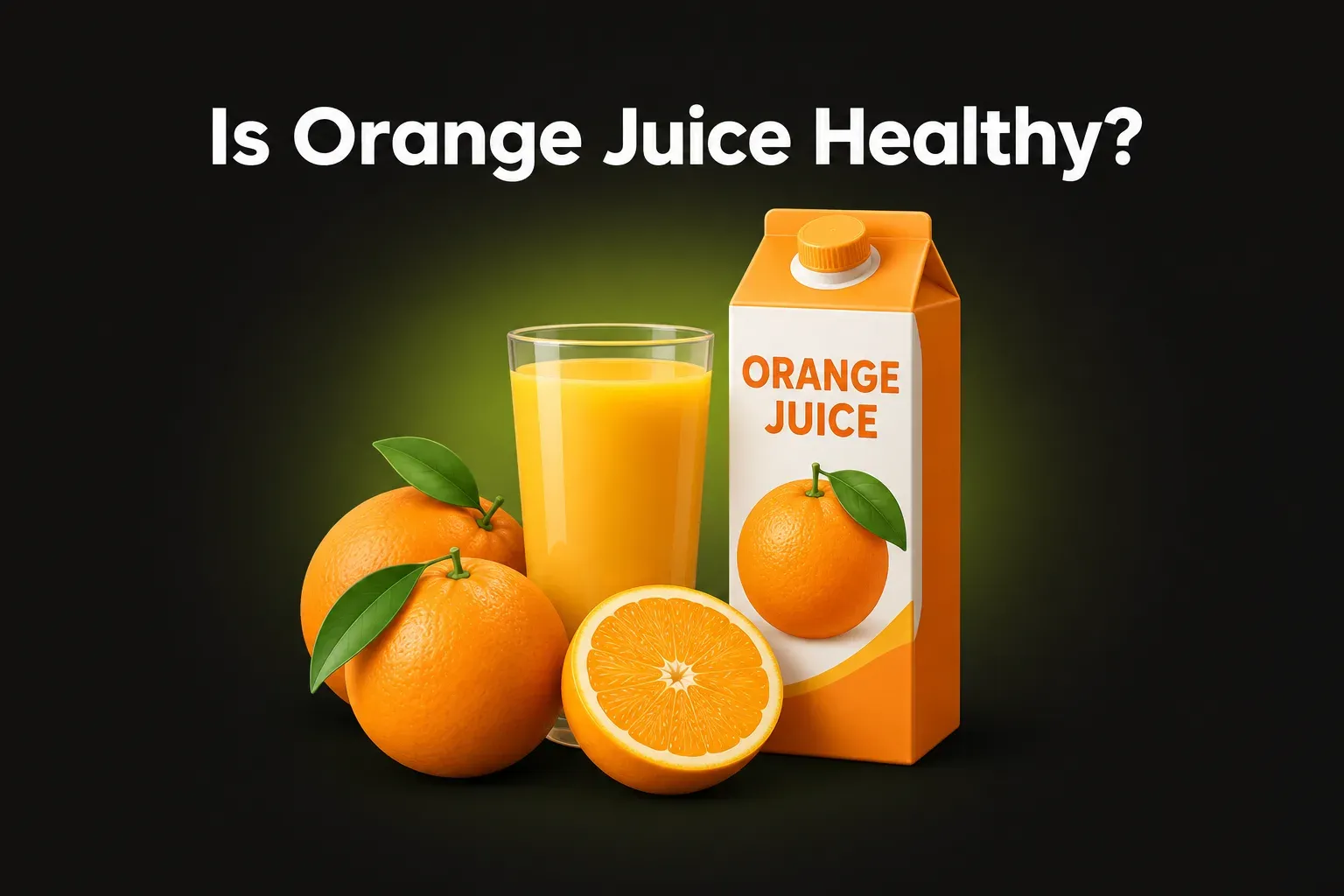
Orange juice is a breakfast classic, and many people see it as a healthy start to the day. But is orange juice healthy, or is it just sugar in a glass?
The short answer: a small glass of 100% orange juice can fit a healthy diet. One cup gives you more than a day’s worth of vitamin C, plus potassium and folate. But it also has about 21 g of sugar and almost no fiber. Studies link daily juice to a slightly higher risk of type 2 diabetes. A whole orange is the better choice. If you drink juice, keep it to about 4–8 oz (120–240 ml) and skip orange drinks, which are mostly water and added sugar.
What’s in a glass of orange juice
Here is 1 cup (8 oz / 240 ml) of orange juice compared with a whole orange and an orange drink. The numbers come from the USDA food database.
| Per serving | Calories | Sugar | Fiber | Vitamin C | Potassium | Folate |
|---|---|---|---|---|---|---|
| Fresh-squeezed orange juice (1 cup) | 112 | 21 g | 0.5 g | 124 mg | 496 mg | 74 mcg |
| Store orange juice, chilled (1 cup) | 122 | 21 g | 0.7 g | 84 mg | 443 mg | 47 mcg |
| Whole orange, medium (131 g) | 62 | 12 g | 3.1 g | 70 mg | 237 mg | 39 mcg |
| Orange juice drink (1 cup) | 134 | 23 g | 0.5 g | 37 mg | 105 mg | 4 mcg |
Source: USDA FoodData Central – orange juice, raw, orange juice, chilled, includes from concentrate, oranges, raw, orange juice drink. Values per 100 g, multiplied to one serving and rounded.
What stands out:
- Vitamin C: a cup of fresh juice has 124 mg. The Daily Value is 90 mg, so that’s about 140%. Store juice has less, because vitamin C slowly breaks down in storage.
- Potassium: about 450–500 mg per cup, or about 10% of the Daily Value. Potassium helps keep your blood pressure in check. See more foods high in potassium.
- Folate: a B vitamin your body needs to make new cells. It matters most before and during pregnancy. A cup of fresh juice gives about 19% of the Daily Value.
- Sugar: about 21 g per cup – roughly 5 teaspoons. A 12 oz can of Coke has 39 g, or about 26 g per 8 oz. So juice isn’t far behind.
- Fiber: almost none. A whole orange has about 6 times more. See calories in an orange.
Juice vs a whole orange
It takes about 3 oranges to make one cup of juice. When you squeeze them, the juice and sugar go into the glass. Most of the fiber stays behind in the pulp and the skin.
Why does that matter?
- You drink it fast. Three oranges take a while to eat. A glass of juice takes a minute.
- It doesn’t fill you up. In one study, 58 adults had a snack of whole apple, applesauce or apple juice before lunch. All snacks had the same calories. The whole apple made people feel the fullest. They also ate about 15% fewer calories at that meal than with no snack. Juice didn’t fill people up as well, even with fiber added back (Flood-Obbagy et al., Appetite, 2009).
- The sugar hits faster. Without fiber, sugar from juice gets into your blood more quickly.
That’s why the World Health Organization counts the sugar in fruit juice as “free sugar” – the same group as table sugar and honey. It advises keeping free sugars under 10% of your daily calories. Below 5% (about 25 g a day) is even better (WHO, 2015). One cup of orange juice nearly fills that 25 g. US labels show 0 g of added sugar on 100% juice, because no sugar was added. Your body still handles it much like added sugar.
Orange juice, diabetes and weight
Here’s what large studies found.
- Type 2 diabetes. Harvard researchers followed about 187,000 US nurses and health workers for up to 24 years. Eating more whole fruit was linked to a lower risk of type 2 diabetes. But drinking more fruit juice was linked to a higher risk. Every 3 extra glasses a week went with an 8% higher risk. Whole oranges showed no link either way (Muraki et al., BMJ, 2013).
- More studies on diabetes. A large review pooled studies of sugary drinks and fruit juice. One glass of fruit juice a day was linked to a 5–7% higher risk of type 2 diabetes. The link was weaker and less certain than for soda (Imamura et al., BMJ, 2015).
- Weight in kids. A review pooled 8 studies with about 34,000 children. In kids aged 1–6, one extra daily serving of juice was linked to a small weight gain over a year. The authors said it was too small to matter for health. In kids aged 7–18, there was no link (Auerbach et al., Pediatrics, 2017).
- Weight in kids and adults. A newer review looked at 42 studies. In children, each extra daily serving of 100% juice was linked to a slightly higher BMI. BMI is a number that compares weight with height. In adults, juice was linked to weight gain mostly when it added extra calories to the diet (Nguyen et al., JAMA Pediatrics, 2024).
These studies show links, not proof. People who drink lots of juice may also eat differently. But the message is the same across studies: whole fruit helps, and lots of juice may not. A small glass now and then is not the problem. Several big glasses every day is.
Orange juice for kids
The American Academy of Pediatrics (AAP) updated its juice advice in 2017. It says juice can add too many calories and cause cavities. It also lacks the protein and fiber kids need (Heyman et al., Pediatrics, 2017).
The AAP’s limits for 100% juice (HealthyChildren.org):
- Under 1 year: no juice at all.
- Ages 1–3: at most 4 oz (120 ml) a day.
- Ages 4–6: at most 4–6 oz (120–180 ml) a day.
- Ages 7–18: at most 8 oz (240 ml) a day.
The AAP also says not to give toddlers juice in a bottle, in a sippy cup they carry all day, or at bedtime. Sipping sugar again and again raises the risk of cavities. Whole fruit is the better choice for kids too.
Not from concentrate, flavor packs and added calcium
From concentrate means the water was taken out of the juice. Later, water is added back. Not from concentrate means the water was never removed. The calories, sugar and potassium are about the same either way.
“Not from concentrate” doesn’t mean fresh-squeezed, though. Big juice makers often take the oxygen out of the juice and store it in huge tanks. It can stay there for up to a year. This process strips out some of the taste. So before packing, companies add back “flavor packs”. These are made from orange aroma caught while the juice is heated, and from parts like peel and pulp. Companies don’t have to list them on the label. That’s what a 2011 ABC News report found (ABC News, 2011). The industry says flavor packs are made by capturing natural orange aroma, not in a lab. They aren’t a health risk that we know of. But they explain why store juice tastes the same all year.
Calcium-fortified orange juice has calcium added. For example, Simply Orange with Calcium & Vitamin D has 350 mg of calcium per cup (Coca-Cola US). That’s a bit more than a cup of milk. It can help if you don’t drink milk. But not all added calcium is absorbed the same. In one small study, 25 women drank two kinds of fortified juice. One had calcium citrate malate. The other had a mix of calcium phosphate and calcium lactate. The first one raised blood calcium about 48% more (Heaney et al., Journal of the American Dietetic Association, 2005). Simply Orange’s calcium version uses calcium phosphate and calcium lactate. So look at which type of calcium the label lists.
8 orange juices and orange drinks compared
Brands of 100% orange juice are very alike. Orange drinks are a different story.
| Product (8 fl oz unless noted) | What it is | Calories | Sugar (added) | Sweeteners and extras |
|---|---|---|---|---|
| Tropicana Pure Premium No Pulp | 100% juice, not from concentrate | 110 | 22 g (0 g) | None – just orange juice |
| Simply Orange Pulp Free | 100% juice, not from concentrate | 110 | 23 g (0 g) | None – just orange juice |
| Minute Maid Original Low Pulp | 100% juice from concentrate | 110 | 24 g (0 g) | None – water and orange juice concentrate |
| Florida’s Natural No Pulp | 100% juice | 110 | 22 g (0 g) | None – just orange juice |
| Great Value No Pulp (Walmart) | 100% juice | 110 | 23 g (0 g) | None – just orange juice |
| Tropicana Light (Trop50) No Pulp, Calcium + Vitamin D | 42% juice, mixed with water | 50 | 10 g (0 g) | Stevia leaf extract, natural flavors, gellan gum, added calcium |
| SunnyD Tangy Original | Juice drink, 5% juice | 60 | 14 g (12 g) | High fructose corn syrup, sucralose, Yellow 5, Yellow 6 |
| Hi-C Orange Lavaburst (6 fl oz box) | Juice drink | 40 | 10 g (10 g) | High fructose corn syrup, sucralose, acesulfame K |
Sources: Open Food Facts for Tropicana Pure Premium, Minute Maid, Florida’s Natural, Great Value, Tropicana Light and SunnyD (label photos); Coca-Cola US for Simply Orange and Hi-C. Checked November 2026. Recipes change – always check the label.
What to notice:
- All five 100% juices have about 110 calories and 22–24 g of sugar. Pick the one you like or the cheapest. A store brand is just as good.
- Tropicana Light (you may also see it as Trop50) cuts sugar in half by adding water. The label says it’s 42% juice. It’s sweetened with stevia, a plant-based sweetener with no calories. Studies in people haven’t found serious harm from stevia at normal amounts.
- SunnyD is not orange juice. Water and high fructose corn syrup come first on the label. The label says it has just 5% juice. It also has the sweetener sucralose and two food dyes, Yellow 5 and Yellow 6.
- Hi-C Orange Lavaburst has fewer calories per box, but all 10 g of its sugar is added. It also has two sweeteners, sucralose and acesulfame K.
The sweeteners in orange drinks
SunnyD and Hi-C use sucralose to add sweetness with fewer calories. Hi-C also has acesulfame K. The FDA allows both. But independent studies have raised questions:
- Sucralose and cancer in mice: mice got sucralose in their food from before birth until they died. More of the males got blood cancers. This was clear at 2,000 ppm in their feed (0.2% of their food) (Soffritti et al., International Journal of Occupational and Environmental Health, 2016).
- Sucralose and the gut: male mice drank sucralose for 6 months. The dose matched the daily limit set for people. Their gut bacteria changed, and their livers showed signs of inflammation (swelling) (Bian et al., Frontiers in Physiology, 2017).
- Acesulfame K: mice got 37.5 mg per kg of body weight a day for 4 weeks. It changed their gut bacteria, and the males gained more weight (Bian et al., PLoS One, 2017).
Why do mouse studies matter? Mice share most of our genes and body processes. And testing possible cancer risks on people would put their health at risk. Still, proof in humans is missing, and one glass likely has less than the cancer-study doses. But several labs see warning signs. So it makes sense to limit drinks with these sweeteners as a precaution, especially for kids. Read more in our guide to artificial sweeteners.
How to drink orange juice the healthy way
- Eat the orange instead when you can. You get the fiber and feel fuller.
- Pick 100% juice. Skip “drinks”, “cocktails” and “punches”.
- Keep the glass small – 4–8 oz (120–240 ml) a day for adults.
- Have it with a meal, not on its own between meals.
- Water it down with plain or sparkling water to cut the sugar. For thirst, plain water is best.
Looking for other drinks? Compare the healthiest soda options or read whether cranberry juice, pineapple juice or V8 is healthy.
See what’s really in your orange juice. With NutriSmart, you photograph the label or scan the barcode. The app lists the sweeteners, preservatives and colors, explains the risks of each one and gives the product a health score out of 100. It also tells you right away if a juice drink is ultra-processed and which ingredients make it so. Set an alert for sucralose or Yellow 5. The app then warns you whenever a product you scan contains it.Get the app free
The bottom line
100% orange juice is not junk food. A cup gives you more vitamin C than you need in a day, plus potassium and folate. But it also has about 21 g of sugar and almost no fiber. Large studies link daily juice to a slightly higher risk of type 2 diabetes, while whole fruit lowers it. So eat a whole orange when you can. If you love juice, keep it to one small glass with a meal. Young kids need even less. And skip orange drinks like SunnyD and Hi-C. They are mostly water, added sugar and sweeteners.
FAQ
Is orange juice healthy?
A small glass of 100% orange juice can fit a healthy diet. It gives you lots of vitamin C, plus potassium and folate. But it has about 21 g of sugar per cup and almost no fiber, so a whole orange is the better choice.
How much sugar is in orange juice?
An 8 oz cup of 100% orange juice has about 21–24 g of sugar. That's about 5–6 teaspoons. None of it is added, but it still counts as free sugar for the World Health Organization.
Is orange juice better than soda?
Yes, 100% orange juice gives you vitamins and minerals that soda lacks. But per ounce, it has almost as much sugar as cola. Treat it like a small treat, not a drink to sip all day.
Is not-from-concentrate orange juice healthier?
Not really. Juice from concentrate and not-from-concentrate juice have about the same calories, sugar and potassium. The difference is mostly taste and price.
How much orange juice can kids drink?
The American Academy of Pediatrics says no juice before age 1. Kids 1–3 should have at most 4 oz a day, kids 4–6 at most 4–6 oz, and kids 7–18 at most 8 oz.
Is Tropicana Light (Trop50) healthier than regular orange juice?
It has about half the sugar and calories – 50 calories and 10 g of sugar per cup. That's because it's only 42% juice, mixed with water and sweetened with stevia. It's a fair swap if you want the taste with less sugar, but water or a whole orange is still better.