Is V8 Healthy? Sodium, Sugar and 8 Versions Compared
Is V8 healthy? Calories, sodium, potassium and vitamins in V8 Original, Low Sodium, Splash and V8 Energy, plus whether it counts as vegetables.
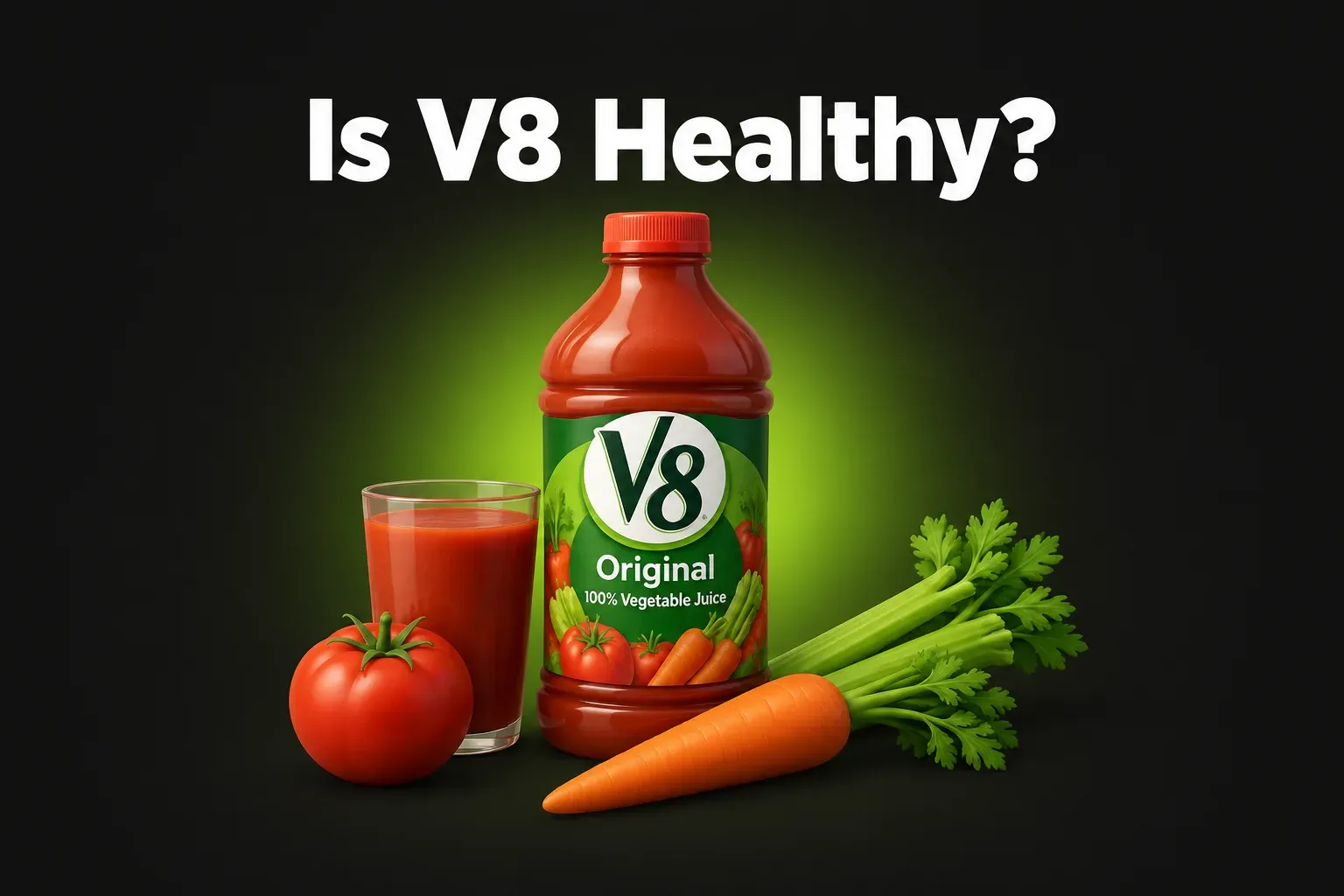
V8 is the red vegetable juice that has been on store shelves for decades. Many people drink it as an easy way to “get their veggies.” But is V8 healthy?
The short answer: V8 Original is a fairly healthy drink with one big catch. An 8 oz glass has just 45 calories, no added sugar, 80% of your daily vitamin C and 20% of your vitamin A. But it also has 640 mg of sodium – more than a quarter of your daily limit. V8 Low Sodium fixes that, with 140 mg of sodium and almost twice the potassium. V8 Splash and V8 Energy are a different story. They are flavored drinks with sweeteners and little or no real vegetable value.
What’s in a glass of V8 Original
Here is the label of V8 Original 100% Vegetable Juice, per 8 oz (240 ml) glass:
| Per 8 oz (240 ml) | Amount | Daily Value |
|---|---|---|
| Calories | 45 | – |
| Total sugars | 7 g | – |
| Added sugars | 0 g | 0% |
| Fiber | 2 g | 7% |
| Protein | 2 g | – |
| Sodium | 640 mg | 28% |
| Potassium | 470 mg | 10% |
| Vitamin C | 72 mg | 80% |
| Vitamin A | 180 mcg | 20% |
Source: V8 (Campbell’s), checked November 2026. Open Food Facts shows the same values.
Ingredients: vegetable juice (water and concentrated juices of tomatoes, carrots, celery, beets, parsley, lettuce, watercress, spinach), salt, vitamin C, natural flavoring, beta carotene, citric acid.
The juice is made from concentrate. That means the water is taken out and added back later. Most of the flavor comes from tomatoes. Beta carotene is a natural orange pigment. Your body turns it into vitamin A.
The 7 g of sugar is the natural sugar from the vegetables. None of it is added.
The big catch: sodium
Salt is the second ingredient, right after the juice. One glass of V8 Original has 640 mg of sodium.
- US guidelines say adults should eat less than 2,300 mg a day (FDA).
- The FDA calls 20% of the Daily Value or more per serving “high.” V8 Original has 28%.
- Americans already eat about 3,400 mg a day on average (FDA).
- A bigger 11.5 oz (340 ml) can has about 920 mg (Open Food Facts).
Why does this matter? Too much sodium raises blood pressure. In a well-known US trial, 412 adults ate diets with high, medium and low sodium. Each diet lasted 30 days. Blood pressure dropped at every step down in sodium. This was true for people with and without high blood pressure (Sacks et al., New England Journal of Medicine, 2001).
V8 Spicy Hot has the same 640 mg of sodium as the Original (V8).
V8 Low Sodium: the better pick
V8 Low Sodium has 140 mg of sodium per 8 oz. That’s 78% less than the Original. It also has 850 mg of potassium – 20% of the Daily Value (V8).
How? Part of the salt is swapped for potassium chloride. It’s a salt substitute that tastes a bit salty.
Potassium helps balance sodium and lower blood pressure. Most Americans don’t get enough of it. Men need about 3,400 mg a day and women about 2,600 mg (NIH Office of Dietary Supplements). One glass of V8 Low Sodium covers about a quarter to a third of that. See more good sources in our list of foods high in potassium.
One warning: people with kidney disease may need to limit potassium. So may people who take some blood pressure medicines, like ACE inhibitors. Ask your doctor before you drink V8 Low Sodium every day.
8 V8 drinks compared
The V8 name is on many drinks, and they are very different. Here are 8 of them, per 8 oz serving.
| Product | Calories | Sugar (added) | Sodium | Potassium | Fiber | Caffeine | What to know |
|---|---|---|---|---|---|---|---|
| V8 Original | 45 | 7 g (0 g) | 640 mg | 470 mg | 2 g | 0 | 100% vegetable juice |
| V8 Low Sodium | 45 | 7 g (0 g) | 140 mg | 850 mg | 1 g | 0 | Potassium chloride replaces some salt |
| V8 Spicy Hot | 45 | 7 g (0 g) | 640 mg | 470 mg | 2 g | 0 | Same base as Original, with spice |
| V8 High Fiber | 60 | 7 g (0 g) | 480 mg | 470 mg | 6 g | 0 | Added soluble corn fiber |
| V8 Deliciously Green (Blend) | 90 | 18 g (0 g) | 55 mg | 350 mg | 0 g | 0 | 100% fruit and vegetable juice; apple, pineapple and kiwi juice add sugar |
| V8 Energy Pomegranate Blueberry | 50 | 10 g (0 g) | 60 mg | 140 mg | 0 g | 80 mg | Caffeine from tea; sweetened with sucralose |
| V8 Energy Zero Sugar Blueberry Raspberry | 5 | 0 g (0 g) | 10 mg | 0 mg | 0 g | 80 mg | Sweetened with stevia |
| V8 Splash Berry Blend | 40 | 9 g (9 g) | 15 mg | not listed | not listed | 0 | 5% juice; high fructose corn syrup and sucralose |
Sources: V8 product pages for Original, Low Sodium, Spicy Hot, High Fiber, Deliciously Green, V8 Energy and V8 Energy Zero Sugar. V8 Splash: Open Food Facts label and Campbell’s Foodservice. Checked November 2026. Recipes change – always check the label.
What stands out:
- V8 Low Sodium is the healthiest of the group. It has the most potassium and less than a quarter of the sodium.
- V8 High Fiber has three times the fiber of the Original. But the extra fiber is added soluble corn fiber, not more vegetables.
- V8 Deliciously Green is a fruit and vegetable blend. It has very little sodium. But it has twice the calories and 18 g of sugar, mostly from fruit juices like apple and pineapple. The label counts it as natural sugar, not added. Your body handles it much like sugar in any juice. Read more in is orange juice healthy?
- V8 Splash is the weakest choice. Campbell’s calls it a flavored drink made with a 5% juice blend. The rest is mostly water, sweeteners and flavors. It lists high fructose corn syrup and sucralose. Campbell’s foodservice page also lists Red 40 for color. Another label we found uses purple carrot juice instead. All of its 9 g of sugar is added.
- V8 Energy has 80 mg of caffeine per 8 oz can. That’s a bit less than a cup of brewed coffee. The regular version uses sucralose. Zero Sugar uses stevia. Compare it with other drinks in our guide to the healthiest energy drink.
What about the sucralose in V8 Energy and Splash?
Sucralose is a zero-calorie sweetener. It’s about 600 times sweeter than sugar. The FDA allows it. But independent labs have found warning signs:
- Mice and cancer. Mice got sucralose in their feed, from before birth until they died. More of the males got blood cancers (leukemias and lymphomas). The rise was clearest at 2,000 ppm (0.2% of their food) and 16,000 ppm (1.6%) (Soffritti et al., International Journal of Occupational and Environmental Health, 2016).
- Rats and gut bacteria. Rats got Splenda (a sucralose sweetener) for 12 weeks. Their helpful gut bacteria dropped. Some changes lasted 12 weeks after they stopped. The doses had 1.1–11 mg of sucralose per kg of body weight a day (Abou-Donia et al., Journal of Toxicology and Environmental Health, 2008). The journal later added an “expression of concern” to this paper. That means editors had questions about it.
- A breakdown product. Scientists studied sucralose-6-acetate. It’s an impurity in sucralose, and the gut may also make it. In lab tests, it damaged DNA in cells. Both it and sucralose made human gut lining tissue leakier (Schiffman et al., Journal of Toxicology and Environmental Health, 2023).
- In people. A French study followed over 100,000 adults. Those who ate more sucralose had a higher risk of heart disease (Debras et al., BMJ, 2022). This kind of study shows a link, not proof of cause.
Why do animal studies count? Rats and mice share most of our genes and body processes. And testing a possible cancer risk on people would put their health at risk. Still, proof in humans is missing. Since several labs see similar signals, it makes sense to limit sucralose as a precaution.
Does V8 count as vegetables?
V8 Original says each 8 oz glass gives you 2 servings of vegetables. Is that true?
Mostly, yes. USDA’s MyPlate counts 1 cup of 100% vegetable juice as 1 cup of vegetables (USDA MyPlate, archived January 2026). V8’s “2 servings” are two half-cup servings. So one glass is 1 cup of vegetables.
How much do you need? Most adult women need 2 to 3 cups a day. Most adult men need 3 to 4 cups. So a glass of V8 covers about a quarter to a half of your daily goal.
Two studies tested this in real life. Campbell’s, the company that makes V8, paid for both, at least in part. Two Campbell’s employees were among the authors.
- Healthy adults. 90 adults got 0, 8 or 16 oz of V8 a day for 12 weeks. Without the juice, all groups ate fewer vegetables than advised. The juice helped them reach the goal. People who started with slightly high blood pressure saw it go down (Shenoy et al., Nutrition Journal, 2010).
- Adults with metabolic syndrome. That’s a group of risks like belly fat, high blood sugar and high blood pressure. 81 adults followed a lower-calorie diet for 12 weeks. Some also drank 8 or 16 oz of V8 Low Sodium a day. The juice drinkers lost a little more weight, but the gap was small. They also got more vitamin C and potassium (Shenoy et al., Nutrition Journal, 2010).
V8 vs tomato juice and whole vegetables
| Per serving | Calories | Sodium | Potassium | Fiber | Vitamin C |
|---|---|---|---|---|---|
| V8 Original (8 oz) | 45 | 640 mg | 470 mg | 2 g | 72 mg |
| V8 Low Sodium (8 oz) | 45 | 140 mg | 850 mg | 1 g | 72 mg |
| Tomato juice, salted (8 oz) | 41 | 615 mg | 527 mg | 1 g | 170 mg |
| Tomato juice, no salt added (8 oz) | 41 | 24 mg | 527 mg | 1 g | 170 mg |
| Raw tomatoes, chopped (1 cup) | 32 | 9 mg | 427 mg | 2.2 g | 25 mg |
| Raw carrots, chopped (1 cup) | 52 | 88 mg | 410 mg | 3.6 g | 8 mg |
Sources: V8 product pages (Original, Low Sodium); USDA FoodData Central for salted tomato juice, unsalted tomato juice, raw tomatoes and raw carrots. USDA values per 100 g, multiplied to one serving and rounded.
What stands out:
- V8 vs tomato juice: they are very close. V8 adds small amounts of seven other vegetables. Unsalted tomato juice has the least sodium of all the juices.
- Juice vs whole vegetables: whole vegetables have more fiber and far less sodium. Fiber helps you feel full and feeds your gut bacteria. Find more ideas in our list of high-fiber foods.
- One plus for juice: tomato juice is rich in lycopene, the red pigment in tomatoes. Your body may absorb it better from cooked tomato products. In one study, people absorbed more lycopene from tomato paste than from fresh tomatoes (Gärtner et al., American Journal of Clinical Nutrition, 1997).
Unsalted tomato juice may also help blood pressure. In Japan, 481 adults drank as much unsalted tomato juice as they liked for a year. In 94 people with untreated high or slightly high blood pressure, it went down a little. Their top number fell from about 141 to 137 (Odai et al., Food Science & Nutrition, 2019). But there was no comparison group, and one author got a grant from a food company.
Who should be careful with V8
- People with high blood pressure, heart failure or kidney disease. The Original has a lot of sodium. Pick Low Sodium – but ask your doctor first if you need to limit potassium.
- People watching their salt. Count V8 toward your 2,300 mg a day.
- Kids, teens and pregnant women. Skip V8 Energy because of the caffeine.
- People with diabetes. The fruit blends and V8 Splash have more sugar. Stick to the vegetable juices.
How to drink V8 the smart way:
- Choose Low Sodium over Original or Spicy Hot.
- Stick to one 8 oz glass a day.
- Eat whole vegetables too. Use V8 as an extra, not a swap.
- Skip V8 Splash. It’s mostly water and sweeteners, with only 5% juice.
- Read the label. “V8” is on many drinks, and they are not all vegetable juice.
Check every V8 bottle before you buy. With NutriSmart, you photograph the label or scan the barcode. The app lists the sweeteners, preservatives and colors, explains the risks of each one and gives the product a health score out of 100. It also tells you right away if a drink is ultra-processed and which ingredients make it so. Set an alert for sucralose or Red 40. The app then warns you whenever a product you scan contains it.Get the app free
The bottom line
V8 Original is a low-calorie vegetable juice with no added sugar and lots of vitamins A and C. One glass counts as 1 cup of vegetables. Its weak spot is sodium: 640 mg per 8 oz. V8 Low Sodium is the better choice, with 140 mg of sodium and extra potassium. Fruit blends add sugar, V8 Energy adds caffeine, and V8 Splash is a 5% juice drink with corn syrup and sucralose. Enjoy a glass of low sodium V8 as a bonus, and keep eating whole vegetables too.
FAQ
Is V8 healthy?
V8 Original is low in calories and has no added sugar. An 8 oz glass gives 80% of your daily vitamin C and 20% of your vitamin A. But it also has 640 mg of sodium, so V8 Low Sodium is the healthier pick.
How much sodium is in V8?
An 8 oz glass of V8 Original or Spicy Hot has 640 mg of sodium. That's 28% of the Daily Value. V8 Low Sodium has 140 mg, and an 11.5 oz can of Original has about 920 mg.
Does V8 count as a serving of vegetables?
Yes. USDA MyPlate counts 1 cup of 100% vegetable juice as 1 cup of vegetables. V8's '2 servings' claim uses half-cup servings. Most adults need 2 to 4 cups of vegetables a day, so one glass covers about a quarter to a half.
Is V8 as good as eating vegetables?
Not quite. A glass of V8 Original has 2 g of fiber, while a cup of chopped carrots has about 3.6 g. Whole vegetables also fill you up better. V8 is a handy extra, not a swap for real vegetables.
Is V8 Splash healthy?
No, it's closer to a juice drink than a vegetable juice. V8 Splash Berry Blend is made with a 5% juice blend. It's sweetened with high fructose corn syrup and sucralose, and some bottles list Red 40.
Is V8 Energy good for you?
It's a lighter energy drink, with 50 calories and 80 mg of caffeine per 8 oz can. The regular version uses sucralose, and Zero Sugar uses stevia. It doesn't replace vegetables, and kids and pregnant women should skip it.