Is Cranberry Juice Healthy? Cocktail vs 100% vs Pure
Is cranberry juice healthy? Sugar in 8 drinks, cocktail vs 100% juice vs pure, plus what studies say about UTIs, kidney stones and warfarin.
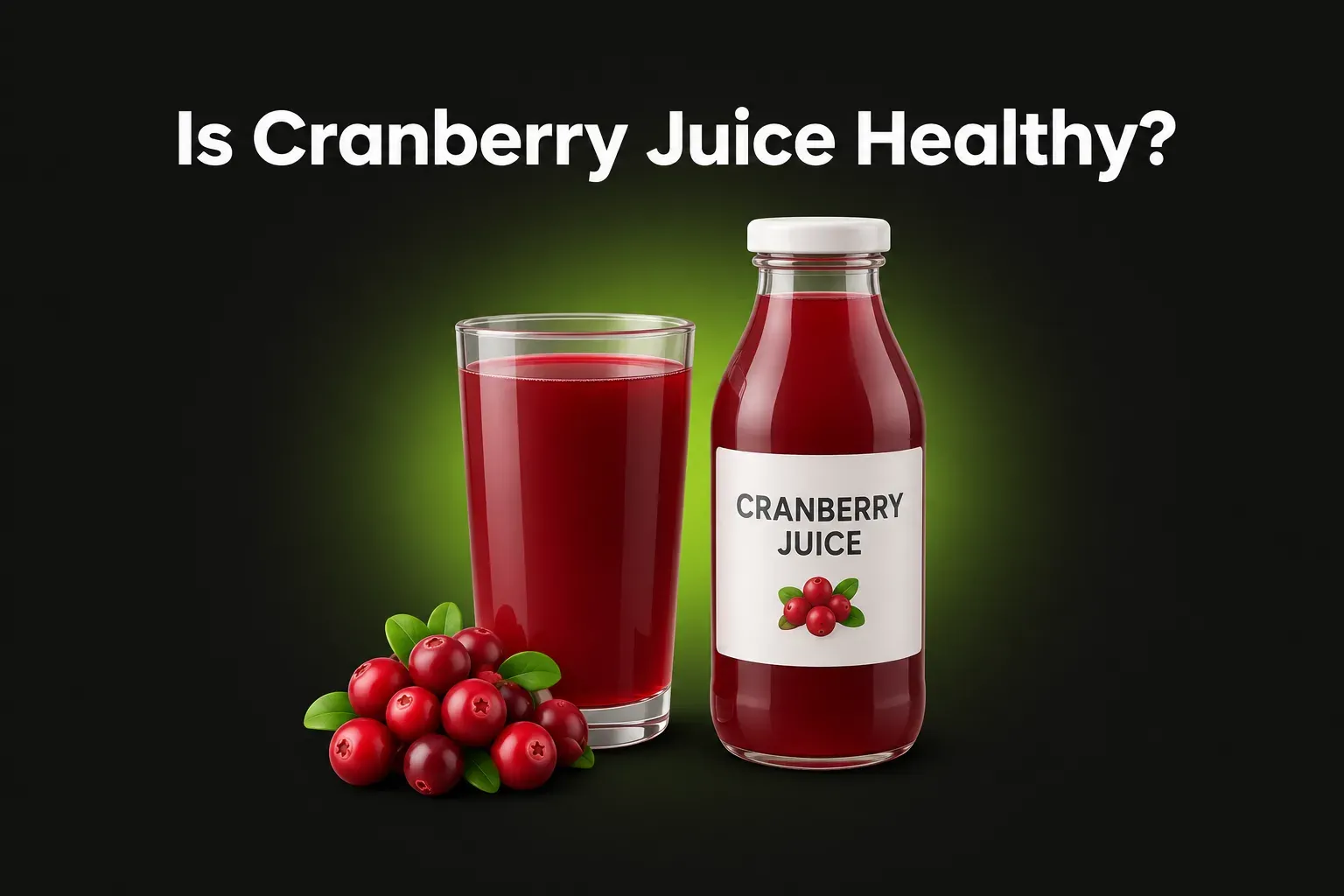
Cranberry juice has a healthy image. Many people drink it to keep UTIs away. But is the bottle in your fridge really good for you?
The short answer: it depends on which kind you buy. Pure, unsweetened cranberry juice is a fairly healthy drink in small amounts. It has about 60–80 calories and no added sugar per cup. But many bottles sold as “cranberry juice” are cranberry juice cocktail. Ocean Spray’s is only 27% juice, with 23 g of added sugar per 8 oz glass. Cranberry products may help prevent UTIs in some people, but they don’t treat them. People with kidney stones or who take warfarin should talk to their doctor first.
Five kinds of cranberry drinks
Cranberries are very tart. So most companies sweeten the juice. How they do it makes all the difference.
- Cranberry juice cocktail. This is the classic red bottle. Ocean Spray’s version is 27% juice, the brand says in Target’s Q&A. The rest is mostly water and sugar.
- 100% juice blends. These have no added sugar. But they mix cranberry with sweeter juices like apple, grape and pear. So they still have a lot of sugar.
- Pure cranberry juice. Only cranberry juice, nothing added. It’s very sour, so most people mix it with water.
- Light drinks. These mix a bit of sugar with sweeteners. They have about half the calories of a cocktail.
- Diet drinks. These use only sweeteners. They have almost no calories.
The front of the bottle often looks the same. So always read the ingredient list and the line that says “Contains __% juice.”
Cranberry juice brands compared
Here are 8 cranberry drinks sold in US stores. All numbers are for one cup (8 oz / 240 ml).
| Product | Type | Calories | Total sugar | Added sugar | Sweetened with |
|---|---|---|---|---|---|
| Ocean Spray Cranberry Juice Cocktail | Cocktail, 27% juice | 110 | 25 g | 23 g | Sugar |
| Great Value Cranberry Juice Cocktail | Cocktail, 27% juice | 110 | 25 g | 23 g | Sugar |
| Ocean Spray Light 50 Cranberry | Light juice drink | 50 | 10 g | 7 g* | Grape juice, sugar, acesulfame K, sucralose |
| Ocean Spray Diet Cranberry | Diet juice drink | 5 | 1 g | 0 g | Sucralose, acesulfame K |
| Ocean Spray 100% Juice Cranberry | 100% juice blend | 100 | 23 g | 0 g | Apple, grape and pear juice |
| Ocean Spray Pure Cranberry | Pure juice | 60 | 9 g | 0 g | None |
| R.W. Knudsen Just Cranberry | Pure juice | 70 | 9 g | 0 g | None |
| Lakewood Organic Pure Cranberry | Pure juice, not from concentrate | 80 | 11 g | 0 g | None |
Source: Ocean Spray product pages (Cocktail, Light 50, Diet, 100% Juice, Pure); Great Value: label photo on Open Food Facts; R.W. Knudsen and Lakewood brand sites. *The 64 oz Light 50 label lists 7 g of added sugar; the 96 oz label lists 6 g.
What stands out:
- The cocktails from Ocean Spray and Walmart’s Great Value are almost the same. Both have 23 g of added sugar per cup.
- The 100% juice blend has no added sugar. But it still has 23 g of sugar – nearly as much as the cocktail. The apple, grape and pear juice in it are naturally sweet.
- Pure cranberry juice has the least sugar, about 9–11 g. All of it comes from the fruit.
- Light 50 gives you both sugar and two sweeteners in one bottle.
- The Diet version adds Red 40, a lab-made color, to its ingredient list.
Pure juice costs much more. On Lakewood’s own site, two 32 oz bottles cost $43 in November 2026. A 64 oz Ocean Spray Cocktail was $2.99 on sale at Target (regular price $3.69). But you mix pure juice with water, so a bottle lasts a long time.
How much sugar is in cranberry juice?
An 8 oz glass of Ocean Spray or Great Value cocktail has 23 g of added sugar. That’s about 6 teaspoons. The American Heart Association says most women should have no more than 100 calories of added sugar a day. That’s about 25 g, or 6 teaspoons. For most men, the limit is 150 calories, or about 36 g (Johnson et al., Circulation, 2009). So one glass is close to a woman’s whole daily limit.
Many people pour more than 8 oz. A 16 oz glass of cocktail has 46 g of added sugar. A 12 oz can of regular soda has about 39 g. Read more in our guide to the healthiest soda.
Liquid sugar is easy to drink fast. It doesn’t fill you up like food does. So the calories add up before you notice. That’s true for vitamin water, pineapple juice and orange juice too.
Does cranberry juice help with UTIs?
Cranberries have natural plant compounds called PACs (proanthocyanidins). PACs make it harder for E. coli bacteria to stick to the bladder wall. These bacteria cause most UTIs.
What the best review found. Cochrane is a group known for careful, independent reviews. In 2023, its experts looked at 50 studies with 8,857 people. Cranberry juice, pills and other products cut the risk of UTIs by about 30% overall. The benefit was clearest in three groups:
- Women with repeat UTIs – about 26% fewer infections.
- Children – about half as many infections.
- People at higher risk because of a medical treatment – about half as many.
But cranberry didn’t seem to help older people in nursing homes, pregnant women or people who can’t empty their bladder well (Williams et al., Cochrane Database of Systematic Reviews, 2023).
A juice study. In one US trial, 373 women with a recent UTI drank 8 oz of a cranberry drink or a look-alike fake drink every day. After 24 weeks, the cranberry group had 39 UTIs. The fake-drink group had 67 (Maki et al., American Journal of Clinical Nutrition, 2016). Keep in mind that two of the authors worked for Ocean Spray.
What this means for you:
- Cranberry may help prevent UTIs. It doesn’t treat an infection you already have. See a doctor for that.
- The Cochrane review couldn’t tell whether juice works better than pills. It also found no clear difference between low and high doses of PACs.
- The FDA lets Ocean Spray say a daily 8 oz cranberry drink may help prevent repeat UTIs in healthy women. But the FDA also says the proof is “limited and inconsistent” (Ocean Spray).
If you drink it for your bladder, pick pure or diluted juice. Then you get the cranberry without 23 g of added sugar a day.
Diet and light cranberry juice: what about the sweeteners?
Ocean Spray Diet has just 5 calories a cup. It uses sucralose and acesulfame K. Light 50 uses both sweeteners plus sugar. These sweeteners are allowed by the FDA. But independent studies raise questions:
- Sucralose and blood cancer in mice. The Ramazzini Institute in Italy fed sucralose to over 800 mice, from before birth until death. Their food had 500 to 16,000 ppm (parts per million) of sucralose. Male mice had more blood cancers, like leukemia. The risk rose with the dose (Soffritti et al., International Journal of Occupational and Environmental Health, 2016).
- Sucralose and the gut. Mice drank sucralose for six months. The dose matched the daily limit allowed for people. Their gut bacteria changed. In their livers, genes linked to inflammation were more active (Bian et al., Frontiers in Physiology, 2017).
- DNA damage in lab tests. Sucralose-6-acetate is a leftover from making sucralose. Rodent tests suggest the gut can also make it from sucralose. In lab tests on cells, it damaged DNA (Schiffman et al., Journal of Toxicology and Environmental Health, 2023).
- Acesulfame K. In mice, four weeks of acesulfame K changed gut bacteria. Male mice gained more weight (Bian et al., PLOS ONE, 2017).
- Studies in people. A French study followed over 100,000 adults for about 8 years. People who had the most acesulfame K had a 13% higher cancer risk than people who had none (Debras et al., PLOS Medicine, 2022). This kind of study shows a link, not proof of cause.
Why do animal studies matter? Rodents share most of their genes and body processes with us. And testing possible cancer risks on people would put their health at risk. Still, proof in humans is missing. But several labs have seen similar warning signs. So it makes sense to limit these sweeteners as a precaution. Read more in our guide to artificial sweeteners.
The Diet version also has Red 40, a lab-made color. In a UK study of about 300 children, drinks with color mixes and a preservative made kids more hyperactive on average (McCann et al., The Lancet, 2007).
Kidney stones: who should be careful
Cranberries have some oxalate. Oxalate is a natural compound. It can join with calcium and form the most common kind of kidney stone. Studies don’t agree on what cranberry juice does:
- Higher risk. 24 adults drank 1 liter (about 34 oz) of cranberry juice a day for a week. Half of them had kidney stones before. The juice raised oxalate and calcium in their urine. Their risk of calcium oxalate and uric acid stones went up. But the risk of a rarer stone type went down (Gettman et al., Journal of Urology, 2005).
- Lower risk. 20 young men in South Africa drank 500 ml (about 17 oz) of cranberry juice, mixed with water, every day for two weeks. Their urine oxalate went down (McHarg et al., BJU International, 2003).
- Pills. In 5 healthy people, cranberry pills at the label dose raised urine oxalate by 43% in one week (Terris et al., Urology, 2001).
If you’ve had kidney stones, ask your doctor before drinking cranberry juice every day. Large amounts and cranberry pills are the bigger worry.
Cranberry juice and warfarin
Warfarin is a blood thinner. In the early 2000s, UK doctors reported a few people on warfarin who had bleeding problems after drinking cranberry juice. So UK health officials warned against the mix.
Later trials found little to worry about. In one US trial, 30 people on warfarin drank 8 oz of cranberry juice or a fake drink daily for 2 weeks. The juice didn’t change the warfarin levels in their blood. Their clotting test was a bit higher on only one day (Ansell et al., Journal of Clinical Pharmacology, 2009). A 2010 review looked at all the case reports and trials. It said the early warnings rested only on a few case reports (Zikria et al., American Journal of Medicine, 2010).
Advice today is still mixed. The UK’s NHS tells people on warfarin not to have cranberry juice or cranberry products. The US National Center for Complementary and Integrative Health says the evidence is conflicting. If you take warfarin, ask your doctor first. Don’t suddenly start or stop drinking it.
How to pick a healthier cranberry juice
- Look for pure cranberry juice, with cranberry juice as the only ingredient.
- Mix it with water or sparkling water. Try 2 oz of pure juice in a glass of sparkling water. It’s tart and refreshing.
- Check the juice line. “Contains 27% juice” means most of the bottle is water and sugar.
- Don’t trust “100% juice” alone. Read the ingredients. Apple and grape juice add a lot of sugar.
- Keep it to one small glass. Even pure juice has natural sugar and no fiber.
- See a doctor for UTI symptoms. Cranberry juice is not a treatment.
Check what’s in your cranberry juice. With NutriSmart, you photograph the label or scan the barcode. The app lists the sweeteners, preservatives and colors, explains the risks of each one and gives the product a health score out of 100. It also tells you right away if a juice drink is ultra-processed, and which ingredients make it so. Set an alert for sucralose or Red 40. The app then warns you whenever a bottle you scan contains it.Get the app free
The bottom line
Pure, unsweetened cranberry juice can be a healthy drink in small amounts. It’s tart, so mix it with water. But many bottles in stores are cocktail. Ocean Spray’s is only 27% juice, with 23 g of added sugar per cup. Even 100% juice blends have nearly as much sugar, from apple and grape juice. Diet versions cut the sugar but add sweeteners with open questions. Cranberry may help prevent UTIs in some people, but it won’t cure one. If you’ve had kidney stones or take warfarin, talk to your doctor first.
FAQ
Is cranberry juice healthy?
Pure, unsweetened cranberry juice is a fairly healthy drink in small amounts. But many bottles in stores are cranberry juice cocktail. Ocean Spray's and Walmart's cocktails are only 27% juice, with 23 g of added sugar per cup.
Does cranberry juice help with UTIs?
It may help prevent them, but it doesn't treat them. A 2023 Cochrane review found that cranberry products cut the risk of UTIs by about 30%. The benefit was clearest in women with repeat UTIs, children and people at higher risk because of a medical treatment.
How much sugar is in cranberry juice?
An 8 oz glass of Ocean Spray Cranberry Juice Cocktail has 25 g of sugar, and 23 g of that is added. Pure unsweetened cranberry juice has about 9–11 g, all from the fruit.
What's the difference between cranberry juice and cranberry juice cocktail?
Cranberry juice cocktail is mostly water and sugar. Ocean Spray's has 27% juice. 100% juice blends are sweetened with apple, grape or pear juice. Pure cranberry juice is only cranberry juice and tastes very tart.
Is diet cranberry juice good for you?
Ocean Spray Diet has only 5 calories and 1 g of sugar per cup. But it's sweetened with sucralose and acesulfame K, and it also has Red 40. Animal studies raise questions about these sweeteners, so it's best as an occasional drink.
Can I drink cranberry juice if I take warfarin?
Ask your doctor first. The NHS in the UK tells people on warfarin not to have cranberry juice. Small US trials found no clear effect, but it's safer to check first.