Is Guacamole Healthy? Nutrition, Store Brands and Chips
Is guacamole healthy? Calories, fat and fiber in 2 tbsp, what avocado studies show, 8 store brands vs Chipotle, and why the chips matter more.
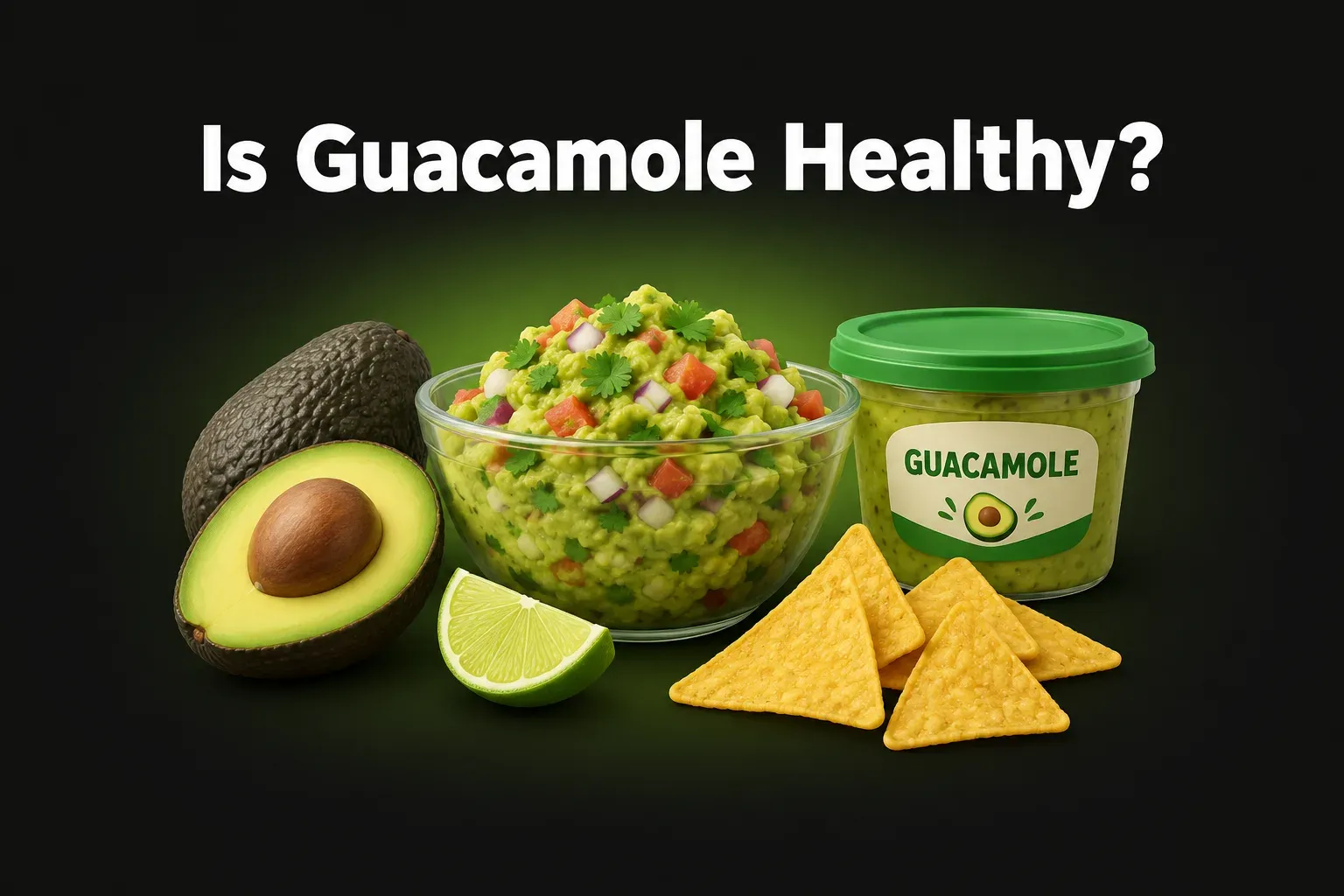
Guacamole is on tacos, burritos, toast and every party table. It’s green, creamy and made from avocado. But is guacamole healthy, or just a tasty excuse to eat chips?
The short answer: real guacamole is a healthy dip. Two tablespoons have about 47 calories, 2 g of fiber and mostly unsaturated fat, the kind linked to a healthier heart. A large study ties eating avocado to a lower risk of heart disease, though some avocado research is paid for by the industry. Most store tubs are close to homemade. Watch out for “guacamole dips” that are mostly water and oil, with little or no fresh avocado and added colors. And the real problem is often the chips: one ounce has nearly three times the calories of 2 tablespoons of guac.
Guacamole nutrition: what’s in 2 tablespoons
Classic guacamole is mashed avocado with onion, lime or lemon juice and salt. Here is what 2 tablespoons (30 g) give you.
| Nutrient | 2 tbsp (30 g) |
|---|---|
| Calories | 47 |
| Fat | 4.3 g |
| – monounsaturated | 2.8 g |
| – saturated | 0.6 g |
| Carbs | 2.5 g |
| – fiber | 2.0 g |
| Protein | 0.6 g |
| Potassium | 142 mg |
| Sodium | 103 mg |
Source: USDA FoodData Central – guacamole (made from avocado, onion, lemon juice and salt). Values per 100 g, multiplied by 30 g and rounded.
What stands out:
- The fat is mostly the good kind. About two thirds of it is monounsaturated fat (the same kind as in olive oil). Only a small part is saturated fat.
- Fiber is high for a dip. Two tablespoons give you 2 g. That’s about 7% of the daily value. Fiber is the part of plants that keeps you full and helps digestion.
- Potassium helps keep blood pressure in check. Avocado is a good source – see our full guide to calories in avocado.
- Sodium comes from the salt you add. Homemade guac lets you control it.
What avocado research shows
Guacamole is mostly avocado. So most of the health research is on avocado itself. Some of it is paid for by the Hass Avocado Board, an industry group. We note it where it applies.
Heart disease. Harvard researchers followed about 110,000 US nurses and health workers for up to 30 years. People who ate two or more servings a week had a 16% lower risk of heart disease and stroke combined than people who ate none. Their risk of heart disease alone was 21% lower. One serving was half an avocado. Eating a quarter avocado a day in place of butter, margarine, cheese or processed meat was linked to a 16–22% lower risk (Pacheco et al., Journal of the American Heart Association, 2022). The US government paid for this study, not the avocado industry. But it’s an observational study. That means it shows a link, not proof that avocado was the cause.
Cholesterol. In a feeding study, 45 adults with extra weight ate three diets for 5 weeks each. The diet with one avocado a day lowered LDL (“bad”) cholesterol the most – by 13.5 mg/dL (Wang et al., Journal of the American Heart Association, 2015). The Hass Avocado Board paid for this study. A review of 18 studies found a different picture. Avocado raised HDL (“good”) cholesterol a little. But it did not clearly lower LDL cholesterol (Mahmassani et al., American Journal of Clinical Nutrition, 2018).
Weight. The largest trial gave 1,008 adults with a large waist one large avocado a day for 6 months. They didn’t gain weight compared with people on their usual diet. But they didn’t lose belly fat either (Lichtenstein et al., Journal of the American Heart Association, 2022). The avocado industry paid for this trial.
Better with salsa. Avocado fat helps your body take in plant nutrients from other foods. In a small study, 11 adults ate salsa with or without about 150 g (5 oz) of avocado. With avocado, they absorbed 4.4 times as much lycopene (the red pigment in tomatoes) (Unlu et al., Journal of Nutrition, 2005). So guac with tomatoes is a smart pairing.
Store-bought guacamole compared
We checked the labels of 8 guacamoles sold in US stores, plus the side of guac at Chipotle. The last column shows what’s added besides avocado and vegetables.
| Product | Serving | Calories | Fat | Sodium | Fiber | Added besides avocado and veggies |
|---|---|---|---|---|---|---|
| Good Foods Chunky Guacamole | 2 tbsp (33 g) | 40 | 3.5 g | 160 mg | 2 g | Nothing |
| Herdez Mild Traditional Guacamole | 30 g | about 50 | about 5 g | about 95 mg | about 1 g | Nothing |
| Trader Joe’s Avocado’s Number | 2 tbsp (30 g) | 50 | 4 g | 120 mg | 2 g | Vinegar, water |
| Wholly Guacamole Classic | 2 tbsp (30 g) | 70 | 6 g | 140 mg | 1 g | Vinegar, a little water |
| Sabra Spicy Guacamole | 2 tbsp (31 g) | 50 | 4.5 g | 150 mg | 1 g | Sugar, citric acid, ascorbic acid, natural flavors |
| Yucatan Authentic Guacamole | 2 oz cup (57 g) | 80 | 8 g | 260 mg | 4 g | Sugar, ascorbic acid, citric acid, xanthan gum |
| Chipotle guacamole (side) | 4 oz (113 g) | 230 | 22 g | 370 mg | 6 g | Made from whole avocados; full recipe not posted |
| Herdez Guacamole Salsa | 2 tbsp (31 g) | about 60 | about 5 g | about 240 mg | 0 g | Water and soybean oil come before avocados; xanthan gum, artificial flavors, Yellow 5, Yellow 6, Blue 1 |
| La Costeña Guacamole Dip | 2 tbsp (30 g) | 60 | 4 g | 210 mg | 0 g | No fresh avocado – avocado powder, soybean oil, shortening, artificial guacamole flavor, BHT, MSG, Yellow 5 |
Sources: Good Foods and Wholly product pages (Wholly ingredients); Open Food Facts labels for Herdez Traditional, Trader Joe’s, Wholly Classic, Sabra Spicy, Yucatan, Herdez Guacamole Salsa and La Costeña; Chipotle nutrition chart (July 2022). Checked November 2026; the La Costeña entry was last updated in 2025. Herdez Traditional values are worked out from the per-100 g label. For Herdez Guacamole Salsa we used the newest label photo; an older label shows 50 calories and 200 mg sodium. Recipes change – always check the tub.
What to notice:
- The real guacs are close. Most have 40–70 calories per 2 tablespoons.
- Good Foods and Herdez Traditional read like a home recipe: avocado, vegetables, lime and salt.
- Yucatan and Sabra Spicy add a little sugar and some helpers. Ascorbic acid is simply vitamin C. It keeps the guac from turning brown.
- None of the labels state how much avocado is inside. But ingredients are listed by weight, from most to least. So check what comes first.
- Herdez Guacamole Salsa is sold as a salsa, not as guacamole. Water, tomatillos and soybean oil all come before avocados.
- La Costeña Guacamole Dip has no fresh avocado at all. Its only avocado is a powder. It comes ninth on the list, after water, oil, starch and shortening. Artificial guacamole flavor and Yellow 5 do the rest.
How store-bought guac stays green
Cut avocado turns brown fast. Brands use a few tricks to stop it.
- High pressure. Wholly seals its guac and then presses it under very high water pressure, with no heat. This is called HPP (high pressure processing). The company says it keeps bacteria from growing, so it can skip preservatives (Wholly).
- Acids. Lime juice, vinegar and citric acid slow browning and add tang.
- Vitamin C. Ascorbic acid also protects the color.
These are simple, common helpers. None of them is an artificial color.
When “guacamole dip” isn’t really guacamole
A product called “dip” or “salsa” may use little avocado. To look and taste like guac, it uses oil, starch, gums, flavors and colors. Here’s what research says about them.
Artificial colors
Herdez Guacamole Salsa lists Yellow 5, Yellow 6 and Blue 1. La Costeña lists Yellow 5.
- In a careful UK study, about 300 children aged 3 and 8–9 drank fruit juice for several weeks. Some weeks, the juice had a mix of artificial dyes, including Yellow 5, plus a preservative. Other weeks, it had no additives. With the additives, the children were a little more hyperactive (McCann et al., The Lancet, 2007).
- In a 2026 study, rats got Yellow 5 (3.75 or 15 mg per kg of body weight) or Yellow 6 (1.75 or 7 mg per kg) for 7–21 days. They had changes in their blood and short-lived DNA damage. The effects were worst when the two dyes were given together (Hayat et al., Journal of Applied Toxicology, 2026).
Why do rat studies matter? Rats share most of our genes and body processes. Testing dyes on people for years would put their health at risk. Proof of harm in people is still missing. But several labs see the same warning signs. So it makes sense to limit artificial colors as a precaution. Real guacamole doesn’t need them.
Gums and emulsifiers
Xanthan gum (in Yucatan and Herdez Guacamole Salsa) is a thickener made by bacteria. In a small study, 9 people with diabetes ate 12 g a day in muffins for 6 weeks. Their blood sugar went down (Osilesi et al., American Journal of Clinical Nutrition, 1985). In Yucatan, it’s near the end of the list, so the amount is small. In mice carrying human gut bacteria, xanthan gum helped certain gut bacteria multiply (Ostrowski et al., Nature Microbiology, 2022). Scientists don’t yet know if this matters for health.
Carboxymethylcellulose (in La Costeña) has more warning signs. In mice, small amounts in drinking water caused mild gut inflammation, weight gain and blood sugar problems (Chassaing et al., Nature, 2015). In a small trial, healthy adults who ate 15 g a day for 11 days had a bit more belly discomfort after meals and less variety in their gut bacteria (Chassaing et al., Gastroenterology, 2022).
La Costeña also lists BHT, a lab-made preservative that is still debated. Read more in our guide to BHA and BHT. Dips like this count as ultra-processed. Real guacamole doesn’t.
Chipotle guacamole
Chipotle says it makes its guac from whole, ripe avocados. A 4 oz side has 230 calories, 22 g of fat, 6 g of fiber and 370 mg of sodium. That’s about as many calories as a whole medium avocado.
The guac isn’t the problem. The chips are. Chipotle’s regular bag of chips has 540 calories. Chips and guacamole together come to 770 calories. Chipotle says that serves two. See the full menu breakdown in is Chipotle healthy?
The real problem: chips
What you dip matters more than the dip. Compare one ounce of each.
| Dipper (1 oz / 28 g) | Calories |
|---|---|
| Tortilla chips | 134 |
| Carrots | 12 |
| Red bell pepper | 7 |
| Cucumber | 4 |
Source: USDA FoodData Central – tortilla chips, carrots, red bell pepper, cucumber. Values per 100 g, multiplied by 28.35 g and rounded.
A quarter cup of guac (about 60 g) has about 93 calories. Add one ounce of chips, and your snack is about 230 calories. But it’s easy to eat three or four ounces from a basket. Then you’re near 500–630 calories before dinner.
Tips:
- Put chips in a bowl. Don’t eat from the bag or basket.
- Mix in vegetables. Carrots, peppers and cucumber slices scoop guac well.
- Pick simple chips. Look for corn, one oil and salt. Compare brands in our guide to the healthiest tortilla chips.
Guacamole vs other dips
Per 2 tablespoons (30 g):
| Dip | Calories | Saturated fat | Fiber | Sodium |
|---|---|---|---|---|
| Guacamole | 47 | 0.6 g | 2.0 g | 103 mg |
| Salsa | 9 | 0 g | 0.6 g | 213 mg |
| Sour cream | 59 | 3.0 g | 0 g | 9 mg |
| Hummus | 71 | 0.8 g | 1.7 g | 128 mg |
Source: USDA FoodData Central – guacamole, salsa, sour cream, hummus. Values per 100 g, multiplied by 30 g and rounded.
Salsa is the lightest, but it has no healthy fat. Sour cream has five times the saturated fat of guac. On tacos or nachos, guac is usually the better creamy topping – here’s how sour cream compares in more detail.
Who should be careful
- People watching their weight. Guac is healthy, but calorie-dense. Keep to about 2–4 tablespoons per meal. Check your daily needs with our calorie calculator.
- People on a low-sodium diet. Store tubs have 95–260 mg of sodium per serving. Homemade guac with a pinch of salt has less.
- People with kidney disease. Avocado is rich in potassium. If your doctor told you to limit potassium, ask about portion sizes.
How to pick or make a healthy guacamole
- Look for avocado first on the ingredient list.
- Skip products where water, oil or starch come before avocado, or that list artificial colors.
- Choose short lists: avocado, vegetables, lime, salt. Vinegar and vitamin C are fine.
- Make it at home: mash 2 avocados with lime juice, onion, tomato, cilantro and a pinch of salt.
Check your guacamole before you buy it. With NutriSmart, you photograph the label or scan the barcode. The app lists the sweeteners, preservatives and colors, explains the risks of each one and gives the product a health score out of 100. It also tells you right away if a dip is ultra-processed, and which ingredients make it so. Set an alert for Yellow 5 or BHT, and the app warns you whenever a product you scan contains one of them.Get the app free
The bottom line
Real guacamole is a healthy dip. Two tablespoons have about 47 calories, 2 g of fiber and mostly unsaturated fat. A large study links avocado to a lower risk of heart disease. But some avocado research is paid for by the industry. Most store tubs, like Good Foods, Herdez Traditional, Trader Joe’s and Wholly, are close to homemade. Skip “guacamole dips” and salsas made with water, oil, avocado powder and dyes. And watch the chips – they add far more calories than the guac. Dip vegetables, or put a small handful of chips in a bowl.
FAQ
Is guacamole healthy?
Yes, real guacamole is a healthy dip. Two tablespoons have about 47 calories, 2 g of fiber and mostly unsaturated fat from avocado. The bigger problem is usually the pile of chips you eat with it.
How many calories are in guacamole?
About 47 calories in 2 tablespoons of homemade-style guacamole, based on USDA data. Store brands range from about 40 to 70 calories per 2 tablespoons. A side of guacamole at Chipotle (4 oz) has 230 calories.
Is guacamole good for weight loss?
It can fit, because its fat and fiber help you feel full. But it is calorie-dense, so keep to about 2–4 tablespoons. Dip vegetables instead of chips to save over 100 calories per ounce.
Is store-bought guacamole healthy?
Many tubs are close to homemade, with avocado listed first and no additives. But some "guacamole dips" and "guacamole salsas" are mostly water and oil, with little or no fresh avocado and added colors. Read the ingredient list before you buy.
Is Chipotle guacamole healthy?
The guacamole itself is made from whole avocados. A 4 oz side has 230 calories, 22 g of fat and 370 mg of sodium. Add the regular bag of chips, and the order jumps to 770 calories.
Is guacamole healthier than sour cream?
In most ways, yes. Per 2 tablespoons, guacamole has fewer calories, about a fifth of the saturated fat and 2 g of fiber. Sour cream has no fiber but much less sodium.