Calories in Avocado: Whole, Half and Per 100 g
How many calories are in a whole avocado, half an avocado and 100 g, plus fat, fiber and carbs, avocado toast and guacamole, and whether avocado is fattening.
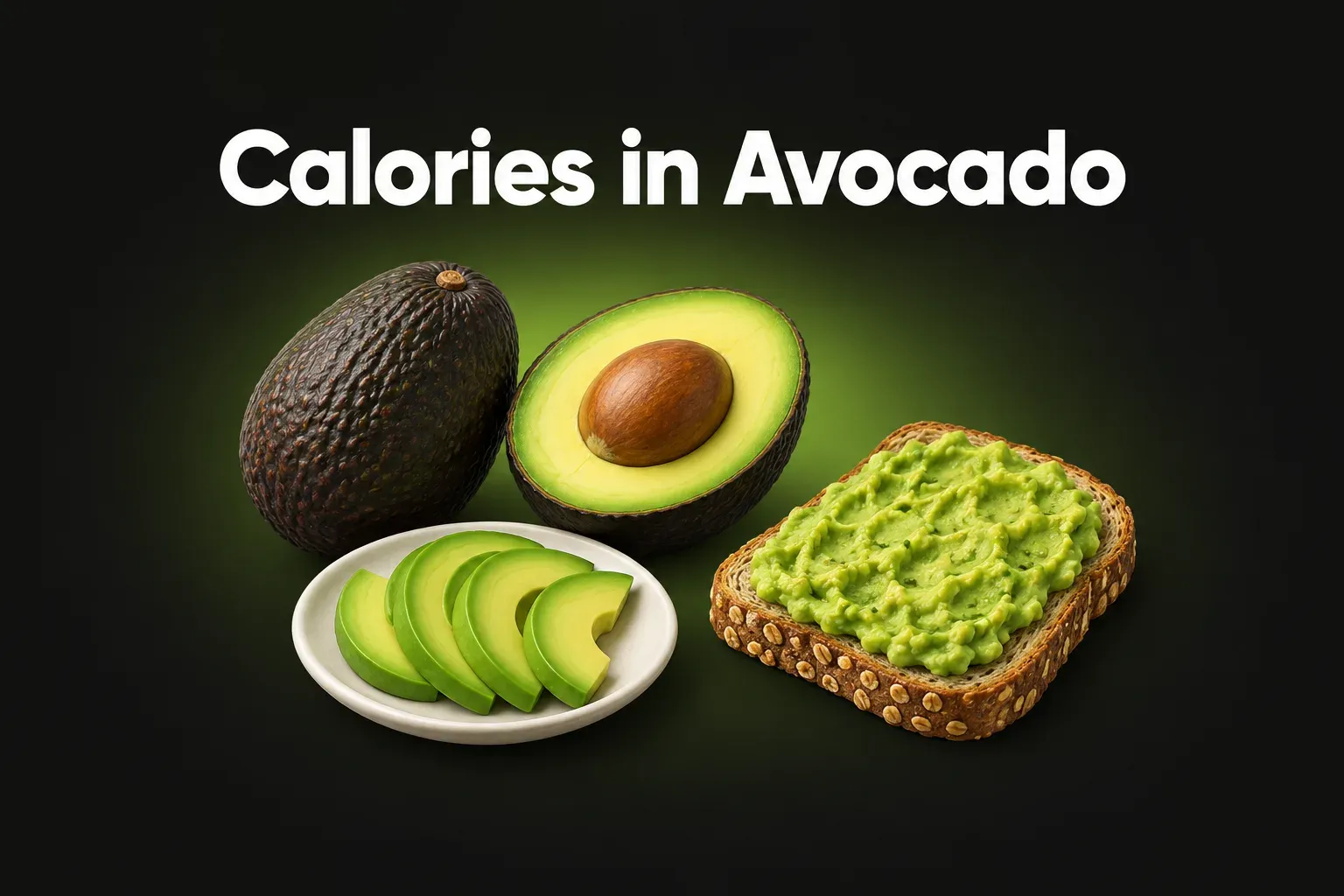
Avocado is on toast, in salads, in bowls and, of course, in guacamole. It’s creamy, filling and full of healthy fat – but it also has more calories than almost any other fruit. So how many calories are in an avocado, and how much should you eat if you’re watching your weight?
The short answer: a medium Hass avocado (about 136 g of flesh) has about 227 calories, and half an avocado has about 115. 100 g of avocado has about 160–167 calories, most of it from healthy monounsaturated fat. Avocado is also very high in fiber and low in sugar. It’s not fattening by itself – just keep an eye on the portion.
Calories in avocado by portion
Values are for Hass avocado – the small, dark, bumpy kind sold in most stores – without skin and pit, from the US Department of Agriculture (USDA FoodData Central):
| Portion | Weight | Calories |
|---|---|---|
| 1 tablespoon, mashed | 15 g | 25 kcal |
| 1 serving (⅓ medium) | 50 g | 84 kcal |
| ½ medium avocado | 68 g | 114 kcal |
| 1 medium avocado | 136 g | 227 kcal |
| 1 large avocado | about 200 g | about 335 kcal |
| 1 cup, cubed | 150 g | 250 kcal |
| 100 g | 100 g | 167 kcal |
Tip: the skin and pit are about a third of an avocado’s weight. A 200 g avocado from the store gives you about 135 g of flesh.
Florida avocados – the big, smooth, bright green kind – have fewer calories per 100 g (about 120) because they have less fat and more water. But one fruit can weigh 300 g or more without skin, so a whole one still has about 365 calories.
Avocado nutrition facts
| Nutrient | Per 100 g | Per ½ medium avocado (68 g) |
|---|---|---|
| Calories | 167 kcal | 114 kcal |
| Fat | 15.4 g | 10.5 g |
| – monounsaturated | 9.8 g | 6.7 g |
| – saturated | 2.1 g | 1.4 g |
| Carbohydrates | 8.6 g | 5.9 g |
| – of which fiber | 6.8 g | 4.6 g |
| – of which sugars | 0.3 g | 0.2 g |
| Protein | 2.0 g | 1.3 g |
| Potassium | 507 mg | 345 mg |
| Folate | 89 µg | 61 µg |
| Vitamin K | 21 µg | 14 µg |
About 80% of an avocado’s calories come from fat – but most of it is monounsaturated fat, the same kind as in olive oil. Avocado is also one of the best fruit sources of fiber: half an avocado gives you almost 5 g, and it has more potassium than a banana per 100 g. See our lists of high fiber foods and foods high in potassium.
Calories in avocado toast, guacamole and other dishes
| Food | Portion | Calories |
|---|---|---|
| Avocado toast (1 slice whole wheat bread + ½ avocado) | 1 slice | about 215 kcal |
| Avocado toast with a fried egg | 1 slice | about 305 kcal |
| Guacamole | 2 tbsp (30 g) | about 50 kcal |
| Guacamole with tortilla chips | ¼ cup + 1 oz chips | about 240 kcal |
| Avocado in a salad | ¼ avocado (34 g) | about 57 kcal |
| Avocado oil | 1 tbsp (14 g) | about 124 kcal |
Guacamole is mostly avocado, so it has about the same calories – the problem is usually the chips you dip in it. A handful of tortilla chips can have more calories than the guacamole itself.
Is avocado fattening?
Not by itself. You gain weight only when you eat more calories than you burn overall. But avocado is calorie-dense: a whole large avocado has as many calories as a small meal.
The largest trial so far gave 1,008 adults with a large waist one large avocado a day for 6 months. Compared with people who ate their usual diet, they didn’t gain more weight – but they didn’t lose belly fat either, and their cholesterol improved only slightly (Lichtenstein et al., Journal of the American Heart Association, 2022). The study was funded by the Avocado Nutrition Center, an industry group, which makes the neutral result even more telling.
In practice: avocado is a good fat that keeps you full, but it doesn’t burn fat. If you’re trying to lose weight, ¼ to ½ avocado per meal is a sensible portion. Read more about the calorie deficit and find your daily target with our calorie calculator.
Avocado on keto and low-carb diets
Avocado is one of the most keto-friendly foods there is: 100 g has only about 2 g of net carbs (carbs minus fiber) and plenty of fat. It also has a very low effect on blood sugar. See our guide to the keto diet.
How to eat avocado when you’re losing weight
- Use it instead of other fats – on bread instead of butter, in sandwiches instead of mayonnaise.
- Stick to ¼–½ avocado per meal and save the rest with the pit in, wrapped tightly, in the fridge.
- Pair it with protein – eggs, beans, chicken or fish – for a meal that keeps you full for hours.
- Watch what comes with it – chips, extra cheese and sour cream add up fast.
- Don’t add avocado on top of everything – swap it in, don’t just add it.
Count the calories in your avocado without guesswork. With NutriSmart, you snap a photo of what you eat, and the app counts your calories, protein, carbs and fat and shows how much you have left for the day. In the food library, you can also see the glycemic index of each food.Get the app free
You can also read how many calories are in an egg and in olive oil, and our healthy breakfast ideas.
The bottom line
A medium Hass avocado has about 227 calories, half an avocado about 115, and 100 g about 167. Most of those calories come from healthy monounsaturated fat, and avocado is also rich in fiber and potassium. It isn’t fattening by itself, but it’s calorie-dense – use it in place of other fats and keep to a quarter to half an avocado per meal.
FAQ
How many calories are in an avocado?
A medium Hass avocado – the small, dark, bumpy kind sold in most stores – has about 136 g of flesh and about 227 calories. Large Hass avocados can have 300 calories or more.
How many calories are in half an avocado?
About 115 calories for half a medium Hass avocado (68 g). The official serving size on US labels is a third of a medium avocado (50 g), with about 80 calories.
How many calories are in 100 g of avocado?
Hass avocado has about 167 calories per 100 g, with 15.4 g of fat, 8.6 g of carbs, 6.8 g of fiber, 2 g of protein and less than 1 g of sugar.
Is avocado fattening?
Not by itself, but it's calorie-dense, so portions matter. In a large 6-month trial, adults who added one avocado a day to their diet didn't gain more weight than the control group. If you're losing weight, a quarter to half an avocado per meal is a good portion.
Is the fat in avocado healthy?
Mostly yes. About two thirds of it is monounsaturated fat, the same type as in olive oil. Replacing butter, mayonnaise or processed spreads with avocado is a good swap.
Is avocado keto-friendly?
Yes. 100 g of Hass avocado has only about 2 g of net carbs (carbs minus fiber), plus lots of fat, so it fits easily into keto and low-carb diets.