Is Sour Cream Healthy? Nutrition, Brands and Swaps
Is sour cream healthy? Calories and saturated fat per 2 tbsp, regular vs light vs fat-free, the Greek yogurt swap and 8 tubs compared.
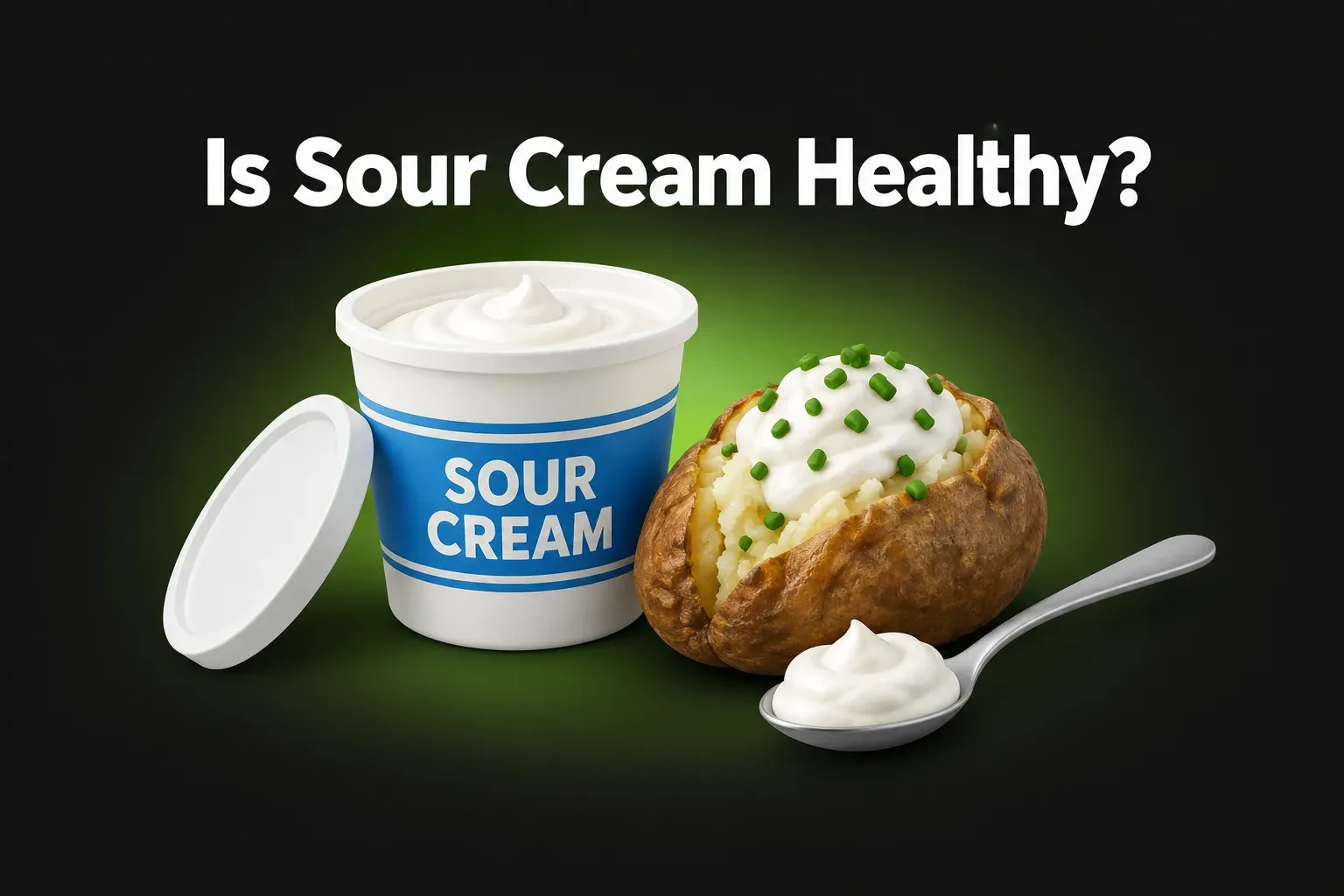
Sour cream goes on tacos, baked potatoes, chili and nachos. It’s creamy and tangy. But is it good for you?
The short answer: sour cream is fine in small amounts, but it’s not a health food. Two tablespoons of regular sour cream have about 60 calories and 3.5 g of saturated fat. That’s about a quarter of the daily limit heart experts suggest. It has only about 1 g of protein. The best tubs have one or two ingredients, like cream and cultures. Many light and fat-free tubs add starches, gums and sometimes carrageenan. For more protein and fewer calories, plain Greek yogurt is an easy swap.
Sour cream nutrition facts
Here is how regular, light and fat-free sour cream compare with Greek yogurt. The numbers are for 2 tablespoons (1 oz / 30 g), the serving size on most US labels.
| Type (2 tbsp, 30 g) | Calories | Fat | Saturated fat | Protein | Carbs |
|---|---|---|---|---|---|
| Sour cream, regular | 59 | 5.8 g | 3.0 g | 0.7 g | 1.4 g |
| Sour cream, light | 41 | 3.2 g | 2.0 g | 1.1 g | 2.1 g |
| Sour cream, fat‑free | 22 | 0 g | 0 g | 0.9 g | 4.7 g |
| Greek yogurt, plain, nonfat | 18 | 0.1 g | 0 g | 3.1 g | 1.1 g |
| Greek yogurt, plain, whole milk | 29 | 1.5 g | 0.7 g | 2.7 g | 1.2 g |
Source: USDA FoodData Central – regular, light and fat-free sour cream, nonfat Greek yogurt, whole milk Greek yogurt. Values per 100 g, multiplied by 30 g and rounded.
What stands out:
- Saturated fat is the main issue. The American Heart Association suggests staying under about 13 g a day on a 2,000-calorie diet (AHA). Brand labels show 3.5 g in 2 tablespoons of regular sour cream. That’s about a quarter of the day.
- Protein is very low. Sour cream is mostly fat and water. Greek yogurt has about 4 times more protein per spoon.
- Sodium is low. Most tubs have 10–20 mg per serving. That’s less than 1% of the 2,300 mg daily value.
Sour cream is a little lighter than cream cheese. Two tablespoons of cream cheese have about 100 calories and 6 g of saturated fat.
What makes it “sour” – cultured vs not
Real sour cream is cream soured by lactic acid bacteria (friendly bacteria that turn milk sugar into acid). US rules say it must have at least 18% milkfat (21 CFR 131.160). The label may call it “sour cream” or “cultured sour cream”.
There’s also “acidified sour cream”. It’s soured with added acids, with or without bacteria (21 CFR 131.162). It must be called “acidified sour cream” on the label.
Does sour cream have probiotics? Maybe, but you can’t count on it. Most tubs don’t say if the bacteria are still alive. Daisy says it adds “live and active cultures” to its cream (Daisy). Good Culture lists two probiotic strains on its label. But no sour cream label shows how many live bacteria are in a spoon. For gut bacteria, kefir and plain yogurt are better bets.
Regular vs light vs fat-free
US rules let makers add “safe and suitable” extras to sour cream (21 CFR 131.160). These can thicken it, stop water from pooling on top or help it last longer. This is where tubs differ the most.
- Regular. The best ones are just cream and cultures. Some add milk and enzymes (they help the cream set).
- Light. For sour cream, light means at least 50% less fat than regular (21 CFR 101.56). Some brands do this simply, with cream and skim milk. Others add modified food starch, gums, carrageenan and preservatives to make up for the lost fat.
- Fat-free. These have the longest lists. Without fat, the tub needs fillers to feel creamy. Common ones are modified food starch, maltodextrin (a starch powder), corn syrup solids, gums and artificial color.
8 sour creams compared
Here are 8 real tubs sold in the US, per 2 tablespoons.
| Product | Calories | Saturated fat | Protein | Sodium | Ingredients |
|---|---|---|---|---|---|
| Daisy Sour Cream | 60 | 3.5 g | 1 g | 15 mg | Cultured cream |
| Daisy Light | 35 | 1.5 g | 2 g | 15 mg | Cultured cream, skim milk, vitamin A |
| Knudsen Hampshire Sour Cream | 60 | 3.5 g | 1 g | 10 mg | Cultured cream, enzymes |
| Breakstone’s All Natural | 60 | 3.5 g | 1 g | 10 mg | Cultured milk and cream, enzymes |
| Great Value Original (Walmart) | 60 | 3.5 g | 1 g | 15 mg | Cultured milk and cream, enzymes |
| Good Culture Sour Cream | 60 | 3.5 g | 1 g | 20 mg | Organic cultured cream, enzymes, live cultures, milk |
| Great Value Light (16 oz) | 40 | 1.5 g | 2 g | 20 mg | Cultured milk, cream, nonfat dry milk, modified cornstarch, maltodextrin, sodium phosphate, carrageenan, carob bean gum, potassium sorbate, vitamin A |
| Breakstone’s Fat Free (32 g) | 30 | 0 g | 2 g | 25 mg | Cultured nonfat milk, corn syrup solids, modified food starch, cream, maltodextrin, artificial color, natural flavor, xanthan gum, vitamin A |
Sources: Open Food Facts for Daisy, Daisy Light, Knudsen, Breakstone’s All Natural, Great Value Original, Good Culture and Great Value Light; USDA FoodData Central brand labels for Breakstone’s All Natural and Breakstone’s Fat Free. Checked November 2026. Recipes change – always check the tub.
What to notice:
- Most regular tubs are simple. Daisy is just cultured cream. Knudsen adds only enzymes. Breakstone’s All Natural and Great Value Original use milk and cream, plus enzymes. None of them have gums or preservatives.
- Daisy Light is the lightest clean pick. It has 35 calories and less than half the saturated fat of regular, with no starch or gums.
- Great Value Light varies. The 16 oz tub above lists carrageenan and potassium sorbate. Walmart’s 8 oz tub lists a simpler recipe: cream, skim milk and milk protein (Open Food Facts). Read the tub you buy.
- Fat-free saves calories, not much else. Breakstone’s Fat Free saves about 30 calories per serving. But it adds corn syrup solids, starch, maltodextrin, a gum and artificial color.
Other light tubs also list carrageenan, such as Lucerne Light (Open Food Facts) and Publix Light (Open Food Facts).
What research says about the additives
The amounts in one spoon are small. But these additives are in many processed foods, so they add up across a day.
Carrageenan
Carrageenan is a thickener made from red seaweed. Several labs have seen warning signs:
- In mice, carrageenan was added to their drinking water (10 mg per liter). The mice cleared sugar from their blood more slowly. Insulin also worked less well (Bhattacharyya et al., Diabetologia, 2012).
- In a human trial, 20 young men took 250 mg twice a day for two weeks. Overall, there was no clear change. But in the men who were overweight, insulin worked less well. Signs of inflammation (the body’s alarm response) also went up (Wagner et al., BMC Medicine, 2024).
- A large French study followed 104,139 adults for about 7 years. Each extra 100 mg of carrageenan a day was linked to a 3% higher risk of type 2 diabetes (Salame et al., Lancet Diabetes & Endocrinology, 2024). This shows a link, not proof.
Gums, maltodextrin and sorbate
- Guar gum and xanthan gum. In the same French study, each extra 500 mg a day of guar gum was linked to an 11% higher risk of type 2 diabetes. For xanthan gum, it was 8% (Salame et al., 2024). In another study, mice ate a diet with 7.5% guar gum for 4 weeks. Then they were given a chemical that inflames the gut (colitis). Their colitis was much worse than in mice fed a plain fiber instead. Changes in their gut bacteria seemed to be the cause. That dose is far more than people eat (Paudel et al., Gut Microbes, 2024).
- Maltodextrin. Mice drank water with 5% maltodextrin for several weeks. It made colitis worse. It also thinned the mucus layer that protects the gut. That’s also a high dose (Laudisi et al., Cellular and Molecular Gastroenterology and Hepatology, 2019).
- Potassium sorbate. Mice got 150–1,000 mg per kg of body weight by mouth for 10 weeks. That’s far more than people eat. The mice developed liver inflammation and changes in gut bacteria. These got better after the sorbate was stopped (Xiao et al., Food and Chemical Toxicology, 2024). A French study followed 105,260 adults for about 7.5 years. People who ate more potassium sorbate had a 14% higher risk of cancer than people who ate none (Hasenböhler et al., BMJ, 2026). Again, this shows a link, not proof.
Why do animal studies matter? Mice share most of our genes and body processes. Testing an additive on people for years would put their health at risk. Clear proof of harm in people is still missing for these additives. But several labs see the same signals. So it makes sense to limit them as a precaution. Plenty of tubs have none of them.
The Greek yogurt swap
Plain Greek yogurt is thick and tangy, a lot like sour cream. It works on tacos, potatoes, chili and in dips. Here is a quarter cup (2 oz / 60 g) of each:
- Regular sour cream: about 120 calories, 7 g of saturated fat and 2 g of protein.
- Nonfat plain Greek yogurt: about 35 calories, 0 g of saturated fat and 6 g of protein (USDA).
That’s 85 fewer calories and 3 times the protein. Whole milk Greek yogurt is creamier and still much lighter than sour cream.
Tips for the swap:
- Pick plain and unsweetened. Vanilla Greek yogurt won’t work on a taco. Our guide to the healthiest yogurt shows what to look for.
- Add a pinch of salt and a squeeze of lime. It tastes closer to sour cream.
- Add it to hot food at the end. Greek yogurt can split if it boils.
How much sour cream is on your plate?
Sour cream is easy to pile on. Here’s how fast it adds up:
- A neat dollop (2 tablespoons): about 60 calories and 3.5 g of saturated fat.
- A big scoop (1/4 cup): about 120 calories and 7 g of saturated fat – over half of the AHA daily limit.
- Chipotle’s sour cream (2 oz): 110 calories and 7 g of saturated fat (Chipotle nutrition chart, 2022).
On a baked potato. A medium baked potato has about 161 calories (calories in a potato). A quarter cup of sour cream adds about 120 more. That’s three-quarters of the potato’s calories. Add butter and cheese, and the toppings beat the potato. Try 2 tablespoons of sour cream with chives, or use Greek yogurt.
On tacos. One spoonful per taco is plenty. On nachos or burritos, pick one creamy topping. Guacamole has mostly unsaturated fat and some fiber. Want to see where these toppings fit in your day? Check your needs with our calorie calculator.
Who should go easy on sour cream
- People with high LDL cholesterol (the “bad” kind) or heart disease. Saturated fat raises LDL. Use 1–2 tablespoons, or switch to light or Greek yogurt.
- People trying to lose weight. Sour cream is easy to overdo.
- People with lactose intolerance. Sour cream has only about 1 g of milk sugar per serving. Many people handle small amounts fine.
How to pick a healthy sour cream
- Read the ingredient list first. The best tubs say cream or milk and cream, plus cultures or enzymes.
- Skip tubs with carrageenan, corn syrup solids or potassium sorbate.
- Want fewer calories? Choose a light tub with a short list, like Daisy Light, rather than most fat-free ones.
- Want more protein? Use plain Greek yogurt, or mix half and half.
- Measure it. Two tablespoons is one serving – smaller than many people think.
Check your sour cream in the store. With NutriSmart, you photograph the label or scan the barcode. The app lists the sweeteners, preservatives and colors, explains the risks of each one and gives the product a health score out of 100. It also tells you right away if a sour cream is ultra-processed, and which ingredients make it so. Set an alert for carrageenan, and the app warns you whenever a tub you scan contains it.Get the app free
The bottom line
Sour cream is fine in small amounts, but it’s not a health food. Two tablespoons of regular sour cream have about 60 calories and 3.5 g of saturated fat, with almost no protein. The best tubs have a very short list, like Daisy, Knudsen, Breakstone’s All Natural and Great Value Original. Light sour cream can be a good pick if the list is short. Many fat-free and some light tubs add starch, gums, carrageenan or preservatives. For more protein and far fewer calories, use plain Greek yogurt. And whatever you choose, measure the dollop.
FAQ
Is sour cream healthy?
In small amounts, it's fine for most people. Two tablespoons of regular sour cream have about 60 calories and 3.5 g of saturated fat, but only about 1 g of protein. It's a topping to measure, not a health food.
How many calories are in 2 tablespoons of sour cream?
Regular sour cream has about 60 calories per 2 tablespoons (30 g). Light sour cream has about 35–40, and fat-free about 20–30. A quarter cup of regular has about 120 calories.
Is light or fat-free sour cream healthier?
Light sour cream has at least 50% less fat. Some light tubs, like Daisy Light, are just cream and skim milk. Many fat-free tubs replace the fat with starch, maltodextrin, gums and sometimes corn syrup solids, so read the label.
Can I use Greek yogurt instead of sour cream?
Yes. Plain Greek yogurt tastes tangy like sour cream. Two tablespoons of nonfat Greek yogurt have about 18 calories and 3 g of protein, vs about 60 calories and 1 g of protein in regular sour cream.
Does sour cream have probiotics?
Sour cream is made with bacteria, but most tubs don't say if the bacteria are still alive. Daisy says it adds live and active cultures, and Good Culture names two probiotic strains. Yogurt and kefir are more reliable sources.
Which sour cream brand is healthiest?
Pick a tub with a short list. Daisy is just cultured cream. Knudsen, Breakstone's All Natural and Great Value Original add only milk or enzymes. Skip tubs with carrageenan, corn syrup solids or preservatives.