Is Peanut Oil Healthy? Nutrition, Frying and Allergy Facts
Is peanut oil healthy? Peanut oil nutrition per tbsp, refined vs cold-pressed, smoke point, deep frying, peanut allergy and 7 brands compared.
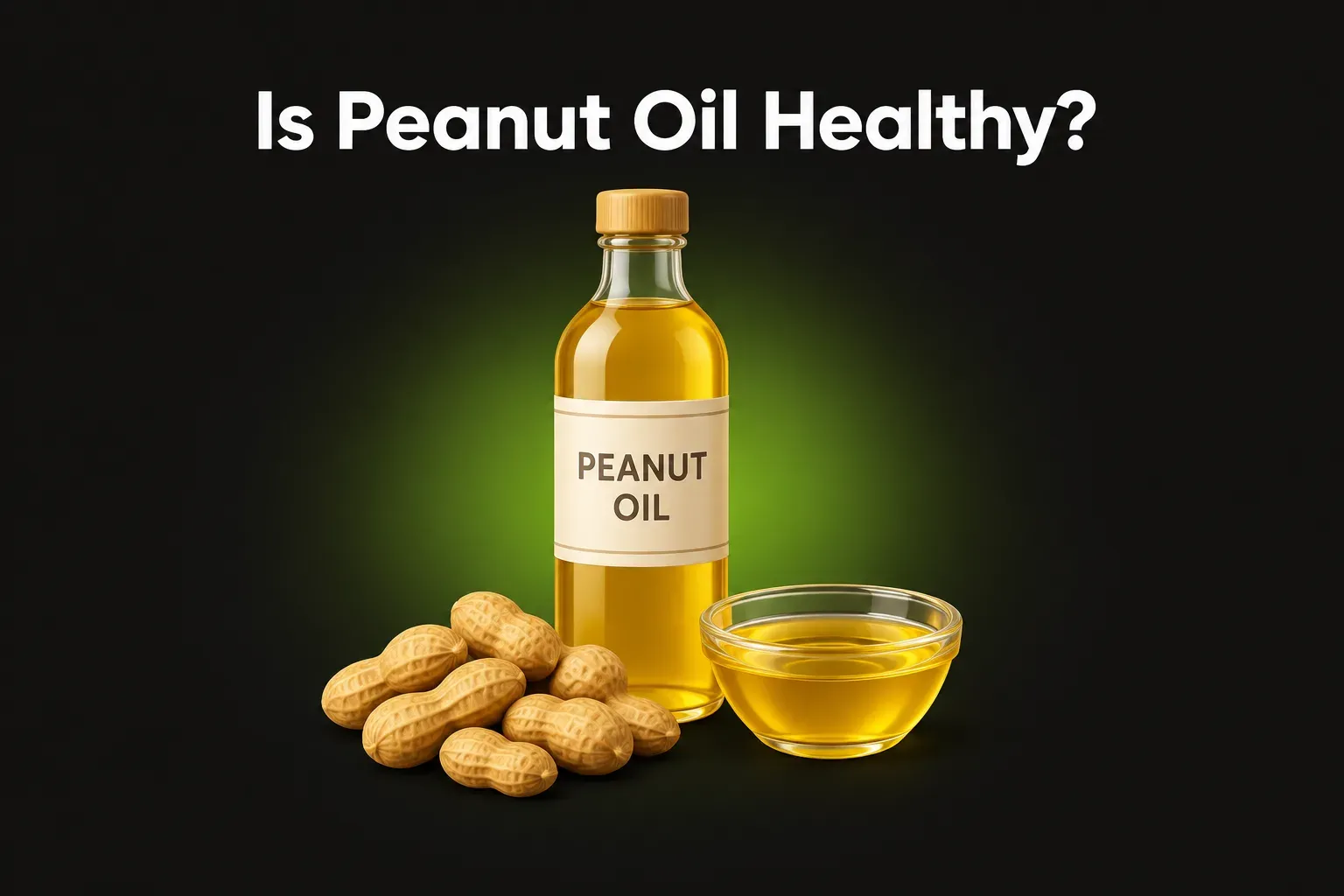
Peanut oil is the classic oil for deep frying. Chick-fil-A cooks its breaded chicken in it, and Five Guys cooks its fries in it. But is peanut oil healthy?
The short answer: in normal amounts, peanut oil is a fairly healthy oil. Most of its fat is unsaturated, and 1 tablespoon gives about 14% of your daily vitamin E. Refined peanut oil handles high heat well, so it’s a good pick for frying. The downsides: it has no omega-3 fats, it has about 120 calories per tablespoon, and fried food is still fried food. If you have a peanut allergy, highly refined oil is usually safe, but cold-pressed and roasted peanut oils are not.
Peanut oil nutrition per tablespoon
Here is what 1 tablespoon (13.5 g) of peanut oil contains, according to the USDA:
| Nutrient | 1 tbsp peanut oil |
|---|---|
| Calories | 119 |
| Total fat | 13.5 g |
| Saturated fat | 2.3 g |
| Monounsaturated fat | 6.2 g |
| Polyunsaturated fat (omega-6) | 4.3 g |
| Omega-3 fat | 0 g |
| Vitamin E | 2.1 mg (14% of daily value) |
| Cholesterol | 0 mg |
Source: USDA FoodData Central – peanut oil. Values per 100 g, multiplied to one tablespoon and rounded. Daily value for vitamin E: 15 mg.
What these words mean:
- Monounsaturated fat is the main fat in peanut oil. It’s the same kind of fat that makes olive oil famous. It’s called oleic acid.
- Omega-6 fat (linoleic acid) is a fat your body needs but can’t make. Most Americans already get plenty of it.
- Omega-3 fat is another fat your body needs. Peanut oil has none, so you need it from fish, walnuts, flaxseed or canola oil.
- Vitamin E is an antioxidant. It helps protect your cells from damage.
Some newer peanut oils are made from high-oleic peanuts. These have even more monounsaturated fat and less omega-6. Spectrum’s peanut oils are one example. See the table below.
Refined, cold-pressed or roasted?
There are three main kinds of peanut oil:
- Refined peanut oil is the most common kind. It comes in big jugs for frying. After the oil is taken from the peanuts, it is cleaned, bleached and steamed. Chick-fil-A describes its oil as “refined, bleached and deodorized.” It has almost no taste and can handle high heat. Refining also removes most of the peanut protein. It removes aflatoxins too – toxins made by molds that can grow on peanuts (Abrante-Pascual et al., Foods, 2024).
- Unrefined peanut oil is pressed and filtered, but not refined. It’s often labeled “cold-pressed” or “unrefined.” It keeps more peanut taste. It can’t take as much heat, and it still contains peanut protein. Note: “expeller-pressed” alone doesn’t mean unrefined. Spectrum’s refined oil is expeller-pressed too.
- Roasted peanut oil is pressed from roasted peanuts and sold in small bottles. It has a strong, nutty taste. It’s best for stir-fries, sauces and drizzling, not for deep frying.
Some frying oils are blends of several oils. If you want pure peanut oil, check that the ingredient list says only “peanut oil.”
Peanut oil brands compared
Here are 7 peanut oils sold in US stores, per 1 tablespoon. The table shows what each brand or store lists.
| Product | Type | Heat (brand) | Calories | Saturated fat | Poly fat | Ingredients |
|---|---|---|---|---|---|---|
| LouAna Peanut Oil (24–128 oz) | Not stated* | 450°F | 120 | 2.5 g | 5 g | Peanut oil |
| LouAna Peanut Oil (3 gallons) | Not stated* | 450°F | 120 | 2.5 g | 5 g | Peanut oil, TBHQ and citric acid (to protect flavor), dimethylpolysiloxane (anti-foaming agent) |
| Planters 100% Pure Peanut Oil | Not stated* | Not listed | 120 | 2.5 g | 5 g | Peanut oil |
| Good & Gather Peanut Oil, 128 oz (Target) | Refined** | 450°F | 130 | 2.5 g | 3 g | Peanut oil |
| Spectrum Organic Peanut Oil, Refined | Refined, high oleic | Up to 460°F | 120 | 1.5 g | 2.5 g | Expeller-pressed refined high-oleic organic peanut oil |
| Spectrum Unrefined Peanut Oil | Unrefined, high oleic | Up to 350°F | 120 | 2 g | 1 g | Expeller-pressed unrefined high-oleic peanut oil |
| La Tourangelle Roasted Peanut Oil | Roasted, expeller pressed | Medium-high | 130 | 1 g | 2 g | Peanut oil |
Sources: brand sites for LouAna, Planters, Spectrum (refined, unrefined) and La Tourangelle; Target for Good & Gather; Vitacost for the La Tourangelle label; Open Food Facts for LouAna’s saturated fat. Heat is the smoke point or heat level the brand or store lists. Checked November 2026. *These labels don’t say if the oil is refined. **Target’s staff answer on the product page says it is refined, not cold-pressed. Recipes change – always check the bottle.
A few things stand out:
- Spectrum’s high-oleic oils and La Tourangelle’s roasted oil list less polyunsaturated (omega-6) fat. The refined Spectrum oil and La Tourangelle also list less saturated fat.
- In this table, only the 3-gallon LouAna jug lists additives. The smaller LouAna bottles list just peanut oil. More about these additives below.
- Unrefined and roasted oils are made for lower heat. The brands list up to 350°F or “medium-high.” Don’t use them for deep frying.
Is peanut oil good for frying?
Yes – refined peanut oil is a good frying oil. The smoke point is the heat at which oil starts to smoke and break down. LouAna lists its peanut oil at 450°F (232°C). Deep frying usually happens at about 350–375°F (177–191°C). So refined peanut oil has room to spare.
When oil gets hot, its fats slowly break down. The more polyunsaturated fat an oil has, the faster it breaks down. Omega-3 fat is the most fragile. Peanut oil has a medium amount of polyunsaturated fat and almost no omega-3. A 2024 review called it “a good alternative for frying” for that reason (Abrante-Pascual et al., Foods, 2024).
But no oil is perfect. A German lab tested five common oils, including peanut oil. Each oil was heated to 374°F (190°C) in a fryer. Chicken nuggets were fried in it from time to time. Samples were taken after 10 minutes and after one hour. All of the oils made more aldehydes as they heated. These are breakdown products that can harm cells (Freis & Vemulapalli, Foods, 2025). The longer oil stays hot, the more breaks down. That’s why reusing oil again and again is a bad idea.
Tips for frying with peanut oil:
- Use refined peanut oil, not unrefined or roasted.
- Keep the oil at 350–375°F. Use a thermometer.
- Don’t reuse it too often. Throw it out if it turns dark, smells off, foams or smokes at normal heat.
Fast food fried in peanut oil
Chick-fil-A says it cooks its breaded chicken in “fully refined, heat-processed peanut oil” (Chick-fil-A). Five Guys says it cooks its fries in 100% refined peanut oil. Fries are the only item cooked in it (Five Guys).
A healthier oil doesn’t make fried food a health food. Breading and fries soak up oil, so the calories add up fast. See is Chick-fil-A healthy? and calories in french fries.
Peanut oil vs other cooking oils
Here is how peanut oil compares with other common cooking fats, per 1 tablespoon.
| Fat (1 tbsp) | Saturated fat | Monounsaturated | Omega‑6 | Omega‑3 | Vitamin E |
|---|---|---|---|---|---|
| Peanut oil | 2.3 g | 6.2 g | 4.3 g | 0 g | 2.1 mg |
| Canola oil | 1.0 g | 8.9 g | 2.7 g | 1.3 g | 2.5 mg |
| Olive oil | 1.9 g | 9.9 g | 1.3 g | 0.1 g | 1.9 mg |
| Avocado oil | 1.6 g | 9.9 g | 1.8 g | 0.1 g | not listed |
| Sunflower oil (regular) | 1.4 g | 2.7 g | 8.9 g | 0 g | 5.6 mg |
| Soybean oil | 2.1 g | 3.1 g | 6.9 g | 0.9 g | 1.1 mg |
| Coconut oil | 11.2 g | 0.9 g | 0.2 g | 0 g | 0 mg |
| Beef tallow | 6.4 g | 5.4 g | 0.4 g | 0.1 g | 0.3 mg |
Source: USDA FoodData Central – peanut, canola, olive, avocado, sunflower, soybean, coconut, beef tallow. Values per 100 g, multiplied by each food’s USDA tablespoon weight (12.8–14 g) and rounded. Omega-6 = linoleic acid; omega-3 = alpha-linolenic acid.
What this shows:
- Peanut oil sits in the middle. It has more monounsaturated fat than soybean or sunflower oil. But it has less than olive, avocado or canola oil.
- It has far less saturated fat than coconut oil or beef tallow. Read more in is beef tallow healthy? Still, among the plant oils here, only coconut oil has more.
- It has no omega-3. Canola and soybean oil have some.
For everyday cooking, olive oil has the most research behind it. For frying, peanut and canola oil are both solid picks. See our full guide to the healthiest cooking oil.
Is peanut oil good for your heart?
What studies in people show
In a US trial, 22 adults ate five different diets, one after another. One diet was rich in peanut oil. Others were rich in olive oil or peanuts, or followed a low-fat plan. Compared with an average American diet, the high-monounsaturated diets lowered LDL (“bad”) cholesterol by 14%. They also lowered triglycerides (a type of blood fat) by 13% (Kris-Etherton et al., American Journal of Clinical Nutrition, 1999). The study was small.
What about the omega-6 fat in peanut oil? Some people worry that it causes inflammation. But a review looked at 15 trials in healthy adults. Eating more omega-6 did not raise inflammation markers in the blood (Johnson & Fritsche, Journal of the Academy of Nutrition and Dietetics, 2012). Another analysis pooled 30 studies with 68,659 people. It looked at omega-6 levels in the blood. People with high levels had about a 22% lower risk of dying from heart disease or stroke than people with low levels (Marklund et al., Circulation, 2019). This shows a link, not proof. Read more in our guide to seed oils.
What animal studies show
Animal studies tell a different story. In rats, rabbits and monkeys, peanut oil caused more clogged arteries than expected for such an unsaturated oil. A US research team looked for the reason. They think a plant protein called lectin may be part of it. Washing the oil removed about half of its lectin. Rabbits ate extra cholesterol with either normal or washed peanut oil. The rabbits on washed oil had less artery damage – 9% to 31% less, depending on the part of the artery (Kritchevsky et al., Lipids, 1998).
Why do animal studies matter? Rats and other lab animals share most of our genes and body processes. And testing a diet that might clog arteries on people would put their health at risk. Still, the rabbits also ate extra cholesterol, which made them prone to artery damage. Proof of this effect in people is missing. In the human trial above, a peanut oil diet lowered cholesterol. There’s no need to avoid peanut oil. But it makes sense not to use it as your only oil. Switch between peanut oil for frying and olive oil for everyday cooking.
Peanut oil and peanut allergy
The US allergen labeling law does not count highly refined oils as major allergens (FDA). So a food made with highly refined peanut oil doesn’t need a “Contains: peanuts” warning.
Why? Refining removes almost all the protein, and protein is what causes allergic reactions. In a UK study, 60 people with a proven peanut allergy tried both kinds of oil. They didn’t know which one they got. None of them reacted to refined peanut oil. But 6 of 60 (10%) reacted to crude (unrefined) peanut oil (Hourihane et al., BMJ, 1997).
What this means for you:
- Highly refined peanut oil is usually safe for people with a peanut allergy.
- Unrefined, cold-pressed and roasted peanut oils still contain protein. Avoid them.
- Restaurants add other risks. Chick-fil-A says it can’t promise its food is free of any allergen. Five Guys offers free peanuts in its restaurants. It says it can’t rule out cross-contamination.
- Ask your allergist before eating food fried in peanut oil.
Additives in big jugs: TBHQ and dimethylpolysiloxane
Most peanut oil bottles list just one ingredient. But some large frying jugs add two more:
- TBHQ is a preservative. It keeps oil from going rancid (stale and bad-smelling) too fast. The FDA allows up to 0.02% of the fat in a food (eCFR, 21 CFR 172.185).
- Dimethylpolysiloxane is a silicone that stops oil from foaming in the fryer. The FDA allows up to 10 parts per million in food (eCFR, 21 CFR 173.340).
The FDA says TBHQ is safe within its limit. But independent researchers have looked at it more closely. In a 2025 study, mice ate food with 0.0014% TBHQ – the normal amount in lab chow. They were then exposed to an egg protein to trigger a food allergy. The mice on TBHQ became more allergic. They also had stronger allergic reactions. Smaller doses showed the same trend, but it was weaker (Jin et al., Frontiers in Immunology, 2025). The authors say this amount is the same as or lower than in many human foods.
Proof of harm in people is missing. So far, this signal comes mostly from one lab group. But TBHQ is easy to avoid in peanut oil. The smaller bottles of LouAna, Planters and Good & Gather list only peanut oil.
Check your peanut oil before you buy it. With NutriSmart, you photograph the label or scan the barcode. The app lists the sweeteners, preservatives and colors, explains the risks of each one and gives the product a health score out of 100. It also tells you right away if a product is ultra-processed and which ingredients make it so. You can set an alert for TBHQ. The app then warns you whenever a product you scan contains it.Get the app free
The bottom line
Peanut oil is a fairly healthy oil in normal amounts. Most of its fat is unsaturated, and it gives a good dose of vitamin E. Refined peanut oil handles high heat, so it’s a good choice for deep frying. Keep the heat at 350–375°F and don’t reuse the oil too often. It has no omega-3, so it shouldn’t be your only oil – use olive oil for everyday cooking. If you have a peanut allergy, highly refined oil is usually safe, but avoid cold-pressed and roasted kinds. In the store, pick a bottle that lists only “peanut oil.” And remember: fried food is still fried food.
FAQ
Is peanut oil healthy?
In normal amounts, yes. Most of its fat is unsaturated, and 1 tablespoon gives about 14% of your daily vitamin E. But it has about 120 calories per tablespoon and no omega-3 fats.
Is peanut oil good for deep frying?
Yes. Refined peanut oil can handle about 450°F (232°C), and deep frying happens at about 350–375°F (177–191°C). It has almost none of the fragile omega-3 fat that breaks down fastest. Still, don't reuse the same oil too many times.
Is peanut oil safe if you have a peanut allergy?
Highly refined peanut oil is usually safe, because refining removes most of the protein that causes reactions. Unrefined, cold-pressed and roasted peanut oils still contain it, so avoid them. Ask your allergist first.
Is peanut oil a seed oil?
Peanuts are legumes, but the oil is pressed from the seed, so it is often grouped with seed oils. It has less omega-6 fat than soybean or sunflower oil and more monounsaturated fat.
Is peanut oil better than vegetable oil?
In the US, vegetable oil is usually soybean oil. Peanut oil has more monounsaturated fat and less omega-6 fat. Soybean oil has some omega-3 fat, and peanut oil has none. Both are fine in normal amounts.
What oil does Chick-fil-A use?
Chick-fil-A cooks its breaded chicken in fully refined peanut oil. Five Guys also cooks its fries in 100% refined peanut oil.