Is Olive Oil Healthy? Extra Virgin vs Light and 8 Brands
Is olive oil healthy? What studies show, extra virgin vs light, cooking with it, stale and fake bottles, and 8 US brands compared.
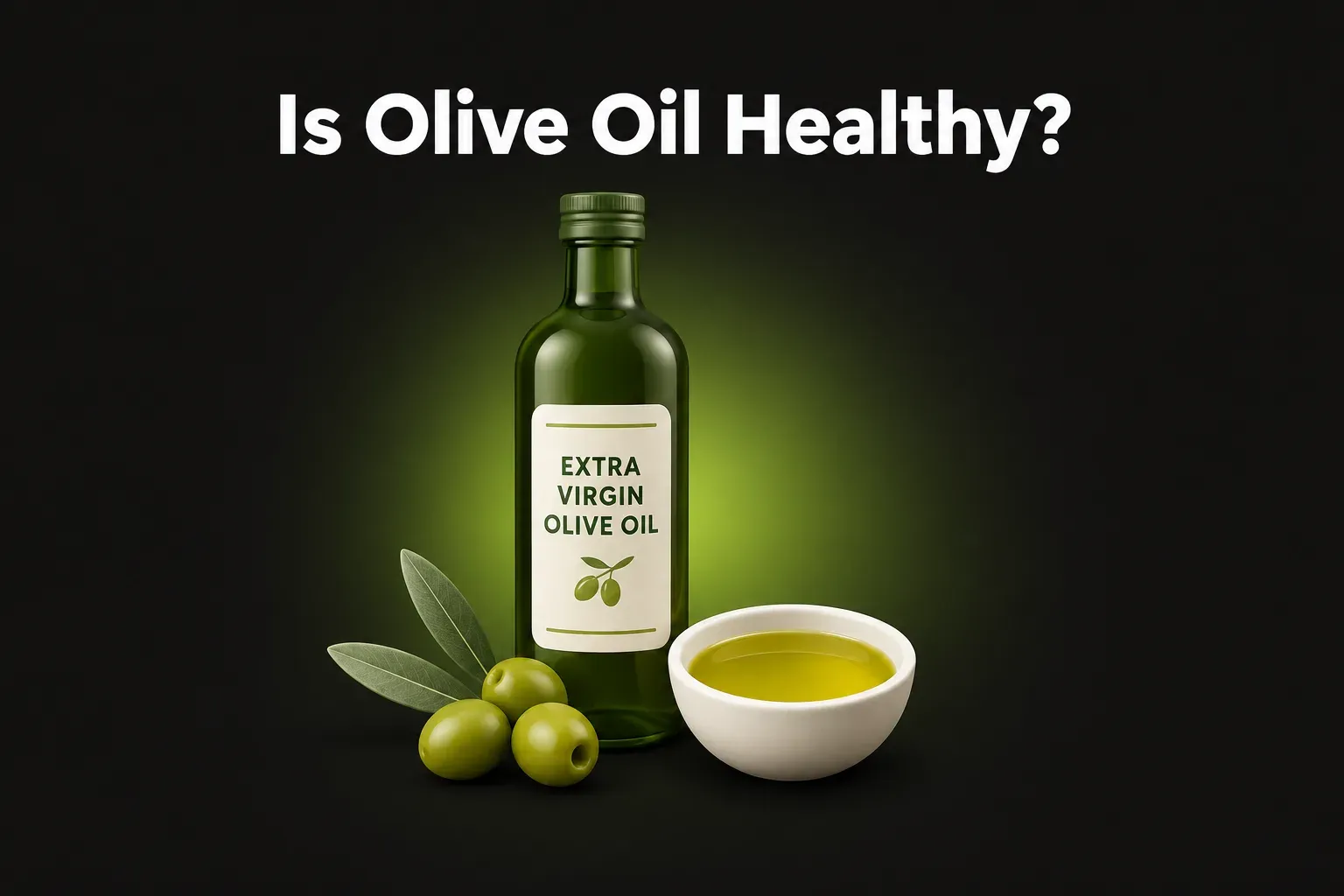
Olive oil is the main fat in the Mediterranean diet. But the bottles on US shelves are not all the same.
The short answer: yes, olive oil is one of the healthiest fats you can eat – especially extra virgin. In a large Spanish trial, a Mediterranean diet with extra virgin olive oil led to about 30% fewer heart attacks, strokes and heart deaths. Harvard studies link more than half a tablespoon a day to a 19% lower risk of death. “Light” and plain “olive oil” are mostly refined, so they keep few polyphenols (plant compounds that protect cells). The other catch is freshness: in past tests, many imported bottles sold as extra virgin failed taste tests. And like every oil, a tablespoon has about 120 calories.
Extra virgin vs virgin vs “light” olive oil
The USDA has grade standards for olive oil. They are voluntary – brands don’t have to use them. Here is what each name means.
| Name on the bottle | How it’s made | Free acidity (max) | Taste |
|---|---|---|---|
| Extra virgin | Pressed only, no chemicals; no taste flaws allowed | 0.8% | Fruity |
| Virgin | Pressed only; small taste flaws allowed | 2.0% | Fruity, small flaws |
| Olive oil (“pure”, “classic”) | Refined olive oil mixed with some virgin oil | 1.0% | Mild |
| Refined olive oil | Lower-grade virgin oil refined until it has almost no taste or smell | 0.3% | Almost none |
| “Light” or “extra light” | Not a USDA grade – a name brands use for mild, mostly refined oil | – | Very mild |
Source: USDA standards for grades of olive oil, 2010. “Free acidity” is measured as oleic acid.
- Free acidity is a sign of how well the olives were treated. For pressed oils, low acidity points to healthy fruit. Refining strips acidity out, along with flavor.
- “Light” means light in taste and color, not in calories.
- Refined oil keeps the good fats but loses most polyphenols. That’s the main health gap between the grades.
How big is that gap? In one trial, the low-polyphenol olive oil had 2.7 mg per kg. The high one had 366 mg per kg – more than 100 times as much (Covas et al., Annals of Internal Medicine, 2006).
What’s in a tablespoon of olive oil
Here is one tablespoon (13.5 g), from the USDA food database:
| Per tablespoon | Amount |
|---|---|
| Calories | 119 |
| Total fat | 13.5 g |
| Monounsaturated fat | 9.9 g |
| Saturated fat | 1.9 g |
| Polyunsaturated fat | 1.4 g |
| Vitamin E | 1.9 mg (13% of the Daily Value) |
| Vitamin K | 8.1 µg (7% of the Daily Value) |
Source: USDA FoodData Central – olive oil. Values per 100 g, multiplied to 13.5 g and rounded. US labels round to 120 calories for a 15 ml tablespoon.
About 73% of the fat is monounsaturated. Most of it is oleic acid, the same main fat as in avocados. Olive oil is low in omega-6 fat, the fat at the center of the seed oil debate. For spoon and cup sizes, see how many calories are in olive oil.
What research says about olive oil
The PREDIMED trial
In Spain, about 7,400 adults aged 55 to 80 joined a trial. All had a high risk of heart disease. They were split into three groups:
- A Mediterranean diet with free extra virgin olive oil
- A Mediterranean diet with free mixed nuts
- Advice to eat less fat
After about 5 years, the olive oil group had about 30% fewer heart attacks, strokes and heart deaths than the low-fat group. The nut group had a similar drop.
There is a twist. The first report came out in 2013. Later, the team found that some people had not been placed in groups at random. So they withdrew the paper and ran the numbers again. The 2018 version gave almost the same result (Estruch et al., New England Journal of Medicine, 2018). The oil used in the trial was donated by Spanish olive oil producers (Guasch-Ferré et al., JACC, 2022).
The Harvard studies
Harvard researchers followed about 92,000 US nurses and health workers for 28 years. Some ate more than half a tablespoon (7 g) a day. Compared with people who rarely ate olive oil, they had a:
- 19% lower risk of dying during the study
- 19% lower risk of dying of heart disease
- 17% lower risk of dying of cancer
- 29% lower risk of dying of brain diseases like Alzheimer’s
Swapping about 2 teaspoons (10 g) of butter, margarine, mayo or dairy fat for olive oil was linked to an 8–34% lower risk of death. But olive oil did not beat other plant oils as a group (Guasch-Ferré et al., JACC, 2022). A later look at the same people found a 28% lower risk of dying with dementia (Tessier et al., JAMA Network Open, 2024).
These studies show a link, not proof. People who use olive oil may have other healthy habits.
Why polyphenols matter
A European trial tested 200 healthy men. They took 25 ml (about 1.7 tablespoons) of olive oil a day for 3 weeks. Each man tried three oils with low, medium and high polyphenols. The more polyphenols, the more their HDL (“good”) cholesterol went up. Damaged (oxidized) LDL (“bad”) cholesterol dropped the most with the high-polyphenol oil (Covas et al., Annals of Internal Medicine, 2006).
In Europe, a label can say the oil’s polyphenols protect blood fats from damage – if it has at least 5 mg per 20 g of oil (EFSA, 2011). The US claim is weaker. The FDA says “limited and not conclusive” evidence suggests about 2 tablespoons a day may lower heart disease risk – if it replaces saturated fat (FDA, 2004).
Can you cook with extra virgin olive oil?
Yes. Many people think extra virgin oil turns harmful as soon as it smokes. But the smoke point (the heat at which oil starts to smoke) isn’t the whole story. How well the oil holds up to heat matters more. See how other oils compare in our guide to the healthiest cooking oil.
- Brands list different numbers. Filippo Berio lists 356–392°F (180–200°C) for its extra virgin oil. California Olive Ranch says its oil smokes at well over 425°F (218°C).
- Olive oil lasts in the fryer. Researchers in Portugal fried with olive oils until they reached the legal limit for broken-down fat. The olive oils lasted 24–27 hours. A common vegetable oil blend lasted 15 hours (Casal et al., Food and Chemical Toxicology, 2010).
- Some polyphenols are lost. In another test, extra virgin oil was heated to 356°F (180°C) for 36 hours. Polyphenols and vitamin E dropped the most. The good fats stayed stable, and the oil kept most of its other plant compounds (Allouche et al., Journal of Agricultural and Food Chemistry, 2007).
So cook with it, and also use some raw – on salads, beans or bread – to get the most polyphenols. For very high heat, canola oil or refined avocado oil are fine picks too.
Stale, fake and pricey: what’s really in the bottle
The UC Davis tests (2010 and 2011)
In 2010, UC Davis tested extra virgin oils from California stores. 69% of imported oils failed the extra virgin standards. Only 10% of California oils failed (UC Davis, 2010).
In 2011, the team tested 134 samples of eight big brands. The five top-selling imported brands failed taste tests 73% of the time. Tasters found flaws like a rancid or fusty (stale, fermented) smell. The researchers said the oils failed because they were old and oxidized, of poor quality, or mixed with cheaper refined oil (UC Davis, 2011). Those five brands were Filippo Berio, Bertolli, Pompeian, Colavita and Star (Supermarket News, 2011).
Keep two things in mind. Both studies were paid for by California olive oil groups, including California Olive Ranch. And the tests are now about 15 years old.
The 2024 industry test
Olive oil prices hit records after two poor harvests, mostly caused by drought and heat (NAOOA, 2025). In Spain, the top producer, extra virgin oil sold for almost €9 per kg wholesale in January 2024. By early 2025, it had dropped to about €4 as harvests recovered (Olive Oil Times, 2025). High prices raised fears of more fraud.
So the North American Olive Oil Association (NAOOA), a trade group of olive oil sellers, bought 216 store bottles in late 2024 and had them tested. A Yale researcher wrote the report:
- Only 2 bottles (under 1%) were mixed with other oils. Both were small brands. The fake extra virgin oil was the cheapest one tested, at $0.30 per ounce.
- About 1 in 9 extra virgin samples (18 of 158) failed lab quality tests. Some also had taste flaws. The bottles waited about 4 months before testing. The report says time, heat and light may have played a part.
- On average, the oils tested for health quality still had enough polyphenols to meet the European claim.
So fake olive oil seems rare in big US brands. Stale or poorly stored oil is the bigger problem.
8 olive oil brands compared
All eight list about 120 calories and 14 g of fat per tablespoon. The real differences are origin, freshness and testing.
| Product | Grade | Where the olives come from | Harvest date shown? | Seal or testing |
|---|---|---|---|---|
| California Olive Ranch 100% California | Extra virgin | California | Yes | Olive Oil Commission of California seal |
| Bertolli Rich Taste | Extra virgin | Blend; one bottle listed Argentina, Chile, Spain, Italy and Portugal | Yes (seasons) | None found on the NAOOA list |
| Colavita Classic | Extra virgin | Italy, Greece, Spain and Portugal | Not found | NAOOA certified |
| Filippo Berio Extra Virgin | Extra virgin | Imported blend, made near Lucca, Italy; countries not listed online | Not found | NAOOA certified |
| Kirkland Signature Organic | Extra virgin, USDA Organic | Packed in the US; one bottle listed Portugal, Spain, Tunisia, Italy and Greece | Best‑by date only | NAOOA certified |
| Pompeian Robust | Extra virgin | Imported; countries not listed on the brand site | Not found | NAOOA certified |
| Graza Sizzle | Extra virgin | Mostly Jaén, Spain, one olive type (Picual); a few bottles come from other regions | Yes | No outside seal found |
| Trader Joe’s Premium | Extra virgin | Packed in Italy; one bottle listed Spain, Tunisia, Greece and Italy | Best‑by date only | None shown |
Sources: California Olive Ranch; Bertolli label photo on Open Food Facts; Colavita product sheet; Filippo Berio; Kirkland label photo on Open Food Facts; Pompeian; Graza FAQ; Trader Joe’s label photo on Open Food Facts; certification from the NAOOA certified list (September 2025). “Not found” means we didn’t see a harvest date on the brand’s site or in label photos. Checked November 2026. Countries can change from one batch to the next – check your bottle.
What to notice:
- California Olive Ranch and Graza print a harvest date. California Olive Ranch’s “100% California” oil comes from one state. (Its “Global” oils are a different product.)
- Bertolli lists harvest seasons on the back label. The bottle in the photo showed two seasons, 2023–24 and 2024–25.
- Colavita, Filippo Berio, Kirkland and Pompeian are on the NAOOA certified list. NAOOA says it buys certified oils off store shelves and tests them for purity. In 2026, it said oils with its seal must have a best-by date no more than 18 months after bottling (Olive Oil Times, 2026).
- Pompeian was the first company to join the USDA’s olive oil monitoring program, in 2012. The program included surprise visits and monthly lab and taste tests (Olive Oil Times, 2012).
- Kirkland Organic comes in a 2 L plastic bottle. Buy it only if you’ll finish it within a few months.
How to pick a healthy olive oil
- Choose extra virgin for the most polyphenols. Use “light” oil only when you want no olive taste.
- Look for a harvest date. Pick the newest one. The California Olive Oil Council says olive oil is best within 18–24 months of harvest (COOC).
- Pick dark glass, a tin or a bag-in-box. Light speeds up the damage.
- Look for a seal from a testing program, like COOC, NAOOA or the USDA. A seal isn’t a guarantee, but it means someone checks.
- Be wary of very low prices. In the 2024 test, the only fake extra virgin oil was the cheapest bottle.
- Smell and taste it. Good oil smells fresh and green, and may taste a bit peppery. Oil that smells like crayons or old nuts is likely rancid (spoiled).
- Store it well. Keep it in a cool, dark cabinet, away from the stove. Use it within about 3–6 months of opening.
- Measure it. A “splash” can be 2–3 tablespoons, or up to 360 calories. Check your needs with our calorie calculator. For meal ideas, see the Mediterranean diet or try it with sardines. It’s also the base of a good homemade pesto.
Check the label on olive oil and the foods made with it. With NutriSmart, you photograph the label or scan the barcode. The app lists the sweeteners, preservatives and colors, explains the risks of each one and gives the product a health score out of 100. It also tells you right away if a product is ultra-processed, and which ingredients make it so. Set an alert for soybean oil, and the app warns you whenever a dressing, mayo or spread you scan lists it. The app reads the label – it can’t taste-test the oil inside.Get the app free
The bottom line
Olive oil is a healthy fat, and extra virgin is the best kind. A large trial and decades of Harvard data link it to fewer heart attacks and a longer life. “Light” and plain olive oil have the same calories but far fewer polyphenols. You can cook with extra virgin oil – just use some raw too. The main risk is stale oil, not fake oil. Pick extra virgin in dark glass, with a recent harvest date and a testing seal. And measure it: each tablespoon has about 120 calories.
FAQ
Is olive oil healthy?
Yes. Olive oil is one of the best-studied healthy fats. In a large Spanish trial, a Mediterranean diet with extra virgin olive oil led to about 30% fewer heart attacks, strokes and heart deaths. Each tablespoon still has about 120 calories.
Is extra virgin olive oil better than regular or light olive oil?
Yes, for health. Extra virgin oil is only pressed, so it keeps its polyphenols, the plant compounds that protect cells. Regular and "light" olive oil are mostly refined and have far fewer. All types have the same calories.
Can you cook with extra virgin olive oil?
Yes. In lab tests, olive oils held up longer in the fryer than a common vegetable oil blend. Heat does break down some polyphenols, so use some of your oil raw too, on salads or finished dishes.
How much olive oil should you have a day?
In Harvard studies, more than half a tablespoon a day was linked to a lower risk of dying. The FDA allows a heart claim for about 2 tablespoons a day, but only when olive oil replaces saturated fat and doesn't add calories.
Is most olive oil fake?
Most is not fake, but some is stale. A 2024 industry test of 216 store bottles found under 1% mixed with other oils. Older UC Davis tests found many imported extra virgin oils failed taste standards, often because they were old or of poor quality.
How do you pick a good olive oil?
Choose extra virgin in a dark glass bottle or tin. Look for a harvest date and buy the newest one. A seal from a testing program helps. Finish the bottle within a few months of opening it.