Is Avocado Oil Healthy? Fats, Fake Bottles and 8 Brands
Is avocado oil healthy? Its fats vs olive and canola oil, smoke point, why most bottles tested stale or mixed, and 8 brands compared.
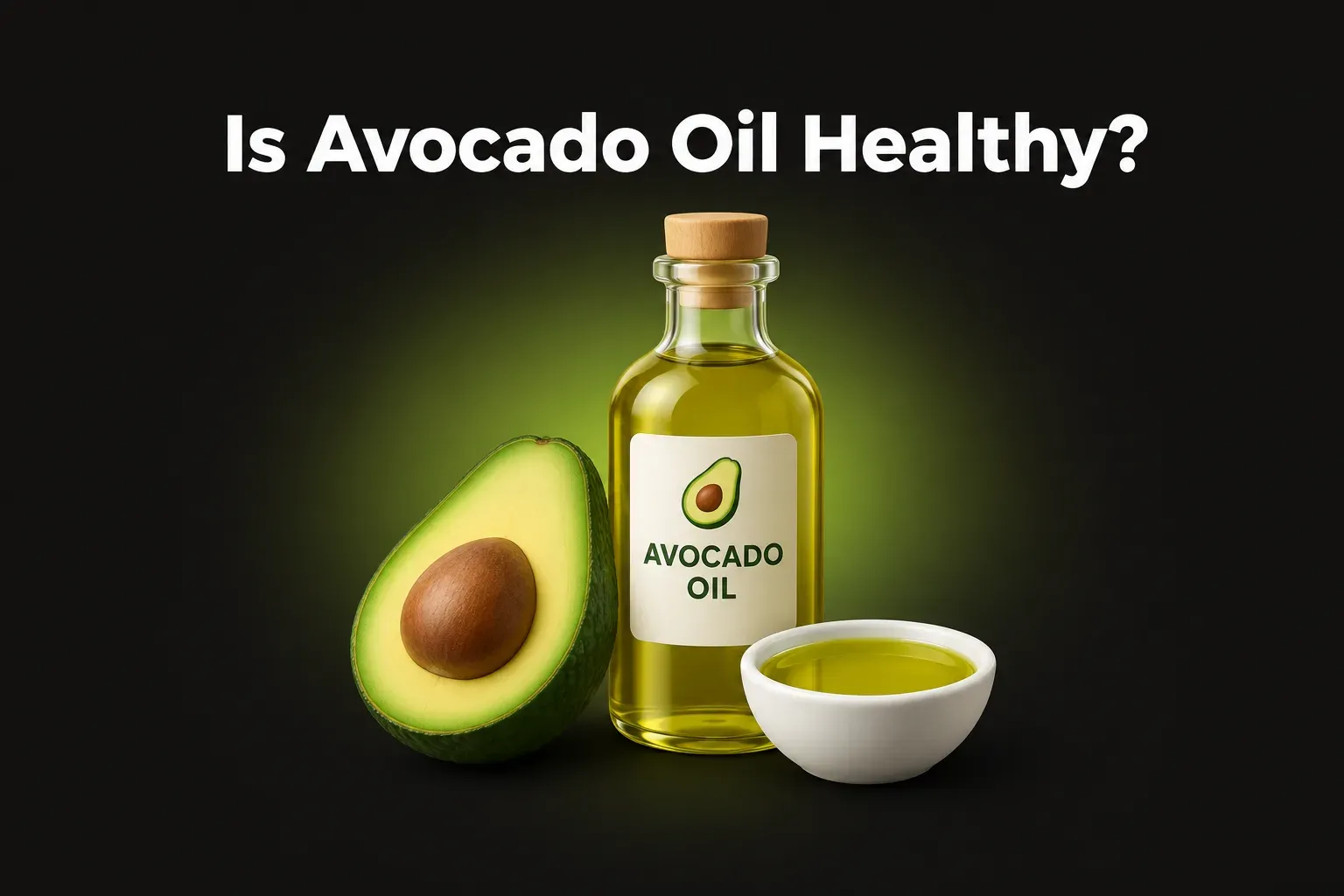
Avocado oil is now on almost every grocery shelf. Brands sell it as the “clean” oil for high-heat cooking. But is it worth the higher price?
The short answer: yes, real avocado oil is a healthy oil. About 71% of its fat is monounsaturated – the same heart-friendly fat as in olive oil. It is low in omega-6 fat, and refined avocado oil handles high heat well. The big problem is what’s in the bottle. In a UC Davis study, at least 82% of US avocado oils were stale or mixed with other oils. A few were almost all soybean oil. Like every oil, it also has about 120 calories per tablespoon.
Avocado oil vs olive, canola and sunflower oil
Here is how one tablespoon (14 g) of each oil compares. The numbers are from the USDA food database.
| Oil (1 tbsp) | Calories | Saturated fat | Mono fat | Poly fat | Omega‑3 (ALA) |
|---|---|---|---|---|---|
| Avocado oil | 124 | 1.6 g | 9.9 g | 1.9 g | 0.1 g |
| Olive oil | 124 | 1.9 g | 10.2 g | 1.5 g | 0.1 g |
| Canola oil | 124 | 1.0 g | 8.9 g | 3.9 g | 1.3 g |
| Sunflower oil (regular) | 124 | 1.4 g | 2.7 g | 9.2 g | 0 g |
Source: USDA FoodData Central – avocado oil, olive oil, canola oil, sunflower oil, high linoleic. Values per 100 g, multiplied to 14 g and rounded. “Mono” is monounsaturated fat, “poly” is polyunsaturated fat.
What stands out:
- Avocado and olive oil are almost twins. Both are about 70% monounsaturated fat. Most of it is oleic acid, the main fat in olives and avocados.
- Canola oil has the least saturated fat and the most omega-3 (ALA, a plant omega-3). Read more in our guide to canola oil.
- Regular sunflower oil is mostly omega-6 (linoleic acid). Avocado oil has about one-fifth as much. Omega-6 is the main worry in the seed oil debate. Grapeseed oil is also mostly omega-6.
- Calories are the same for every oil. A tablespoon of any of them has about 120 calories. See how many calories are in olive oil for spoon and cup sizes. To compare more oils, see the healthiest cooking oil.
What research says about oils like avocado oil
There are very few studies of avocado oil in people. Most are in rats, mice or cells. A 2019 review said there is still a gap in what we know about its health effects (Flores et al., Molecules, 2019).
So we lean on research about its main fat and about olive oil, which is very similar.
- Swapping saturated fat for unsaturated fat helps the heart. The American Heart Association reviewed the evidence. It found that this swap lowers LDL (“bad”) cholesterol and the risk of heart disease. The effect was strongest when the new fat was polyunsaturated (Sacks et al., Circulation, 2017).
- Olive oil has the strongest proof. A review pooled 32 studies with about 841,000 people. People who ate the most of these fats, including olive oil, had about 11% lower risk of death. But when the authors looked closer, the clear link was with olive oil, not with monounsaturated fat from mixed sources (Schwingshackl and Hoffmann, Lipids in Health and Disease, 2014).
- A big trial used extra virgin olive oil. In Spain, about 7,400 adults aged 55 to 80 had a high risk of heart disease. One group ate a Mediterranean diet and got free extra virgin olive oil. Another group was told to cut back on fat. Over about 5 years, the olive oil group had about 30% fewer heart attacks, strokes and heart deaths (Estruch et al., New England Journal of Medicine, 2018).
What about avocado oil itself? In one study, 11 healthy adults ate a salad with or without avocado oil. Carotenoids are plant pigments, like beta-carotene. With under 2 tablespoons (24 g) of avocado oil, people absorbed several times more of them from the salad (Unlu et al., Journal of Nutrition, 2005). In another study, obese mice got avocado oil for 90 days. Their insulin response got better, and their livers held less fat (de Oliveira Marques et al., Nutrients, 2022). Mice share most of our genes and body processes. But the authors say human studies are still needed.
Bottom line on health: avocado oil’s fats look a lot like olive oil’s. That’s a good sign. But the proof in people is for olive oil, not avocado oil.
Smoke point: refined vs unrefined
The smoke point is the heat at which an oil starts to smoke and break down. There are two main kinds of avocado oil.
- Refined avocado oil is filtered and cleaned after pressing. It is pale yellow, nearly clear, and tastes neutral. Brands such as Chosen Foods and Marianne’s list it at about 500°F (260°C). That’s high enough for searing, roasting and air frying.
- Virgin or unrefined avocado oil is only pressed and filtered. It is green and tastes like avocado. It keeps more natural plant compounds. But it has a lower smoke point. La Tourangelle lists 375°F (190°C) for its virgin and refined blend. Use it for dressings and medium heat.
Smoke point isn’t the whole story. Oils high in polyunsaturated fat break down faster when heated. That can form aldehydes (harmful compounds made when fat breaks down). One researcher has questioned frying at high heat with oils rich in this fat (Grootveld, Frontiers in Nutrition, 2022). Avocado oil is low in it, so it is a sturdy choice for high heat.
The big problem: stale and fake avocado oil
The 2020 UC Davis study
Researchers at UC Davis bought 22 avocado oils from stores and online. They tested how pure and how fresh each one was (Green and Wang, Food Control, 2020). Here’s what they found (UC Davis):
- At least 82% were stale before their expiration date or mixed with other oils.
- 15 samples were already stale (oxidized) before the date on the bottle.
- 6 samples were mixed with cheaper oils, such as sunflower, safflower or soybean oil.
- 3 bottles labeled “pure” or “extra virgin” were almost all soybean oil.
- Only two brands were pure and fresh: Chosen Foods and Marianne’s. Both are refined oils made in Mexico.
- CalPure, made in California, was the purest and freshest of the virgin oils.
The researchers received a $25,000 grant from Dipasa USA, an avocado oil supplier based in Mexico (Food Processing, 2020).
The 2023 follow-up: store brands
In 2023, the same lab tested 36 store-brand oils from 19 retailers in the US and Canada. Only 31% were pure. Only 36% matched the quality on the label, such as “extra virgin.” Cheaper oils were more likely to be mixed. But a high price didn’t guarantee purity (Green and Wang, Food Control, 2023; Phys.org). The public reports don’t name the stores.
2026: avocado oil in chips, mayo and dressings
A 2026 UC Davis study tested 54 foods labeled as made with avocado oil. 48 of them (89%) had other, cheaper oils too. That included 93% of chips, 71% of mayos and all the salad dressings tested. Only 1 of 20 foods made with olive oil failed the same test. The study had no outside funding (Lopez-Alvarez et al., Applied Food Research, 2026; News-Medical). Keep this in mind when you shop for mayo, chips or salad dressing.
Why this happens
The FDA has no standard of identity for avocado oil. That’s a legal definition of what a food must contain. So the FDA has no clear way to police what “pure avocado oil” means. In 2024, the world food standards group (Codex Alimentarius) added avocado oil to its list of named oils (WHO, 2024). But Codex is voluntary, not US law. An avocado oil trade group says the Codex limits rest on too few samples. It is building its own testing program (Fresh Fruit Portal, 2026).
8 avocado oils compared
All eight labels list about 120–130 calories, 14 g of fat and 1.5–2 g of saturated fat per tablespoon. So the real differences are the type of oil and the proof of purity.
| Product | Type | Smoke point listed | What the brand says about testing | UC Davis 2020 |
|---|---|---|---|---|
| Chosen Foods 100% Pure | Refined | 500°F+ | Third-party tested, “tested to Codex standards” | Pure and fresh |
| Marianne’s Avocado Oil | Refined (per UC Davis) | Up to 500°F | Third-party tested, “Seed Oil Free Certified” | Pure and fresh |
| Primal Kitchen Pure | Refined | “High heat” | Refiner tests the oil and gives certificates of analysis | Not named |
| BetterBody Foods | Refined | Not listed | No testing claim on the product page | Not named |
| La Tourangelle Salads & Sauté | Virgin + refined blend | 375°F | “Codex-compliant & batch-tested for purity” | Not named |
| Spectrum | Cold‑pressed, refined | Not listed | Not found | Not named |
| 365 by Whole Foods Market | Expeller‑pressed, refined | Not listed | Not found | Not named |
| Trader Joe’s Avocado Oil | Not stated | Not listed | Not found | Not named |
Sources: brand sites for Chosen Foods (smoke point from its smoke point guide), Marianne’s, Primal Kitchen, BetterBody Foods and La Tourangelle; Open Food Facts labels for Spectrum, 365, Trader Joe’s, Marianne’s, BetterBody and Primal Kitchen, checked November 2026. “Not named” means the public study reports don’t name the brand – not that it failed. Marianne’s site doesn’t say if its oil is refined, so that comes from the 2020 study. Brand claims are the company’s own; we did not test the oils.
What to notice:
- Chosen Foods and Marianne’s are the only brands in this table with a published independent pass. That was in 2020, so newer bottles may differ.
- Most big brands sell refined oil. In the 2020 study, the only two oils that were both pure and fresh were refined.
- Store brands did poorly in the 2023 study – only about 1 in 3 was pure. That doesn’t mean 365 or Trader Joe’s failed. The results for each store simply weren’t made public.
How to spot real avocado oil
- Check the color. Virgin oil should be green. Refined oil is light yellow and almost clear. A yellow “extra virgin” oil is a warning sign.
- Smell and taste it. Fresh virgin oil tastes grassy and buttery, a bit like mushrooms. Stale oil smells like play dough.
- Be wary of a very low price. One expert said good avocado oil for under $10 a gallon is hard to believe (NutraIngredients, 2020). In the 2023 study, cheaper oils were more likely to be mixed.
- Look for a harvest or production date. Pick the newest one. The “best before” date isn’t always reliable.
- Look for proof of testing. “Third-party tested” or Codex testing claims are a plus. A seal is still the company’s own claim, not a guarantee.
- Buy a size you’ll finish. Store it in a cool, dark cabinet, away from the stove. Dark glass or tins block light.
Check the label on avocado oil and the foods made with it. With NutriSmart, you photograph the label or scan the barcode. The app lists the sweeteners, preservatives and colors, explains the risks of each one and gives the product a health score out of 100. It also tells you right away if a product is ultra-processed, and which ingredients make it so. Set an alert for soybean oil, and the app warns you whenever a mayo, chip or dressing you scan lists it. The app reads the label – it can’t lab-test the oil inside.Get the app free
The bottom line
Real avocado oil is a healthy cooking oil. Its fats are very close to olive oil’s, it is low in omega-6, and refined avocado oil handles high heat well. But proof in people is much stronger for extra virgin olive oil. And many US bottles have tested stale or mixed with cheaper oils. Buy from a brand that publishes testing, check the color and date, and finish the bottle while it’s fresh. Use any oil in measured spoons – each tablespoon has about 120 calories.
FAQ
Is avocado oil healthy?
Yes, real avocado oil is a healthy cooking fat. About 71% of its fat is monounsaturated, the same main fat as in olive oil. The catch is quality: in US tests, most bottles were stale or mixed with cheaper oils.
Is avocado oil better than olive oil?
Not that we know of. Their fats are very similar, but extra virgin olive oil has far more research in people behind it. Refined avocado oil is a good pick for high-heat cooking because of its neutral taste and high smoke point.
Is avocado oil a seed oil?
No. Avocado oil is pressed from the soft flesh of the fruit, like olive oil. It is low in omega-6 fat, which is the main worry people have about seed oils.
What is the smoke point of avocado oil?
Brands list refined avocado oil at about 500°F (260°C). Virgin or unrefined oil is lower. La Tourangelle lists 375°F (190°C) for its blend of virgin and refined oil.
How can you tell if avocado oil is real?
Virgin oil should be green and taste grassy and buttery. Refined oil is pale yellow and almost clear. Oil that smells like play dough is stale. A very low price is a warning sign.
Which avocado oil brands passed testing?
In the 2020 UC Davis study, only Chosen Foods and Marianne's were both pure and fresh. Both are refined oils made in Mexico. CalPure from California was the best of the virgin oils.