Healthiest Salad Dressing: 9 Store Brands Compared
What is the healthiest salad dressing? 9 store dressings compared by calories, sugar, sodium, oil and additives, plus an easy homemade vinaigrette.
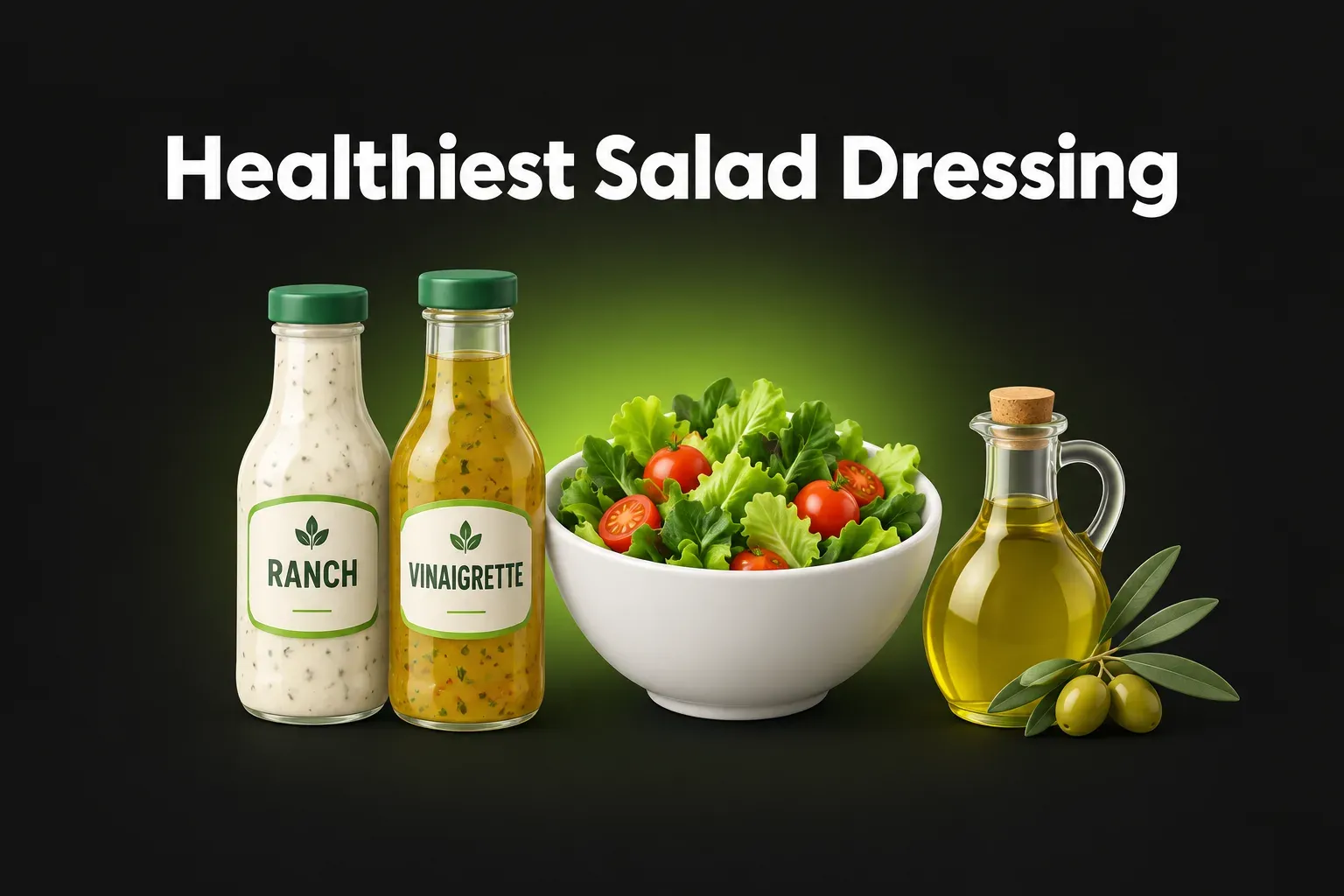
A salad is one of the healthiest things you can eat. But the dressing can add up to 150 calories, sugar and preservatives. It only takes a few seconds. So which bottle is worth buying?
The short answer: the healthiest salad dressing is a simple olive-oil vinaigrette. It is just oil, vinegar or lemon juice, and a little salt. In stores, look for olive or avocado oil as the first oil. Aim for 0–2 g of sugar and under about 250 mg of sodium per 2 tbsp. Yogurt-based dressings are the best creamy choice. The worst picks are classic creamy dressings with soybean oil and preservatives. Fat-free dressings that swap the oil for sugar are bad picks too.
9 store salad dressings compared
All numbers are per 2 tbsp (30 ml), the serving on the label.
| Dressing | Calories | Sugar | Sodium | Main oil | Additives to note |
|---|---|---|---|---|---|
| Primal Kitchen Italian Vinaigrette | about 110 | 0 g | about 240 mg | Avocado | Konjac fiber (thickener) |
| Newman’s Own 100% Extra Virgin Olive Oil Italian | 120 | 0 g | 290 mg | Extra virgin olive | Xanthan gum |
| Newman’s Own Balsamic Vinaigrette | 110 | 1 g | 270 mg | Canola | Caramel color, xanthan gum |
| Bolthouse Farms Classic Ranch Yogurt | 50 | 2 g | 260 mg | Soybean (small amount) | Xanthan gum |
| Primal Kitchen Ranch | about 120 | 0 g | about 230 mg | Avocado | Gums or starch (thickeners) |
| Wish-Bone Italian | 80 | 4 g | 320–350 mg | Soybean | Added sugar, xanthan gum |
| Hidden Valley Original Ranch | 130 | 1 g | 260 mg | Soybean or canola | MSG, EDTA, sorbic acid, artificial flavors |
| Ken’s Steak House Ranch | 140 | 1 g | 290 mg | Soybean | MSG, EDTA, sorbic acid |
| Ken’s Fat Free Raspberry Pecan | 45 | 10 g | 290 mg | None | Sugar, maltodextrin, potassium sorbate, sodium benzoate |
Sources: Newman’s Own labels on SmartLabel (Olive Oil Italian, Balsamic); all other products from Open Food Facts and US grocery listings, checked in November 2026. “About” means sources differ a little. Recipes change – always check the bottle.
What stands out:
- Calories are close for most oil-based dressings: 110–140 per 2 tbsp. The yogurt ranch has only 50.
- The oil is the big difference. Only three bottles use olive or avocado oil. Most others use soybean or canola oil.
- Classic ranch carries the most additives. Hidden Valley and Ken’s both list MSG, EDTA and sorbic acid.
- The fat-free dressing has the most sugar: 10 g in 2 tbsp. That’s about 2½ teaspoons.
The healthiest types of salad dressing
1. Olive-oil vinaigrette
Olive oil has the best research of any salad oil. A large Harvard study followed more than 92,000 US adults for 28 years. Some ate more than ½ tbsp of olive oil a day. They were 19% less likely to die during the study. That was compared with people who rarely or never ate it (Guasch-Ferré et al., Journal of the American College of Cardiology, 2022). This study shows a link, not proof.
A Spanish trial gives stronger proof. It followed 7,447 adults at high risk of heart disease. One group ate a Mediterranean diet with extra virgin olive oil. Another group was told to eat less fat. The olive oil group had about 30% fewer heart attacks, strokes and heart deaths (Estruch et al., New England Journal of Medicine, 2018). Read more in our guide to the Mediterranean diet.
Check the label, though. Many “Italian” or “balsamic” bottles use mostly canola or soybean oil. They may add just a splash of olive oil.
2. Yogurt-based dressings
Yogurt dressings swap most of the oil for buttermilk and yogurt. That’s why Bolthouse Farms Classic Ranch has 50 calories instead of 130–140. They’re a good pick if you love creamy dressings. They’re sold cold, in the produce section.
3. Avocado-oil dressings
Avocado oil is rich in the same kind of fat as olive oil (monounsaturated fat). Primal Kitchen dressings use it with no added sugar. There’s much less research on avocado oil than on olive oil. Still, it’s a solid choice.
The worst types of salad dressing
Classic creamy dressings
Classic bottled ranch is mostly oil and water, with egg yolk and buttermilk. Hidden Valley and Ken’s ranch have 130–140 calories per 2 tbsp. They also add sugar, MSG (a flavor booster) and preservatives. Mayo is made the same way, with oil and egg yolk – compare jars in our guide to the healthiest mayo. Creamy coleslaw dressing is similar – see is coleslaw healthy?
Fat-free dressings with sugar
“Fat-free” sounds healthy. But when the oil goes out, sugar, starch and preservatives come in. Ken’s Fat Free Raspberry Pecan lists water and sugar first. It has 10 g of sugar per 2 tbsp. The American Heart Association suggests a limit on added sugar. It’s about 25 g a day for women and 36 g for men (Johnson et al., Circulation, 2009).
There’s another problem: your salad needs some fat. Many vegetable nutrients only absorb with fat. In a small study, 7 adults ate the same salad three times. The dressing had 0 g, 6 g or 28 g of canola oil. Carotenoids are plant pigments like beta-carotene and lycopene. With the fat-free dressing, the body took in almost none of them. More fat meant more absorbed (Brown et al., American Journal of Clinical Nutrition, 2004).
How to read a salad dressing label: 5 checks
| Check | Aim for | Why |
|---|---|---|
| First oil | Olive or avocado | Best evidence for heart health |
| Sugar | 0–2 g | Sweet dressings can have 5–10 g |
| Sodium | Under about 250 mg | Many bottles have 260–350 mg per 2 tbsp |
| Preservatives | Few or none | EDTA, potassium sorbate and sodium benzoate keep bottles fresh for months |
| Serving | 2 tbsp | Most people pour more – the numbers double fast |
Sodium adds up fast. The daily limit for adults is 2,300 mg (FDA). Say you pour 4 tbsp of a 350 mg dressing. That’s 700 mg – almost a third of the day.
What about soybean oil?
Soybean and canola oil are seed oils. They’re the most common oils in bottled dressings because they’re cheap.
The research is mixed. In one study, male mice ate a high-fat diet with soybean oil added. They had more weight gain and diabetes than mice on a coconut oil diet or a high-fructose (sugar) diet. Their livers also got fatty (Deol et al., PLoS One, 2015). Animal studies matter. Mice share most of our genes and many of our body processes. And feeding people a harmful diet on purpose would put their health at risk.
But in people, the picture looks better. A Harvard study followed 221,054 adults for up to 33 years. Some ate the most plant oils, like soybean, canola and olive oil. They were 16% less likely to die than those who ate the least (Zhang et al., JAMA Internal Medicine, 2025). In the Harvard olive oil study above, olive oil was not clearly better than other plant oils. So soybean oil isn’t the main problem in a dressing. Olive oil is simply the choice with the strongest trial proof.
The additives in bottled dressings
Shelf-stable dressings sit on a shelf for months. To stay smooth and fresh, they need help. Here are the common additives and what independent research says.
- Xanthan gum – a thickener that keeps oil and vinegar mixed. Regulators consider it safe. A French study followed 104,139 adults. Every extra 500 mg a day was linked to an 8% higher risk of type 2 diabetes (Salame et al., The Lancet Diabetes & Endocrinology, 2024). That’s a link, not proof.
- EDTA – grabs tiny bits of metal so the oil doesn’t go rancid. In a Harvard study, mice got doses close to what people get from food. EDTA changed their gut bacteria. Some females got EDTA from before birth. They gained about a third less body fat for the same food. Males showed no change (Schell et al., American Journal of Clinical Nutrition, 2025). It’s one study, and the effect isn’t clearly harmful. But it shows EDTA can affect the gut.
- Potassium sorbate and sorbic acid – stop mold and yeast. Potassium sorbate is a form of sorbic acid. Mice got 150–1,000 mg per kg of body weight a day for 10 weeks. They developed liver inflammation and changes in gut bacteria. Both got better after the mice stopped (Xiao et al., Food and Chemical Toxicology, 2024). In another study, rats got 300 mg per kg a day for 8 weeks. Earlier tests found no harm at this dose. Yet it lowered helpful Lactobacillus bacteria (Rezaei et al., Journal of the Science of Food and Agriculture, 2026).
Most of these doses are higher than what you get from a salad. Human proof is missing. But several labs see the same signal: preservatives can disturb gut bacteria. So it makes sense to limit them when an easy swap exists.
Easy homemade vinaigrette
You can beat almost any bottle in 2 minutes. Shake these in a jar:
- 3 tbsp extra virgin olive oil
- 2 tbsp red wine vinegar or lemon juice
- 1 tsp mustard (it keeps the oil and vinegar mixed)
- 1 pinch salt (about ⅛ tsp) and black pepper
It makes about ⅓ cup (80 ml) – enough for 2–3 salads.
| Per 2 tbsp | Homemade vinaigrette | Bottled Italian (table above) |
|---|---|---|
| Calories | about 135 | 80–120 |
| Sugar | 0 g | 0–4 g |
| Sodium | about 130 mg | 240–350 mg |
| Additives | None | Gums, sometimes preservatives |
Homemade values calculated from USDA FoodData Central (olive oil, red wine vinegar, mustard, salt). Bottled range from Primal Kitchen Italian, Newman’s Own Olive Oil Italian and Wish-Bone Italian.
The homemade version has a few more calories, because it has more oil and no water. One tablespoon of olive oil has about 119 calories – see calories in olive oil. If you’re watching your weight, measure it. Use our calorie calculator to see how dressing fits your day.
Add flavor with garlic, fresh herbs or lemon zest. For a creamy version, stir in a spoon of plain Greek yogurt.
Compare salad dressings in the store. With NutriSmart, you photograph the label or scan the barcode. The app lists the sweeteners, preservatives and colors, explains the risks of each one and gives the product a health score out of 100. It also tells you right away if a dressing is ultra-processed and which ingredients make it so. You can even set an alert for an ingredient like EDTA – the app warns you whenever a scanned product contains it.Get the app free
The bottom line
The healthiest salad dressing is a simple olive-oil vinaigrette. Make it at home, or buy one with olive or avocado oil first on the label. Aim for 0–2 g of sugar and under about 250 mg of sodium per 2 tbsp. Pick one with few preservatives. Yogurt-based ranch is the best creamy pick. Skip fat-free dressings that add sugar, and go easy on classic bottled ranch. Whatever you choose, measure 2 tbsp – the pour matters as much as the bottle.
FAQ
What is the healthiest salad dressing?
A simple vinaigrette made with extra virgin olive oil, vinegar or lemon juice and a little salt. In stores, look for olive or avocado oil as the first oil. Aim for 0–2 g of sugar and under about 250 mg of sodium per 2 tbsp. A yogurt-based dressing is a good creamy choice.
Is fat-free salad dressing healthier?
Usually not. Many fat-free dressings replace the oil with sugar, starch and preservatives. A salad also needs some fat. In a small study, people took in almost none of the plant pigments like beta-carotene when the dressing was fat-free.
Is ranch dressing bad for you?
Classic bottled ranch has about 130–140 calories per 2 tbsp. Most of it comes from soybean or canola oil. Many brands also add sugar, MSG and preservatives like EDTA. A yogurt-based ranch has about a third of the calories.
Is balsamic vinaigrette healthy?
It can be. Balsamic vinaigrette usually has fewer additives than creamy dressings. Newman's Own Balsamic, for example, has 1 g of sugar per 2 tbsp. Check which oil is first – many bottles use canola or soybean oil with only a little olive oil.
How much salad dressing should I use?
About 2 tbsp (30 ml) for a side salad. That's the serving on the label. Many people pour twice that, which doubles the calories and sodium.
What is a healthy homemade salad dressing?
Mix 3 tbsp of extra virgin olive oil, 2 tbsp of red wine vinegar or lemon juice, 1 tsp of mustard and a pinch of salt and pepper. It has no sugar, no additives and about 130 mg of sodium per 2 tbsp.