Is Coleslaw Healthy? Calories, Sugar and Better Picks
Is coleslaw healthy? Cabbage vs creamy dressing, KFC and Popeyes slaw, deli tubs and bottled slaw dressings compared, plus a lighter Greek yogurt recipe.
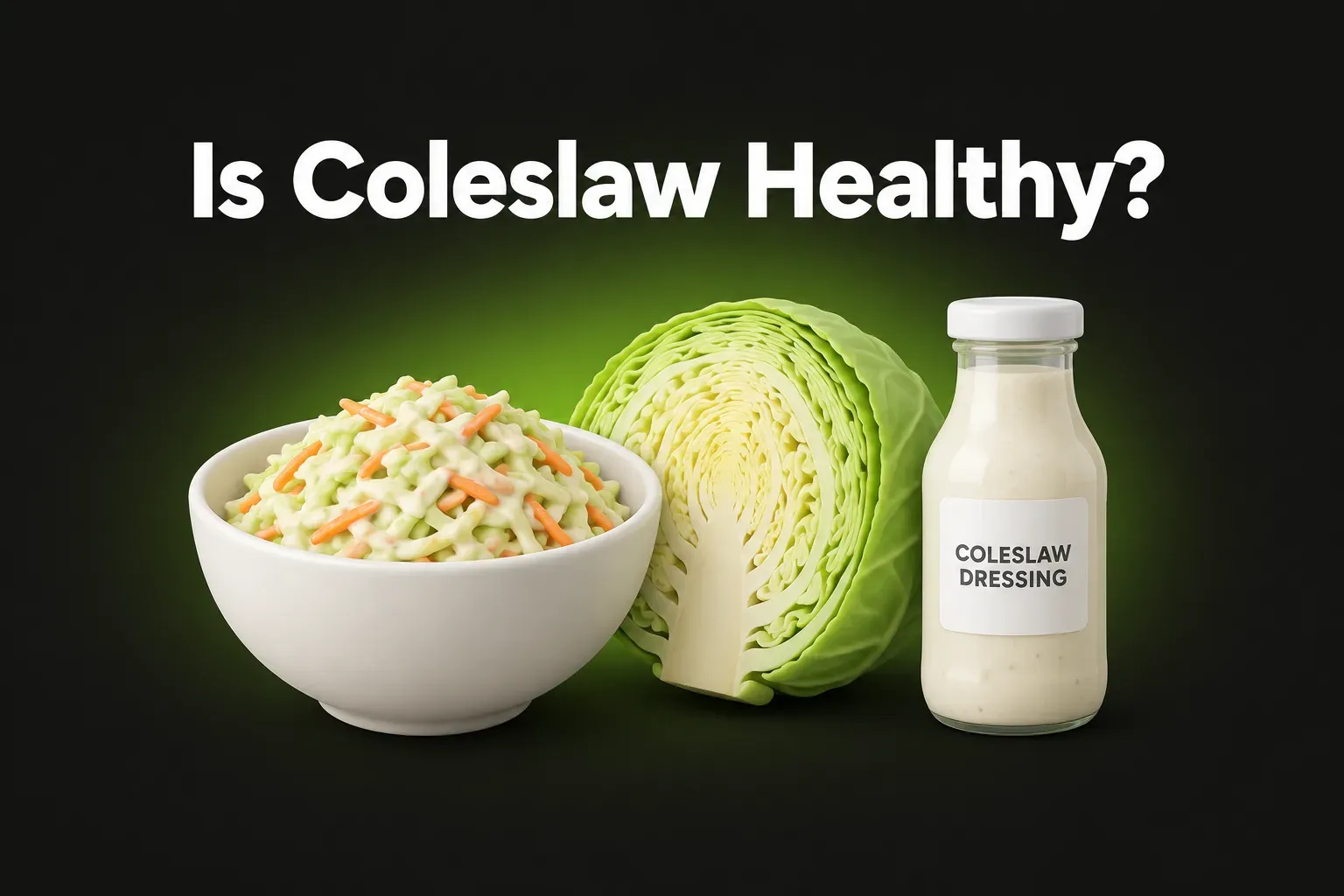
Coleslaw sits next to fried chicken and barbecue all over the US. It looks like a salad, but is coleslaw healthy, or is it mostly mayo and sugar?
The short answer: the cabbage in coleslaw is very healthy. It’s low in calories and rich in vitamin C, vitamin K and fiber. The problem is the creamy dressing. It’s usually made with soybean oil, sugar and egg, and it adds almost all the calories. A half cup of creamy coleslaw has about 130–170 calories and 4–13 g of sugar. Some deli tubs also add preservatives like EDTA and potassium sorbate. A vinegar slaw or a homemade slaw with Greek yogurt is a much lighter choice.
Cabbage: the healthy part
Cabbage is a cruciferous vegetable. That’s the plant family that also includes broccoli, kale and Brussels sprouts. Here is what 1 cup of shredded raw cabbage (70 g) gives you:
| Per 1 cup shredded cabbage | Amount |
|---|---|
| Calories | about 18 |
| Fiber | 1.8 g |
| Sugar | 2.2 g |
| Vitamin C | 26 mg (28% of the Daily Value) |
| Vitamin K | 53 mcg (44% of the Daily Value) |
| Sodium | 13 mg |
Source: USDA FoodData Central, cabbage, raw. Daily Values are based on 90 mg of vitamin C and 120 mcg of vitamin K.
Vitamin K helps your blood clot. Vitamin C helps your body heal and protects your cells.
Cruciferous vegetables also have natural compounds called glucosinolates. They give cabbage its sharp taste. Scientists are studying them for heart and cancer protection.
One large study followed 134,796 adults in Shanghai, China. People who ate the most cruciferous vegetables were 22% less likely to die during the study than those who ate the least. The link was mainly with heart disease deaths (Zhang et al., American Journal of Clinical Nutrition, 2011). This kind of study shows a link, not proof. But it fits with lots of advice to eat more vegetables.
So the base of coleslaw is great. Now let’s look at what goes on top.
The creamy dressing: where the calories come from
A classic creamy coleslaw dressing is mostly mayo, sugar and vinegar. Mayo is mostly soybean oil, plus egg yolk.
Here’s how it adds up. A half cup of creamy coleslaw has about 129 calories, 8.8 g of fat, 8.2 g of sugar and 308 mg of sodium, based on USDA data (USDA FoodData Central). The cabbage and carrots bring only about 20 of those calories. The rest comes from the dressing.
Chick-fil-A’s old coleslaw is a good example. The chain dropped it on January 18, 2016. A kale and broccolini side took its place. As a goodbye, Chick-fil-A shared the recipe. It used 1 cup of mayo and 1/4 cup of sugar for two 10 oz bags of cabbage (NBC Chicago, 2016). That’s a lot of oil and sugar for about 1 1/4 pounds (570 g) of cabbage.
Sugar
The American Heart Association suggests no more than about 25 g of added sugar a day for women and 36 g for men (Johnson et al., Circulation, 2009). A half cup of sweet deli slaw can have 10–13 g. That’s up to half of a woman’s daily limit in one small side.
Soybean oil
Many people worry about soybean oil. It’s high in an omega-6 fat called linoleic acid.
- In mice: in one study, male mice on a high-fat diet with soybean oil had more weight gain, diabetes and fatty liver than mice on a coconut oil diet (Deol et al., PLoS One, 2015). Mouse studies matter, because mice share most of our genes and body processes. But one mouse study can’t prove the same happens in people.
- In people: researchers pooled 30 studies with 68,659 people. Those with the most linoleic acid in their blood or body fat had a 22% lower risk of dying from heart disease (Marklund et al., Circulation, 2019).
- A Harvard study followed 221,054 adults for up to 33 years. People who ate the most plant oils, including soybean oil, were 16% less likely to die during the study than those who ate the least (Zhang et al., JAMA Internal Medicine, 2025).
So the bigger issue in coleslaw is the amount of dressing, not soybean oil itself. Our guide to the healthiest mayo goes deeper.
Fast food and store coleslaw compared
Here’s how popular ready-made coleslaws compare. Serving sizes differ, so check the second column.
| Coleslaw | Serving | Calories | Fat | Sugar | Sodium | Preservatives on label |
|---|---|---|---|---|---|---|
| KFC Coleslaw (Individual) | 1 side | 170 | 12 g | 10 g | 180 mg | No list found |
| KFC Coleslaw (Family) | 1 container | 640 | 46 g | 37 g | 670 mg | No list found |
| Popeyes Coleslaw (Regular) | 1 side | 160 | 12 g | 10 g | 210 mg | No list found |
| Publix Deli Sweet Coleslaw | 1/2 cup | 170 | 11 g | 10 g | 250 mg | EDTA, potassium sorbate |
| Aldi Coleslaw | 1/2 cup | about 140 | 9 g | 13 g | 390 mg | Potassium sorbate, sodium benzoate |
| Sally Sherman Classic Coleslaw | 2/3 cup | about 230 | 18 g | 11 g | 810 mg | EDTA (in the mayo) |
| Whole Foods Market Picnic Coleslaw | 100 g | about 160 | 15 g | 4 g | 220 mg | None |
| Plain shredded cabbage | 1 cup | 18 | 0 g | 2 g | 13 mg | None |
Sources: KFC and Popeyes nutrition data on Nutritionix (KFC updated October 2026, Popeyes updated November 2026). Publix: SmartLabel. Aldi, Sally Sherman and Whole Foods: labels on Open Food Facts (Aldi, Sally Sherman, Whole Foods); the Sally Sherman ingredient list there is cut off, so it may list more. Cabbage: USDA. We couldn’t find a coleslaw ingredient list from KFC or Popeyes online.
What stands out:
- KFC and Popeyes sides are close: about 160–170 calories and 10 g of sugar. The family size at KFC has 37 g of sugar.
- Deli tubs vary a lot. Sally Sherman’s has 810 mg of sodium in 2/3 cup. That’s about a third of the 2,300 mg daily limit.
- Whole Foods Picnic Coleslaw has the least sugar of the store slaws and no preservatives. But it still has 15 g of fat per 100 g, because the mayo is the main part of the dressing.
Bottled coleslaw dressings compared
If you make slaw from a bag of shredded cabbage, the dressing decides how healthy it is. Here are popular US bottles, per 2 tablespoons.
| Dressing (2 tbsp) | Calories | Fat | Sugar | Sodium | First ingredients | Additives to note |
|---|---|---|---|---|---|---|
| Marzetti Original Slaw | 160 | 15 g | 6 g | 360 mg | Soybean oil, sugar | None |
| Marzetti Light Original Slaw | 90 | 6 g | 7 g | 360 mg | Water, sugar, soybean oil | None |
| Kraft Coleslaw | 80 | 4.5 g | 8 g | 280 mg | High fructose corn syrup, vinegar | Polysorbate 60, potassium sorbate, EDTA, artificial flavor |
| Hidden Valley Coleslaw | 150 | 15 g | 4 g | 160 mg | Soybean and/or canola oil | Sorbic acid, EDTA |
| Marie’s Coleslaw | 150 | 13 g | 7 g | 170 mg | Soybean oil, sugar | None |
| Litehouse Coleslaw | about 110 | about 9 g | about 8 g | about 130 mg | Water, canola and/or soybean oil | Maltodextrin, modified corn starch |
Sources: Marzetti Original and Marzetti Light official pages; Kraft Heinz; Hidden Valley SmartLabel; Marie’s and Litehouse labels on Open Food Facts (Marie’s, Litehouse), with Litehouse ingredients from the Litehouse site.
A few things to know:
- Light dressings cut the calories by about half. But they don’t cut the sugar. Marzetti Light has 7 g of sugar, more than the original.
- Kraft Coleslaw has the fewest calories. But its first ingredient is high fructose corn syrup, and it has 8 g of added sugar in 2 tablespoons.
- Marzetti Original and Marie’s have short lists with no added preservatives. Both are sold cold, and the fridge helps keep them fresh.
The additives in coleslaw: EDTA, sorbate and emulsifiers
Shelf-stable dressings and deli tubs often add preservatives. These stop mold and keep the taste fresh. Here’s what the research says.
Calcium disodium EDTA protects flavor. In 2025, Harvard researchers gave mice EDTA at doses close to what people eat in food. It changed their gut bacteria. Female mice exposed from before birth absorbed fewer calories and gained 32% less body fat for the same food (Schell et al., American Journal of Clinical Nutrition, 2025). Male mice showed no such change. Less body fat isn’t clearly harmful. But it shows that EDTA can change how the gut works.
Potassium sorbate and sorbic acid stop mold. Mice got 150–1,000 mg per kg of body weight a day for 10 weeks. Their organs and blood sugar looked normal. But they had liver inflammation and changes in their gut bacteria. These got better 5 weeks after the sorbate was stopped (Xiao et al., Food and Chemical Toxicology, 2024). In a lab test, potassium sorbate and other preservatives slowed helpful human gut bacteria more than bacteria linked to inflammation (Hrncirova et al., Folia Microbiologica, 2019).
Polysorbate 60 keeps Kraft’s dressing smooth. It’s an emulsifier, which means it helps oil and water mix. It hasn’t been tested much on its own. But its close relative, polysorbate 80, caused low-grade inflammation and weight gain in mice, at low doses in their drinking water. It also changed their gut bacteria (Chassaing et al., Nature, 2015).
Why do animal studies matter? Mice share most of their genes and body processes with us. And testing these additives on people on purpose would put their health at risk. There is no proof yet that the amounts in coleslaw harm people. But several labs found effects on the gut. So it makes sense to limit these additives when an easy swap exists.
Vinegar slaw vs creamy coleslaw
Vinegar slaw is popular in the South, especially with barbecue. It skips the mayo. The dressing is mostly vinegar, a little oil or none, sugar and spices.
- Less fat and fewer calories, since there’s no mayo.
- More crunch, because vinegar doesn’t weigh the cabbage down.
- Watch the sugar. Some recipes use a lot of it to balance the sour taste.
If you like tangy cabbage, sauerkraut is another option. It’s fermented cabbage, with no sugar or mayo.
A lighter homemade coleslaw with Greek yogurt
This makes 4 servings of about 1 cup each:
- 4 cups shredded cabbage and carrots (one 10 oz bag of coleslaw mix)
- 1/2 cup nonfat plain Greek yogurt
- 2 tbsp mayo
- 2 tbsp apple cider vinegar
- 1 tsp sugar or honey
- 1 tsp Dijon mustard, a pinch of celery seed, salt and pepper
Mix the dressing, then toss it with the cabbage. Let it rest for 20 minutes in the fridge.
Each serving has about 90 calories, 4 g of protein and 4 g of sugar, with only about 1 g of it added. A tablespoon of nonfat Greek yogurt has about 9 calories (USDA FoodData Central). A tablespoon of regular mayo has about 90–100. Swapping most of the mayo for yogurt is what makes the big difference. See our healthiest yogurt guide to pick a plain one with no added sugar.
Nutrition per serving is our estimate from USDA values for cabbage and Greek yogurt and a typical 90-calorie tablespoon of mayo.
For more light dressing ideas, see the healthiest salad dressing guide.
How to pick a healthier coleslaw
- Make it at home when you can. You control the sugar and the mayo.
- Pick vinegar slaw at barbecue places if it’s offered.
- Order the smallest side. A KFC individual side has 170 calories. The family size has 640.
- Read the dressing label. Look for 6 g of sugar or less per 2 tbsp and no high fructose corn syrup.
- Skip long lists with EDTA, potassium sorbate, sodium benzoate or polysorbate 60.
- Use less dressing. Start with half of what the bottle says.
Scan coleslaw and slaw dressings before you buy. With NutriSmart, you photograph the label or scan the barcode. The app lists the sweeteners, preservatives and colors, explains the risks of each one and gives the product a health score out of 100. It also tells you right away if a coleslaw or dressing is ultra-processed, and which ingredients make it so. Set an alert for EDTA or potassium sorbate, and the app warns you whenever a product you scan contains it.Get the app free
The bottom line
Coleslaw starts with one of the healthiest vegetables you can eat. Cabbage is low in calories and high in vitamin C, vitamin K and fiber. But a creamy dressing turns it into a side with about 130–170 calories and up to 13 g of sugar per half cup. Fast food sides from KFC and Popeyes have about 160–170 calories and 10 g of sugar. Some deli tubs and bottled dressings also add preservatives like EDTA and potassium sorbate. For the healthiest slaw, make it at home with Greek yogurt or vinegar. If you buy it, choose a small serving and a short ingredient list.
FAQ
Is coleslaw healthy?
The cabbage is very healthy, but the creamy dressing adds most of the calories. A half cup of creamy coleslaw has about 130–170 calories and 4–13 g of sugar. A light or homemade slaw can be a good side.
How many calories are in coleslaw?
A half cup of creamy coleslaw has about 130 calories, based on USDA data. Store tubs range from about 140 to 230 calories per serving. A cup of plain shredded cabbage has only about 18 calories.
Is KFC coleslaw healthy?
It's one of the lighter sides at KFC, but it's not a health food. An individual side has 170 calories, 12 g of fat and 10 g of sugar. The family size has 640 calories and 37 g of sugar.
Is vinegar slaw healthier than creamy coleslaw?
Usually, yes. It has no mayo, so it tends to have less fat and fewer calories. But some vinegar slaws use a lot of sugar, so taste or check the label.
Is coleslaw good for weight loss?
Plain cabbage is great for weight loss because it's filling and very low in calories. Creamy coleslaw can have 15 g of fat in a half cup. A light dressing made with Greek yogurt cuts the calories a lot.
What is the healthiest coleslaw dressing?
A homemade dressing with Greek yogurt or vinegar is best. Among bottles, the light versions have about half the calories of regular ones. Look for short ingredient lists without EDTA, potassium sorbate or high fructose corn syrup.