Healthiest Mayo: 9 Brands Compared by Oil and Additives
What is the healthiest mayo? Hellmann's, Duke's, Kraft, Kewpie, Primal Kitchen, Chosen Foods and Vegenaise compared by oil, sugar, sodium and additives.
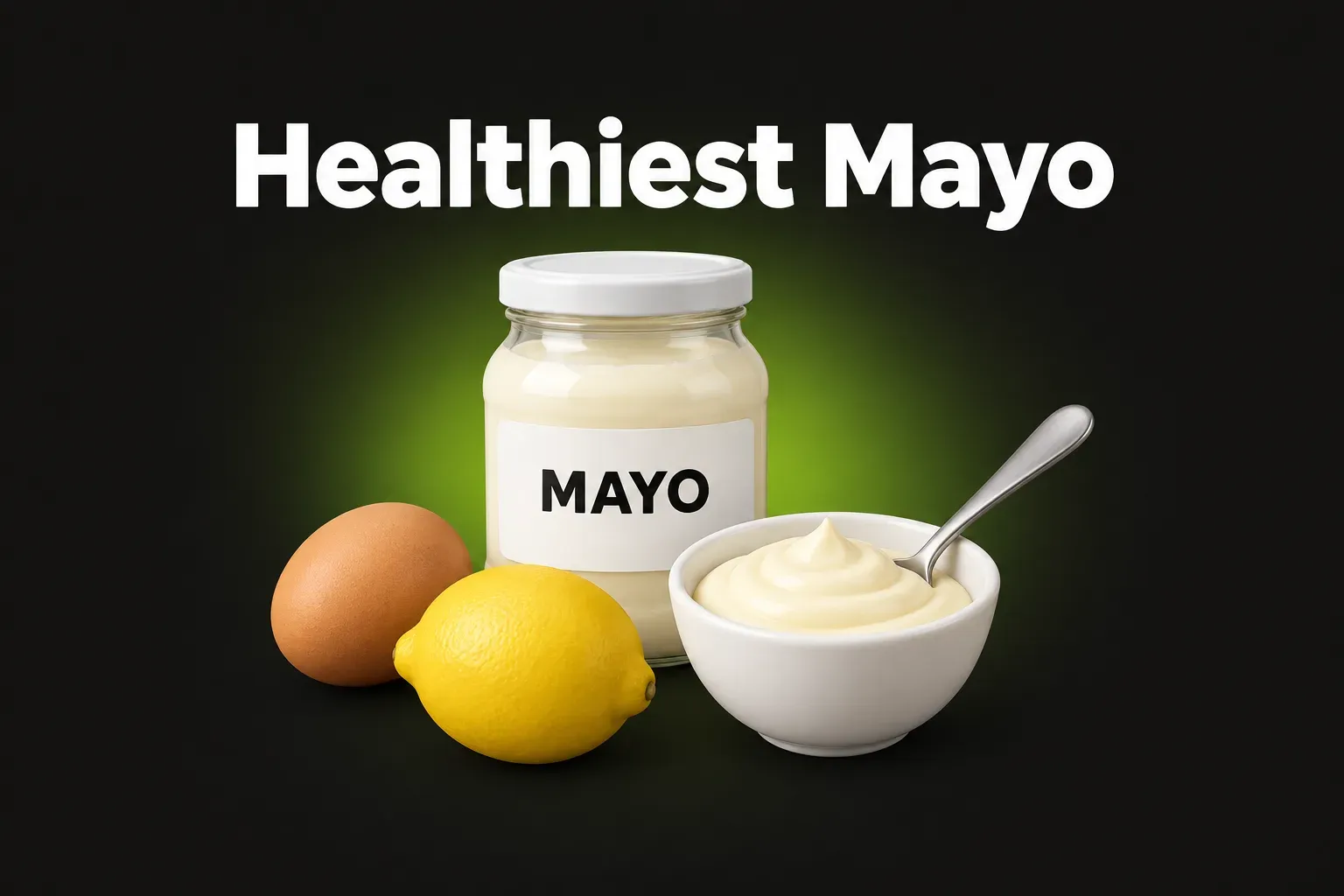
Mayo is in sandwiches, tuna salad, coleslaw and dips. But jars now promise avocado oil, olive oil, “light” or “no seed oils”. So which is the healthiest mayo?
The short answer: the healthiest mayo has a short ingredient list: oil, eggs, vinegar or lemon, and salt. Primal Kitchen and Chosen Foods use only avocado oil, with no sugar and no EDTA. Duke’s is a good classic choice with no sugar. All real mayos have about 90–100 calories per tablespoon, so the portion matters more than the brand. Be careful with light and “olive oil” mayos. They swap oil for water, starch and preservatives. Some even have more soybean oil than olive oil.
9 popular mayos compared per tablespoon
Here are 9 mayos sold in US stores. Numbers are for 1 tablespoon, as printed on the label.
| Mayo (1 tbsp) | Main oil | Calories | Sat fat | Sodium | Sugar in list | EDTA |
|---|---|---|---|---|---|---|
| Hellmann’s / Best Foods Real | Soybean | 90 | 1.5 g | 90 mg | Yes | Yes |
| Duke’s Real | Soybean | 100 | 2 g | 70 mg | No | Yes |
| Kraft Real Mayo | Soybean | 90 | 1.5 g | 70 mg | Yes | Yes |
| Kewpie (US) | Soybean | 100 | 2 g | 115 mg | Yes | Yes |
| Sir Kensington’s Classic | Sunflower | 100 | 1 g | 95 mg | Yes | No |
| Primal Kitchen Avocado Oil | Avocado | 100 | 1.5 g | 85 mg | No | No |
| Chosen Foods Classic | Avocado | 100 | 1.5 g | 50 mg | No | No |
| Vegenaise Original (egg-free) | Canola and safflower | 80 | 0.5 g | 70 mg | Yes | No |
| Hellmann’s Light | Water, then soybean | 35 | 0.5 g | 110 mg | Yes | Yes |
Sources: brand sites for Duke’s, Chosen Foods, Vegenaise, Kewpie USA (the US-made bottle) and Primal Kitchen (ingredients); Open Food Facts US labels for Hellmann’s, Hellmann’s Light, Kraft, Sir Kensington’s and Primal Kitchen, checked November 2026. Serving sizes on labels range from 13 g to 15 g. Some Hellmann’s jars use a 14 g serving and list 100 calories and 95 mg of sodium. “Sugar in list” means sugar, cane sugar or brown rice syrup appears in the ingredients. Every jar except Hellmann’s Light shows 0 g of sugar per tablespoon. Recipes change – always check the jar.
What stands out:
- Calories are almost the same. Real mayo must be at least 65% oil by law (21 CFR 169.140). So every full-fat jar lands at 80–100 calories per tablespoon. For comparison, a tablespoon of olive oil has about 120.
- The oil is the biggest difference. Four of the classic brands use soybean oil. Primal Kitchen and Chosen Foods use avocado oil. Sir Kensington’s uses sunflower oil.
- Sugar is tiny. Several brands list sugar, but the amount rounds to 0 g per tablespoon. Duke’s, Primal Kitchen and Chosen Foods have none at all.
- Kewpie uses only egg yolks, which makes it rich. Its US recipe also has MSG (a flavor booster) and EDTA. Read more about MSG.
- Sodium ranges from 50 mg to 115 mg. That is small next to the 2,300 mg daily limit, unless you use a lot.
“Olive oil” and “avocado oil” jars: check the order
Big brands also sell “olive oil” and “avocado oil” versions. The front of the jar suggests a better oil. The back often tells a different story.
| Product (1 tbsp) | First ingredients | Calories | Added thickeners and preservatives |
|---|---|---|---|
| Hellmann’s Olive Oil Mayonnaise Dressing | Water, soybean oil, olive oil | 60 | Modified potato starch, sorbic acid, EDTA |
| Hellmann’s Avocado Oil Mayonnaise Dressing | Water, avocado oil, soybean oil, canola oil | 60 | Modified corn starch, sorbic acid, EDTA |
| Kraft Mayo with Olive Oil | Water, olive oil, canola oil, vinegar, soybean oil | 45 | Modified food starch, potassium sorbate, EDTA, phosphoric acid |
Source: Open Food Facts US labels, checked November 2026. Serving size 14–15 g. Calories are rounded as on the label.
Ingredients are listed from most to least. So in the Hellmann’s olive oil jar, there is more soybean oil than olive oil. In all three, water comes first. These products have less than 65% oil, so they can’t be called plain “mayonnaise”. That’s why the label says “mayonnaise dressing” or just “mayo”.
They have fewer calories, which can help. But you trade oil for water, modified starch and more preservatives. Want olive oil? Make your own mayo, or pick a jar with olive oil listed first.
Light mayo: fewer calories, longer list
Hellmann’s Light has 35 calories per tablespoon, about a third of the regular one. That is a real saving if you use a lot of mayo.
But look at what fills the gap. Water is the first ingredient. Then come soybean oil, modified food starch (corn and potato), eggs and sugar. The jar also has sorbic acid and EDTA to keep it fresh. The label even marks some items as “ingredient not in mayonnaise”.
Sorbic acid is a common preservative. Potassium sorbate is a form of it. Regulators allow both. But independent labs have seen some warning signs in animals:
- Mice got 150–1,000 mg of potassium sorbate per kg of body weight a day. After 10 weeks, their organs and blood sugar looked normal. But they had liver inflammation and changes in gut bacteria. Both got better after the mice stopped (Xiao et al., Food and Chemical Toxicology, 2024).
- In another lab, rats got 300 mg per kg a day for 8 weeks. Earlier tests found no harm at this dose. Yet it lowered helpful Lactobacillus bacteria in their gut (Rezaei et al., Journal of the Science of Food and Agriculture, 2026).
These doses are much higher than what a spoon of mayo gives you. Proof of harm in people is missing. But animal studies matter. Rats and mice share most of our genes and body processes. Testing a preservative on people for years would put their health at risk. Two labs saw gut changes, so it makes sense to limit it as a precaution. Using a smaller amount of regular mayo is often the simpler choice.
What is EDTA, and should you avoid it?
Most classic mayos list calcium disodium EDTA. It grabs tiny bits of metal in the food. That keeps the oil from going rancid (stale and bitter). The FDA allows it in mayonnaise. Learn more in our guide to disodium EDTA.
In older animal tests, the lowest dose that caused harm was 750 mg per kg of body weight a day (Lanigan and Yamarik, International Journal of Toxicology, 2002). A spoon of mayo has only a tiny fraction of that.
A newer study adds a question. Harvard researchers gave mice doses close to what people get from food. EDTA changed their gut bacteria. In a second test, mice got EDTA from before birth. The females absorbed fewer calories. They gained about a third less body fat for the same food. Males showed no change (Schell et al., American Journal of Clinical Nutrition, 2025). It’s one study, and the effect isn’t clearly harmful. But it shows EDTA can affect the gut. If you’d rather skip it, Primal Kitchen, Chosen Foods, Sir Kensington’s and Vegenaise have none.
Soybean oil vs avocado oil: what the research says
Many people pick avocado oil mayo to avoid seed oils. Soybean oil is high in linoleic acid, an omega-6 fat. Avocado oil is mostly monounsaturated fat, the same main fat as in olive oil.
What animal studies show. In one study, male mice ate a high-fat diet with soybean oil. They gained more weight and got more diabetes than mice on a coconut oil diet. Their livers also got fatty (Deol et al., PLoS One, 2015). The diet had about as much fat and soybean oil as a typical American diet. This matters, because mice share most of our genes and body processes. But one mouse study can’t prove the same happens in people.
What studies in people show. The picture looks better:
- A review looked at 15 trials in healthy adults. Eating more linoleic acid did not raise blood signs of inflammation (Johnson and Fritsche, Journal of the Academy of Nutrition and Dietetics, 2012).
- 30 studies with 68,659 people were combined. People with the most linoleic acid in their blood or body fat were 22% less likely to die from heart and blood vessel disease (Marklund et al., Circulation, 2019). Two authors got research support from Unilever, the company that makes Hellmann’s.
- A Harvard study followed 221,054 adults for up to 33 years. People who ate the most plant oils, including soybean oil, were 16% less likely to die than those who ate the least (Zhang et al., JAMA Internal Medicine, 2025).
These studies show a link, not proof. Still, they don’t suggest that soybean oil mayo is harmful in normal amounts. Avocado oil is a fine choice if you prefer it. Just don’t expect it to cut calories.
One catch with avocado oil. UC Davis researchers tested 22 avocado oils sold in the US. At least 82% were stale or mixed with other oils. Three were labeled “pure” or “extra virgin” but were almost all soybean oil (UC Davis, Food Control, 2020). That study looked at bottled oil, not mayo. But it shows why the brand you trust matters. Read more in is avocado oil healthy?
Swap some mayo for Greek yogurt
The easiest way to make mayo healthier is to use less of it. Plain Greek yogurt is the best helper.
- 1 tbsp of nonfat plain Greek yogurt (about 15 g) has about 9 calories and 1.5 g of protein (USDA FoodData Central).
- 1 tbsp of mayo has about 90–100 calories and almost no protein.
- Half and half gives you about 50 calories per tablespoon, and it still tastes creamy.
Try it in tuna salad, chicken salad, egg salad and coleslaw. Add a squeeze of lemon, a little mustard and salt. For a dip, use mostly yogurt with herbs and garlic. See our guide to the healthiest yogurt to pick a plain one with no added sugar.
Mayo is also the base of creamy dressings like ranch. Our healthiest salad dressing guide shows lighter options.
How to pick a healthier mayo
- Read the ingredients, not the front. “Made with olive oil” or “avocado oil” can still mean mostly soybean oil. Look for one oil, listed first.
- Look for a short list. Oil, eggs or yolks, vinegar or lemon, salt and spices are all you need.
- Skip EDTA and sorbic acid if you can. Several brands make mayo without them.
- Be careful with light mayo. It saves calories, but adds water, starch and preservatives.
- Measure your portion. Use 1 tablespoon, not 3. That alone saves about 200 calories.
Find the healthiest mayo on the shelf. With NutriSmart, you photograph the label or scan the barcode. The app lists the sweeteners, preservatives and colors, explains the risks of each one and gives the product a health score out of 100. It also tells you right away if a mayo is ultra-processed, and which ingredients make it so. Set an alert for EDTA or sorbic acid. The app then warns you whenever a jar you scan contains it.Get the app free
The bottom line
The healthiest mayo is the one with the shortest list. Primal Kitchen and Chosen Foods use only avocado oil, with no sugar and no EDTA. Duke’s is a good classic pick with no sugar. All real mayos have about 90–100 calories per tablespoon, so the amount you use matters most. Light and “olive oil” mayos have fewer calories. But they add water, starch and preservatives, and some have more soybean oil than olive oil. Studies in people don’t show that soybean oil mayo is harmful in normal amounts. For fewer calories and more protein, mix your mayo half and half with plain Greek yogurt.
FAQ
What is the healthiest mayo brand?
There is no single winner. Primal Kitchen and Chosen Foods use only avocado oil and skip sugar and EDTA. Duke's has no sugar and a short list. Most classic mayos have about 90–100 calories per tablespoon.
Is avocado oil mayo healthier than regular mayo?
It has the same calories – about 100 per tablespoon. It has more monounsaturated fat and less omega-6 fat. Studies in people don't show that soybean oil mayo is harmful, so the main gain is a shorter ingredient list.
Is light mayo healthier?
It has about a third of the calories – 35 per tablespoon in Hellmann's Light. But water comes first, and starch, sugar, sorbic acid and EDTA fill the gap. If you only use a little mayo, regular mayo with a short list is a fine choice.
Is olive oil mayo really made with olive oil?
Partly. Many "olive oil" mayos list water first, and some have more soybean or canola oil than olive oil. They also add starch and preservatives. Read the ingredient order on the jar.
Is mayo bad for you?
Not in small amounts. A tablespoon is mostly oil and egg, with little sugar. The problem is the portion – 3 tablespoons on a sandwich add about 300 calories.
What can I use instead of mayo?
Plain Greek yogurt is the easiest swap. A tablespoon of nonfat Greek yogurt has about 9 calories and 1.5 g of protein. Mix it half and half with mayo to keep the rich taste.