Are Sardines Healthy? Nutrition, Mercury and Best Cans
Are sardines healthy? Protein, omega-3, calcium and vitamin D per can, mercury, gout, BPA, olive oil vs water vs sauce, and 8 brands compared.
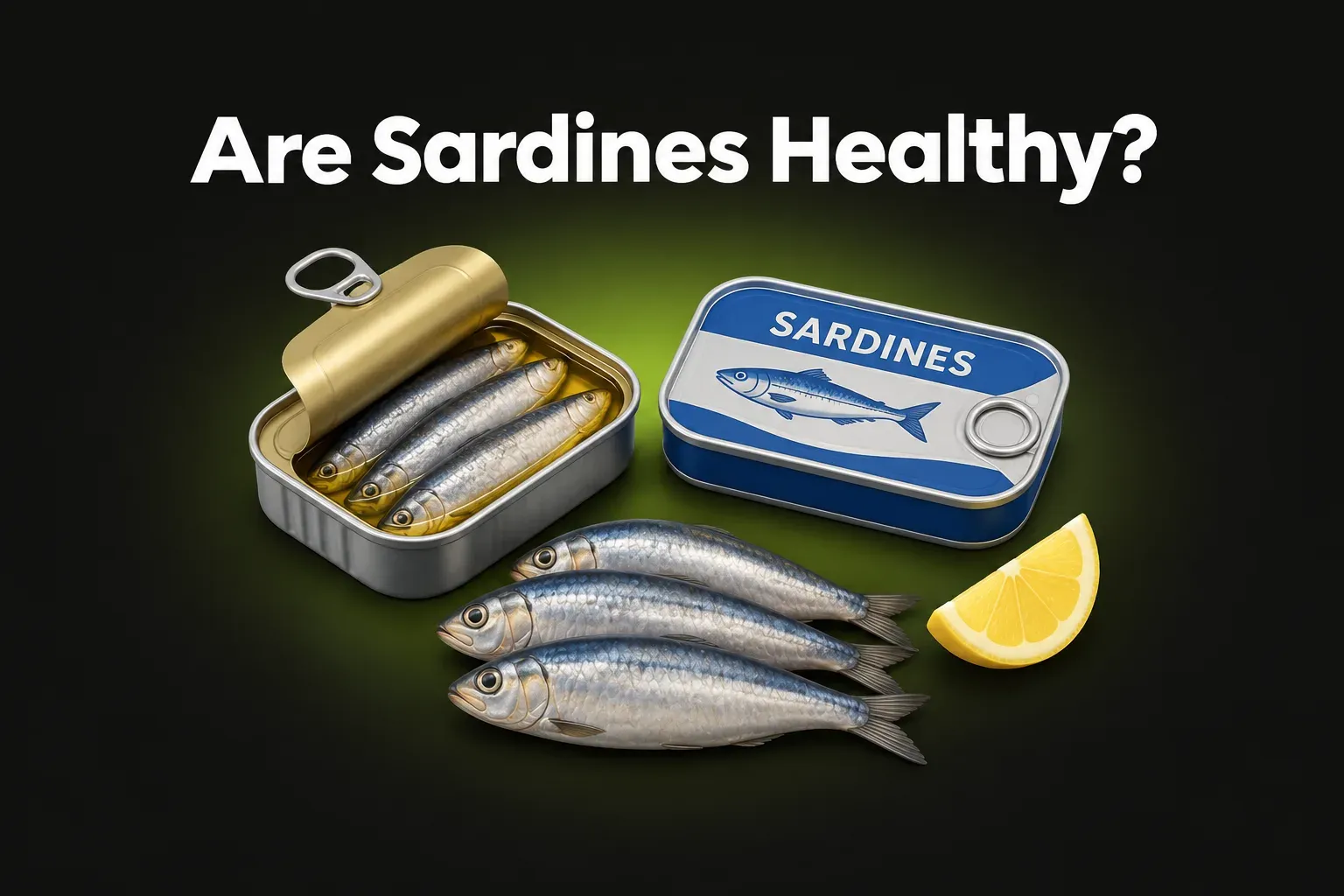
Sardines are small, oily fish that come packed tight in a tin. They’re cheap, keep for years and need no cooking. But are they good for you?
The short answer: yes – canned sardines are one of the healthiest and cheapest foods in the store. One can has about 23 g of protein, almost 1 g of omega-3 fats, about 350 mg of calcium (from the soft bones) and more than 3 days’ worth of vitamin B12. They are also very low in mercury. The main downsides are sodium, purines for people with gout, and sauces with added starches and sugar. Pick sardines with bones, packed in olive oil or water.
Sardine nutrition per can
Here is what a standard 3.75 oz can of sardines in oil has, drained. That leaves about 3.2 oz (92 g) of fish.
| Nutrient | One can (92 g) | Daily value |
|---|---|---|
| Calories | 191 | – |
| Protein | 22.6 g | 45% |
| Fat | 10.5 g | 13% |
| Omega-3 (EPA + DHA) | 0.90 g | – |
| Calcium | 351 mg | 27% |
| Vitamin D | 4.4 mcg (178 IU) | 22% |
| Vitamin B12 | 8.2 mcg | 342% |
| Selenium | 48 mcg | 88% |
| Iron | 2.7 mg | 15% |
| Sodium | 282 mg | 12% |
Source: USDA FoodData Central – sardines, Atlantic, canned in oil, drained, with bone. Values per 100 g, multiplied to one 92 g can and rounded. Daily values from FDA label rules.
What stands out:
- Protein: 23 g is close to what you get from 4 large eggs. Sardines are a cheap way to reach your goal. See more high-protein foods.
- Omega-3: EPA and DHA are the fats in fish that help your heart and brain. One can has almost 1 g. A large review looked at many studies. People who ate 1–2 servings of fish a week had about a third less risk of dying from heart disease (Mozaffarian and Rimm, JAMA, 2006).
- Calcium: most of it is in the tiny bones. They are soft from canning, so you don’t notice them.
- Vitamin D: few foods have it naturally. A can gives about a fifth of your daily need. Find more in our list of foods high in vitamin D.
- Vitamin B12: one can covers more than 3 days’ worth. B12 helps make red blood cells and keeps nerves healthy.
Sardines vs tuna vs salmon
How do sardines stack up against other canned fish? Here are 3 oz (85 g) of each, drained.
| Canned fish (3 oz) | Calories | Protein | Omega‑3 | Calcium | Vitamin D | Mercury |
|---|---|---|---|---|---|---|
| Sardines in oil | 177 | 20.9 g | 0.83 g | 325 mg | 4.1 mcg | 0.013 ppm |
| Light tuna in water | 73 | 16.5 g | 0.19 g | 14 mg | 1.0 mcg | 0.126 ppm |
| Pink salmon | 117 | 19.6 g | 0.92 g | 241 mg | 12.3 mcg | 0.014 ppm |
Source: USDA FoodData Central – sardines, light tuna, pink salmon; mercury means from FDA testing, 1990–2012. Omega-3 = EPA + DHA. Values per 100 g, multiplied to 85 g and rounded.
Tuna is the leanest. But sardines have about 4 times the omega-3 and more than 20 times the calcium. Salmon is close to sardines and has the most vitamin D. Want the full story on tuna? Read is canned tuna healthy?
Mercury: one of the safest fish
Mercury is a metal that builds up in fish. Too much can harm the brain, mostly in babies and young kids. Big fish that eat other fish build up the most.
Sardines are small and eat plankton (tiny sea plants and animals). So they have very little mercury. In FDA tests, sardines had an average of 0.013 ppm (parts per million). Swordfish had 0.995 ppm – about 75 times more.
The FDA puts sardines on its “Best Choices” list. Pregnant and breastfeeding women can eat 2–3 servings a week from this list (FDA). Kids can have 2 smaller servings a week.
Do sardines help with blood sugar?
One trial tested this directly. Researchers in Spain studied 152 adults aged 65 and older. All had prediabetes (blood sugar a bit higher than normal). Both groups got the same healthy diet for a year. One group also ate about 7 oz (200 g) of sardines a week. That’s about two cans.
After a year, fewer people in the sardine group were at very high risk of diabetes. Their insulin worked better. Their “good” HDL cholesterol went up. Their triglycerides (a type of blood fat) and blood pressure went down (Díaz-Rizzolo et al., Clinical Nutrition, 2021). It was one study in one city, so we need more research.
Olive oil, soybean oil, water or sauce?
What the sardines swim in changes the label more than the fish does.
- Olive oil. A good fat, linked to heart health in many studies. It adds calories. Read more on whether olive oil is healthy.
- Soybean oil. Cheaper and higher in omega-6 fats. A drained can holds only a little of it. Still, olive oil is the better pick. See our guide to seed oils.
- Water. The fewest calories. Some brands add no salt at all.
- Tomato or mustard sauce. Tasty, but often saltier. Some add sugar, starch or flavor boosters. King Oscar’s Zesty Tomato sauce lists soybean oil, sugar and carob bean gum (King Oscar). Chicken of the Sea’s mustard sauce lists maltodextrin, modified starch and MSG (Open Food Facts). Simple sauces exist too. Crown Prince Sardines in Tomato Sauce lists only sardines, tomato paste, water and salt (Open Food Facts).
Tip: if you drain the can, most of the packing oil goes down the sink. That cuts calories from any oil-packed can.
8 sardine brands compared
Here are 10 cans from 8 brands sold in the US. Numbers are per can, as the labels show. Cans in oil or water are drained. Sauce cans count the sauce too.
| Product | Serving | Calories | Protein | Fat | Sodium | Calcium |
|---|---|---|---|---|---|---|
| King Oscar Sardines in Extra Virgin Olive Oil (two layer) | 3 oz (85 g) | 230 | 16 g | 18 g | 350 mg | 260 mg |
| King Oscar Sardines in Water, Low Sodium | 3 oz (85 g) | 160 | 14 g | 11 g | 130 mg | 325 mg |
| King Oscar Sardines in Dijon Mustard | 3.75 oz (106 g) | 170 | 15 g | 12 g | 580 mg | 260 mg |
| Wild Planet Wild Sardines in Extra Virgin Olive Oil | 3 oz (85 g) | 170 | 17 g | 11 g | 250 mg | 325 mg |
| Season Sardines in Extra Virgin Olive Oil | 3 oz (85 g) | 180 | 21 g | 11 g | 480 mg | 455 mg |
| Bela Sardines in Extra Virgin Olive Oil with Smoke Flavor | 3 oz (85 g) | 170 | 20 g | 10 g | 200 mg | 360 mg |
| Matiz Wild Sardines in Spanish Olive Oil | 3 oz (84 g) | 200 | 20 g | 14 g | 320 mg | 395 mg |
| Chicken of the Sea Wild-Caught Sardines in Water | 2.4 oz (69 g) | 120 | 11 g | 8 g | 270 mg | 172 mg |
| Crown Prince Skinless & Boneless Sardines in Pure Olive Oil | 2.8 oz (80 g) | 170 | 21 g | 10 g | 230 mg | 40 mg |
| Trader Joe’s Skinless & Boneless Sardines in Olive Oil | 2.8 oz (80 g) | 200 | 19 g | 13 g | 210 mg | not listed* |
Sources: Wild Planet product page; Open Food Facts label data for King Oscar olive oil, water and Dijon, Season, Bela, Matiz, Chicken of the Sea, Crown Prince and Trader Joe’s; protein and calcium for King Oscar from kingoscar.com, checked November 2026. Calcium converted from % daily value where needed. *Calcium is not listed in the label data we found; boneless sardines are usually low. Recipes change – always check the can.
What to notice:
- Calcium depends on the bones. Cans with bones have about 170–455 mg. Crown Prince’s skinless and boneless can has just 40 mg.
- Sodium ranges a lot. King Oscar in water has 130 mg. Its Dijon mustard can has 580 mg – about a quarter of the daily limit.
- Brisling sardines are richer. King Oscar uses brisling, a small, oily fish also called sprat. Its olive oil can has the most fat and calories here. On its website, King Oscar lists 2,200 mg of omega-3 for this can. Wild Planet’s label lists 974 mg.
- Most ingredient lists are short. The olive oil cans list just fish, oil and salt. Some add water or smoke flavor.
BPA in sardine cans
BPA (bisphenol A) is a chemical used in the plastic lining of many food cans. It can act like the hormone estrogen in the body.
Food in cans can raise the BPA in your body. In a US study of 75 adults, people ate one serving of canned soup a day for 5 days. Their urine BPA was more than 10 times higher than after 5 days of fresh soup (Carwile et al., JAMA, 2011). A national survey found the same link with canned food in general (Hartle et al., Environmental Research, 2016). A lab in Portugal tested 21 cans of tuna and sardines from one maker. BPA ranged from too low to measure up to 62 micrograms per kg (Cunha et al., Food Chemistry, 2017).
Is that harmful? Animal studies raise concern. Pregnant rats got about 0.1 mg of BPA per kg of body weight a day in their water. Their babies grew heavier and stayed heavier as adults (Rubin et al., Environmental Health Perspectives, 2001). Another study used mice. Pregnant mice got tiny doses of 2 micrograms per kg a day. Their male babies grew up with a larger prostate (Nagel et al., Environmental Health Perspectives, 1997).
Why do animal studies matter? Rodents share most of our genes and body processes. Testing BPA on pregnant women would put them and their babies at risk. So proof of harm in people is still missing. But many labs have seen effects at low doses (Vandenberg et al., Endocrine Reviews, 2012). In 2023, the European Food Safety Authority made its safe daily level for BPA about 20,000 times lower (EFSA). In late 2024, the EU banned BPA in food packaging, with a phase-in period (EFSA). The FDA still allows it in can linings.
Good news: some sardine brands have moved away from BPA. King Oscar says all its cans are certified BPA-NI (BPA not intentionally added) (King Oscar). Wild Planet says its can linings are made without BPA (Wild Planet, 2019). Both note that tiny traces can still turn up, since BPA is everywhere. As a precaution, pick brands that make this claim.
Who should limit sardines
Sardines are a great fit if you:
- Want cheap protein with no cooking. Check your daily target with our protein calculator.
- Don’t eat much fish and want more omega-3.
- Need more calcium or vitamin D but don’t drink milk.
Be careful if you:
- Have gout. Sardines are high in purines (natural compounds the body turns into uric acid). Fresh sardines had about 210 mg per 100 g, more than salmon (119 mg) or tuna (157 mg) (Kaneko et al., Biological and Pharmaceutical Bulletin, 2014). A US study followed 47,150 men for 12 years. Those who ate the most seafood had a 51% higher risk of gout than those who ate the least (Choi et al., New England Journal of Medicine, 2004).
- Need to cut salt. Pick cans with about 250 mg of sodium or less, or no-salt-added sardines in water.
- Have a fish allergy. Fish is a major food allergen. Avoid sardines completely.
How to pick healthy sardines
- Choose sardines with bones for the most calcium.
- Pick olive oil or water. Skip soybean oil when you can.
- Check the sodium. About 250 mg or less per can is a good target.
- Read the ingredients. Fish, oil or water, and salt is all you need. Sauces may add sugar, starch or MSG.
- Look for a no-BPA can lining on the label or the brand’s website.
Compare sardine cans in the store. With NutriSmart, you photograph the label or scan the barcode. The app lists the sweeteners, preservatives and colors, explains the risks of each one and gives the product a health score out of 100. It also tells you right away if a canned fish in sauce is ultra-processed, and which ingredients make it so. Set an alert for an ingredient like MSG, and the app warns you whenever a can you scan contains it.Get the app free
The bottom line
Canned sardines are one of the healthiest foods you can buy. One can gives about 23 g of protein, almost 1 g of omega-3, plenty of calcium from the bones and more than 3 days’ worth of vitamin B12. They are also among the lowest-mercury fish. Choose sardines with bones, in olive oil or water, with about 250 mg of sodium or less. Go easy on salty sauces. If you have gout, talk to your doctor about how often to eat them.
FAQ
Are sardines healthy?
Yes, for most people. A can of sardines has about 23 g of protein, almost 1 g of omega-3 fats, calcium from the soft bones and a lot of vitamin B12. They are also one of the lowest-mercury fish you can buy.
Is it OK to eat sardines every day?
For most healthy adults, sardines are one of the safest fish to eat often, because their mercury is very low. Watch the salt, since some cans have 500 mg of sodium or more. People with gout should eat them less often.
Are sardines in olive oil or water healthier?
Both are good. Water-packed sardines have fewer calories. Olive oil adds calories but is a healthy fat. If you drain the can, much of the added oil goes down the sink anyway.
Do canned sardines have mercury?
Very little. FDA tests found an average of 0.013 ppm in sardines. That is about 10 times less than canned light tuna. The FDA lists sardines as a Best Choice, even during pregnancy.
Are sardines bad for gout?
They can be. Sardines are high in purines, which the body turns into uric acid. In a large study of men, those who ate the most seafood had a higher risk of gout. If you have gout, ask your doctor how often to eat them.
Should I eat the bones in canned sardines?
Yes. The bones are soft and safe to eat. They are where most of the calcium comes from. Skinless and boneless sardines have much less calcium.