Is Canned Tuna Healthy? Mercury, Protein and Best Brands
Is canned tuna healthy? Light vs albacore, mercury limits for kids and pregnancy, water vs oil, sodium, flavored pouches and 8 brands compared.
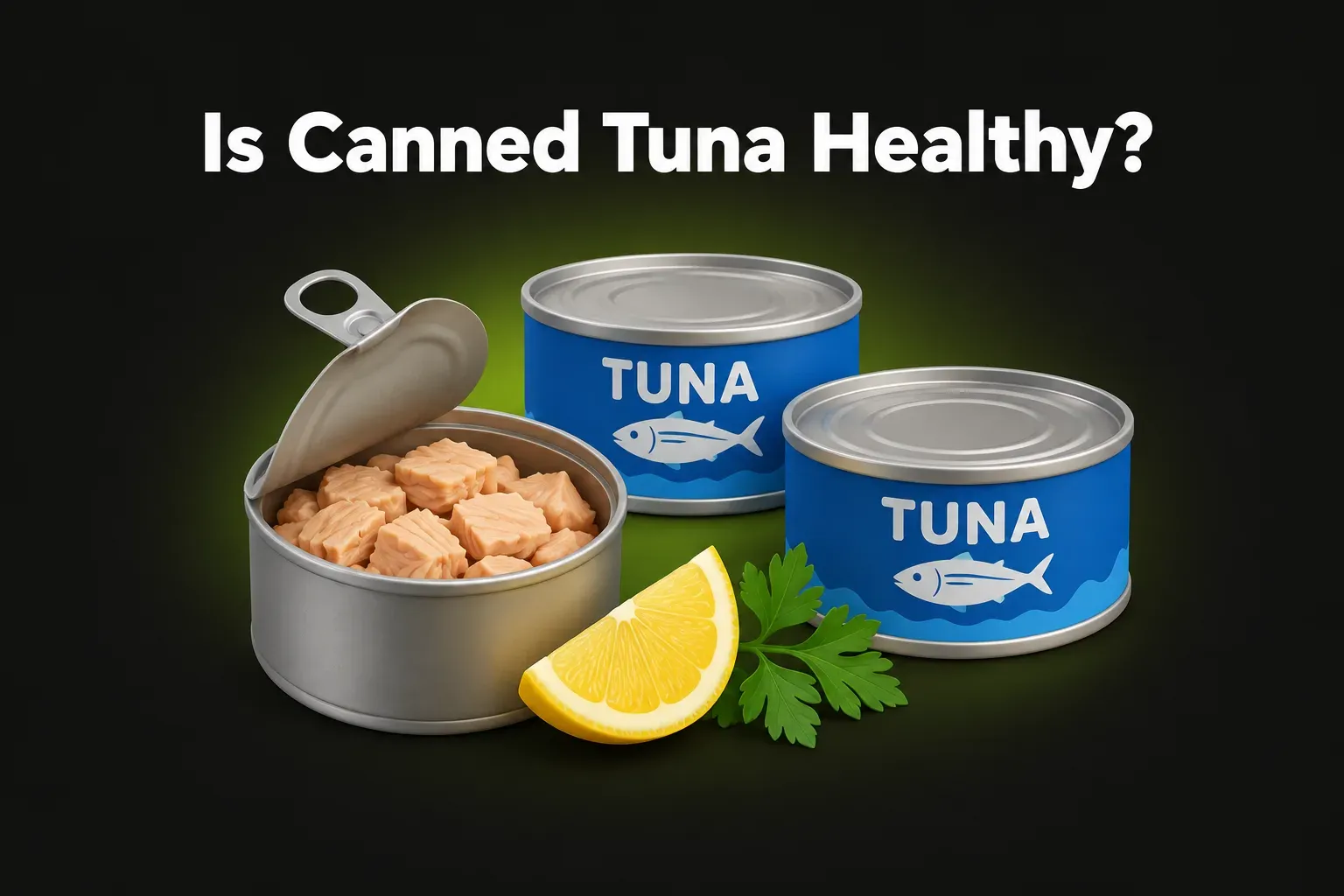
Canned tuna is one of the cheapest ways to get protein. It keeps for years and works in salads, sandwiches and pasta. But what about the mercury?
The short answer: yes – canned tuna is healthy for most people in sensible amounts. A 5 oz can of light tuna in water has about 20–23 g of protein, 90–110 calories and almost no fat. The main worry is mercury. Light and skipjack tuna are low enough for about 3 cans a week. Albacore (white) tuna has about 3 times more mercury, so keep it to about 1 can a week. Choose tuna in water, watch the sodium, and read the label on flavored pouches.
Light vs albacore vs yellowfin
- Light tuna is mostly skipjack. It’s a small, fast-growing tuna. Some “light” cans also use yellowfin or tongol.
- Albacore is sold as “white” tuna. It’s bigger, with paler meat and a milder taste.
- Yellowfin (“ahi”) is another large tuna, often packed in olive oil.
Bigger fish live longer and eat other fish, so they build up more mercury.
Here is what 3 oz (85 g) of drained canned tuna gives you:
| Canned tuna (3 oz) | Calories | Protein | Fat | Omega‑3 | Sodium | Selenium | Mercury |
|---|---|---|---|---|---|---|---|
| Light tuna in water | 73 | 16.5 g | 0.8 g | 0.19 g | 210 mg | 60 mcg | 0.126 ppm |
| Light tuna in oil | 168 | 24.7 g | 7.0 g | 0.11 g | 354 mg | 65 mcg | 0.126 ppm |
| Albacore in water | 109 | 20.1 g | 2.5 g | 0.73 g | 320 mg | 56 mcg | 0.350 ppm |
| Albacore in oil | 158 | 22.5 g | 6.9 g | 0.21 g | 337 mg | 51 mcg | 0.350 ppm |
Source: USDA FoodData Central – light in water, light in oil, albacore in water, albacore in oil. All drained. Values per 100 g, multiplied to 85 g and rounded. Omega-3 = EPA + DHA. Mercury = mean from FDA testing, 1990–2012. ppm = parts per million.
What stands out:
- Protein: tuna is one of the leanest high-protein foods. Check your daily target with our protein calculator.
- Omega-3: albacore has almost 4 times more than light tuna. These are the fish fats that help your heart and brain.
- Selenium: 3 oz covers about a full day’s need of this cell-protecting mineral.
- Mercury: albacore has almost 3 times more than light tuna. Fresh or frozen yellowfin is about the same as albacore, at 0.354 ppm.
How much mercury is too much?
Mercury is a metal that can harm the brain and nerves. Babies in the womb and young kids are most at risk.
- Kids exposed before birth. In the Faroe Islands, 917 children were tested at age 7. Their mothers had eaten pilot whale meat, which is very high in mercury. Kids with more mercury at birth scored lower on language, attention and memory tests (Grandjean et al., Neurotoxicology and Teratology, 1997).
- Adults who eat a lot of fish. Doctors in San Francisco checked the blood of 89 patients. Many of them ate a lot of fish. 89% had more mercury than the EPA’s safe level. Their levels dropped after they stopped eating fish (Hightower and Moore, Environmental Health Perspectives, 2003).
But fish also helps. A UK study followed 11,875 pregnant women. Kids whose mothers ate less than 12 oz (340 g) of seafood a week were more likely to score in the lowest group for verbal IQ (Hibbeln et al., Lancet, 2007). So the goal is not zero fish. It’s low-mercury fish.
A rough guide for adults. The EPA’s safe level is 0.1 micrograms of mercury per kg of body weight a day (Hightower and Moore, 2003). For a 150 lb (68 kg) adult, that’s about 48 micrograms a week. One drained 5 oz can of light tuna has about 14 micrograms. A can of albacore has about 40. So that adult can eat about 3 cans of light tuna or 1 can of albacore a week, if they eat no other fish. Lighter people and kids should eat less.
FDA advice for pregnancy and kids
The FDA and EPA sort fish into three groups (FDA):
| Tuna type | FDA group | Pregnant or breastfeeding |
|---|---|---|
| Canned light (includes skipjack) | Best choice | 2–3 servings a week |
| Albacore / white, canned or fresh | Good choice | 1 serving a week |
| Yellowfin | Good choice | 1 serving a week |
| Bigeye | Choice to avoid | None |
Source: FDA and EPA, Advice about Eating Fish, revised October 2021. One adult serving = 4 oz (113 g).
For kids, a serving is smaller. It’s 1 oz at ages 1–3, 2 oz at ages 4–7, 3 oz at ages 8–10 and 4 oz from age 11. The FDA suggests 2 servings a week from the “best choices” list. For kids, light tuna is the better pick.
Consumer Reports is stricter. In 2023, it tested 30 cans of tuna in water from Bumble Bee, Chicken of the Sea, Safe Catch, StarKist and Wild Planet. All were within FDA limits. Albacore had about 3 times more mercury than light tuna. But about 1 in 5 cans had a mercury spike big enough to change the FDA advice for that tuna. Chicken of the Sea’s albacore had 10 times more mercury than its light tuna (Food Safety Magazine, 2023). So Consumer Reports suggests that pregnant people avoid canned tuna. It says other adults can have up to 3 servings of light tuna a week, or one 4 oz serving of albacore (CBS News, 2023).
Water or oil?
Tuna in water is the lighter choice. Once drained, light tuna in oil has more than twice the calories of tuna in water.
Oil has another downside. Some of the fish’s own omega-3 fats leak into the oil and go down the sink when you drain it. In the USDA data, drained albacore in oil has less than a third of the omega-3 of albacore in water.
Still, olive oil is a healthy fat, and it’s a better pick than soybean or sunflower oil. Read more on whether olive oil is healthy.
Watch the sodium
Most regular cans have about 360 mg of sodium per 5 oz can. That’s about 16% of the 2,300 mg daily limit. Bread, mayo and pickles add more. Pick “low sodium” or “no salt added” cans. StarKist’s lower-sodium light tuna has 270 mg per can (StarKist).
8 canned tuna brands compared
Here are 8 tuna cans sold in the US. The numbers come from their labels.
| Product | Tuna | Serving | Calories | Protein | Fat | Sodium | Ingredients |
|---|---|---|---|---|---|---|---|
| StarKist Chunk Light in Water | Light | 5 oz can, drained (113 g) | 90 | 20 g | 0.5 g | 360 mg | Light tuna, water, vegetable broth, salt |
| StarKist Solid White Albacore in Water | Albacore | 1 can, drained (113 g) | 110–130* | 26–30 g* | 1 g | 320–360 mg* | White tuna, water, vegetable broth, salt, pyrophosphate |
| Bumble Bee Chunk Light in Water | Light | 5 oz can, drained (113 g) | 110 | 23 g | 1 g | 360 mg | Light tuna, water, vegetable broth, sea salt |
| Chicken of the Sea Chunk Light in Water | Light | 5 oz can, drained (113 g) | about 100 | 23 g | 0.5 g | about 360 mg | Light tuna, water, vegetable broth (soy), salt |
| Wild Planet Skipjack Wild Light Tuna | Skipjack | 5 oz can, not drained (142 g) | 140 | 32 g | 1.5 g | 450 mg | Skipjack tuna, sea salt |
| Safe Catch Elite Wild Tuna | Skipjack | 3 oz (85 g), 1.5 per can | 100 | 24 g | 0 g | 210 mg | Skipjack tuna |
| Genova Yellowfin Tuna in Olive Oil | Yellowfin | 5 oz can, drained (113 g) | 210 | 29 g | 11 g | 500 mg | Yellowfin tuna, olive oil, water, sea salt |
| Kirkland Signature Solid White Albacore | Albacore | 7 oz can, drained (153 g) | about 190 | 42 g | 3 g | about 340 mg | Albacore tuna, water, sea salt, sodium acid pyrophosphate |
Sources: brand websites for StarKist albacore, Bumble Bee, Wild Planet, Safe Catch and Genova; Open Food Facts labels for StarKist Chunk Light, StarKist albacore, Chicken of the Sea and Kirkland; checked November 2026. *The StarKist site and store labels show different numbers, so we give the range. Chicken of the Sea and Kirkland numbers come from label photos and may vary. Recipes change – always check the can.
What to notice:
- Ingredient lists are short: tuna, water, salt and often “vegetable broth” (usually soy).
- Some albacore cans add pyrophosphate. This is a phosphate salt. US rules allow up to 0.5% of the weight in canned tuna. It stops harmless, glass-like crystals from forming (21 CFR 161.190). See below.
- Wild Planet and Safe Catch have nothing to drain. The fish cooks in its own juices. Wild Planet lists 582 mg of omega-3 in its skipjack can and an average of 1,500 mg in its albacore can.
- Safe Catch tests for mercury. The brand says it tests every tuna. Its Elite tuna must stay under 0.1 ppm, with an average of 0.04 ppm (Safe Catch). That’s lower than the FDA’s 0.126 ppm mean for light tuna.
- Genova has the most fat and sodium here. And yellowfin is a “good choice” fish, not a “best choice”.
Flavored pouches: check the label
Plain pouches are as healthy as cans. Flavored ones are a different story. Some have more sodium than a whole can of tuna.
| Pouch (74 g or 71 g) | Calories | Sodium | Sugar | Additives on the label |
|---|---|---|---|---|
| StarKist Tuna Creations Hickory Smoke | 110 | 340 mg | 0 g | Natural smoke flavor |
| Bumble Bee Lemon & Pepper | 80 | 280 mg | 1 g | Modified corn starch, yeast extract, citric acid, natural flavors |
| StarKist Tuna Creations Herb & Garlic | 110 | 390 mg | 1 g | Modified corn starch, yeast extract, caramel color, natural flavors |
| StarKist Tuna Creations Ranch | 70 | 360 mg | 0.5 g | MSG, titanium dioxide, xanthan gum, natural flavors |
| StarKist Tuna Creations Thai Chili | 90 | 430 mg | 4 g | Corn syrup, phosphoric acid, sodium benzoate, potassium sorbate |
| StarKist Tuna Creations Hot Buffalo | 70 | 620 mg | 0 g | Maltodextrin, modified corn starch, xanthan gum, sodium diacetate |
Sources: Bumble Bee (71 g pouch); StarKist product pages for calories, sodium and sugar; Open Food Facts label photos for the StarKist ingredients: Hickory Smoke, Herb & Garlic, Ranch, Thai Chili and Hot Buffalo (74 g pouches), checked November 2026.
Two additives deserve a closer look:
- Titanium dioxide is a white color. In 2021, the European Food Safety Authority said it can no longer be called safe (EFSA). The EU then banned it in food. In a French study, rats got 10 mg per kg of body weight a day in their water for 100 days. 4 of 11 rats developed early changes in the colon that can lead to cancer. None of the 12 control rats did (Bettini et al., Scientific Reports, 2017). Read more about titanium dioxide.
- Phosphates like pyrophosphate add to the phosphorus you already get from food. A US study followed about 9,700 healthy adults. Those who ate more than 1,400 mg of phosphorus a day had a higher risk of death. This shows a link, not proof (Chang et al., American Journal of Clinical Nutrition, 2014). In a small trial, 11 healthy men ate a meal with 1,200 mg of phosphorus. Two hours later, their blood vessels relaxed less well than after a 400 mg meal (Shuto et al., Journal of the American Society of Nephrology, 2009). More on sodium phosphate.
Why do animal studies count? Rats share most of our genes and body processes. And testing a possible cancer risk on people would put their health at risk. Proof in humans is still missing, and labels don’t say how much of each additive is used. But when several labs see the same warning signs, it makes sense to limit these additives as a precaution. Pick plain tuna and add your own lemon or herbs. That also skips the MSG in some flavors.
BPA in cans
Many can linings contain BPA (bisphenol A), a chemical that can act like the hormone estrogen. In a Harvard trial, 75 adults ate 12 oz (340 g) of canned soup a day for 5 days. Their urine had more than 10 times as much BPA as after 5 days of fresh soup (Carwile et al., JAMA, 2011). A lab in Portugal tested 21 cans of tuna and sardines from one maker. It found up to 62 micrograms of BPA per kg (2.2 lb) of food (Cunha et al., Food Chemistry, 2017). If you eat tuna often, look for “BPA-free” or “BPA-NI” cans. Read more in our guide to whether sardines are healthy.
Is canned tuna sustainable?
- Pole-and-line and troll fishing catch tuna one at a time on hooks. Very few other animals get caught by mistake. This is called bycatch.
- Big purse seine nets often use FADs (fish aggregating devices). These are floating objects that draw fish in. They also pull in young tuna, sharks and sea turtles (Seafood Watch).
- “Dolphin safe” means no dolphins were harmed. It says nothing about sharks, turtles or young tuna.
Look for “pole and line”, “troll caught”, “FAD-free” or the blue MSC fish logo. Wild Planet says it uses only pole-and-line or troll fishing. Safe Catch says it never uses FADs or long lines.
How tuna fits a healthy diet
A big review looked at many studies. People who ate 1–2 servings of fish a week had about a 36% lower risk of dying from heart disease. Fish rich in omega-3 seemed to help most (Mozaffarian and Rimm, JAMA, 2006). Sardines and salmon have more omega-3 and much less mercury, so swap some in. Our guide to whether sushi is healthy shows which tuna is highest in mercury. And imitation crab is cheap, but has far less protein than tuna.
How to pick a healthy canned tuna:
- Choose light or skipjack for everyday meals. Save albacore and yellowfin for once a week.
- Pick tuna in water, or olive oil for a richer taste.
- Aim for about 300 mg of sodium or less per can.
- Keep the ingredient list short: tuna, water or oil, and salt.
- Skip flavored pouches with sugar, MSG, titanium dioxide or preservatives.
- Look for pole-and-line or FAD-free fishing.
Scan your canned tuna in the store. With NutriSmart, you photograph the label or scan the barcode. The app lists the sweeteners, preservatives and colors, explains the risks of each one and gives the product a health score out of 100. It also tells you right away if a flavored tuna pouch is ultra-processed, and which ingredients make it so. Set an alert for an ingredient like titanium dioxide, and the app warns you whenever a product you scan contains it.Get the app free
The bottom line
Canned tuna is a cheap, healthy source of lean protein for most people. Mercury is the main limit. Healthy adults can eat about 3 cans of light tuna a week, or about 1 can of albacore. Pregnant women should follow the FDA limits or skip canned tuna, and kids need smaller servings. Choose light tuna in water with a short ingredient list, and go easy on flavored pouches.
FAQ
Is canned tuna healthy?
Yes, for most people. A 5 oz can of light tuna in water has about 20–23 g of protein and only 90–110 calories. The catch is mercury, so pick light or skipjack tuna and don't eat albacore every day.
How much canned tuna is safe to eat per week?
For a healthy adult, about 3 cans of light tuna a week is a sensible limit. Albacore has about 3 times more mercury, so keep it to about 1 can a week. Kids need smaller amounts.
Which canned tuna has the least mercury?
Light tuna made from skipjack. FDA tests found an average of 0.126 ppm in canned light tuna and 0.350 ppm in canned albacore. Some brands, like Safe Catch, say they test every fish for mercury.
Is tuna in water or oil healthier?
Tuna in water has fewer calories once drained – less than half as many for light tuna. It also keeps more of its omega-3 fats, because some of them leak into the oil you pour away. Tuna in olive oil is still a fine choice if the extra calories fit your day.
Can I eat canned tuna while pregnant?
The FDA says yes, in limited amounts. Pregnant women can eat 2–3 servings (4 oz each) a week of low-mercury fish like canned light tuna. Albacore and yellowfin count as 1 serving a week. Consumer Reports is stricter and suggests skipping canned tuna during pregnancy.
Are flavored tuna pouches healthy?
Many are fine, but read the label. Some add sugar, starch, MSG, preservatives or colors such as titanium dioxide. Plain pouches with just tuna, water or oil and salt are the best pick.