Is SPAM Healthy? Ingredients, Sodium and Nitrites
Is SPAM healthy? SPAM ingredients, calories, fat and sodium in Classic, Lite and Less Sodium, what nitrites mean for you, and better swaps.
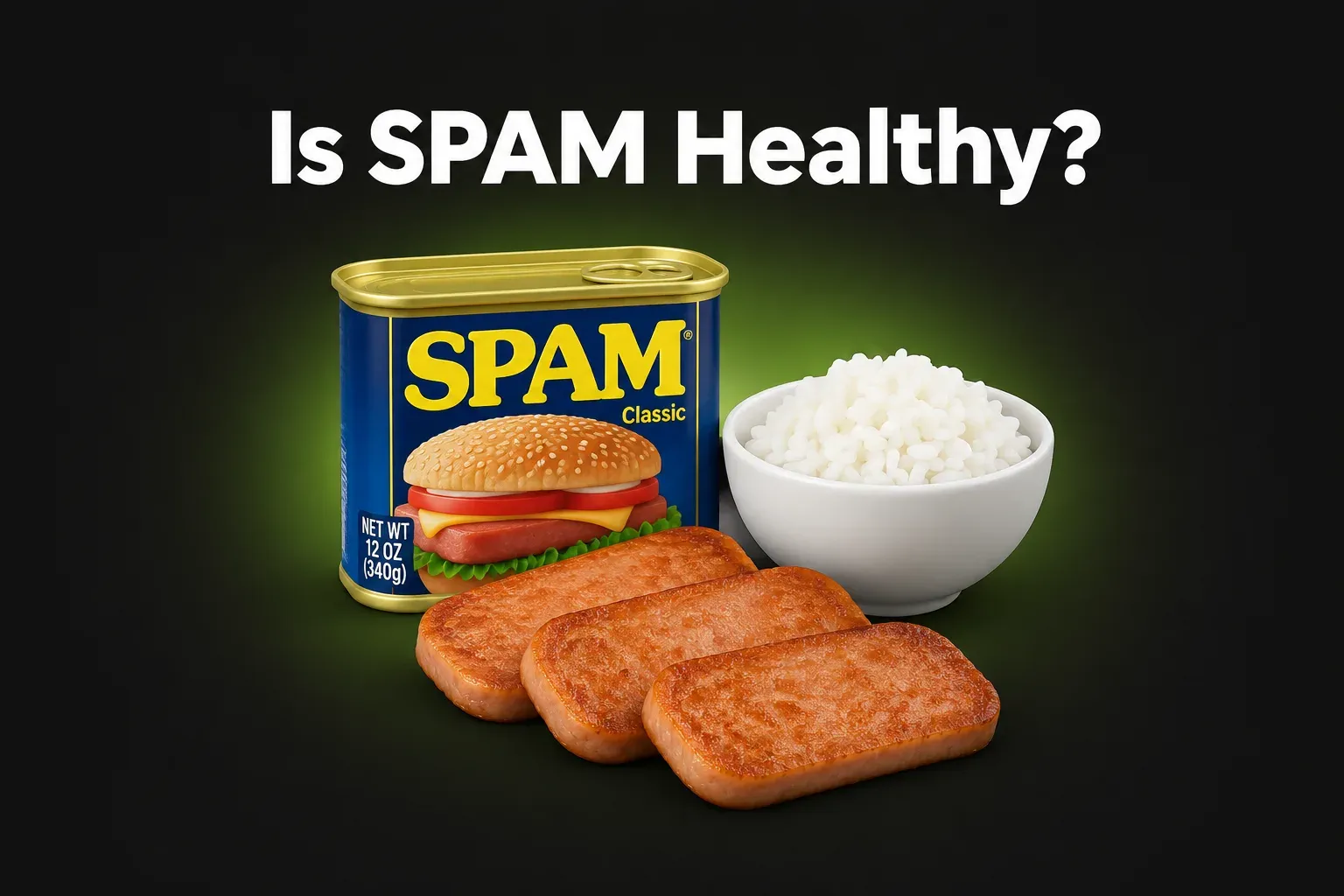
SPAM is cheap, keeps for years in the pantry and is a breakfast classic in Hawaii. But is SPAM healthy?
The short answer: not really, but it’s fine now and then. A 2 oz serving of SPAM Classic has 180 calories, 16 g of fat and 790 mg of sodium – a third of a day’s limit. It gives only 7 g of protein. It’s also a processed meat cured with sodium nitrite. The WHO’s cancer agency says processed meat causes colorectal cancer. SPAM Lite and 25% Less Sodium are a bit better, but they’re still processed meat. For everyday protein, canned tuna or chicken is a much better pick.
SPAM ingredients: what’s in a can
The classic 12 oz (340 g) can of SPAM Classic has just six ingredients. Here they are in label order:
- Pork with ham – the meat. It’s pork mixed with ham, which comes from the pig’s back leg. Read more in is ham healthy?
- Salt – adds flavor and helps the meat keep. It’s where most of the sodium comes from.
- Water – keeps the meat moist.
- Modified potato starch – potato starch that’s been treated to work better in food. It soaks up water, so the meat stays firm and juicy.
- Sugar – a little for taste. The label lists 1 g of added sugar per serving.
- Sodium nitrite – a curing salt. It keeps the meat pink and helps stop the germs that cause botulism, a rare but deadly food poisoning.
Source: ingredient list on the SPAM Classic page on SPAM.com, which matches Open Food Facts (checked November 2026).
Here are the nutrition facts. The can has 6 servings of 2 oz (56 g) each.
| Nutrient | Per 2 oz (56 g) | Whole can (12 oz) |
|---|---|---|
| Calories | 180 | 1,080 |
| Fat | 16 g | 96 g |
| Saturated fat | 6 g (30% of the Daily Value) | 36 g |
| Sodium | 790 mg (34% of the Daily Value) | 4,740 mg |
| Carbs | 1 g | 6 g |
| Added sugar | 1 g | 6 g |
| Protein | 7 g | 42 g |
Source: SPAM Classic label on SPAM.com. Whole-can values are the label numbers times 6.
SPAM’s ingredient list is short. The problem isn’t one strange ingredient. It’s the mix of salt, saturated fat and nitrite, with little protein for the calories. About 80% of SPAM’s calories come from fat. Open Food Facts also lists SPAM Classic as ultra-processed (NOVA group 4). Learn more in our guide to ultra-processed food.
Why so many people eat SPAM
Hormel first sold SPAM in 1937. During World War II, it fed soldiers because it didn’t need a fridge. It spread with US troops to places like Hawaii, the Philippines, South Korea and Okinawa. It’s still loved there today.
Hawaii is famous for it. A 2021 story shared on Hormel’s newsroom says people in Hawaii eat about 7 million pounds of SPAM a year (Hormel Foods). Think SPAM musubi, SPAM and eggs with rice, and SPAM fried rice.
People also buy it as a budget protein. It’s cheap and cooks in minutes. But per calorie, SPAM is a weak protein source. You get about 4 g of protein per 100 calories. Canned tuna gives about 22 g for the same calories. See our list of cheap healthy meals for other low-cost ideas.
SPAM Classic vs Lite vs 25% Less Sodium
Hormel makes several versions. Here’s how the three main ones compare.
| Per 2 oz (56 g) | Classic | Lite | 25% Less Sodium |
|---|---|---|---|
| Calories | 180 | 110 | 180 |
| Fat | 16 g | 8 g | 16 g |
| Saturated fat | 6 g | 3 g | 6 g |
| Sodium | 790 mg | 580 mg | 580 mg |
| Protein | 7 g | 9 g | 7 g |
| Sodium nitrite | Yes | Yes | Yes |
Source: SPAM.com labels for Classic, Lite and 25% Less Sodium.
SPAM Lite has half the fat and less sodium. It also has 2 g more protein. SPAM 25% Less Sodium cuts the salt but keeps all the fat and calories.
Both lighter versions have a longer ingredient list. They add:
- Mechanically separated chicken. This is a chicken paste. Machines press bones with bits of meat through a sieve to get it. It’s safe and legal. It costs less than whole cuts of meat.
- Sodium phosphates. These help the meat hold water. Your body absorbs most of the phosphate added to food. Too much phosphorus may be hard on the heart and kidneys, mostly in people with kidney disease.
- Potassium chloride. It’s a salt swap that replaces some of the sodium.
- Sodium ascorbate. It’s a form of vitamin C. It helps the cure work. It also slows the forming of nitrosamines, compounds linked to cancer.
So the lighter versions are better for salt and fat. But they’re more processed, and they still have sodium nitrite.
The salt problem
SPAM’s biggest issue is sodium. The FDA’s Daily Value for sodium is 2,300 mg a day. One 2 oz serving of Classic uses up 34% of it. And many people eat more than one serving. Half a can is 3 servings – that’s 2,370 mg of sodium, more than a full day’s limit.
Too much salt raises blood pressure. And high blood pressure raises the risk of heart attack and stroke.
- What the research shows. A big review pooled 34 trials with over 3,000 people. Eating about 4.4 g less salt a day for at least four weeks lowered blood pressure. It worked in people with and without high blood pressure (He et al., BMJ, 2013).
If you have high blood pressure, heart or kidney disease, SPAM Classic is a food to keep rare.
Processed meat, cancer and your heart
SPAM is a processed meat. That means meat that’s salted, cured, smoked or treated to last longer. Bacon, ham, hot dogs, deli meat and beef jerky count too.
- Cancer. In 2015, the WHO’s cancer agency (IARC) put processed meat in Group 1. That’s its “causes cancer in humans” group. Experts looked at over 800 studies. Each 50 g of processed meat a day – a bit less than one 2 oz serving of SPAM – raised colorectal cancer risk by about 18% (Bouvard et al., Lancet Oncology, 2015).
- Heart disease and diabetes. A review of 20 studies with over 1.2 million people looked at meat and health. Each 50 g of processed meat a day was linked to a 42% higher risk of heart disease. It was also linked to a 19% higher risk of type 2 diabetes. Fresh red meat didn’t show the same links (Micha et al., Circulation, 2010).
Group 1 means the proof is strong. It doesn’t mean SPAM is as risky as smoking. Smoking raises cancer risk far more. But the risk grows with how much and how often you eat it.
Sodium nitrite: what the studies show
Nitrite is one of the main suspects behind the cancer link. In the stomach or at high heat, it can react with pieces of protein. This forms nitrosamines and similar compounds. Many of them cause cancer in animals.
Regulators like the FDA allow nitrite in cured meat at set limits. But it’s worth looking at independent research too.
Animal studies. A French lab in Toulouse tested cured meat on rats. The rats first got a chemical that starts colon cancer. Then they ate diets with large amounts of meat for 100 days.
- Nitrite-treated ham. Rats ate test hams made with or without nitrite. Cooked ham with nitrite, stored open to the air, caused more precancer spots in the colon. The same ham without nitrite caused fewer (Santarelli et al., Cancer Prevention Research, 2010).
- Store-bought hot dogs. Here, about 40% of the rats’ diet was hot dog. These rats had more nitroso compounds in their stool. They also had about 2.5 times as many precancer spots as rats that ate no meat (Santarelli et al., International Journal of Cancer, 2013).
Those are huge doses – no person eats that much. So why do these studies matter? Rats share most of our genes and body processes. And testing a possible cause of cancer on people would put their health at risk. Animal studies show how the harm could happen.
Studies in people.
- Volunteers. The same French team gave people 180 g of cured meat a day for 4 days. That’s about 6 oz. Their stool had more nitroso compounds – the same warning sign seen in rats (Pierre et al., American Journal of Clinical Nutrition, 2013).
- NutriNet-Santé. This French study followed over 100,000 adults. People who got the most nitrite from additives had a 58% higher risk of prostate cancer than people who got none. The link was mainly with sodium nitrite. Nitrite from natural sources like vegetables showed no link. The authors say other large studies need to confirm this (Chazelas et al., International Journal of Epidemiology, 2022).
Studies in people show links, not proof of cause. Still, several labs see the same signal. That’s a good reason to limit nitrite-cured meat as a precaution. NutriSmart rates sodium nitrite (E250) at its highest risk level. Read more in our guide to nitrates and nitrites in food.
SPAM vs other canned meats and fish
How does SPAM stack up against other shelf-stable proteins? All values are per 2 oz (56 g).
| Product | Calories | Fat | Sat fat | Sodium | Protein |
|---|---|---|---|---|---|
| SPAM Classic | 180 | 16 g | 6 g | 790 mg | 7 g |
| SPAM 25% Less Sodium | 180 | 16 g | 6 g | 580 mg | 7 g |
| SPAM Lite | 110 | 8 g | 3 g | 580 mg | 9 g |
| SPAM Oven Roasted Turkey | 80 | 4.5 g | 1.5 g | 520 mg | 9 g |
| Armour Treet | 130 | 10 g | 3.5 g | about 690 mg | 5 g |
| Libby’s Corned Beef | 130 | 7 g | 3.5 g | 530 mg | 14 g |
| StarKist Chunk Light Tuna in Water | about 45 | under 0.5 g | 0 g | about 180 mg | about 10 g |
| Swanson Chunk Chicken Breast in Water | about 55 | 1 g | about 0.3 g | about 225 mg | 10 g |
SPAM: labels on SPAM.com, including Oven Roasted Turkey. Treet, corned beef and chicken: label data in USDA FoodData Central (Treet, Libby’s, Swanson 12.5 oz can). Tuna: StarKist.com label for the 5 oz can. Treet’s serving is 55 g. Tuna values are converted from a drained can (113 g), and Swanson values from its 3 oz (85 g) serving.
What stands out:
- SPAM Classic has the most calories, fat and sodium in the group.
- Treet has less fat, but its first ingredient is mechanically separated chicken. It also has less protein than SPAM.
- Corned beef has twice the protein of SPAM for fewer calories. But it’s still cured with sodium nitrite.
- Canned tuna and chicken give more protein for a third of the calories or less, with no nitrite.
Hot dogs and deli meat have the same issues. See our guides to the healthiest hot dogs and the healthiest deli meat.
Better protein swaps for SPAM
You can keep the pantry convenience without the cured meat:
- Canned tuna. Pick “light” tuna in water. The FDA puts canned light tuna on its list of best fish choices because it’s low in mercury.
- Canned chicken breast. It works in fried rice, wraps and salads. Rinse it to cut some of the salt.
- Canned salmon or sardines. They add omega-3 fats.
- Eggs. Cheap, quick and a great match for rice.
- Canned beans or lentils. They’re cheap and add fiber too.
For more ideas, see our list of high protein foods.
How to eat SPAM more wisely
If you love SPAM, you don’t have to give it up. Just make it a treat, not a daily habit.
- Keep it to once a week or less, and stick to one 2 oz serving.
- Choose Lite or Oven Roasted Turkey for less fat and salt.
- Slice it thin and let rice and vegetables fill the plate.
- Don’t burn it. Fry it until golden, not black.
- Skip other salty foods that day, like soy sauce, instant noodles and chips.
- Add vegetables or fruit with vitamin C. It may help stop nitrosamines from forming.
Watch the rice too. A big bowl adds a lot of calories. Check our guide to calories in rice.
See what’s really in your can of SPAM. With NutriSmart, you photograph the label or scan the barcode. The app lists the sweeteners, preservatives and colors, explains the risks of each one and gives the product a health score out of 100. It also tells you right away if a canned meat is ultra-processed, and which ingredients make it so. Set an alert for sodium nitrite, and the app warns you whenever a product you scan contains it.Get the app free
The bottom line
SPAM isn’t a healthy everyday food. A 2 oz serving of SPAM Classic has 180 calories, 16 g of fat and 790 mg of sodium, but only 7 g of protein. It’s a processed meat cured with sodium nitrite. The WHO’s cancer agency says processed meat causes colorectal cancer. Rat studies and studies in people point the same way, so it makes sense to limit it. SPAM Lite and Oven Roasted Turkey have less fat and salt, but they’re still cured meat. Enjoy SPAM as an occasional treat. For everyday protein, canned tuna, canned chicken, eggs and beans are much better choices.
FAQ
Is SPAM healthy?
Not really. A 2 oz serving of SPAM Classic has 180 calories, 16 g of fat and 790 mg of sodium, but only 7 g of protein. It's a processed meat with sodium nitrite, so it's best as an occasional food.
What are the ingredients in SPAM?
SPAM Classic has just six ingredients: pork with ham, salt, water, modified potato starch, sugar and sodium nitrite. Sodium nitrite is a curing salt. It keeps the meat pink and helps stop the germs that cause botulism.
How much sodium is in SPAM?
A 2 oz serving of SPAM Classic has 790 mg of sodium. That's 34% of the daily limit. A whole 12 oz can has about 4,740 mg – more than two days' worth.
Is SPAM Lite healthier than regular SPAM?
It's lighter. SPAM Lite has 110 calories, 8 g of fat and 580 mg of sodium per 2 oz, plus 2 g more protein. But it is still a processed meat with sodium nitrite. It also adds mechanically separated chicken and sodium phosphates.
Does SPAM cause cancer?
No single food causes cancer on its own. But the WHO cancer agency lists processed meat, like SPAM, as a cause of colorectal cancer. Each 50 g a day – a bit less than one 2 oz serving – is linked to about 18% higher risk.
Is SPAM real meat?
Yes. SPAM Classic is made from pork and ham, plus salt, water, modified potato starch, sugar and sodium nitrite. Lite and 25% Less Sodium also contain mechanically separated chicken.
What is a healthier swap for SPAM?
Canned tuna or canned chicken breast in water. A 2 oz serving has about 45–55 calories, about 10 g of protein and much less sodium. Both are just as easy to keep in the pantry.