Is Ham Healthy? Sodium, Nitrites and 8 Brands Compared
Is ham healthy? Protein, sodium and sugar per 2 oz, nitrite vs "uncured" ham, water-added labels, the cancer link and 8 hams compared.
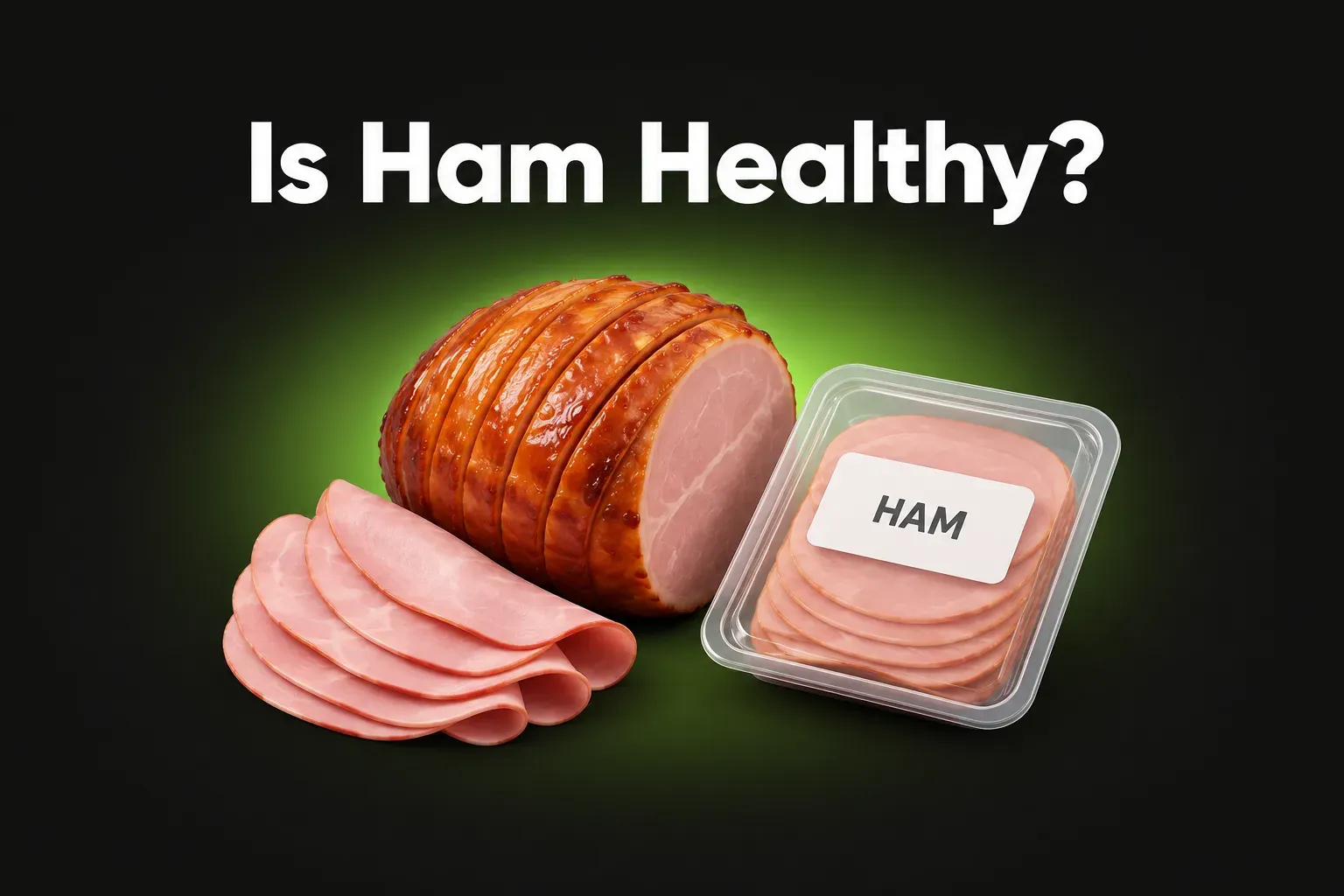
Ham is a lunchbox classic and the star of many holiday tables. But is ham healthy, or just another salty processed meat?
The short answer: ham is not a health food, but it’s fine now and then. Two ounces of deli ham give about 9–11 g of protein for only 60–70 calories. But they also have about 440–600 mg of sodium – up to a quarter of a day’s limit. Ham is cured, so it’s a processed meat. The WHO’s cancer agency says processed meat causes colorectal cancer. Honey and glazed hams add sugar, and “uncured” ham still contains nitrite from celery. Keep ham to a few times a week. Pick brands lower in sodium with a short ingredient list.
Ham nutrition per 2 oz
Two ounces (56 g) is the usual serving on deli packs – about 2–4 thin slices. Here are the numbers from the USDA food database.
| Ham type (2 oz / 56 g) | Calories | Protein | Fat | Sodium |
|---|---|---|---|---|
| Deli ham, regular | 92 | 9.3 g | 4.9 g | 456 mg |
| Deli ham, 96% fat-free, water added | 60 | 9.4 g | 2.3 g | 529 mg |
| Ham | 97 | 12.5 g | 5.1 g | 417 mg |
| Ham with natural juices | 89 | 12.8 g | 4.1 g | 470 mg |
| Ham, water added | 92 | 8.8 g | 6.0 g | 566 mg |
| Ham and water product | 83 | 7.7 g | 5.2 g | 616 mg |
| Fresh ham (not cured), roasted, lean | 118 | 16.5 g | 5.3 g | 36 mg |
Source: USDA FoodData Central – deli regular, deli 96% fat-free, ham, with natural juices, water added, ham and water product, fresh ham. The four label grades (ham to ham and water product) are unheated bone-in slices. Values per 100 g, converted to 2 oz.
What stands out:
- Protein: plain ham is a good source. But the more water a ham holds, the less protein you get.
- Sodium: every cured ham is salty. Fresh ham is the same pork leg without the cure. It has about one-twelfth of the sodium.
- Fat: ham is leaner than bacon, salami or SPAM.
The sodium problem
Sodium is the biggest issue with ham. Adults should eat less than 2,300 mg of sodium a day (FDA). A ham sandwich with 4 oz of ham already has about 900–1,200 mg – before you add bread, cheese or mustard.
In a study of what Americans eat, cold cuts and cured meats were the third-biggest source of sodium. Only pizza and bread gave more (Ahmed et al., Nutrients, 2023).
Why does it matter? Too much salt raises blood pressure. A big review pooled 34 trials with over 3,000 people. Eating about 4.4 g less salt a day for at least four weeks lowered blood pressure. It worked in people with and without high blood pressure (He et al., BMJ, 2013).
Sugar in honey and glazed hams
Plain ham has almost no sugar. Flavored hams do:
- Honey and maple deli hams usually have 2–3 g of sugar per 2 oz. That’s not much on its own.
- Spiral holiday hams are cured with sweeteners and often come with a glaze packet. Smithfield’s Hickory Smoked Spiral Sliced Ham lists 8 g of added sugar per 3 oz. Its glaze packet starts with high-fructose corn syrup and sugar (Smithfield).
The American Heart Association advises no more than 25 g of added sugar a day for women and 36 g for men (Johnson et al., Circulation, 2009). A big holiday plate with 6 oz of glazed ham can use up two-thirds of the women’s limit.
Nitrite vs “uncured” ham
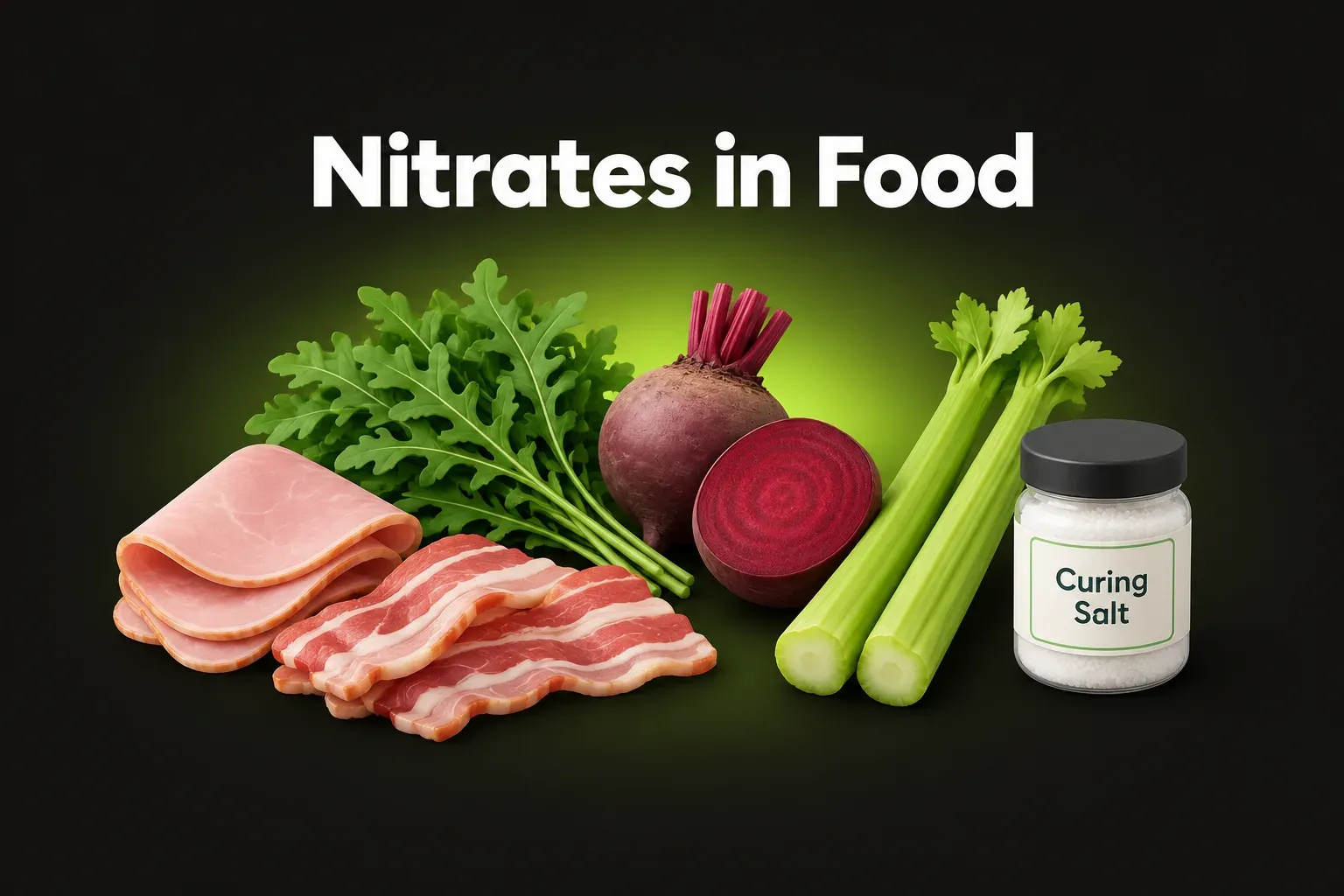
Cured ham is made with salt and sodium nitrite. Nitrite keeps ham pink, adds flavor and stops dangerous bacteria. The problem: nitrite can form nitrosamines. These are compounds that cause cancer in animals. They can form in your gut and when meat is cooked at high heat. Read more in our guide to nitrates in food.
“Uncured” ham uses celery powder or celery juice instead. But celery is naturally rich in nitrate, and bacteria turn it into nitrite. That’s the same substance. The label must say “no nitrates or nitrites added.” Most add “except those naturally occurring in celery powder.”
What animal studies show. A lab in Toulouse, France, has tested cured ham on rats many times. The rats first got a chemical that starts colon cancer.
- In one study, the rats ate test hams for 100 days. One ham was cooked, made with nitrite and stored open to the air. It caused more early signs of colon cancer than the same ham made without nitrite (Santarelli et al., Cancer Prevention Research, 2010).
- A later study compared hams made in different ways. The usual nitrite dose was 120 mg per kg of ham. Cutting it to 90 mg or removing it led to fewer early signs of colon cancer. One ham was made with vegetable stock, a natural source of nitrate like celery. It acted very much like regular nitrite ham (Guéraud et al., npj Science of Food, 2023).
In both studies, some authors worked for or got funding from the French pork industry.
What studies in people show. A French study followed over 100,000 adults for about 7 years. People who ate the most nitrite from additives had a 58% higher risk of prostate cancer than people who ate none. The link was mainly with sodium nitrite. Nitrite from natural sources, like vegetables and water, showed no cancer link (Chazelas et al., International Journal of Epidemiology, 2022). In the same group, people who ate more sodium nitrite had about a 50% higher risk of type 2 diabetes. They were compared with people who ate none. Here, nitrite from food and water was linked to diabetes too, but less strongly (Srour et al., PLOS Medicine, 2023).
Why do rat studies matter? Rats and mice share most of our genes and body processes. And feeding people a possible cancer cause for years would put their health at risk. The studies in people show links, not proof. But several labs keep seeing the same signal from nitrite-cured meat. So it makes sense to eat less cured ham, whether the label says “cured” or “uncured.”
Ham is a processed meat
In 2015, the WHO’s cancer agency (IARC) put processed meat in Group 1. That’s its “causes cancer in humans” group. Experts looked at over 800 studies. Eating 50 g of processed meat a day raised colorectal cancer risk by about 18%. That’s a bit less than one 2 oz serving of ham (Bouvard et al., Lancet Oncology, 2015).
Group 1 means the proof is strong, not that ham is as dangerous as smoking. One sandwich won’t give you cancer. But the risk adds up if you eat ham every day for years.
Heart health is a concern too. A review of 20 studies with over 1.2 million people looked at meat and health. Each 50 g of processed meat a day was linked to a 42% higher risk of heart disease. It was also linked to a 19% higher risk of type 2 diabetes. Fresh red meat didn’t show the same links (Micha et al., Circulation, 2010).
“Water added” and “ham and water product”
Ham is cured in a brine – salty water with nitrite and other ingredients. Some of that water stays in the meat. US rules set how much meat protein the lean part of the ham must keep. The less protein it keeps, the more the name must tell you (eCFR, 9 CFR 319.104):
- “Ham” – the most meat protein, the least added water.
- “Ham with natural juices” – a bit more water.
- “Ham, water added” – more water still.
- “Ham and water product” – the most water. The label must say what share of the weight is added ingredients.
The USDA table above shows the effect. Protein drops from 12.5 g to 7.7 g per 2 oz, and sodium rises from 417 to 616 mg. Oscar Mayer’s Chopped Ham & Water Product shows it well. Two slices (56 g) have 100 calories, 7 g of fat and only 6 g of protein. Its ingredients include corn syrup, modified food starch and several preservatives (Oscar Mayer).
Phosphates help ham hold water. Most hams list sodium phosphates. Your body absorbs most of the phosphate from additives. It absorbs much less of the natural phosphorus in food (Ritz et al., Deutsches Ärzteblatt International, 2012). A large US study followed about 9,700 healthy adults. Above 1,400 mg of phosphorus a day, the more people ate, the higher their risk of death (Chang et al., American Journal of Clinical Nutrition, 2014). This shows a link, not proof. People with kidney disease should avoid phosphate additives.
8 hams compared
All values are per 2 oz (56 g).
| Ham | Calories | Protein | Sugar | Sodium | Cured with | Phosphates |
|---|---|---|---|---|---|---|
| Applegate Naturals Applewood Smoked Ham | 60 | 11 g | 0 g | 440 mg | Celery powder | No |
| Oscar Mayer Deli Fresh Smoked Ham | 60 | 10 g | 2 g | 500 mg | Celery juice | Yes |
| Great Value Cooked Ham, Water Added | 60 | 10 g | 0 g | 540 mg | Sodium nitrite | Yes |
| Hillshire Farm Ultra Thin Honey Ham | 70 | 9 g | 3 g | 570 mg | Celery powder | Yes |
| Boar’s Head Maple Honey Ham (deli counter) | 60 | 10 g | 3 g | 570 mg | Not checked* | Not checked* |
| Smithfield Spirals Hickory Smoked Spiral Ham | about 100 | about 9 g | about 5 g | about 590 mg | Sodium nitrate** | Yes |
| Land O’Frost Premium Honey Ham | about 55 | about 9 g | about 2 g | about 600 mg | Sodium nitrite | Yes |
| Hormel Canned Ham | about 65 | about 9 g | about 1 g | about 700 mg | Sodium nitrite | Yes |
Sources: brand websites – Applegate, Oscar Mayer, Hillshire Farm, Smithfield, Land O’Frost, Hormel. Open Food Facts labels – Great Value, Boar’s Head. Smithfield and Hormel list 3 oz (84 g), Land O’Frost 50 g and Applegate 55 g; we converted them to 2 oz and rounded. *The Boar’s Head website could not be opened, and the deli label photo (2021) shows only the nutrition facts. **As written on Smithfield’s site; most cured hams use sodium nitrite.
What to notice:
- Applegate has the least sodium, no sugar and no phosphates. Its list is short: pork, pork broth, sea salt, celery powder, spice extracts and rosemary extract.
- Oscar Mayer Deli Fresh and Hillshire Farm use celery instead of sodium nitrite. They still add phosphates and sugar.
- Honey and maple hams add 2–3 g of sugar. The spiral ham adds more, and its glaze packet adds more still.
- Hormel’s canned ham is the saltiest. One 3 oz serving has 1,050 mg of sodium – almost half a day’s limit.
- Ham steaks are cured ham too. An older Smithfield ham steak label (2022) on Open Food Facts shows about 950 mg of sodium per 3 oz.
How to choose a healthier ham
- Read the sodium. Aim for under 450 mg per 2 oz. Compare “lower sodium” versions too.
- Check the name. “Ham” beats “ham with natural juices,” which beats “water added.” Skip “ham and water product.”
- Look for a short list. Pork, water, salt and spices is best. Skip hams with phosphates, corn syrup and starches.
- Go easy on honey and glazed hams. Use only half the glaze packet, or make your own with mustard and a little honey.
- Don’t count on “uncured.” It still has nitrite from celery. It’s only better if the rest of the label is too.
- Watch the portion. Two ounces is a serving. At holidays, fill half your plate with vegetables.
- Try fresh ham. Roasted fresh pork leg is not cured and has about 36 mg of sodium per 2 oz. Slice it thin for sandwiches. Home-roasted turkey or chicken works too.
Food safety: deli ham can carry Listeria, a germ that’s rare but dangerous. Pregnant women, people over 65 and people with weak immune systems should heat deli meats to 165 °F (74 °C) or until steaming hot (CDC).
Thinking about other cured meats? See is turkey bacon healthy? and our list of the healthiest hot dogs.
See what’s really in your ham. With NutriSmart, you photograph the label or scan the barcode. The app lists the sweeteners, preservatives and colors, explains the risks of each one and gives the product a health score out of 100. It also tells you right away if a ham is ultra-processed, and which ingredients make it so. Set an alert for sodium nitrite or phosphates, and the app warns you whenever a product you scan contains them.Get the app free
The bottom line
Ham gives you plenty of protein for few calories, but it’s salty and processed. Two ounces of deli ham have about 440–600 mg of sodium, and canned ham has even more. Honey and glazed hams add sugar. “Uncured” ham still has nitrite from celery, and all cured ham counts as processed meat linked to colorectal cancer. Enjoy ham a few times a week, not every day. Pick plain “ham” with less sodium, no phosphates and little sugar – or roast a fresh pork leg instead.
FAQ
Is ham healthy?
Ham is high in protein but very salty: 2 oz of deli ham often has 500–600 mg of sodium. It's also a processed meat linked to colorectal cancer. Enjoy it now and then, not every day.
How much sodium is in ham?
Most deli hams have about 440–600 mg of sodium per 2 oz (56 g). Canned ham can reach about 700 mg per 2 oz. That's a big share of the 2,300 mg daily limit for adults.
Is uncured ham healthier?
Not by much. "Uncured" ham is cured with celery powder, which is rich in nitrate that turns into nitrite – the same substance. The real plus of some uncured brands is a short ingredient list with no phosphates.
Is ham a processed meat?
Yes. Ham is cured with salt and nitrite (or celery powder), so it counts as processed meat. In 2015, the WHO's cancer agency put processed meat in Group 1, its "causes cancer" group, for colorectal cancer.
What does "ham, water added" mean?
It means the ham holds extra water from the curing brine, so it has less meat protein than plain "ham." "Ham and water product" has even less protein. Its label must say how much of its weight is added ingredients.
What is the healthiest ham to buy?
Pick ham with under 450 mg of sodium per 2 oz, little or no sugar and no phosphates. The word "ham" alone on the label is better than "water added" or "ham and water product." Fresh roasted pork leg, which is not cured, is the healthiest choice of all.