Is Turkey Bacon Healthy? Turkey vs Pork and 8 Brands
Is turkey bacon healthy? Calories, fat and sodium vs pork bacon, what mechanically separated turkey and "uncured" mean, and 8 brands compared.
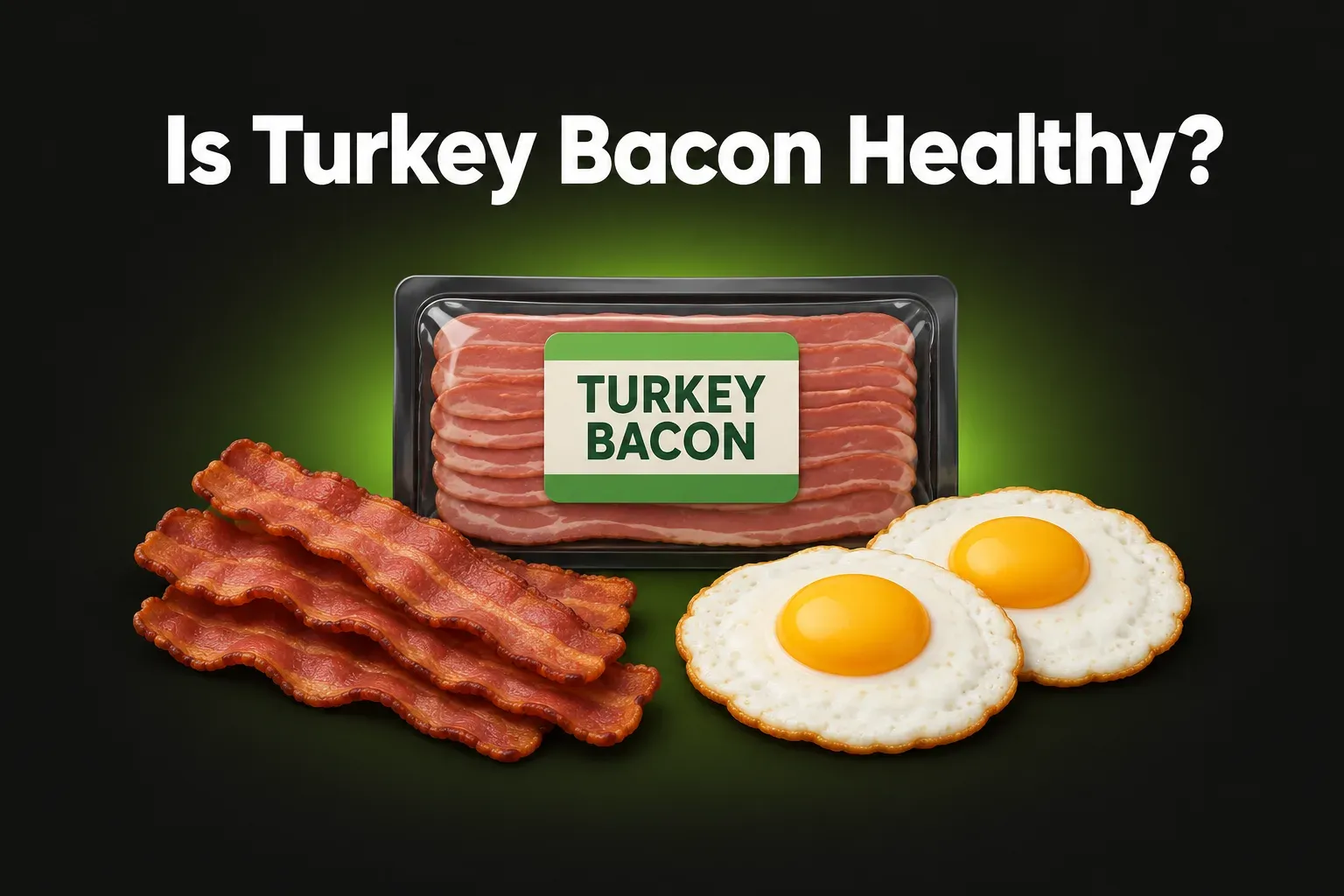
Turkey bacon looks like the smart swap at breakfast. It’s lighter, and it’s often sold as the healthier choice. But what’s really in those striped slices?
The short answer: turkey bacon is lighter than pork bacon, but it’s not a health food. A slice has about 30 calories and half the saturated fat of pork bacon. But it’s almost as salty. Some brands use mechanically separated turkey, and many add sodium nitrite and phosphates. It’s also still processed meat, which is linked to colorectal cancer. If you eat it, pick a brand made from whole turkey with a short ingredient list. And keep it to a few slices, a few times a week.
Turkey bacon vs pork bacon
Here is how one cooked slice of each compares. The numbers are from the USDA food database.
| Per slice (8 g, cooked) | Turkey bacon | Pork bacon |
|---|---|---|
| Calories | 30 | 44 |
| Fat | 2.1 g | 3.5 g |
| Saturated fat | 0.6 g | 1.2 g |
| Sodium | 164 mg | 177 mg |
| Protein | 2.4 g | 2.9 g |
| Sugar | 0.3 g | 0 g |
Source: USDA FoodData Central – turkey bacon, microwaved and pork bacon, baked. Values per 100 g, scaled to one 8.1 g slice and rounded.
What stands out:
- Calories: turkey bacon saves about 14 calories per slice. That’s about a third less. For more on pork bacon, see calories in bacon.
- Saturated fat: turkey bacon has about half as much. That’s its biggest plus. Saturated fat can raise “bad” LDL cholesterol.
- Sodium: almost the same. Three slices of either have about 500 mg. That’s more than a fifth of the 2,300 mg daily value on US labels.
- Protein: pork bacon has a bit more per slice. Neither one is a big protein source.
So turkey bacon is a lighter choice. It’s not a low-salt one.
What turkey bacon is made of
Pork bacon is a slice of real pork belly. Turkey bacon is different, because turkeys don’t have bacon. So makers chop turkey meat and add salt and flavor. Then they press it into a block and slice it. The stripes come from light and dark meat pressed together. Labels often call this “chopped and formed.”
Mechanically separated turkey
Some big brands, like Butterball and Jennie-O, list “mechanically separated turkey” first. This is a meat paste. Machines push turkey bones with bits of meat still on them through a sieve under high pressure. The result is a paste that feels like cake batter.
It’s legal in the US, and the label must name it clearly. US rules also limit how much bone it can contain (USDA final rule, Federal Register, 1995). It’s not dangerous. But it’s a sign of a cheaper, more processed product.
Other brands use turkey thighs or dark meat turkey instead. You can see the difference in the protein. Most of those slices have 5–6 g of protein for 45–50 calories. Thin slices made mostly from mechanically separated turkey have about 2 g for 30 calories.
Nitrite vs “uncured” celery powder
Most turkey bacon is cured with sodium nitrite. Nitrite keeps the meat pink and gives it the classic bacon flavor. It also stops dangerous bacteria from growing.
The problem: nitrite can form nitrosamines. These are compounds that cause cancer in animals. They can form in your gut and when meat is cooked at high heat. Read more in our guide to nitrates in food.
“Uncured” turkey bacon uses celery powder instead. But celery is naturally rich in nitrate, and bacteria turn it into nitrite. That’s the same substance. US labels have to add a line like “no nitrates or nitrites added except those naturally occurring in celery powder.”
Does it make a difference? A French lab tested this in rats. The rats ate ham made in different ways. Ham made with a vegetable stock (a natural source of nitrate) acted very much like ham with regular nitrite. Ham with less nitrite or none at all caused fewer early signs of colon cancer (Guéraud et al., npj Science of Food, 2023). Some of the authors work for a French pork industry institute.
So “uncured” doesn’t mean nitrite-free. The real upside of uncured brands is something else. They usually have fewer additives overall.
Phosphates, sugar and other additives
Sodium phosphate
Most nitrite-cured turkey bacons add sodium phosphate. It helps the meat hold water, so slices stay juicy. Your body absorbs almost all the phosphate from additives. It absorbs much less of the natural phosphorus in food (Ritz et al., Deutsches Ärzteblatt International, 2012).
Why does it matter? A Japanese team exposed rat blood vessels to extra phosphate. The vessels relaxed less than they should. Then 11 healthy men ate a meal with 1,200 mg of phosphorus. Two hours later, their arteries widened less. That’s an early sign of stress on blood vessels (Shuto et al., Journal of the American Society of Nephrology, 2009).
A large US study followed about 9,700 healthy adults. Above 1,400 mg of phosphorus a day, the more people ate, the higher their risk of death (Chang et al., American Journal of Clinical Nutrition, 2014). This shows a link, not proof. One slice of bacon adds only a little phosphate. But it adds up across a day of processed foods. People with kidney disease should avoid phosphate additives.
Sugar
Most brands add sugar, dextrose or cane sugar. The amount is small – 0 to 1 g per slice. It’s there for flavor and browning. It’s not a big concern.
Other additives
You’ll also see sodium erythorbate (a close cousin of vitamin C that helps the pink color form). Potassium lactate and sodium diacetate slow down bacteria. Many brands also add smoke flavor. Oscar Mayer lists soy lecithin, so it contains soy.
Is turkey bacon still processed meat?
Yes. In 2015, the World Health Organization’s cancer agency (IARC) said processed meat causes colorectal cancer. Its experts found that each 50 g of processed meat eaten a day raises the risk by about 18% (Bouvard et al., Lancet Oncology, 2015). That’s about 6 slices of cooked turkey bacon. Beef jerky is a processed meat too.
Does that apply to turkey? IARC’s own Q&A says most processed meats are made from pork or beef. But it adds that they “may also contain” poultry. IARC also says it didn’t judge the cancer risk of plain poultry or fish (IARC Q&A, 2015).
Other studies point the same way:
- A large US study followed more than 200,000 health workers for over 20 years. Men who ate the most ready-to-eat meat, poultry and seafood products had a 44% higher risk of colorectal cancer (Wang et al., BMJ, 2022).
- A French study followed about 101,000 adults. People who ate more nitrite from food additives had a higher risk of prostate cancer (Chazelas et al., International Journal of Epidemiology, 2022). The same team found more type 2 diabetes in people who ate more sodium nitrite (Srour et al., PLOS Medicine, 2023).
- In rats, cured meat made with nitrite and stored in air caused more early signs of colon cancer than the same meat without nitrite (Santarelli et al., Cancer Prevention Research, 2010). Two of the authors were paid by a French pork institute.
Why do rat studies matter? Rats and mice share most of our genes and body processes. And testing a possible cancer cause on people for years would put their health at risk. The studies in people show links, not proof. But labs in several countries keep seeing the same signal from nitrite-cured meat. So it makes sense to eat less of it, whether it’s pork or turkey.
8 turkey bacons compared
Here are 8 turkey bacons sold in the US, per slice as listed on the label. Slice sizes differ a lot, so look at the weight too.
| Product | Slice | Calories | Fat | Sat fat | Sodium | Protein |
|---|---|---|---|---|---|---|
| Butterball Original | 14 g | 30 | 2 g | 0.5 g | 140 mg | 2 g |
| Jennie-O Turkey Bacon | 15 g | 30 | 2.5 g | 0.5 g | 130 mg | 2 g |
| Oscar Mayer Original | 18 g | 45 | 3.5 g | 1 g | 220 mg | 3 g |
| Great Value Uncured (Walmart) | 24 g | 45 | 2.5 g | 1 g | 180 mg | 5 g |
| Godshall’s Original | 28 g | 50 | 2 g | 0.5 g | 220 mg | 6 g |
| Columbus Hickory Smoked | 28 g | 45 | 2 g | 0.5 g | 200 mg | 6 g |
| Wellshire Classic Uncured | 28 g | 45 | 2.5 g | 0.5 g | 200 mg | 6 g |
| Applegate Naturals Uncured | 15 g (cooked) | 30 | 1.5 g | 0 g | 150 mg | 5 g |
Sources: brand sites for Jennie-O, Oscar Mayer, Godshall’s, Wellshire and Applegate; Hormel SmartLabel for Columbus; label photos on Open Food Facts for Butterball and Great Value, checked November 2026. Recipes change – always check the pack.
And here is what each one is made of:
| Product | Meat | Cured with | Phosphate |
|---|---|---|---|
| Butterball Original | Mechanically separated turkey, turkey | Sodium nitrite | Yes |
| Jennie‑O Turkey Bacon | Mechanically separated turkey, turkey | Sodium nitrite | Yes |
| Oscar Mayer Original | Turkey | Sodium nitrite | Yes |
| Great Value Uncured (Walmart) | Dark meat turkey | Celery powder | No |
| Godshall’s Original | Turkey thigh, turkey | Sodium nitrite | Yes |
| Columbus Hickory Smoked | Dark meat turkey | Celery powder | No |
| Wellshire Classic Uncured | Dark meat turkey | Celery powder | No |
| Applegate Naturals Uncured | Turkey | Celery powder | No |
Sources: the same labels as the table above.
What to notice:
- Thin slices from Butterball and Jennie-O have the fewest calories: 30 per slice. But both list mechanically separated turkey first, and both add nitrite and phosphate.
- Oscar Mayer is made from turkey, not the paste. But its 18 g slice has 220 mg of sodium. That’s as much as Godshall’s slice, which is much thicker.
- Thick slices (24–28 g) from Great Value Uncured, Godshall’s, Columbus and Wellshire have 45–50 calories and 180–220 mg of sodium. But they’re made from whole thigh or dark meat and give 5–6 g of protein.
- Applegate has the shortest list: turkey, water, sea salt, celery powder, onion powder and spices. It also has 0 g of saturated fat and 5 g of protein for 30 calories.
Best picks and how to choose
Our picks:
- Applegate Naturals Uncured – the shortest list, the most protein per calorie, and no phosphates.
- Wellshire Classic Uncured, Columbus Hickory Smoked or Great Value Uncured – dark meat turkey, no phosphates and 5–6 g of protein per slice. Watch the sodium: 180–200 mg per slice.
- Godshall’s Original – whole turkey thigh, but cured with sodium nitrite and phosphate.
How to pick at the store:
- Read the first ingredient. Choose “turkey,” “turkey thigh” or “dark meat turkey” over “mechanically separated turkey.”
- Skip phosphates if you can. Look for “sodium phosphate” in the list.
- Don’t trust “uncured” alone. It still has nitrite from celery. But it does usually mean fewer other additives.
- Check the sodium per slice. Aim for about 150 mg or less for a thin slice.
- Keep the portion small. Have two or three slices as a side, and not every day. Get the rest of your protein from eggs, Greek yogurt or other high-protein breakfast foods.
Want a sandwich instead? See our guide to the healthiest deli meat. Hot dogs have the same problems as turkey bacon – here are the healthiest hot dogs.
See what’s really in your turkey bacon. With NutriSmart, you photograph the label or scan the barcode. The app lists the sweeteners, preservatives and colors, explains the risks of each one and gives the product a health score out of 100. It also tells you right away if a turkey bacon is ultra-processed, and which ingredients make it so. Set an alert for sodium nitrite or sodium phosphate, and the app warns you whenever a pack you scan contains it.Get the app free
The bottom line
Turkey bacon is lighter than pork bacon. A thin slice has about 30 calories and half the saturated fat. But it’s almost as salty. Some brands are made mostly from mechanically separated turkey, and many add sodium nitrite and phosphates. “Uncured” brands still contain nitrite from celery powder. Like all processed meat, turkey bacon is linked to colorectal cancer. So treat it as a small side, a few times a week. Pick a brand made from whole turkey with a short ingredient list, like Applegate, Wellshire, Columbus or Great Value Uncured.
FAQ
Is turkey bacon healthy?
It's lighter than pork bacon, but it's not a health food. A slice has about 30 calories and half the saturated fat of pork bacon. But it's almost as salty, and it still counts as processed meat.
Is turkey bacon healthier than regular bacon?
A little. Per slice, it has about 14 fewer calories and about half the saturated fat. Sodium is almost the same, and both are processed meats linked to colorectal cancer.
Is uncured turkey bacon better?
Not by much. "Uncured" turkey bacon is cured with celery powder, which turns into nitrite – the same substance as in regular bacon. But uncured brands often have shorter ingredient lists with no phosphates.
What is mechanically separated turkey?
It's a meat paste made by pushing turkey bones with bits of meat through a sieve under high pressure. It's legal and must be named on the label. Some big brands, like Butterball and Jennie-O, list it first.
How many calories are in a slice of turkey bacon?
About 30 calories for a thin slice, based on USDA data. Thick slices from brands like Godshall's, Wellshire and Columbus have 45–50 calories, but also about 6 g of protein.
Is turkey bacon good for weight loss?
It can help, because it saves calories compared with pork bacon. Two thin slices have about 60 calories. But it's salty, so keep it as a side, not the main protein of your breakfast.