Is Ramen Bad for You? Ingredients, Sodium and 9 Brands
Is ramen bad for you? Ramen ingredients, sodium, fried noodles, TBHQ and MSG, 9 instant brands compared and how to make it healthier.
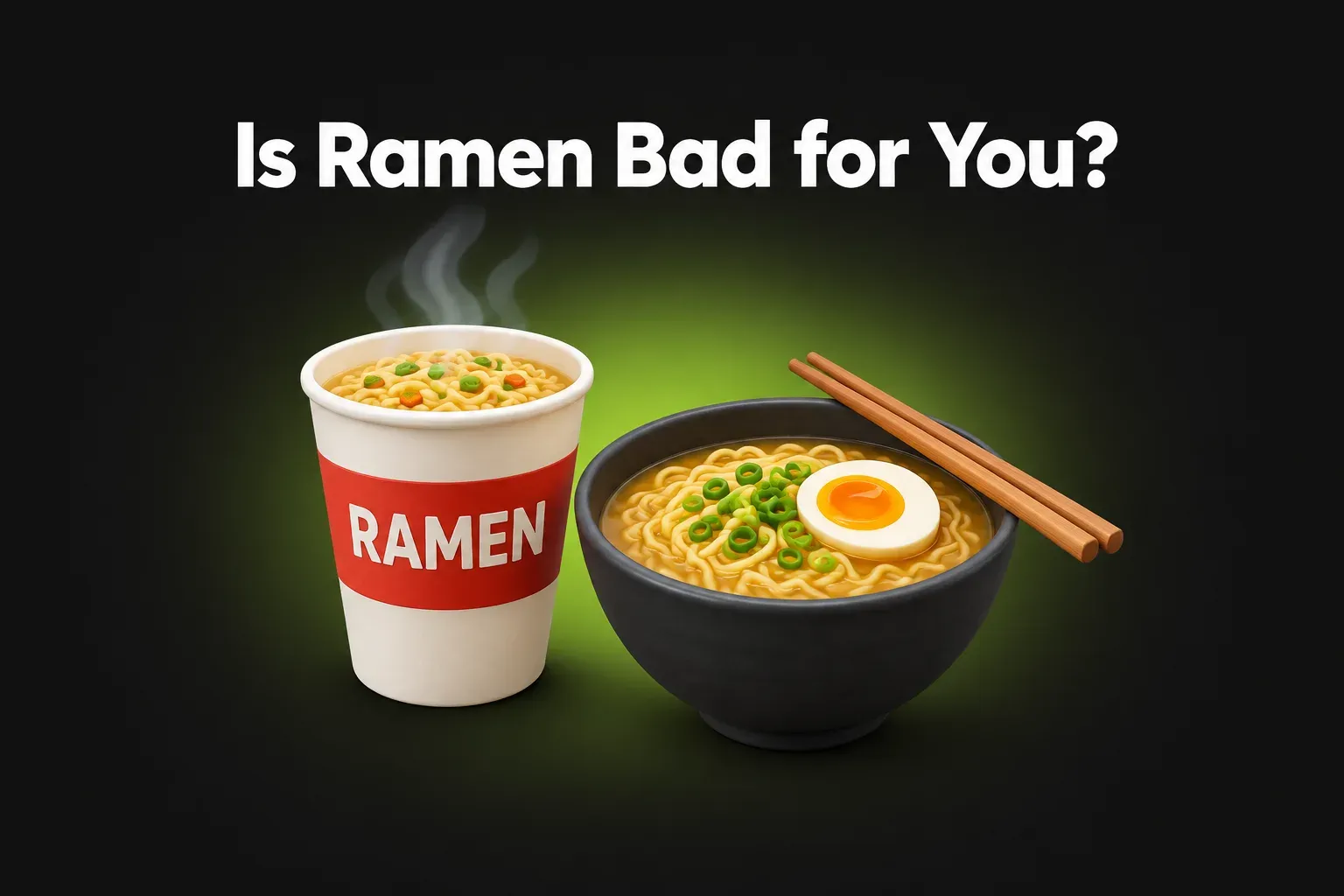
Instant ramen is cheap, fast and comforting. It’s ready in about three minutes. But is ramen bad for you?
The short answer: one pack now and then won’t hurt a healthy person. The problem is what’s inside – and how often you eat it. A pack of instant ramen has about 1,100–1,800 mg of sodium. That’s half to three-quarters of a whole day’s limit. The noodles are usually fried in palm oil, and many brands add the preservative TBHQ. There is little protein or fiber. Studies in Korea link eating instant noodles two or more times a week to heart and blood sugar risks. You can make it much better with half the seasoning, an egg and vegetables.
Ramen ingredients: what’s in a pack of instant ramen
Let’s start with one of the best-known packs in the US: Maruchan Ramen Chicken Flavor (3 oz / 85 g). Here are the numbers for the whole pack:
| Per pack (3 oz / 85 g) | Amount |
|---|---|
| Calories | 380 |
| Fat | 14 g |
| Saturated fat | 7 g |
| Sodium | 1,520 mg |
| Carbohydrates | 54 g |
| Fiber | 2 g |
| Protein | 8 g |
Source: Maruchan. The label lists half a pack as one serving (190 calories, 760 mg sodium). We doubled it, since most people eat the whole pack.
Here is the ingredient list from the Maruchan Ramen Chicken label, in order. Ingredients come in order of weight, so the first ones make up most of the pack.
Noodles:
- Enriched wheat flour – white flour with iron and some B vitamins (niacin, thiamine, riboflavin, folic acid) added.
- Vegetable oil (canola, cottonseed or palm) – the fat in the noodles. It can be any of these three oils (canola oil, palm oil).
- TBHQ – a preservative that keeps the oil from going stale.
- Salt – adds flavor to the dough. Salt and everything after it are each less than 1% of the noodles.
- Potassium carbonate – an alkaline salt. It makes ramen noodles springy and gives them their yellow tint.
- Soy sauce (water, wheat, soybeans, salt) – a small amount for flavor.
- Sodium carbonate – another alkaline salt with the same job.
- Sodium hexametaphosphate, sodium tripolyphosphate and monosodium phosphate – phosphate salts that help the noodles hold water and keep their texture.
Seasoning packet (soup base):
- Salt – the first ingredient, so there is more salt than anything else.
- Sugar – softens the salty taste. The rest of the packet is less than 1% each.
- MSG (monosodium glutamate) – adds a savory, meaty taste.
- Maltodextrin – a starch powder that carries the flavors.
- Spices (celery seed) – for flavor.
- Hydrolyzed corn, wheat and soy protein – proteins broken into small pieces. They taste savory, like broth.
- Turmeric, natural flavors and dried chive, garlic and onion – for taste. Turmeric also adds a yellow color.
- Disodium guanylate, disodium inosinate and yeast extract – flavor boosters. The first two work with MSG to make it taste stronger.
- Palm oil, lactose and powdered cooked chicken – small amounts. Lactose is milk sugar. The chicken is the last item on the list.
The pack contains wheat, soy and milk.
Source: Maruchan Ramen Chicken Flavor label, checked November 2026.
What does that mean?
- Refined flour. The bran is removed, so there’s little fiber. That’s why ramen doesn’t keep you full for long. Whole wheat or bean pasta has more fiber – see the healthiest pasta.
- Fried noodles. Frying dries the noodles so they keep for months. It also adds most of the fat.
- Salt first. Salt is the main ingredient in the seasoning packet.
- Flavor boosters. MSG, disodium inosinate, disodium guanylate, yeast extract and hydrolyzed protein all add a savory, meaty taste.
- TBHQ. This preservative keeps the oil from going stale.
This mix of refined flour, oil, salt and additives is a classic example of an ultra-processed food.
9 instant ramens compared
Here are nine popular instant noodles sold in the US, per full package. Sodium is also shown as a share of the 2,300 mg daily limit. Labels were checked in November 2026.
| Ramen (whole package) | Calories | Fat (saturated) | Sodium | Protein | TBHQ | Added MSG |
|---|---|---|---|---|---|---|
| Maruchan Ramen Chicken (3 oz) | 380 | 14 g (7 g) | 1,520 mg (66%) | 8 g | Yes | Yes |
| Maruchan Ramen Chicken 25% Less Sodium (3 oz) | 380 | 14 g (7 g) | 1,120 mg (49%) | 8 g | Yes | No |
| Nissin Top Ramen Chicken (3 oz) | 380 | 14 g (7 g) | 1,590 mg (69%) | 9 g | Yes | No |
| Maruchan Instant Lunch Chicken (2.25 oz cup) | 290 | 12 g (6 g) | 1,150 mg (50%) | 6 g | Yes | Yes |
| Nissin Cup Noodles Chicken (2.25 oz cup) | 290 | 11 g (5 g) | 1,160 mg (50%) | 6 g | Yes | No |
| Nissin Cup Noodles Protein Chicken (2.5 oz cup) | 320 | 12 g (6 g) | 1,480 mg (64%) | 16 g | Yes | No |
| Nongshim Shin Ramyun (4.2 oz) | 520 | 16 g (8 g) | 1,620 mg (70%) | 11 g | No | Yes |
| Nongshim Shin Ramyun Light (3.4 oz, air-dried) | 340 | 2.5 g (0.5 g) | 1,800 mg (78%) | 9 g | No | No |
| Samyang Buldak Hot Chicken (4.9 oz) | 560 | 18 g (7 g) | 1,630 mg (71%) | 14 g | No | Yes |
Sources: brand websites – Maruchan (25% Less Sodium, Instant Lunch), Nissin (Top Ramen, Cup Noodles, Cup Noodles Protein) and Nongshim (Shin Ramyun, Shin Light). Buldak: Samyang America. Maruchan bag labels show half a pack; we doubled them. “Added MSG” means monosodium glutamate in the ingredient list.
What stands out:
- Every one has more than 1,100 mg of sodium. Even the “25% less sodium” pack has 1,120 mg.
- Less fat doesn’t mean less salt. Shin Ramyun Light uses air-dried noodles, so it has only 2.5 g of fat. But it has the most sodium in the table.
- Cup Noodles Protein has 16 g of protein – twice the regular cup. It also has 1,480 mg of sodium.
- “No added MSG” is on Top Ramen and Cup Noodles. But they still use other flavor boosters, like disodium guanylate, disodium inosinate and yeast extract. Buldak’s hot pepper seasoning does list MSG.
- Shin Ramyun and Buldak use tocopherols (a form of vitamin E) to keep the oil fresh, not TBHQ.
Want calories for other sizes and restaurant bowls? See our guide to calories in ramen.
The biggest problem: sodium
The FDA says adults should eat less than 2,300 mg of sodium a day. The average American already eats about 3,400 mg (FDA). One pack of ramen can give you two-thirds of the limit before you eat anything else.
Too much sodium raises your blood pressure. High blood pressure strains your heart and blood vessels. Here is what research shows:
- Less salt, lower blood pressure. A review pooled 34 trials with 3,230 people. People cut their salt by about 4.4 g a day. That’s about 1,700 mg of sodium – roughly one pack of ramen. After four weeks or more, their top blood pressure number fell by about 4 points. The drop was bigger in people with high blood pressure (He et al., BMJ, 2013).
- Less sodium, fewer strokes. A large trial took place in 600 villages in rural China. It included 20,995 older people with high blood pressure or a past stroke. Half the villages swapped regular salt for a salt with less sodium. Over about five years, they had 14% fewer strokes and fewer deaths (Neal et al., New England Journal of Medicine, 2021).
- Salt and stomach cancer. A review pooled seven studies with almost 270,000 people. People who ate a lot of salt had a 68% higher risk of stomach cancer than those who ate little (D’Elia et al., Clinical Nutrition, 2012).
What studies say about eating instant noodles
Two studies from South Korea looked at instant noodles directly. At the time, Koreans ate more instant noodles per person than people in any other country.
- Korean adults. Researchers studied 10,711 adults aged 19 to 64. Women who ate instant noodles two or more times a week had 68% higher odds of metabolic syndrome. That’s a group of problems that raise the risk of heart disease and diabetes. They include a large waist, high blood pressure, high blood sugar and high blood fats. The link held even after the researchers looked at the rest of the diet. It was not seen in men (Shin et al., Journal of Nutrition, 2014).
- College students. A second study looked at 3,397 students in Seoul, aged 18 to 29. Some ate instant noodles three or more times a week. They had about 2.6 times the odds of high triglycerides (a type of blood fat). The comparison group ate them once a month or less. Female students who ate more noodles also had higher diastolic blood pressure (the bottom number) (Huh et al., Nutrition Research and Practice, 2017).
These studies took a snapshot at one point in time. So they show a link, not proof that noodles cause the problems. But the results match what we know about salt, refined flour and saturated fat.
Fried noodles and palm oil
Most instant noodles are fried. Most brands in our table use palm oil, at least in part. Palm oil is high in saturated fat. A pack of Maruchan or Top Ramen has about 7 g of saturated fat – about a third of the daily value (20 g).
A review pooled clinical trials on palm oil. Compared with oils low in saturated fat, palm oil raised LDL (“bad”) cholesterol by about 9 mg/dL (Sun et al., Journal of Nutrition, 2015). High LDL builds up in blood vessels over time.
Air-dried noodles skip the frying. That’s why Shin Ramyun Light has only 2.5 g of fat. Look for “non-fried” or “air-dried” on the pack.
TBHQ and MSG
TBHQ (tert-butylhydroquinone) is a lab-made preservative. In the US, it can make up no more than 0.02% of the fat in a food. In the EU, the safe daily limit is 0.7 mg per kg of body weight. But independent studies raise questions:
- Immune cells. Scientists at Michigan State University put mouse immune cells in a dish with TBHQ. The cells that kill viruses and cancer cells (NK cells) worked less well (Boss et al., Food and Chemical Toxicology, 2018).
- Food allergies. The same lab fed mice TBHQ at 0.0014% of their food. That’s the normal amount in lab mouse feed. The authors say it’s the same as or less than in many human foods. Then the mice got an egg protein. They made more allergy antibodies and had worse allergic reactions (Jin et al., Frontiers in Immunology, 2024).
Why do mouse studies matter? Mice share most of our genes and body processes. And testing whether a preservative causes allergies in people would put their health at risk. Proof in humans is still missing. But several studies point the same way. So it makes sense to limit TBHQ as a precaution.
MSG (monosodium glutamate) adds a savory taste. The European Food Safety Authority set a safe daily limit of 30 mg per kg of body weight (EFSA, 2017). One careful trial tested people who thought they reacted to MSG. A large dose (5 g) on an empty stomach caused more symptoms than a dummy dose (placebo) in some of them. But the symptoms were not serious, and they often didn’t come back when people were tested again (Geha et al., Journal of Allergy and Clinical Immunology, 2000). A review of animal studies found that MSG damaged nerve cells and hurt short-term memory in mice. High doses also lowered serotonin, a chemical messenger in the brain (Ankul et al., Frontiers in Pharmacology, 2023). There’s no proof of this in people. Still, cutting back on salty, MSG-rich foods like instant noodles is a sensible precaution.
Restaurant ramen vs instant ramen
Restaurant ramen is a different meal. The noodles are fresh, not fried. Most bowls come with pork, chicken, egg and vegetables. But the broth is very salty, and rich tonkotsu (pork bone) broth is fatty too.
| Ramen | Calories | Sodium | Protein |
|---|---|---|---|
| Instant pack, Maruchan Chicken (3 oz) | 380 | 1,520 mg | 8 g |
| Instant cup, Cup Noodles Chicken (2.25 oz) | 290 | 1,160 mg | 6 g |
| Ramen bowl with toppings, USDA average (per 100 g) | 127 | 333 mg | 7.1 g |
| Large restaurant bowl (about 21 oz / 600 g) | about 760 | about 2,000 mg | about 43 g |
Sources: Maruchan, Nissin and USDA FoodData Central (“Ramen bowl”). The 600 g bowl is our estimate from the USDA values per 100 g.
So a restaurant bowl gives you far more protein, plus meat, egg and vegetables. But it can have even more sodium than a pack. A simple trick helps: eat the noodles and toppings, and leave some of the broth. Much of the salt is in the broth. The same is true for pho.
How to make ramen healthier
You don’t have to give up ramen. A few small changes make a big difference:
- Use half the seasoning packet, or less. Salt is the first ingredient in the packet. Add garlic, ginger, chili flakes or a squeeze of lime instead.
- Pick a lower-sodium version. Maruchan’s 25% Less Sodium pack has 400 mg less sodium than the regular one.
- Add protein. A large egg adds about 6 g of protein (USDA). Tofu, leftover chicken or edamame work too. Salty toppings like SPAM add even more sodium. See more high-protein foods.
- Add vegetables. Toss in frozen peas, spinach, bok choy, mushrooms or green onion. They add fiber and help you feel full.
- Try air-dried noodles. They have much less fat. But check the sodium – it can still be high. For other types, see the healthiest noodles.
- Don’t drink all the broth. Much of the sodium stays in the bowl.
- Keep it occasional. The Korean studies saw risks at two or more times a week. For cheap meals with more nutrients, see our cheap healthy meals.
Check your ramen before you buy. With NutriSmart, you photograph the label or scan the barcode. The app lists the sweeteners, preservatives and colors, explains the risks of each one and gives the product a health score out of 100. It also tells you right away if a ramen pack is ultra-processed, and which ingredients make it so. Set an alert for TBHQ or MSG, and the app warns you whenever a product you scan contains it.Get the app free
The bottom line
Ramen isn’t poison, and one pack now and then is fine for most people. But instant ramen is mostly refined flour, fried fat and salt. A single pack has about 1,100–1,800 mg of sodium, and many brands add TBHQ and MSG. Eating it two or more times a week has been linked to heart and blood sugar risks. Restaurant ramen has more protein but often just as much salt. If you love ramen, use half the seasoning, add an egg and vegetables, and keep it to a treat.
FAQ
Is ramen bad for you?
Once in a while, it's fine for most healthy people. But a pack of instant ramen has about 1,100–1,800 mg of sodium and little protein or fiber. Eating it two or more times a week has been linked to heart and blood sugar risks.
What are the ingredients in instant ramen?
In Maruchan Ramen Chicken, the noodles are enriched wheat flour and vegetable oil with the preservative TBHQ. They also have a little salt, soy sauce, carbonates and phosphates. The seasoning packet is mostly salt and sugar, plus MSG, maltodextrin, flavor boosters, spices and a bit of powdered chicken.
How much sodium is in a pack of ramen?
A 3 oz pack of Maruchan or Top Ramen Chicken has about 1,500–1,600 mg of sodium. That's about two-thirds of the 2,300 mg daily limit. A cup has about 1,150 mg.
Is restaurant ramen healthier than instant ramen?
In some ways. The noodles aren't fried, and meat and eggs add a lot more protein. But a large restaurant bowl can have about 2,000 mg of sodium and 760 calories, so it's not a light meal.
Why are instant noodles fried?
Frying dries the noodles fast, so they keep for months and cook in minutes. Most brands fry them in palm oil. So a pack or cup has about 5–8 g of saturated fat. Air-dried noodles have much less fat.
Is the TBHQ in ramen safe?
The FDA allows up to 0.02% of the fat in a food. But mouse studies found it can weaken immune cells and make food allergies worse. Proof in people is missing, so it's worth limiting.
How can I make instant ramen healthier?
Use half the seasoning packet or less. Add an egg, tofu or chicken for protein, plus a big handful of vegetables. Pick a lower-sodium version when you can.