Healthiest Pasta: 7 Types Compared by Protein and Fiber
What is the healthiest pasta? Regular, whole wheat, chickpea, lentil, edamame, protein and gluten-free pasta compared, plus portions and sauces.
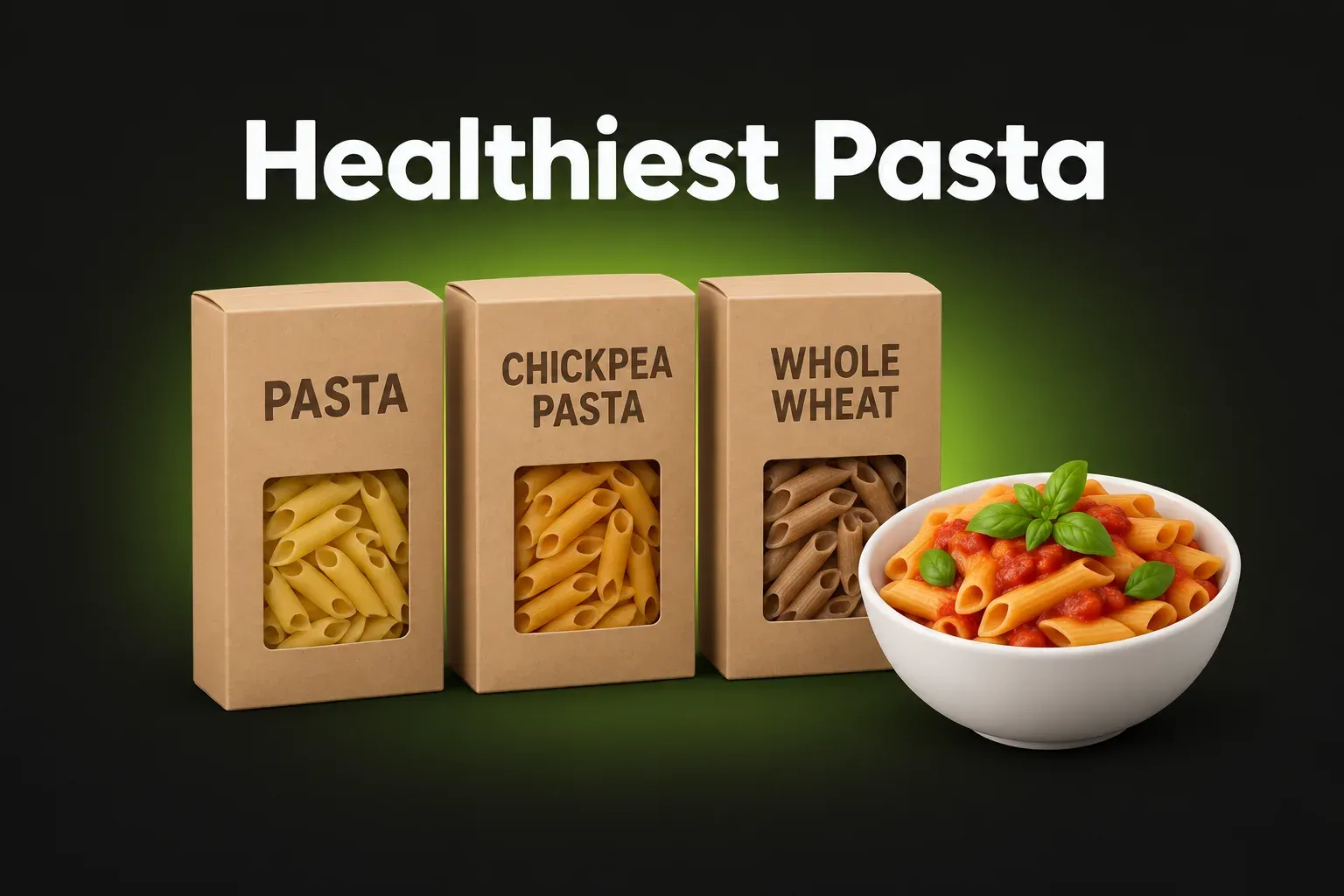
Pasta used to mean one thing: a box of plain wheat noodles. Now the shelf has whole wheat, chickpea, lentil, edamame, protein and gluten-free pasta. So which one is the healthiest pasta?
The short answer: for most people, the healthiest picks are whole wheat pasta and bean pastas made from chickpeas, lentils or edamame. Like regular pasta, they have about 180–200 calories per 2 oz (56 g) of dry pasta. But they give you more fiber and protein. Edamame pasta has the most protein by far, about 24 g. Regular pasta is fine too, in a normal portion. Gluten-free corn and rice pasta is the weakest pick, unless you need to avoid gluten. The portion and the sauce often matter more than the type of noodle.
Pasta types compared per serving
All numbers are for one serving: 2 oz (56 g) of dry pasta. “Net carbs” means total carbs minus fiber. It is a rough guide to the starch your body digests.
| Pasta (2 oz dry) | Made from | Calories | Protein | Fiber | Net carbs |
|---|---|---|---|---|---|
| Barilla Classic Penne | Wheat (semolina) | 200 | 7 g | 3 g | 39 g |
| Barilla Whole Grain Penne | Whole grain wheat | 180 | 8 g | 7 g | 32 g |
| Barilla Protein+ Penne | Wheat, lentil, pea protein, chickpea | 190 | 10 g | 5 g | 33 g |
| Banza Chickpea Penne | Chickpeas, pea starch | 190 | 11 g | 5 g* | 29 g |
| Barilla Red Lentil Penne | Red lentil flour | 190 | 14 g | 6 g | 28 g |
| Explore Cuisine Edamame Spaghetti | Organic edamame flour | 180 | 24 g | 13 g | 7 g |
| Barilla Gluten Free Penne | Corn and rice flour | 190 | 4 g | 2 g | 42 g |
Source: US nutrition labels via Open Food Facts – Barilla Classic Penne, Whole Grain Penne, Protein+ Penne, Banza Chickpea Penne, Red Lentil Penne, Explore Cuisine Edamame Spaghetti, Barilla Gluten Free Penne. Net carbs = total carbs minus fiber. *A recent Banza label lists 5 g of fiber, but some boxes list 7 g. Labels change, so check the box you buy.
What stands out:
- Calories barely change. Every pasta here has 180–200 calories per serving.
- Protein goes up with beans. Regular pasta has 7 g. Chickpea pasta has 11 g, red lentil pasta 14 g and edamame pasta 24 g.
- Fiber goes up too. Whole wheat and bean pastas have 5–13 g of fiber. Regular pasta has 3 g.
- Gluten-free corn and rice pasta has the least protein and fiber.
Regular pasta: not as bad as its reputation
Regular pasta is made from durum wheat semolina and water. In the US, it is also enriched with B vitamins and iron. It has little fiber, but it is not a “junk” food.
Pasta raises blood sugar less than you might expect. Scientists measure this with the glycemic index (GI). It is a 0–100 scale of how fast a food raises blood sugar. Pure glucose is 100. Foods at 55 or below count as low.
In the international GI tables, white spaghetti scored 49. White bread scored 75 and boiled white rice 73 (Atkinson et al., Diabetes Care, 2008). So pasta is a low-GI food, unlike most bread and rice. Even sourdough isn’t clearly better for blood sugar than regular bread. See our list of low glycemic index foods for more.
Why? Pasta dough is pressed into a dense shape, so its starch digests more slowly. A Swedish study compared pasta with bread made from the same ingredients. The pasta gave lower peaks in blood sugar and insulin (Granfeldt et al., European Journal of Clinical Nutrition, 1991).
What about weight? A review pooled 32 trial comparisons with 2,448 adults. In these trials, pasta was part of a low-GI eating plan. It did not lead to weight gain. People actually lost about 1.4 lb (0.6 kg) more than on higher-GI diets (Chiavaroli et al., BMJ Open, 2018). The weight loss was small. Also, some of the authors had received funding from food companies, including Barilla.
Whole wheat pasta: the easy upgrade
Whole wheat pasta keeps the whole grain, including the bran (the outer layer). That is where most of the fiber is. Barilla Whole Grain Penne has 7 g of fiber per serving, versus 3 g in the classic penne. It also has 20 fewer calories.
Its GI is about the same as white pasta. Whole wheat spaghetti scored 48 in the GI tables (Atkinson et al., Diabetes Care, 2008). The real gain is the fiber. Most Americans don’t get enough. Our list of high fiber foods shows how much you need each day.
Bean pasta: chickpea, lentil and edamame
Bean pastas are made from legume flour – ground chickpeas, lentils, peas or soybeans. They are the clear winners for protein and fiber.
- Banza Chickpea Penne: 11 g of protein and 5 g of fiber. It is made from chickpeas, pea starch, tapioca and xanthan gum (a thickener).
- Barilla Red Lentil Penne: 14 g of protein and 6 g of fiber. Its only ingredient is red lentil flour.
- Explore Cuisine Edamame Spaghetti: about 24 g of protein and 13 g of fiber, with only 7 g of net carbs. Its only ingredient is organic edamame flour.
Bean pastas also tend to raise blood sugar less. In an Italian study, pastas made from 100% legume flour had a GI of about 20–23. Regular wheat pasta scored about 53 in the same test (Turco et al., Food & Function, 2019).
One catch: flour is not the same as whole beans. An Iowa State study tested 19 adults with type 2 diabetes or metabolic syndrome (a mix of risk factors for diabetes and heart disease). Whole peas and lentils raised blood sugar less than the same amount eaten as flour (Winham et al., Foods, 2025). So bean pasta is a good step, but a bowl of whole lentils is even better.
Two tips:
- Go slow. More fiber can cause gas or bloating at first. Start with a smaller portion, or mix it with regular pasta.
- Check for allergies. Edamame pasta is made from soy. Chickpea and lentil pastas may not suit people with legume allergies.
For more high-protein options, see our guides to high protein foods and plant-based protein.
Protein pasta and veggie pasta
Protein pasta like Barilla Protein+ mixes wheat with lentil flour, pea protein and chickpea flour. It has 10 g of protein and 5 g of fiber per serving. It tastes much like regular pasta, so it’s a good middle step.
Veggie pasta is still mostly wheat. Barilla’s veggie penne lists wheat semolina first, then tomato and carrot puree (Open Food Facts). Real vegetables on top of your pasta add far more fiber.
Gluten-free pasta: only if you need it
Gluten-free pasta is a must for people with celiac disease. For everyone else, it is not healthier. Barilla Gluten Free Penne is made from corn and rice flour. It has 4 g of protein and 2 g of fiber – the lowest in our table. In the GI tables, rice noodles scored a GI of 53, a bit higher than white spaghetti (Atkinson et al., Diabetes Care, 2008).
If you avoid gluten, chickpea, lentil and edamame pastas are better picks. They are naturally gluten-free.
Barilla Gluten Free Penne also lists mono- and diglycerides on its label. This emulsifier helps the pasta hold its shape. Regulators allow it. But independent research has raised questions:
- In a French study of 92,000 adults, people who ate the most mono- and diglycerides had a 15% higher risk of cancer overall. This type of study shows a link, not proof (Sellem et al., PLOS Medicine, 2024).
- In a study from Taiwan, mice ate food where the oil was swapped for mono- and diglycerides. The emulsifier made up 5.5% of their food for 14 weeks. Their blood fat and blood sugar got worse. Gut bacteria also tended to move into the gut’s protective mucus layer (Panyod et al., Communications Biology, 2024). That dose is likely far higher than what you get from a bowl of pasta.
Why do animal studies matter? Mice share most of our genes and body processes. Testing an additive on people for years would put their health at risk. Proof of harm in people is still missing. But two research teams saw warning signs, and the emulsifier is easy to avoid. So it makes sense to limit it as a precaution. Bean pastas like Banza, Barilla Red Lentil and Explore Cuisine Edamame don’t use it.
Al dente and cooled pasta: does it matter?
You often hear that al dente pasta (cooked so it is still firm) raises blood sugar less. The proof for this is thin. In a French study, 12 healthy adults ate pasta boiled for 11, 16.5 or 22 minutes. Blood sugar and insulin were about the same each time (Bornet et al., American Journal of Clinical Nutrition, 1990). So cook pasta the way you like it.
Cooling pasta looks more helpful. When cooked starch cools, some of it turns into resistant starch. This starch resists digestion and acts more like fiber.
- Type 1 diabetes: 32 adults who use insulin pumps ate freshly cooked pasta or pasta cooled in the fridge for 24 hours and then reheated. Cooling raised the resistant starch by about 60%. Blood sugar rose about 50 mg/dL after the cooled pasta, versus about 85 mg/dL after fresh pasta. Low blood sugar episodes did not go up (Rogowicz-Frontczak et al., Nutrients, 2026).
- Chickpea pasta: in 12 healthy adults, cooling and reheating doubled the resistant starch. The GI dropped from 39 to 33 (Bojarczuk et al., Metabolites, 2024).
- Hot, cold or reheated: a UK study found that reheated pasta caused a slightly smaller blood sugar rise than fresh hot pasta. Blood sugar also went back to normal faster (Hodges et al., Foods, 2019).
These studies are small, and cooling does not remove calories. Still, cooking pasta ahead, chilling it and reheating it is an easy trick to try.
Portion size: the biggest factor
One serving of pasta is 2 oz (56 g) dry. That makes about 1 to 1¼ cups cooked. One cup of cooked penne has about 169 calories before sauce (USDA). It is easy to serve yourself two or three servings without noticing.
To keep portions in check, weigh the dry pasta a few times to learn what 2 oz looks like. Fill half the bowl with vegetables. Add protein, like chicken, shrimp or beans, to stay full longer.
Watching your weight? A calorie deficit is what counts. Pasta fits in one, just like rice, in a measured portion.
Sauces: where the calories hide
The sauce can double the calories of your bowl. Here is how common sauces compare.
| Sauce | Amount | Calories | Fat | Sodium |
|---|---|---|---|---|
| Marinara (jarred) | ½ cup (132 g) | 66 | 2 g | 577 mg |
| Alfredo | ½ cup (130 g) | 195 | 19.5 g | 718 mg |
| Pesto | 2 tbsp (32 g) | 186 | 19 g | 316 mg |
Source: USDA FoodData Central – marinara, Alfredo, pesto. Values per 100 g, multiplied to the amount shown and rounded.
- Tomato sauce is the lightest choice. But jarred marinara can be salty. Look for one with less sodium and no added sugar.
- Alfredo is the heaviest. Half a cup has about 11 g of saturated fat, mostly from cream, butter and cheese.
- Pesto is rich. It is made from basil, olive oil, nuts and cheese, so it is high in fat. Use a spoonful or two. Read more in is pesto healthy?
Olive oil with garlic and lemon works too. As with salad dressings, the oil adds up fast.
Check any pasta box or jar of sauce in seconds. With NutriSmart, you photograph the label or scan the barcode. The app lists the sweeteners, preservatives and colors, explains the risks of each one and gives the product a health score out of 100. It also tells you right away if a pasta or sauce is ultra-processed, and which ingredients make it so. You can even set an alert for an ingredient like mono- and diglycerides. The app then warns you on every scanned product that contains it.Get the app free
The bottom line
The healthiest pasta for most people is whole wheat pasta or a bean pasta made from chickpeas, lentils or edamame. They have about the same calories as regular pasta but more fiber and protein. Edamame pasta has the most protein and the fewest net carbs. Regular pasta is still a low-GI food and fits a healthy diet in a 2 oz portion. Choose gluten-free corn and rice pasta only if you need it. Cooling and reheating pasta may lower its effect on blood sugar a little. Most of all, watch the portion, pile on vegetables and pick a light tomato sauce over Alfredo.
FAQ
What is the healthiest pasta?
For most people, whole wheat pasta or a bean pasta made from chickpeas, lentils or edamame. They have more fiber and protein than regular pasta, with about the same calories. Portion size and sauce matter just as much as the type.
Is chickpea pasta healthier than regular pasta?
In most ways, yes. A 2 oz serving of Banza chickpea penne has 11 g of protein and 5 g of fiber. Regular Barilla penne has 7 g of protein and 3 g of fiber. Calories are almost the same, about 190–200.
Is whole wheat pasta better than white pasta?
Yes, mainly because of fiber. Barilla Whole Grain Penne has 7 g of fiber per 2 oz, and the classic penne has 3 g. Both raise blood sugar less than white bread.
Which pasta has the most protein?
Edamame pasta. Explore Cuisine Edamame Spaghetti has about 24 g of protein per 2 oz serving. Red lentil pasta has about 14 g, and chickpea pasta about 11 g. Regular pasta has about 7 g.
Does cooling pasta make it healthier?
It can help your blood sugar a little. Cooling cooked pasta in the fridge turns some starch into resistant starch, which acts more like fiber. In small studies, cooled and reheated pasta raised blood sugar less than fresh pasta.
How much pasta is one serving?
One serving is 2 oz (56 g) of dry pasta. That makes about 1 to 1¼ cups of cooked pasta and has about 200 calories before sauce.