Healthiest Noodles: Soba, Rice, Shirataki and More Compared
What are the healthiest noodles? Soba, rice, egg, udon, shirataki, kelp, chickpea and instant ramen compared by calories, protein, fiber and sodium.
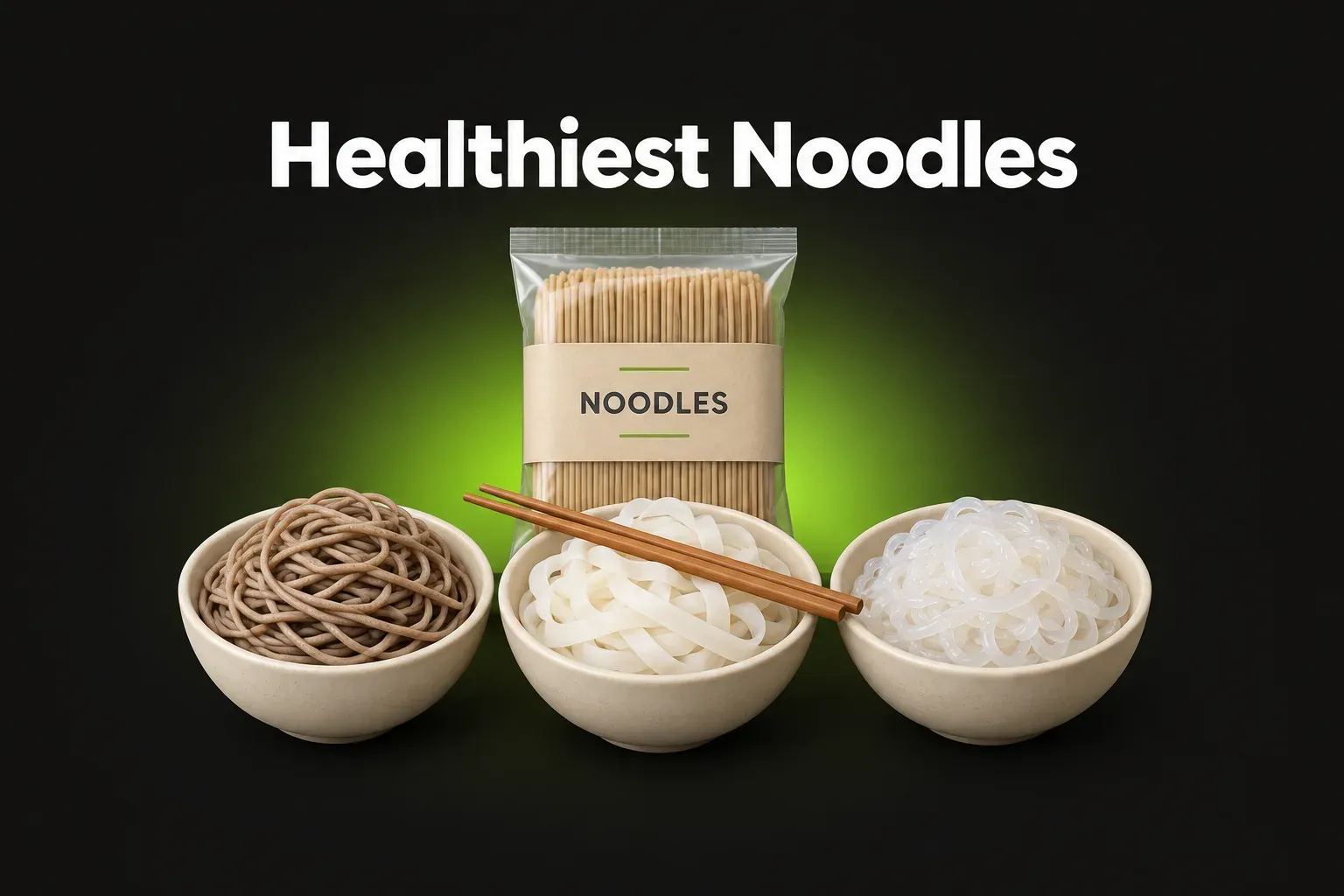
Noodles are fast, cheap and filling. But a pack of shirataki and a pack of instant ramen are very different foods. So which are the healthiest noodles?
The short answer: the healthiest everyday picks are 100% buckwheat soba, chickpea or lentil noodles and whole wheat spaghetti. They have about 190–200 calories per 2 oz (56 g) of dry noodles, with more fiber or protein than white noodles. For the fewest calories, choose shirataki (konjac) or kelp noodles – about 5–10 calories per serving. Rice noodles are fine if you need to avoid gluten, but they have little protein. Instant ramen is the weakest pick: it’s fried, and one pack can have about 1,600 mg of sodium.
Noodle types compared per 2 oz
These numbers come from the USDA food database. They are for 2 oz (56 g) of dry noodles. That makes about 1 cup of cooked noodles.
| Noodle (2 oz dry) | Calories | Protein | Fiber | Fat | Sodium |
|---|---|---|---|---|---|
| Soba (typical) | 188 | 8.1 g | not listed | 0.4 g | 444 mg |
| Rice noodles | 204 | 3.3 g | 0.9 g | 0.3 g | 102 mg |
| Egg noodles | 215 | 8.0 g | 1.8 g | 2.5 g | 12 mg |
| Whole wheat spaghetti | 197 | 7.8 g | 5.2 g | 1.6 g | 3 mg |
| Instant ramen with seasoning | 246 | 5.7 g | 1.6 g | 9.9 g | 1,042 mg |
Source: USDA FoodData Central – soba, rice noodles, egg noodles, whole wheat pasta, instant ramen. Values per 100 g, multiplied to 56 g and rounded. Fiber for soba is not listed in this entry, and USDA does not say how much of it is buckwheat.
What stands out:
- Calories are almost the same. Most dry noodles have about 190–215 calories per 2 oz. Instant ramen has more, because the noodles are fried.
- Fiber is the big difference. Whole wheat spaghetti has about 5 g. Rice noodles have less than 1 g.
- Protein: soba, egg noodles and whole wheat spaghetti have about 8 g. Rice noodles have only about 3 g.
- Sodium: many wheat noodles have salt in the dough. Instant ramen has the most by far.
9 noodle products compared (labels)
Brands can be very different, even for the same kind of noodle. Here are 9 products sold in the US. Each one is shown per the serving on its label.
| Product | Serving | Calories | Protein | Fiber | Sodium |
|---|---|---|---|---|---|
| Miracle Noodle Spaghetti (shirataki) | about 3.5 oz | 5 | 0 g | 2 g | 0 mg |
| Sea Tangle Kelp Noodles | 4 oz (113 g) | 6–10 | 0 g | 1–2 g | about 35 mg |
| Eden 100% Buckwheat Soba | 2 oz (55 g) | 200 | 6–7 g | 2–3 g | 5 mg |
| Lotus Foods Buckwheat & Brown Rice Soba | 2 oz (56 g) | 200 | 6 g | 2 g | 0 mg |
| Lotus Foods Millet & Brown Rice Ramen | 1 cake (70 g) | 250 | 6 g | 2 g | 0 mg |
| Wel-Pac Japanese Udon | 2 oz (56 g) | 190 | 5 g | 1 g | about 950 mg |
| Banza Chickpea Spaghetti | 2 oz (56 g) | 190 | 11 g | 11 g | 10 mg |
| immi Black Garlic “Chicken” Ramen | 1 packet | 350 | 28 g | 12 g | 900–1,200 mg |
| Nissin Top Ramen Chicken | 1 packet (85 g) | 380 | 9 g | 2 g | 1,590 mg |
Sources: brand pages for Miracle Noodle (sodium from an older label on Open Food Facts), Banza and immi (the brand lists 1,200 mg of sodium; an older label shows about 900 mg); labels in USDA FoodData Central for Eden and Wel-Pac; labels on Open Food Facts for Sea Tangle (1, 2), Lotus Foods Soba, Lotus Foods Ramen and Top Ramen, checked November 2026. Where labels differ, we show a range. Shirataki and kelp noodles are sold wet, so their servings are not dry weight. Recipes change – always check the pack.
A few things to notice:
- Shirataki and kelp noodles are almost calorie-free. But they also have no protein.
- Banza has 11 g of protein and 11 g of fiber. That’s more of both than wheat noodles.
- immi has the most protein, from pea protein and wheat gluten. But a packet still has about 900–1,200 mg of sodium.
- Udon looks harmless, but this brand has about 950 mg of sodium per 2 oz. That’s from salt in the dough.
Soba: check for 100% buckwheat
Soba is a Japanese noodle made with buckwheat flour. Despite its name, buckwheat is not wheat. It’s a seed, and it has no gluten.
But many soba noodles are mostly wheat. For example, Eden’s Spelt Soba is 80% spelt (a type of wheat) and only 20% buckwheat, plus sea salt (label). Eden’s 100% Buckwheat Soba is made only from whole buckwheat flour. It has about 2–3 g of fiber and almost no sodium.
Buckwheat may help your heart and blood sugar. A review looked at 13 trials in people. Eating buckwheat lowered blood sugar by about 15 mg/dL. It also lowered total cholesterol by about 19 mg/dL (Li et al., Nutrients, 2018). The studies were quite different from each other, so the result is not certain. And they tested buckwheat foods in general, not only noodles.
One warning: some people are allergic to buckwheat. Reactions can be serious.
Shirataki and kelp noodles: the lightest picks
Shirataki noodles are made from konjac, a root grown in Asia. The flour is mostly glucomannan, a soluble fiber. Soluble fiber soaks up water and forms a gel in your gut. The noodles are mostly water. That’s why a serving of Miracle Noodle has only about 5 calories.
Does glucomannan help you lose weight? The proof is weak:
- A review looked at 8 trials in people who were overweight. Glucomannan pills did not lead to real weight loss compared with a dummy pill (placebo). Some people had stomach pain, diarrhea or constipation (Onakpoya et al., Journal of the American College of Nutrition, 2014).
- An older review of 14 studies with 531 people found a small loss of about 1.7 lb (0.8 kg) (Sood et al., American Journal of Clinical Nutrition, 2008).
So shirataki won’t melt fat. It helps because it swaps out about 200 calories of regular noodles. Glucomannan may also help your cholesterol. A review of 12 trials found that about 3 g a day lowered LDL (“bad”) cholesterol by about 10% (Ho et al., American Journal of Clinical Nutrition, 2017). Keep in mind that these reviews tested glucomannan itself, not shirataki noodles.
Kelp noodles are made from kelp (a seaweed), water and sodium alginate, a thickener made from seaweed. They have about 6–10 calories per 4 oz.
The catch: shirataki and kelp noodles have no protein and few vitamins. A bowl of them alone won’t keep you full for long. Add chicken, shrimp, eggs or tofu, plus vegetables. Rinse shirataki under cold water before you cook them. For more light swaps, see our list of zero calorie foods.
Rice, egg and udon noodles
Rice noodles are used in pad thai and pho. They are gluten-free and have very little fat or sodium. But they have only about 3 g of protein and under 1 g of fiber per 2 oz. Brown rice noodles, like the Lotus Foods ones, have a bit more fiber.
Egg noodles are wheat noodles with egg added. They have about the same protein as pasta, and a little more fat. They are fine in a normal portion.
Udon are thick, chewy wheat noodles. They are low in fiber. Dry udon can also be very salty, as the Wel-Pac label shows.
Bean noodles: the most protein and fiber
Noodles made from chickpeas, lentils or other beans are the winners for protein and fiber. Banza Chickpea Spaghetti has 11 g of protein and 11 g of fiber per 2 oz. It has about the same calories as wheat noodles. The current recipe is chickpeas, pea starch, tapioca and xanthan gum (a plant-based thickener).
Bean noodles are also kind to blood sugar. In an Italian study, pastas made from 100% bean flour had a glycemic index (GI) of about 20–23. GI is a 0–100 scale of how fast a food raises blood sugar. Regular wheat pasta scored about 53 in the same test (Turco et al., Food & Function, 2019). We compare more brands in healthiest pasta.
Instant ramen: the weakest pick
Most instant ramen noodles are fried in palm oil to dry them. A pack of Nissin Top Ramen Chicken has 380 calories, 14 g of fat and 1,590 mg of sodium. That’s about 70% of the 2,300 mg daily limit for adults. It has only 9 g of protein and 2 g of fiber.
Why does salt matter? A review of 34 trials with 3,230 people looked at cutting salt. People ate about 4.4 g less salt a day. That’s about 1,700 mg of sodium – about one pack of ramen. Their top blood pressure number fell by about 4 points (He et al., BMJ, 2013).
How often you eat it matters too. A Korean study looked at 10,711 adults. Women who ate instant noodles two or more times a week had 68% higher odds of metabolic syndrome. That’s a group of problems like a large waist, high blood pressure and high blood sugar. The link was not seen in men (Shin et al., Journal of Nutrition, 2014). This kind of study shows a link, not proof.
Top Ramen also lists TBHQ, a preservative that keeps the oil from going bad. US regulators allow it in small amounts. But an independent lab at Michigan State University found a warning sign. Mice ate food with 0.0014% TBHQ – the normal amount in lab mouse feed. They became more sensitive to an egg allergen and had worse allergic reactions (Jin et al., Frontiers in Immunology, 2025).
Animal studies matter. Mice share most of our genes and body processes. Testing a preservative on people for years would put their health at risk. Proof of harm in people is still missing. But it’s easy to pick noodles without TBHQ, so limiting it is a sensible precaution. Read more in is ramen bad for you? and calories in ramen.
The best noodles for your goal
For weight loss
Shirataki and kelp noodles have the fewest calories by far. Bean noodles are a good choice too. Their protein and fiber help you stay full. Whatever you pick, measure about 2 oz of dry noodles. It’s easy to eat more than that. Not sure how much to eat? Try our calorie calculator.
For blood sugar
In the international GI tables, whole wheat spaghetti scored 48, rice noodles 53 and udon 55 (Atkinson et al., Diabetes Care, 2008). A GI of 55 or below counts as low. Bean noodles score much lower, and shirataki has almost no digestible carbs. 100% buckwheat soba is another good pick. See our list of low glycemic index foods for more.
For gluten-free eating
Good gluten-free choices are 100% buckwheat soba, rice noodles, shirataki, kelp noodles and chickpea noodles. Watch out for regular soba – it often contains wheat. If you have celiac disease, look for a “certified gluten-free” label.
For the most protein
immi (28 g per packet) and bean noodles like Banza (11 g per 2 oz) lead the pack. Wheat, egg and buckwheat noodles have about 6–8 g. Add eggs, chicken, shrimp or tofu to any bowl for more.
Check your noodles before you buy. With NutriSmart, you photograph the label or scan the barcode. The app lists the sweeteners, preservatives and colors, explains the risks of each one and gives the product a health score out of 100. It also tells you right away if a pack of noodles is ultra-processed, and which ingredients make it so. Set an alert for TBHQ, and the app warns you whenever a product you scan contains it.Get the app free
The bottom line
The healthiest noodles for most people are 100% buckwheat soba, chickpea or lentil noodles and whole wheat spaghetti. They have about the same calories as white noodles, but more fiber or protein. Shirataki and kelp noodles have almost no calories, but no protein either, so add chicken, eggs or tofu to the bowl. Rice noodles are a fine gluten-free choice, though they are low in protein and fiber. Keep instant ramen as an occasional meal, because it is fried and very salty. Whatever you choose, read the label for sodium and stick to about 2 oz of dry noodles.
FAQ
What are the healthiest noodles?
For most people, 100% buckwheat soba, chickpea or lentil noodles and whole wheat spaghetti. They give you more fiber or protein than white noodles. For the fewest calories, pick shirataki or kelp noodles and add protein and vegetables.
Are soba noodles healthy?
Yes, especially 100% buckwheat soba. Eden 100% Buckwheat Soba has about 200 calories, 6–7 g of protein and 2–3 g of fiber per 2 oz, with almost no sodium. Many soba noodles are mostly wheat and contain salt, so read the label.
Are shirataki noodles good for weight loss?
They can help, because a serving has only about 5 calories. They're made from konjac flour and water. But they have no protein, and studies on glucomannan, their fiber, show little or no weight loss by itself.
Are rice noodles healthier than pasta?
Not really. Rice noodles have fewer than half the protein of regular pasta and less fiber. Their glycemic index is a bit higher too. They are a good choice if you need to avoid gluten.
What noodles are best for blood sugar?
Chickpea, lentil and other bean noodles raise blood sugar the least, along with shirataki. Whole wheat spaghetti and buckwheat soba are good picks too. Keep the portion to about 2 oz dry and add protein and vegetables.
Is instant ramen bad for you?
Once in a while, it's fine. But one pack of Top Ramen Chicken has 380 calories and 1,590 mg of sodium, which is about 70% of a day's limit. The noodles are fried in palm oil and have little protein or fiber.