Is Imitation Crab Healthy? Surimi vs Real Crab and Brands
Is imitation crab healthy? What surimi is made of, protein and sodium vs real crab, additives, allergies, pregnancy, and 6 brands compared.
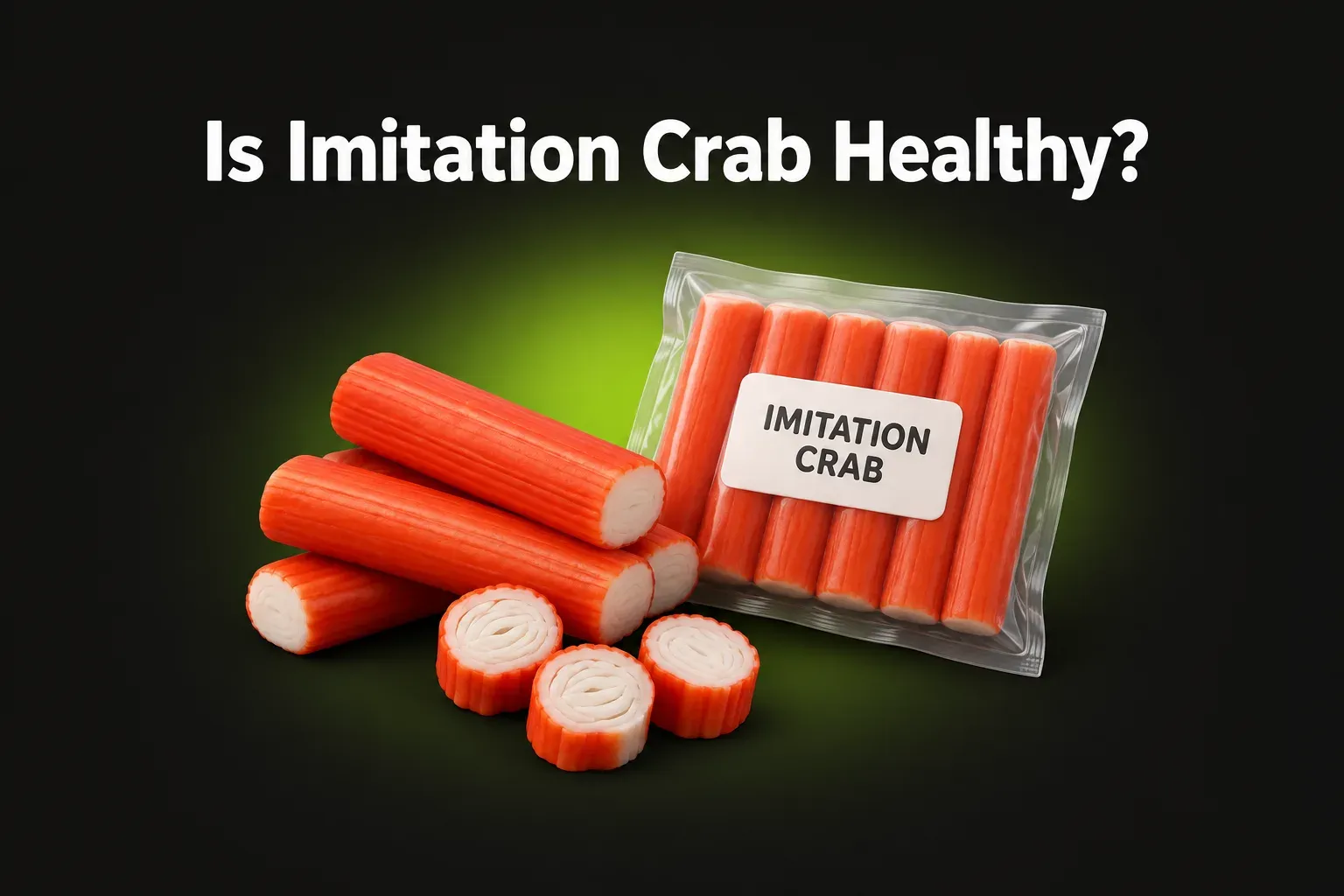
Imitation crab is in California rolls, crab salads and cheap seafood dips. It looks like crab and costs much less. But what is it really, and is it good for you?
The short answer: imitation crab is okay in small amounts, but it’s not a health food. It’s a fish paste (called surimi) mixed with starch, sugar, salt and additives. A 3 oz (85 g) serving has about 80 calories and almost no fat. But it has less than half the protein of real crab and much less omega-3. It also has 9–19 g of carbs that real crab doesn’t have. It often has egg, wheat and crab extract, so it’s risky with allergies. It’s fully cooked, so it’s fine in pregnancy if kept cold.
What is imitation crab made of?
Imitation crab starts as surimi. That’s a paste made from white fish, most often Alaska pollock. The fish is minced and washed. This removes most of the fat and flavor. Then it’s mixed with other ingredients, shaped into sticks or flakes, and cooked.
A typical label lists:
- Fish: Alaska pollock (some brands also use whiting or threadfin bream).
- Water and starch: corn, potato, pea, tapioca or wheat starch. These hold the shape and add bulk.
- Sugar and sorbitol: for a sweet taste and to protect the fish when it’s frozen.
- Salt and potassium chloride (a salt swap).
- Egg white: to make it firm and glossy.
- Oil: a little soybean or fish oil.
- Flavor: crab or lobster extract, rice wine, and flavor boosters like MSG or disodium inosinate.
- Phosphates: such as sodium tripolyphosphate. They help the fish hold water and stay springy.
- Color: carmine (a red dye made from insects), paprika or tomato lycopene.
That long list makes most imitation crab an ultra-processed food.
Imitation crab vs real crab
Here is how 3 oz (85 g) compares. The numbers are from the USDA food database.
| Per 3 oz (85 g) | Imitation crab | Alaska king crab, cooked | Blue crab, cooked |
|---|---|---|---|
| Calories | 81 | 83 | 71 |
| Protein | 6.5 g | 16.5 g | 15.2 g |
| Carbs | 12.8 g | 0 g | 0 g |
| Fat | 0.4 g | 1.3 g | 0.6 g |
| Sodium | 450 mg | 910 mg | 336 mg |
| Omega‑3 (EPA + DHA) | 24 mg | 351 mg | 143 mg |
| Vitamin B12 | 0.5 µg | 9.8 µg | 2.8 µg |
| Zinc | 0.3 mg | 6.5 mg | 3.2 mg |
Source: USDA FoodData Central – imitation crab made from surimi, Alaska king crab, cooked, blue crab, cooked. Values per 100 g, multiplied to 3 oz and rounded.
What stands out:
- Calories are about the same. But real crab gives you more than twice the protein.
- Carbs: real crab has none. Imitation crab gets its carbs from starch and sugar.
- Omega-3: these are healthy fats that help your heart and brain. King crab has about 15 times more than plain imitation crab. Washing the minced fish removes most of the fat. Some brands add fish oil back. Trans-Ocean says its Crab Classic has 100 mg per 3 oz.
- Sodium: imitation crab has more salt than blue crab. But king crab is even saltier.
- Vitamins and minerals: real crab is rich in vitamin B12 and zinc. Imitation crab has very little of either.
6 imitation crab brands compared
Here are 6 products sold in the US, per ½ cup (3 oz / 85 g) unless noted. Real crab is at the bottom for comparison.
| Product | Calories | Protein | Carbs | Sugar | Sodium | Notable additives |
|---|---|---|---|---|---|---|
| Trans-Ocean Crab Classic, Flake Style | 80 | 6 g | 14 g | 4 g | 390 mg | Sorbitol, carrageenan, phosphate, carmine; certified gluten-free |
| Louis Kemp Crab Delights, Flake Style | 80 | 6 g | 14 g | 3 g | 430 mg | Sorbitol, two phosphates; wheat starch in some packs |
| Aquamar Surimi Flake | 110 | 5 g | 19 g | 5 g | 470 mg | Wheat starch, two phosphates, flavor boosters, carmine |
| JFC Kani Kamaboko sticks | 90 | 7 g | 14 g | 4 g | 600 mg | Wheat starch, sorbitol, two phosphates, MSG |
| Trader Joe’s Surimi Imitation Crabmeat | 70 | 8 g | 9 g | 3 g | 370 mg | Short list: pea starch, tomato lycopene color |
| Walmart Classic Creations, Flake Style | 80 | 6 g | 14 g | 3 g | 450 mg | Sorbitol, carrageenan, phosphate, carmine |
| Alaska king crab, cooked | 83 | 16.5 g | 0 g | 0 g | 910 mg | None |
| Blue crab, cooked | 71 | 15.2 g | 0 g | 0 g | 336 mg | None |
Sources: Trans-Ocean product page; Open Food Facts for Louis Kemp, Aquamar, JFC and Trader Joe’s; USDA FoodData Central for Walmart Classic Creations, king crab and blue crab; checked November 2026. JFC values are for 8 sticks (85 g) and come from a 2022 label. Walmart values come from a 2023 label. Recipes change – always check the pack.
What to notice:
- Most brands are very close: about 80 calories, 6 g of protein and 3–4 g of sugar.
- Trader Joe’s has the most protein and the least salt. Its list is also the shortest. It uses tomato lycopene for color instead of carmine. It lists no phosphates, no sorbitol and no egg.
- Aquamar has the most carbs and calories, plus 2 g of fat.
- The kanikama sticks (the Japanese name for crab sticks) have the most salt: 600 mg is about a quarter of the 2,300 mg daily value.
- Walmart’s store brand is sold as Classic Creations. Its ingredient list is very close to Trans-Ocean’s.
The additives worth knowing
All of these are allowed by the FDA. But approval doesn’t answer every question. Here is what independent research shows.
Phosphates
Imitation crab often has one or two phosphates, like sodium tripolyphosphate. They keep the fish paste juicy and firm. Your body absorbs most of the phosphate from additives. It absorbs much less from the natural phosphorus in meat or beans. German kidney doctors reviewed the research. They wrote that too much phosphate mainly harms blood vessels. For example, it can lead to calcium buildup in artery walls (Ritz et al., Deutsches Ärzteblatt International, 2012).
A study at UT Southwestern in Dallas tested this in mice. For 12 weeks, mice ate food with 2% phosphate instead of the normal 0.6%. They didn’t gain weight. But they ran for less time on a treadmill, moved around less and burned less fat. In the same study, 1,603 Dallas adults wore activity trackers. Those with more phosphate in their blood moved less (Peri-Okonny et al., Circulation, 2019).
Why do mouse studies matter? Mice share most of our genes and body processes. Feeding people extra phosphate for years to see if it harms them would put their health at risk. Proof in people is still missing. But several labs see the same warning signs. So it makes sense to limit phosphate additives as a precaution – especially if you have kidney disease.
Sorbitol
Sorbitol is a sugar alcohol. It protects the fish paste in the freezer. Labels don’t say how much there is. Your gut absorbs it only partly. Large amounts can cause gas and diarrhea. In a Monash University study, 41 people took 10 g of sorbitol. Only about a third fully absorbed it. People with IBS (irritable bowel syndrome) got more gut symptoms (Yao et al., Journal of Human Nutrition and Dietetics, 2014). A serving or two of imitation crab is unlikely to bother most people. If you have IBS, watch how you feel.
MSG and flavor boosters
Some kanikama sticks list MSG. Other brands use disodium inosinate, disodium guanylate or hydrolyzed soy protein. These boost the savory taste. A large US study tested 130 people who said MSG made them sick. On different days, they got 5 g of MSG without food, or a dummy dose. Neither they nor the researchers knew which was which. Some people reported symptoms. But none were serious or lasting. And the reactions didn’t come back the same way when they were tested again (Geha et al., Journal of Allergy and Clinical Immunology, 2000).
An older study injected newborn mice with large doses of MSG under the skin. The mice got brain damage and grew up obese (Olney, Science, 1969). The doses were very high, and they were injected, not eaten. There’s no proof that the small amount in food does this in people. Still, it’s a reason not to make MSG-heavy foods a daily habit.
Carmine and carrageenan
Carmine gives many brands their red stripe. It’s made from crushed insects, so it’s not vegetarian. It can also cause allergic reactions. Doctors in Japan reviewed 22 cases of carmine allergy. All were adult women, and almost all had anaphylaxis (a severe, sudden allergic reaction). One of the main recent sources was fish sausage, a product much like imitation crab (Takeo et al., Allergology International, 2018).
Trans-Ocean and Walmart’s Classic Creations also list carrageenan, a seaweed thickener. Mouse studies link it to blood sugar problems. In a German trial, 20 young men took 250 mg of carrageenan twice a day for two weeks. In the men who were overweight, the body responded less well to insulin. Blood tests also showed more inflammation (Wagner et al., BMC Medicine, 2024). The trial was small, so this still needs to be confirmed.
Imitation crab and allergies
Imitation crab is a common hidden allergen. Check the label for:
- Fish: it’s mostly pollock or other white fish. In a French study, 6 people with a fish allergy had skin tests. They reacted to cod and, less strongly, to surimi made from cod (Mata et al., Allergy, 1994). If you’re allergic to fish, avoid it.
- Shellfish: many brands add real crab or lobster extract. Trans-Ocean lists king, blue and snow crab plus lobster. Trans-Ocean’s own FAQ says most imitation crab may have crab or shellfish in its flavors. Trader Joe’s label lists only pollock as an allergen.
- Egg: most brands use egg whites. Trader Joe’s doesn’t.
- Wheat and gluten: Aquamar, the JFC kanikama sticks and some Louis Kemp packs use wheat starch. Trans-Ocean’s Crab Classic is certified gluten-free. Trader Joe’s labels its pack gluten-free.
- Soy: some brands use soy lecithin, soybean oil or hydrolyzed soy protein.
Is imitation crab safe in pregnancy?
Yes, for most people. Imitation crab is sold fully cooked, so you can eat it cold from the pack. It’s also low in mercury. FDA tests found an average of 0.031 ppm (parts per million) of mercury in pollock and 0.065 ppm in crab (FDA). Swordfish has about 1 ppm. Both pollock and crab are on the FDA’s “Best Choices” list. The FDA says pregnant women can eat 2–3 servings of these a week, at 4 oz each (FDA).
A few tips:
- Keep it cold. Trans-Ocean says not to leave it out of the fridge for more than 2 hours.
- Eat it by the use-by date. Once the pack is open, eat it within 3 days.
- Watch the sushi. A California roll is fine. But many rolls also have raw fish, which doctors advise skipping in pregnancy. Read more in is sushi healthy.
Who should limit imitation crab
It’s a fine choice if you:
- Want a cheap, low-fat seafood for salads, wraps or sushi at home.
Think twice if you:
- Need more protein. Real crab, shrimp, tuna or chicken give you 2–4 times more per serving. See our list of high-protein foods and check your needs with the protein calculator.
- Watch your salt or have high blood pressure.
- Have kidney disease, because of the added phosphates.
- Eat low-carb or keto. A serving has 9–19 g of carbs.
- Have a fish, shellfish, egg or wheat allergy.
How to pick a better imitation crab
- Compare protein. Look for 7–8 g or more per serving.
- Check the sodium. Pick one under 400 mg per serving.
- Read the ingredients. A shorter list with no phosphates is better.
- Check allergens every time. Recipes change, even within one brand.
Check what’s really in your imitation crab. With NutriSmart, you photograph the label or scan the barcode. The app lists the sweeteners, preservatives and colors, explains the risks of each one and gives the product a health score out of 100. It also tells you right away if a pack is ultra-processed, and which ingredients make it so. Set an alert for carmine or phosphates, and the app warns you whenever a product you scan contains them.Get the app free
The bottom line
Imitation crab is a low-calorie, low-fat fish product. But it’s not a swap for real crab. A 3 oz serving has only 5–8 g of protein, little omega-3, 9–19 g of carbs and 370–600 mg of sodium. Most brands also add sugar, sorbitol, phosphates and red coloring. It’s fine now and then, and it’s safe in pregnancy because it’s cooked and low in mercury. If you eat it often, choose a brand with more protein, less salt and a shorter ingredient list. Skip it if you’re allergic to fish, shellfish, egg or wheat.
FAQ
Is imitation crab healthy?
It's a fine food now and then, but not a health food. A 3 oz serving has about 80 calories and almost no fat. But it has less than half the protein of real crab. Most brands also add starch, sugar, salt and phosphates.
What is imitation crab made of?
Mostly a white fish paste called surimi, usually from Alaska pollock. Brands add water, starch, sugar, sorbitol, salt, egg white and flavors. The red color comes from carmine, paprika or tomato lycopene.
Does imitation crab have real crab in it?
Many brands add a little crab meat or crab extract for flavor. Trans-Ocean, Louis Kemp and Aquamar list crab on the label. So people with a shellfish allergy should read the label carefully.
Can you eat imitation crab while pregnant?
Yes, if it's kept cold and eaten before the use-by date. It's sold fully cooked, and pollock is one of the lowest-mercury fish. Limit it because of the salt, and skip sushi rolls that also have raw fish.
Is imitation crab good for weight loss?
It's low in calories and fat, so it can fit. But it has only 5–8 g of protein per serving and 9–19 g of carbs. Real crab, shrimp or canned tuna fill you up better for the same calories.
Is imitation crab gluten-free?
Not always. Aquamar, some Louis Kemp packs and some kanikama sticks use wheat starch. Trans-Ocean's Crab Classic is certified gluten-free, and Trader Joe's labels its pack gluten-free. Always check the label if you have celiac disease.