Is Sesame Oil Healthy? Toasted vs Light, 9 Oils Compared
Is sesame oil healthy? Its fats per tablespoon, toasted vs light, blood pressure studies, sesame allergy, soybean oil blends and 9 bottles compared.
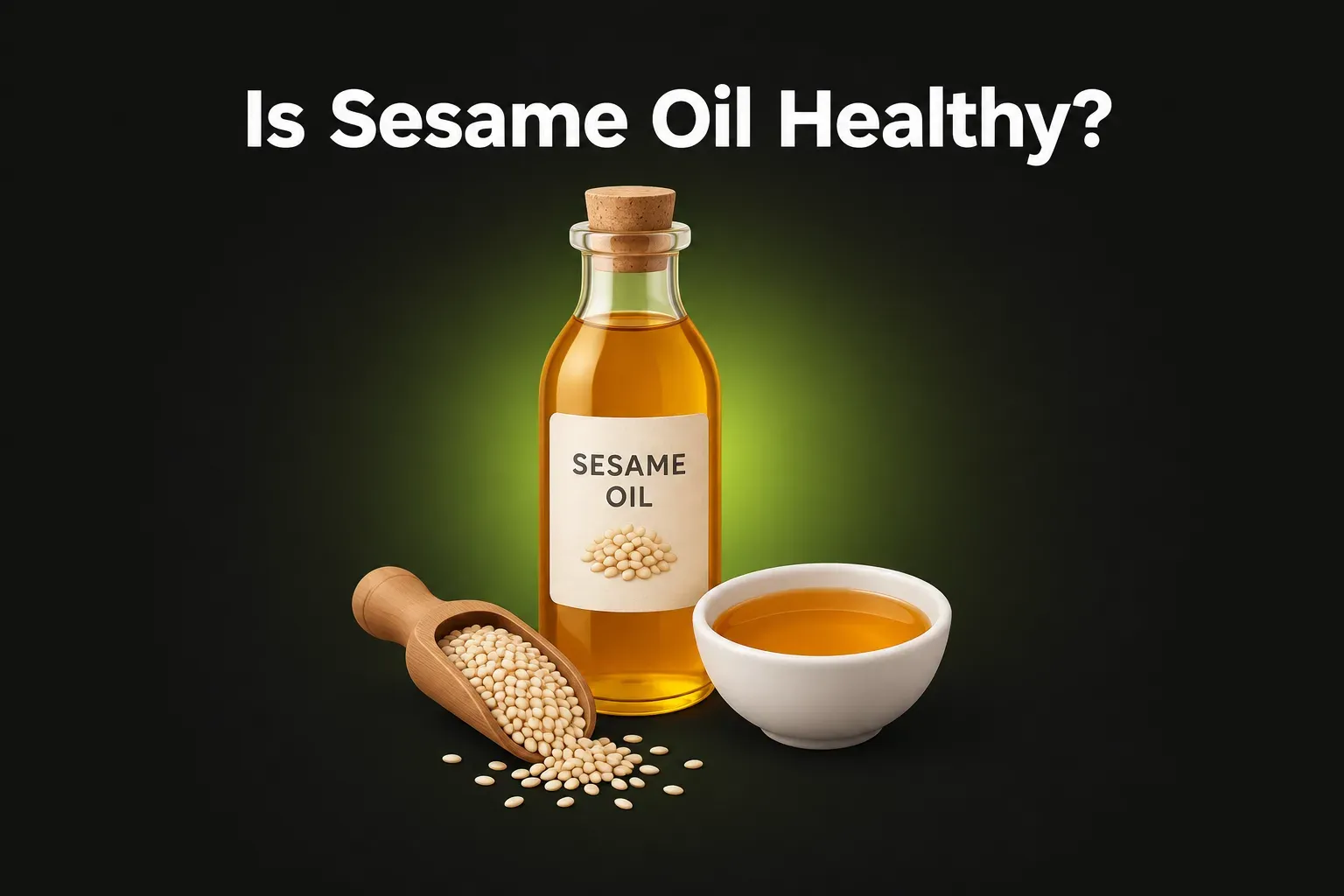
Sesame oil gives stir-fries, noodles and dressings their nutty flavor. But is that small bottle good for you, or just tasty?
The short answer: yes, sesame oil is a healthy oil when you use it in normal amounts. About 80% of its fat is unsaturated, and it has natural antioxidants called lignans (sesamin, sesamolin and sesamol). A few small studies suggest it may lower blood pressure a little, but the proof is weak. Like every oil, it has about 120 calories per tablespoon. Use light (refined) sesame oil for cooking and toasted sesame oil as a finishing drop. Skip it if you have a sesame allergy, and check the label for soybean oil blends.
Sesame oil vs olive, canola and soybean oil
Here is how one tablespoon of each oil compares. The numbers are from the USDA food database.
| Oil (1 tbsp) | Calories | Saturated fat | Mono fat | Poly fat | Omega‑6 (linoleic) |
|---|---|---|---|---|---|
| Sesame oil | 120 | 1.9 g | 5.4 g | 5.7 g | 5.6 g |
| Olive oil | 120 | 1.9 g | 9.9 g | 1.4 g | 1.3 g |
| Canola oil | 120 | 1.0 g | 8.6 g | 3.8 g | 2.6 g |
| Soybean oil | 120 | 2.1 g | 3.1 g | 7.8 g | 6.9 g |
Source: USDA FoodData Central – sesame, olive, canola, soybean. Values per 100 g, scaled to 13.6 g (1 tbsp) and rounded. “Mono” is monounsaturated fat, “poly” is polyunsaturated fat.
What stands out:
- Sesame oil sits in the middle. Its fat is about half monounsaturated (the main fat in olive oil) and half polyunsaturated.
- Most of the poly fat is omega-6 (linoleic acid). That’s the fat at the center of the seed oil debate. Sesame oil has less of it than soybean oil, but more than olive or canola oil.
- It has almost no omega-3. Canola oil has about 30 times more.
- It’s rich in plant sterols. These are natural plant compounds that look a lot like cholesterol. USDA lists about 118 mg per tablespoon in sesame oil, about four times more than in olive oil.
What makes sesame oil special: lignans
Sesame seeds contain lignans, plant compounds that act as antioxidants. Antioxidants help slow down damage from oxygen, in the body and in food. The two main ones in the seed are sesamin and sesamolin. When the oil is made, some sesamolin turns into sesamol, another strong antioxidant.
These lignans help explain an odd fact. Sesame oil has lots of polyunsaturated fat, which usually spoils fast. Yet it stays fresh much longer than most plant oils. A review credits its lignans, its vitamin E (mainly the gamma form) and compounds made when the seeds are roasted (Wan et al., Journal of the Science of Food and Agriculture, 2015).
What do lignans do in people? Most human trials used sesamin pills, not oil. A review pooled 7 trials with 212 people. Sesamin lowered total cholesterol by about 11 mg/dL and LDL (“bad”) cholesterol by about 8 mg/dL. The top blood pressure number fell by about 4 points (Sun et al., Frontiers in Endocrinology, 2022).
Animal studies point the same way. A review pooled 17 studies in lab animals that were obese, diabetic or had fatty liver. Sesamin lowered their cholesterol, blood fats and blood sugar (Zuo et al., Nutrition Reviews, 2025). Why do animal studies matter? Lab animals like rats and mice share most of our genes and body processes. And some tests would be too risky or take too long in people. But pills are not the same as a splash of oil. We don’t know how much sesamin a normal serving of oil gives you.
Does sesame oil lower blood pressure?
This is the most common health claim. Here’s what the studies show.
The Sankar studies from India
In one study, 530 people with high blood pressure took a drug called nifedipine. Most of them (356) were told to use sesame oil as their only cooking oil. Others used sunflower oil, peanut oil or no special oil. The dose was about 35 g of oil a day (about 2½ tbsp) for 60 days. Blood pressure fell in every group, even with the drug alone. Cholesterol and blood fats improved in the sesame and sunflower groups. The authors said sesame oil did best of the three oils (Sankar et al., Clinica Chimica Acta, 2005).
A smaller follow-up had 50 people on other blood pressure drugs. They used sesame oil as their only cooking oil for 45 days. Their blood pressure dropped to normal. When they stopped for 45 days, it went back up. They also lost a little weight (Sankar et al., Yale Journal of Biology and Medicine, 2006).
These results sound great. But in the first study, blood pressure also fell in the group that took only the drug. The second study had no control group at all. So it’s hard to tell how much came from the oil itself.
What larger reviews say
- A 2017 review pooled 8 trials of sesame (as oil, seeds or other forms) with 843 people. Overall, systolic blood pressure (the top number) dropped by about 8 points. But in the 4 best-run trials, the drop was only about 3 points (Khosravi-Boroujeni et al., Journal of the Science of Food and Agriculture, 2017).
- A 2022 review looked only at sesame oil. It found drops of about 2.7 points in the top number and 2 points in the bottom number. Fasting blood sugar fell by about 3 mg/dL (Atefi et al., Journal of Diabetes and Metabolic Disorders, 2022). The authors said more studies are needed.
- A careful trial in Iran included about 95 adults with type 2 diabetes. It tested sesame oil, canola oil and a blend of both. Each person used each oil for 9 weeks. Nobody, not even the researchers, knew which oil was which. Sesame oil was not clearly better than canola oil. In men, the blend lowered blood pressure a bit more than either oil alone (Amiri et al., European Journal of Nutrition, 2022).
Bottom line on health: sesame oil looks like a good swap for butter, lard or other saturated fats. The American Heart Association says swapping saturated fat for unsaturated fat lowers LDL cholesterol and heart risk (Sacks et al., Circulation, 2017). But sesame oil is not a blood pressure medicine. Don’t stop any pills because of it.
Toasted vs light sesame oil
There are two very different kinds on US shelves.
- Toasted sesame oil (also called dark or roasted) is pressed from roasted seeds. It’s dark amber and tastes strongly nutty. A few drops flavor a whole dish. It smokes at a fairly low heat. Spectrum lists its toasted oil at up to 350°F (177°C). La Tourangelle’s smoke point guide lists sesame oil at 325°F (163°C).
- Light sesame oil is pressed from raw seeds. “Light” means light in color and taste, not in calories. If it’s refined (filtered and cleaned after pressing), it’s pale and mild. Spectrum lists its refined sesame oil at up to 445°F (229°C). That works for stir-frying and roasting.
Roasting changes the oil a little. In one lab study, seeds were roasted at different heats. Roasting made the oil more resistant to spoiling. But it lowered some natural compounds, like plant sterols (by up to about 17%). The best oil came from roasting at 410°F (210°C) (Arab et al., Molecules, 2022). Another study found that roasting lowered sesamolin and raised sesamol. Very hot roasting (482°F / 250°C) also made more trans fats (Comini et al., ACS Food Science and Technology, 2023).
Simple rule: cook with light sesame oil, finish with toasted. Smoking oil breaks down and tastes bitter. For more on heat, see our guide to the healthiest cooking oil.
9 sesame oils compared
Here are 9 real products sold in the US, per 1 tablespoon.
| Product | Type | Ingredients | Calories | Heat guide (brand) |
|---|---|---|---|---|
| Kadoya Pure Sesame Oil | Roasted | Sesame seed oil | 130 | Not listed |
| Dynasty Sesame Oil (100% Pure) | Seasoning oil | Sesame seed oil | 130 | Drops to season |
| Lee Kum Kee Pure Sesame Oil | Roasted | Sesame oil | 130 | Drops before serving |
| Lee Kum Kee Sesame Oil blended with Soybean Oil | Blend | Sesame oil, soybean oil | 130 | Not listed |
| La Tourangelle Toasted Sesame Oil | Toasted | Sesame seed oil | 130 | Medium |
| Kevala Organic Toasted Sesame Oil | Toasted | Organic toasted sesame oil | 122 | Low to medium |
| Spectrum Toasted Sesame Oil, Unrefined | Toasted | Expeller pressed unrefined toasted sesame oil | 120 | Up to 350°F |
| Spectrum Sesame Oil, Refined | Light | Expeller pressed refined sesame oil | 120 | Up to 445°F |
| Trader Joe’s Organic Toasted Sesame Oil | Toasted | Organic toasted sesame oil | 120 | Not listed |
Sources: brand sites for Lee Kum Kee Pure, La Tourangelle, Spectrum (toasted, refined); Vitacost for Kevala; Open Food Facts for Kadoya, Dynasty, Lee Kum Kee Pure, Lee Kum Kee blend, La Tourangelle and Trader Joe’s. Checked November 2026. All have 14 g of fat and 1.5–2 g of saturated fat per tablespoon. Dynasty’s label calls its oil a table seasoning and doesn’t say if the seeds are roasted. The 120–130 calorie gap is label rounding. Recipes change – always check the bottle.
What to notice:
- Eight of the nine are 100% sesame. The calories are the same in practice.
- Lee Kum Kee sells two bottles that look alike. One is pure. The other is blended with soybean oil.
- Spectrum is the only brand here with a light, refined sesame oil for high heat. The others are made for flavor.
Watch out for “sesame oil” blends
Some bottles called “sesame oil” are partly soybean oil. Soybean oil is cheaper and has almost no taste. It isn’t harmful, but you get less sesame and more omega-6 for your money.
How to spot a blend:
- Read the ingredients, not the front. Look for “soybean oil”, “vegetable oil” or “canola oil” next to sesame oil.
- Check the order. US labels list ingredients from most to least by weight. If soybean oil comes first, the bottle has more soybean than sesame. For example, one “Blended Sesame Oil” by Fwusow Industry lists soybean oil first (Open Food Facts, 2022 entry).
- Look for “pure” or “100%”. Words like “blended”, “seasoning oil” or “sesame flavored” mean it’s not all sesame.
Lee Kum Kee’s US label doesn’t show the share of each oil. Its “Hot Blended Sesame Oil” is also sesame and soybean oil, plus chili (Lee Kum Kee).
Is sesame oil ultra-processed? A bottle of pure sesame oil is a cooking ingredient, not an ultra-processed food. Sauces and dressings made with it can be, though.
Sesame allergy: a major allergen since 2023
Sesame is now one of the 9 major food allergens in the US. The FASTER Act made it official. Since January 1, 2023, labels must name it (FDA).
Sesame allergy is not rare. A national survey of about 79,000 people asked about food allergies. About 1 in 200 said they had a sesame allergy. About 1 in 430 had clear signs of a true allergic reaction. About a third of those had used an epinephrine shot for it (Warren et al., JAMA Network Open, 2019).
Can people with a sesame allergy use sesame oil? No. Food Allergy Research & Education (FARE) says most people with a food allergy can safely eat highly refined oils made from that food. But sesame oil is not highly refined, so people with a sesame allergy should avoid it (FARE). Tahini, the paste in hummus, is pure sesame too.
How much sesame oil is healthy?
There’s no official limit. Think of it like any other oil.
- A teaspoon of toasted sesame oil (about 40 calories) is plenty to flavor a stir-fry or a bowl of noodles.
- Light sesame oil can replace other cooking oils. Rotate it with olive oil, which has the most research behind it. See is olive oil healthy?
- Count it in your calories. Oil is easy to overpour. Three tablespoons add about 360 calories. Our calorie calculator shows your daily needs.
- Store it well. Keep it in a cool, dark place, and smell it before use. If it smells like crayons or paint, it has gone bad.
Want a similar nutty oil for higher heat? Read is peanut oil healthy?
Check the label on sesame oil and the sauces made with it. With NutriSmart, you photograph the label or scan the barcode. The app lists the sweeteners, preservatives and colors, explains the risks of each one and gives the product a health score out of 100. It also tells you right away if a product is ultra-processed, and which ingredients make it so. Set an alert for soybean oil or sesame, and the app warns you whenever a bottle, sauce or dressing you scan contains it.Get the app free
The bottom line
Sesame oil is a healthy oil for most people. Most of its fat is unsaturated, and its lignans help keep it fresh. Small studies hint that it may lower blood pressure a little, but the proof is weak. It has about 120 calories per tablespoon, like every oil. Cook with light sesame oil and finish with toasted. Read the label to avoid soybean oil blends. If you have a sesame allergy, skip it completely.
FAQ
Is sesame oil healthy?
Yes, in normal amounts. Most of its fat is unsaturated, and it has natural antioxidants called lignans. Like every oil, it has about 120 calories per tablespoon, so a little goes a long way.
Is toasted sesame oil healthy?
Yes. Toasted sesame oil has the same fats as light sesame oil. Roasting the seeds changes the taste and some natural compounds, but it still makes a healthy finishing oil. Use it in small amounts, not for frying.
Can you cook with sesame oil?
Light (refined) sesame oil handles high heat. Spectrum lists its refined oil at up to 445°F (229°C). Toasted sesame oil smokes much sooner, at about 325–350°F (163–177°C), so add it at the end.
Does sesame oil lower blood pressure?
It might, a little. Reviews of small trials found drops of about 2–3 points in the top number. Most of the trials were small and short, so the proof is still weak.
Is sesame oil a seed oil?
It comes from a seed, and about 41% of its fat is omega-6, like many seed oils. But it's rarely part of the seed oil debate, and it has natural lignans that help keep it from spoiling.
Is sesame oil safe if you have a sesame allergy?
No. Food Allergy Research & Education (FARE) says sesame oil is not highly refined, so people with a sesame allergy should avoid it. Since 2023, US labels must name sesame as a major allergen.