Is Hummus Healthy? Nutrition, Oils and 8 Brands Compared
Is hummus healthy? Protein, fiber and sodium per 2 tbsp, what chickpeas and tahini do, store-bought oils and preservatives, and 8 US brands compared.
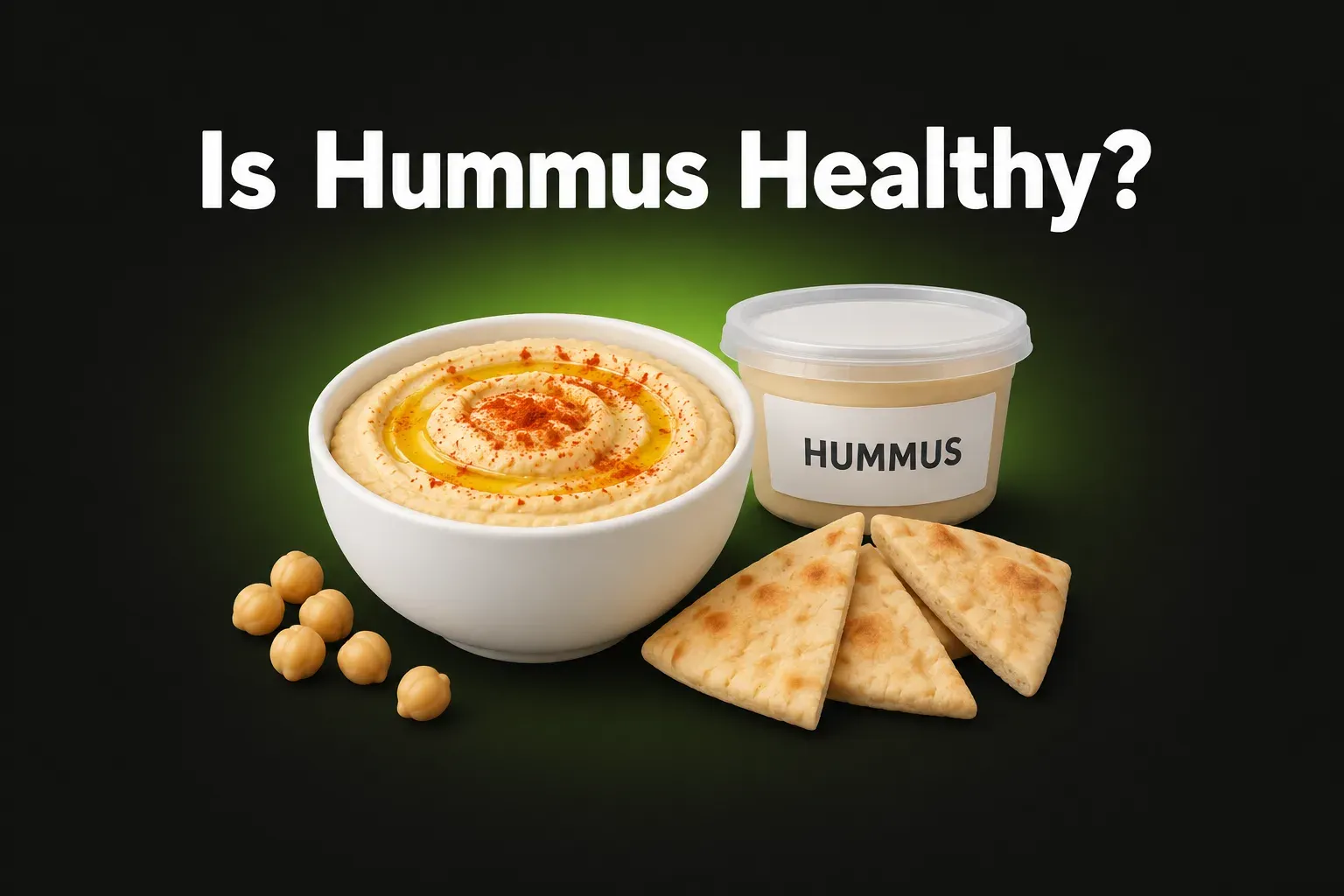
Hummus is a creamy dip made from chickpeas and sesame paste. It’s one of the most popular dips in the US. But is the tub from the store as healthy as it looks?
The short answer: yes, hummus is a healthy food for most people. Two tablespoons have about 70 calories, 2 g of protein, 2 g of fiber and mostly healthy fats. Studies link chickpeas and other beans to lower cholesterol and a healthier heart. The catches are portion size, the salty chips you dip in it, and what some brands add – like soybean oil and potassium sorbate. Pick a short ingredient list and pair it with veggies.
What’s in 2 tablespoons of hummus
A serving on the label is 2 tablespoons (about 1 oz / 30 g). Most people eat more, so here is a quarter cup too.
| Nutrient | 2 tbsp (30 g) | 1/4 cup (62 g) |
|---|---|---|
| Calories | 71 | 146 |
| Protein | 2.3 g | 4.8 g |
| Fiber | 1.7 g | 3.4 g |
| Total fat | 5.3 g | 10.9 g |
| Saturated fat | 0.8 g | 1.6 g |
| Sugar | 0.2 g | 0.4 g |
| Sodium | 128 mg | 262 mg |
| Potassium | 94 mg | 192 mg |
Source: USDA FoodData Central – hummus, commercial. Values per 100 g, converted to each portion (1/4 cup = 61.5 g) and rounded.
What stands out:
- Fat: most of it is the unsaturated kind, from sesame and oil. Less than 1 g per serving is saturated fat.
- Fiber: 2 tablespoons give about 6% of the 28 g daily value. Fiber feeds your gut and keeps you full.
- Sugar: almost none.
- Sodium: about 5–7% of the 2,300 mg daily limit per serving. That’s fine, unless you eat half the tub.
Hummus also has a little iron and folate (a B vitamin your body needs to make new cells).
What chickpeas and tahini do for you
Heart and cholesterol
Chickpeas are a pulse – the dry seeds of plants like beans, lentils and peas. There is good research on pulses.
A Harvard review pooled long-term studies on nuts and legumes. For legumes, it combined 5 studies. Eating 4 servings a week (100 g each) was linked to a 14% lower risk of heart disease (Afshin et al., American Journal of Clinical Nutrition, 2014). These studies show a link, not proof.
Trials tell us more. One review combined 26 trials with 1,037 people. They ate about 130 g of pulses a day. That’s about 3/4 cup of cooked chickpeas. Their LDL cholesterol (the “bad” kind) went down. The drop was small – about 7 mg/dL (Ha et al., CMAJ, 2014). Two tablespoons of hummus have far fewer chickpeas than that. So hummus helps most as one part of a bean-rich diet, like the Mediterranean diet.
Weight and appetite
A review of 21 trials looked at pulses and body weight. People ate about one serving a day for about 6 weeks. They lost about 0.75 lb (0.34 kg) more than people who didn’t eat pulses (Kim et al., American Journal of Clinical Nutrition, 2016). That’s small. But it happened even when people weren’t trying to eat less.
One trial tested hummus itself. 39 adults ate a quarter cup of hummus with pretzels as an afternoon snack. On other days, they ate granola bars or no snack at all. After the hummus, they felt less hungry than with no snack. They also ate about 20% less dessert later. Their blood sugar was about 5% lower than after the bars (Reister and Leidy, Journal of Nutrition, 2020). To be fair, Sabra paid for this study. One author also advises the company.
Tahini
Tahini is ground sesame seeds. It gives hummus its creamy taste. A review of 10 trials found that sesame lowered triglycerides (a type of fat in the blood). It did not clearly lower cholesterol (Khalesi et al., British Journal of Nutrition, 2016). Sesame oil is a different product – see is sesame oil healthy?
Want more foods like this? See our guides to plant-based protein and high-fiber foods.
Store-bought hummus: oils and preservatives
Homemade hummus has chickpeas, tahini, lemon, garlic, salt and olive oil. Store tubs often swap a few of these.
Soybean, canola or olive oil
Many big brands use soybean, canola or sunflower oil. These cost less than olive oil. Sabra Classic lists “soybean and/or sunflower oil”. Good & Gather uses canola oil.
Are these oils bad? Studies in people mostly say no. Linoleic acid is the main fat in soybean oil. A large analysis pooled 30 studies with 68,659 people. Those with high levels of it in their blood were 22% less likely to die of heart and blood vessel disease than those with low levels (Marklund et al., Circulation, 2019).
But one mouse study raised a warning sign. Some mice ate a high-fat diet made with soybean oil and coconut oil. Others ate a diet with mostly coconut oil. The soybean oil mice gained more weight, got fattier livers and showed signs of diabetes (Deol et al., PLoS One, 2015). In that study, fat made up 40% of all the calories the mice ate, every day. A few spoons of hummus give you much less soybean oil. Still, olive oil has the most proof for heart health. If you can, pick a hummus made with it. Read more about seed oils.
Potassium sorbate
Some brands add potassium sorbate to stop mold. The FDA calls it “generally recognized as safe”. But independent labs have seen some warning signs:
- Human cells in a dish: at 125–1,000 micrograms per ml, it damaged DNA in white blood cells (Mamur et al., Toxicology in Vitro, 2010).
- Mice: mice got 150–1,000 mg per kg of body weight every day for 10 weeks. They developed liver inflammation and changes in their gut bacteria. Their organs showed no other clear harm. The problems got better 5 weeks after the mice stopped (Xiao et al., Food and Chemical Toxicology, 2024).
Why do animal studies matter? Mice share most of our genes and body processes. Testing an additive on people for years would put their health at risk. There’s no proof of harm in people at the amounts in food. But more than one lab has seen warning signs, so it’s smart to limit it as a precaution. Most hummus brands in our table don’t use it.
Citric acid
Citric acid is the sour acid found in lemons. Brands add it to keep hummus fresh and tangy. It’s one of the gentler additives.
Flavored hummus
Savory flavors are usually close to classic. Boar’s Head Red Pepper has 70 calories per serving – 20 fewer than its Traditional. Dessert hummus is different. Boar’s Head Dark Chocolate has 6 g of added sugar per 2 tablespoons. Good & Gather Brownie Batter has 4 g. Treat these like a dessert, not a health food.
8 store-bought hummus brands compared
Here are 8 classic hummus tubs sold in the US, per 2 tablespoons.
| Product | Calories | Fat | Sodium | Fiber | Oil | Potassium sorbate |
|---|---|---|---|---|---|---|
| Sabra Classic | 70 | 5 g | 135 mg | 2 g | Soybean and/or sunflower oil | Yes |
| Cedar’s Original Hommus | 60 | 4.5 g | 115 mg | 1 g | Sunflower and olive oil | No |
| Boar’s Head Traditional | 90 | 7 g | 160 mg | 1 g | Sunflower and olive oil | No |
| Ithaca Classic | 70 | 5 g | 125 mg | 2 g | Extra virgin olive oil | No |
| Trader Joe’s Classic | 80 | 6 g | 110 mg | 1 g | Sunflower and extra virgin olive oil | No |
| Good & Gather Classic | 80 | 5 g | 140 mg | 2 g | Canola oil | No |
| Baba’s Creamy Traditional | 60 | 3.5 g | 125 mg | 2 g | No added oil | No |
| Little Sesame Original | 80 | 6 g | 125 mg | 1 g | Sunflower and extra virgin olive oil | No |
Sources: Target listings for Sabra Classic, Boar’s Head, Ithaca, Good & Gather, Baba’s and Little Sesame; brand page for Cedar’s; Open Food Facts for Trader Joe’s. Checked November 2026. Sabra’s serving is 30 g, the others 28 g. All have 2 g of protein per serving. Recipes change – always check the tub.
What to notice:
- Calories are close. All 8 land between 60 and 90 per serving. The amount of oil makes the difference.
- Ithaca uses only extra virgin olive oil. Baba’s adds no oil at all – its fat comes from tahini, so it’s the lowest in fat here.
- Cedar’s, Boar’s Head, Trader Joe’s and Little Sesame mix olive oil with sunflower oil.
- Sabra is the only one here with potassium sorbate.
- Sodium ranges from 110 to 160 mg. Boar’s Head is the saltiest per serving.
Listeria recalls: what happened
Hummus is a fresh, ready-to-eat food. That makes it a target for Listeria, a germ that can grow even in the fridge.
- April 2015: Sabra recalled about 30,000 cases of Classic hummus. Michigan inspectors found Listeria in a random store sample. No illnesses were reported (WGBH, 2015).
- November 2016: Sabra recalled many of its hummus products in the US and Canada. Listeria was found in one of its plants. It was not found in the hummus that was tested (Fortune, 2016).
- March 2021: Sabra recalled about 2,100 cases of one 10 oz Classic tub. This time it was Salmonella, found by the FDA in a single tub. No illnesses were reported (FDA, 2021).
The CDC says Listeria is most risky for pregnant women, newborns, adults 65 and older and people with weak immune systems. If you’re in one of these groups, keep hummus cold and eat it soon after opening. Check recall news, and throw out any tub on a list.
Portion size and dippers
Hummus is easy to overeat. A 10 oz (283 g) tub has about 670 calories, based on the USDA values above. And what you dip in it can matter more than the hummus.
| Dipper (1 oz / 28 g) | Calories | Sodium |
|---|---|---|
| Cucumber slices | 4 | 1 mg |
| Baby carrots | 10 | 22 mg |
| Pita bread | 78 | 152 mg |
| Hard pretzels | 109 | 352 mg |
| Pita chips | 130 | 242 mg |
Source: USDA FoodData Central – cucumber, baby carrots, pita bread, pretzels, pita chips. Values per 100 g, converted to 1 oz and rounded.
A quarter cup of hummus with 2 oz of baby carrots has about 165 calories and 300 mg of sodium. The same hummus with 2 oz of pita chips has about 400 calories and almost 750 mg of sodium. Veggie straws aren’t much better than chips – see are veggie straws healthy? For more ideas, see our list of low-calorie snacks. You can check your daily needs with our calorie calculator.
Who should be careful
- People with a sesame allergy. Tahini is sesame. Since 2023, it’s one of the 9 major food allergens that US labels must name.
- People on a low-salt diet. Watch the portion and skip salty dippers.
- People with IBS (a common gut problem). Chickpeas and garlic can cause gas and bloating. See our low-FODMAP diet guide.
- Pregnant women and older adults. Keep it cold, eat it soon and follow recalls.
How to pick a healthy hummus
- Read the oil. Olive oil is the best pick. No added oil is great too. Sunflower is fine.
- Skip potassium sorbate when you can. Most brands don’t use it.
- Look for 130 mg of sodium or less per 2 tablespoons.
- Measure a portion. A quarter cup is a good snack size.
- Dip veggies instead of chips most of the time.
See what’s really in your hummus. With NutriSmart, you photograph the label or scan the barcode. The app lists the sweeteners, preservatives and colors, explains the risks of each one and gives the product a health score out of 100. It also tells you right away if a hummus is ultra-processed and which ingredients make it so. Set an alert for potassium sorbate, and the app warns you whenever a tub you scan contains it.Get the app free
The bottom line
Hummus is a healthy dip for most people. Two tablespoons have about 70 calories, 2 g of protein, 2 g of fiber and mostly healthy fats. Chickpeas are linked to lower cholesterol and a healthier heart. Store brands differ in oil and preservatives, so read the label. Choose one made with olive oil and without potassium sorbate. Keep to about a quarter cup, and dip veggies more often than chips.
FAQ
Is hummus healthy?
Yes, for most people. Two tablespoons have about 70 calories, 2 g of protein, 2 g of fiber and mostly healthy fats. The catch is portion size, the salty chips people dip in it, and the oil and preservatives in some store brands.
Is hummus good for weight loss?
It can help. Chickpeas are filling, and trials link beans and peas to a small weight loss. But hummus has about 70 calories per 2 tablespoons, so a whole tub adds up fast.
How much hummus should I eat a day?
A serving is 2 tablespoons, but most people eat about a quarter cup (4 tablespoons). That's about 145 calories and 260 mg of sodium. A quarter cup a day fits well in most diets.
Is store-bought hummus as healthy as homemade?
It's close, but not the same. Many store brands use soybean, canola or sunflower oil instead of olive oil, and some add potassium sorbate. At home you choose the oil and the salt.
Is hummus a good source of protein?
It's a modest source. Two tablespoons have about 2 g of protein, and a quarter cup about 5 g. It's a good plant protein to add to a meal, but not enough on its own.
Can you eat hummus when pregnant?
Usually yes, if it has been kept cold, is within its date and is eaten soon after opening. Store hummus has been recalled for Listeria, a germ that's risky in pregnancy. Throw out any tub on a recall list.