Are Pretzels Healthy? Salt, Carbs and Better Picks
Are pretzels healthy? Calories, salt and carbs in hard and soft pretzels, how they compare with chips and popcorn, and 9 popular brands compared.
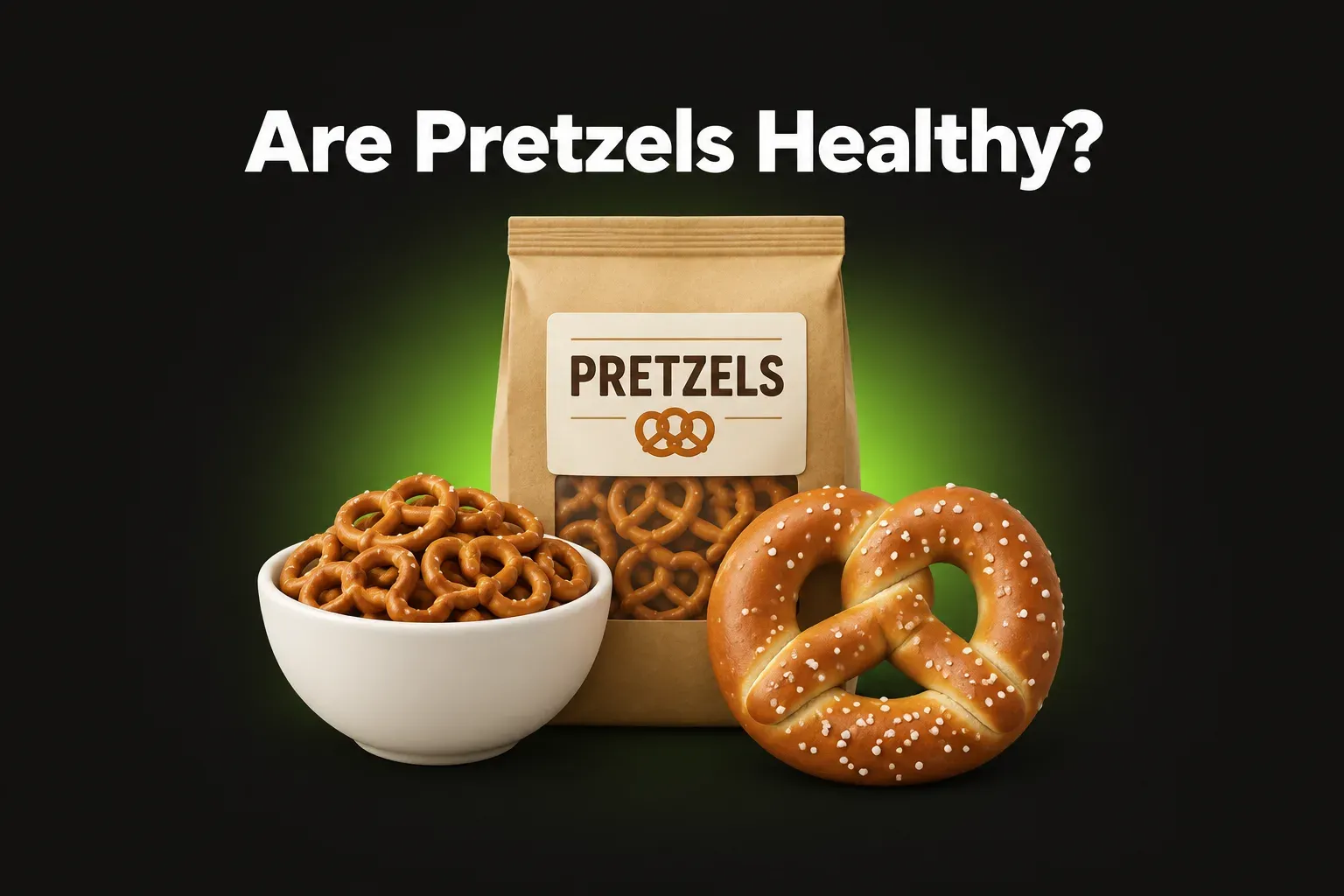
Pretzels look like the “light” choice in the snack aisle. They are baked, low in fat and sold in almost every store. But are pretzels healthy?
The short answer: pretzels are fine as a small snack, but they are not a health food. An ounce of hard pretzels has about 110 calories and less than 1 g of fat. But most are made from white flour, have only about 1 g of fiber and raise blood sugar fast. Salted ones often have 250–450 mg of sodium per ounce – more than many chips. Unsalted or whole wheat pretzels are the better picks. Soft pretzels and chocolate- or yogurt-covered pretzels are treats.
What’s in 1 ounce of hard pretzels
Here are the basic numbers for 1 oz (28 g) of hard pretzels from the USDA food database. That’s about 17 mini twists.
| Per 1 oz (28 g) | Salted | Unsalted | Whole wheat |
|---|---|---|---|
| Calories | 109 | 108 | 103 |
| Carbs | 23 g | 22 g | 23 g |
| Fiber | 1.0 g | 0.8 g | 2.2 g |
| Protein | 2.8 g | 2.6 g | 3.1 g |
| Fat | 0.8 g | 1.0 g | 0.7 g |
| Sodium | 352 mg | 71 mg | 58 mg* |
Source: USDA FoodData Central – salted, unsalted, whole wheat. Values per 100 g, converted to 1 oz and rounded. *The USDA whole wheat entry mixes salted and unsalted pretzels, so salted ones have more.
What stands out:
- Fat is very low. Pretzels are baked, not fried. That’s their main plus.
- Fiber is low. Most pretzels use enriched flour. That’s white flour with some B vitamins and iron added back after milling. The fiber is not added back.
- Protein is low too. About 3 g per ounce won’t keep you full for long.
- Salt is the big issue. The salt on top is what turns 71 mg into 352 mg.
Salt: the biggest problem with pretzels
The FDA says adults should keep sodium under 2,300 mg a day. The average American eats about 3,400 mg (FDA). The FDA even names pretzels as a snack to buy in low-sodium or no-salt-added versions.
One ounce of salted pretzels is about 15% of the daily limit. But pretzels are easy to overeat. Three handfuls from a big bag can be 3 oz. With some brands, that’s over 1,100 mg of sodium – about half a day’s limit.
Why does it matter? Too much salt raises blood pressure. A review of 34 trials looked at people who cut back on salt for at least 4 weeks. On average, they ate about 4.4 g less salt a day. Their top blood pressure number dropped by about 4 points. The drop was bigger in people with high blood pressure (He et al., BMJ, 2013).
Fast carbs: why pretzels don’t keep you full
Pretzels are almost all starch. White flour is digested quickly, so sugar enters your blood fast.
The glycemic index (GI) shows how fast a food raises blood sugar. A GI of 70 or more is high. Oven-baked hard pretzels from Australia scored 83–84 in tests listed in the University of Sydney’s GI database. That’s even higher than white bread, which scores about 75. A soft wheat pretzel scored 66 in a US test with 12 adults (Simmons et al., Food & Function, 2011). Learn more about low glycemic index foods.
A fast rise in blood sugar can be followed by a drop. Then hunger comes back soon.
Pretzels also miss the benefits of whole grains. A review of 45 studies found that people who ate 90 g of whole grains a day (about 3 servings) had a 19% lower risk of heart disease. They also had a 17% lower risk of dying early (Aune et al., BMJ, 2016). These studies show a link, not proof. But white-flour pretzels don’t count toward that goal.
Pretzels vs chips vs popcorn
Here’s how 1 oz of each compares:
| Snack (1 oz) | Calories | Fat | Fiber | Protein | Sodium |
|---|---|---|---|---|---|
| Hard pretzels, salted | 109 | 0.8 g | 1.0 g | 2.8 g | 352 mg |
| Potato chips, plain | 151 | 9.6 g | 0.9 g | 1.8 g | 149 mg |
| Air‑popped popcorn (about 3.5 cups) | 110 | 1.3 g | 4.1 g | 3.7 g | 2 mg |
Source: USDA FoodData Central – pretzels, potato chips, air-popped popcorn. Values per 100 g, converted to 1 oz and rounded.
- Pretzels beat chips on calories and fat. But they have more than twice the sodium.
- Popcorn wins overall. It’s a whole grain with 4 times the fiber, and plain popcorn has almost no salt. Read more in is popcorn healthy?
- Love chips? See the healthiest chips. And here’s why veggie straws aren’t as light as they look. Like spicy snacks? Here’s whether Takis are bad for you.
9 popular pretzels compared
Brands differ a lot, especially in salt and fat. Here are 9 pretzels sold in US stores, per label serving.
| Product | Serving | Calories | Fat | Sodium | What’s inside |
|---|---|---|---|---|---|
| Rold Gold Tiny Twists Original | 1 oz (28 g) | 120 | 1 g | 370 mg | Enriched flour, salt, corn oil, corn syrup |
| Snyder’s of Hanover Mini Pretzels | 1 oz (28 g) | 110 | 0.5 g | 250 mg | Enriched flour, malt, cane sugar, canola oil |
| Snyder’s of Hanover Unsalted Mini Pretzels | 1 oz (28 g) | 110 | 0.5 g | 90 mg | Same as above, no salt on top |
| Snyder’s Pretzel Pieces Honey Mustard & Onion | 1 oz (28 g) | 140 | 7 g (3 g sat.) | 190 mg | Palm oil, sugar, whey, hydrolyzed soy protein |
| Dot’s Homestyle Original Seasoned Twists | 1 oz (28 g) | 140 | 6 g | 250 mg | Oil, seasoning with MSG, artificial flavor and gums |
| Unique Extra Dark Splits | 3 (28 g) | about 110 | about 1.5 g | about 370 mg | Unbleached flour, sunflower oil, salt, yeast, soda |
| Quinn Sea Salt Pretzel Sticks (gluten-free) | 30 g | 130 | 3 g | 390 mg | Whole grain sorghum flour, potato and tapioca starch |
| Glutino Original Pretzel Twists (gluten-free) | 30 g | 110 | 2 g | 640 mg | Corn and potato starch, palm oil, cellulose gum |
| Quinn Peanut Butter Filled Nuggets (gluten-free) | 30 g | 140 | 6 g | 300 mg | Peanut butter, sorghum flour, starches |
Sources: Open Food Facts labels for Rold Gold, Snyder’s Mini, Snyder’s Unsalted, Snyder’s Pretzel Pieces, Dot’s, Unique and Glutino; Quinn Snacks brand site for the Sea Salt Sticks and Peanut Butter Nuggets. Checked November 2026. Unique values are worked out from per-100 g data, so they are marked “about.” Some store listings still show older labels with slightly different numbers. Recipes change – always check the bag.
What to notice:
- Snyder’s Unsalted Mini Pretzels are the clear pick for salt. At 90 mg, they meet the FDA’s “low sodium” mark (140 mg or less per serving).
- Unique Splits have the shortest list, but they’re still salty.
- Seasoned pretzels like Dot’s and Snyder’s Pretzel Pieces have 6–7 g of fat per ounce. That’s about two-thirds of the fat in plain chips.
- Gluten-free doesn’t mean lower salt. Glutino has the most sodium in the table.
Soft pretzels: one is a meal’s worth
Mall pretzels are much bigger than a handful of twists. Here’s what the Auntie Anne’s nutrition guide for 2026 lists:
| Auntie Anne’s pretzel | Calories | Sodium | Sugar | Protein |
|---|---|---|---|---|
| Original | 350 | 900 mg | 10 g | 8 g |
| Cinnamon Sugar | 480 | 310 mg | 29 g | 9 g |
| Jalapeño | 350 | 1,180 mg | 10 g | 8 g |
Source: Auntie Anne’s Nutrition and Allergen Guide 2026, linked from the Auntie Anne’s website. Values per pretzel, without dips.
One Original Pretzel has about the calories of 3 oz of hard pretzels. Its 900 mg of sodium is 39% of the daily limit. The Cinnamon Sugar one has 28 g of added sugar – more than the daily limit of about 6 teaspoons (25 g) the American Heart Association suggests for women. Dips add even more.
If you love them, share one and skip the dip.
Whole wheat and gluten-free pretzels
Whole wheat pretzels are a real step up. They have about twice the fiber of regular pretzels (2.2 g vs 1 g per ounce). They count toward your whole grains. Look for “whole wheat flour” as the first ingredient, not just “made with whole grain.”
Gluten-free pretzels are a must if you have celiac disease. But they are not healthier for everyone else. Many are made from corn starch and potato starch, with little protein or fiber. Glutino’s twists have just 1 g of protein per serving. Quinn uses whole grain sorghum flour first, which is a better start. Still, its sticks have less than 1 g of fiber per serving.
Filled, chocolate and yogurt-covered pretzels
Peanut butter filled pretzels have more fat and calories. Quinn’s nuggets have 140 calories and 6 g of fat per 30 g. Their protein is only 3 g, about the same as plain pretzels. The fat may keep you full a little longer, but they are easy to overeat.
Chocolate- and yogurt-covered pretzels are candy. The USDA lists about 130 calories and 11 g of sugar per ounce for chocolate-coated pretzels (USDA). The “yogurt” coating is mostly sugar and palm kernel oil. On Glutino’s yogurt-covered pretzels, sugar is the first ingredient in the coating. A 30 g serving has 150 calories, 12 g of sugar and 6 g of saturated fat, based on a 2023 label (Open Food Facts). Don’t expect the benefits of real yogurt.
What else is on the label
Plain pretzels have short ingredient lists. Flavored and gluten-free ones add more:
- Palm oil is high in saturated fat. It’s in Snyder’s Pretzel Pieces and Glutino.
- MSG boosts the savory taste in Dot’s seasoning. Most people handle it fine, but it adds a little more sodium.
- Cellulose gum is another name for carboxymethylcellulose (E466). It’s in Glutino’s pretzels and in Dot’s seasoning.
Cellulose gum is allowed by the FDA. But independent labs have found warning signs:
- In mice: mice drank water with 1% cellulose gum for 12 weeks. They got mild gut inflammation. They also gained weight and had blood sugar problems (Chassaing et al., Nature, 2015).
- In people: 16 healthy adults ate a controlled diet for 11 days. Seven of them got 15 g of it a day. They had a bit more belly discomfort. Their gut bacteria became less varied. The bacteria also made fewer of the healthy substances they usually produce (Chassaing et al., Gastroenterology, 2022). That dose is far more than you’d get from pretzels.
- In a large study: about 95,000 French adults were followed for about 7 years. Those who ate more of it had a slightly higher risk of heart disease (Sellem et al., BMJ, 2023). This shows a link, not proof.
Why do mouse studies matter? Mice share most of their genes and body processes with us. And testing a possibly harmful additive on people for years would put their health at risk. There’s no proof that the small amount in a serving of pretzels makes people sick. But since several labs see the same signal, it’s wise to limit it.
Do pretzels help or hurt weight loss?
Pretzels can fit a weight loss plan if you count them. In one trial, 95 adults with overweight followed a lower-calorie diet for 12 weeks. Each day, they ate either 1.5 oz of tree nuts or pretzels with the same calories. Both groups lost weight – about 3.5 lb with nuts and 4.3 lb with pretzels. The gap was so small it could be due to chance (Lei et al., Nutrients, 2025).
Another trial at Purdue tested 81 adults with higher blood sugar. For 16 weeks, they ate either 2 oz of almonds or a pretzel snack with the same calories. Blood sugar results were the same in both groups. But the almond group’s overall diet got better. People also got tired of the pretzels faster than the almonds (Huang et al., British Journal of Nutrition, 2024).
So calories matter most, but nuts bring more fiber, protein and healthy fats. Check your daily needs with our calorie calculator.
How to make pretzels a better snack
- Pick unsalted or “lightly salted” pretzels. Aim for 140 mg of sodium or less per serving.
- Choose whole wheat when you can. Look for whole wheat flour as the first ingredient.
- Portion them out. Put 1 oz (about 17 mini twists) in a bowl. Don’t eat from the bag.
- Add protein. Pair pretzels with hummus, cheese, Greek yogurt dip or nuts. You’ll stay full longer. More ideas are in our list of high-protein snacks.
- Treat coated and soft pretzels as dessert. Enjoy them now and then, not every day.
- Look for short lists. A basic pretzel needs only flour, water, yeast, salt and a little oil.
See what’s really in your pretzels. With NutriSmart, you photograph the label or scan the barcode. The app lists the sweeteners, preservatives and colors, explains the risks of each one and gives the product a health score out of 100. It also tells you right away if a bag of pretzels is ultra-processed, and which ingredients make it so. You can set an alert for an ingredient like cellulose gum or palm oil. The app then warns you on every product you scan that contains it.Get the app free
The bottom line
Pretzels are a low-fat snack, but not a healthy one on their own. They are mostly white flour, low in fiber and protein, and they raise blood sugar fast. Salted ones are often saltier than chips. Unsalted and whole wheat pretzels are the best picks, in a 1 oz portion with some protein on the side. Seasoned, filled, coated and soft pretzels have more fat, sugar or salt, so save them for treats. For a crunchy snack with more fiber, plain popcorn is the better choice.
FAQ
Are pretzels healthy?
They are fine in small amounts, but they are not a health food. Hard pretzels are low in fat, but they are made from white flour, have little fiber and are often very salty. Unsalted or whole wheat pretzels are the better picks.
Are pretzels healthier than chips?
They have less fat and fewer calories. An ounce of hard pretzels has about 110 calories and under 1 g of fat. An ounce of plain potato chips has about 150 calories and 10 g of fat. But salted pretzels can have more than twice the sodium.
Are pretzels good for weight loss?
They can fit if you count the portion. In one 12-week trial, adults on a lower-calorie diet lost weight while eating pretzels every day. But pretzels are not very filling, so pair them with protein, like hummus or cheese.
How much sodium is in pretzels?
Most salted hard pretzels have about 250–450 mg of sodium per ounce. Some gluten-free brands have over 600 mg per serving. Unsalted pretzels have about 70–90 mg.
Are soft pretzels healthy?
Not really, because they are big. An Auntie Anne's Original Pretzel has 350 calories and 900 mg of sodium. That is about 39% of the daily sodium limit in one snack.
Are pretzels good for diabetics?
They raise blood sugar fast. Hard pretzels have a glycemic index of about 83, which is high. If you have diabetes, eat a small portion with protein or fat, or choose popcorn or nuts instead.